

Part 1: The Box on the Lawyer’s Desk
Camille Whitfield laughed when she saw the box.
It wasn’t a loud laugh. It was a short breath through her nose, the sound people make when something proves exactly what they expected all along.
The box sat in the center of Walter Haines’s desk, on the third floor of a brick building on East Morehead Street in Charlotte. It was dark walnut, about the size of a loaf of bread. It had no carving, no brass corners, and no lock that I could see.
Nothing else was on the desk. There were no folders, no thick stack of documents, no will with colored tabs sticking out the side.
“Preston left very specific instructions,” Walter said.
Camille crossed her legs and smoothed her skirt. Her brothers, Grant and Miles, sat on either side of her like bookends. None of the three looked at me.
I knew what they were thinking. I’d known since the day I met them.
They believed they understood exactly why I had married their father. If I’m being honest, they weren’t entirely wrong.
Two years earlier, I was thirty-two and drowning. I owed $38,600. Most of it came from my mother’s last year in hospice, and the rest from a credit card I’d used to keep the lights on afterward.
My rent was $1,140 a month for a one-bedroom off Central Avenue. My car had a check-engine light I had stopped looking at. My phone rang with numbers I had learned not to answer.
I worked for a catering company called Silver Fork. We did weddings, galas, corporate retreats, anywhere rich people needed someone to carry a tray and stay invisible.
I was good at staying invisible.
The night I met Preston Whitfield, I’d been on my feet for seven hours. It was a children’s hospital fundraiser in a hotel ballroom uptown. My black work shoes had a crack across the left sole that let in every bit of spilled ice.
I was weaving through the crowd with a tray of champagne when a silver-haired man in a navy suit stopped me. I gave him the smile they train you to give, the one that says yes, sir, of course, sir.
“What’s your name?” he asked.
“Nora.”
He nodded as if he were filing it away somewhere important. Then he looked down at my shoes and back up at my face.
“Do your feet hurt?”
I nearly dropped the tray. Nobody at those events asked servers anything except where the restroom was or whether the crab cakes had gluten in them.
“A little,” I said. He was still waiting, so I added, “A lot, actually.”
“Then I’ll take two of those,” he said, lifting two glasses off my tray, “so you have less to carry.”
It was such a small thing. I’ve replayed it a thousand times since, trying to understand why it undid me the way it did.
I think it’s because nobody had noticed I was tired in years. Not since my mother.
He found me again near the coat check at the end of the night and asked if he could buy me coffee sometime. I said yes mostly because I was too exhausted to think of a polite way to say no.
That coffee turned into dinner. Dinner turned into Sunday drives out to his house on Lake Norman, where he had lived alone since his wife, Diane, died four years before.
He was sixty-two. He had built a commercial flooring company from one van and a rented warehouse into a business with offices in three states. He owned watches that cost more than my car, yet he wore the same gray cardigan around the house until the elbows went thin.
Three months after the fundraiser, he asked me to marry him on his back dock. There was no ring box and no speech. He just said, “I’d like you to stay. Would you?”
I said yes.
My best friend, Tasha, didn’t speak to me for a week. When she finally called, she said, “Nora, I love you, but you know how this looks.”
“I know how it looks,” I said.
“Do you know how it is?”
I didn’t answer. I wasn’t sure I knew.
Preston’s children made up their minds before I had said ten words to them. Grant shook my hand like he was checking it for a weapon. Miles was polite and cold.
Camille, the oldest, watched me the way store security watches a teenager with an oversized backpack. Every lamp I moved, she noticed, and every gift Preston gave me, she somehow heard about.
She would text her father things like “Did Nora pick out the new couch?” He would show me, sigh, and type back, “I did. It’s ugly. I love it.”
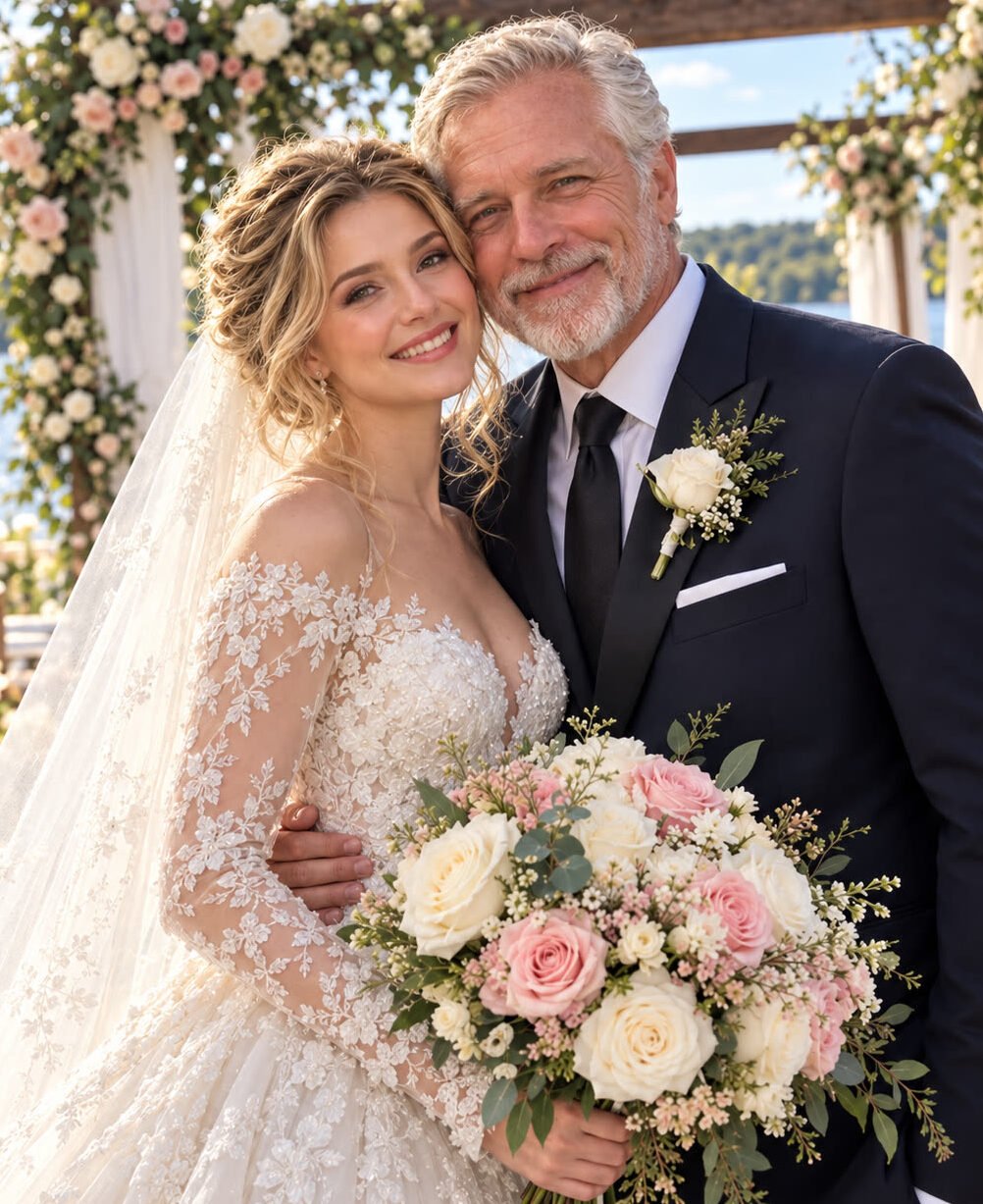
We married in late June by the water, under an arch of white and blush roses. Preston insisted on paying a florist for it, even though I told him I could do it myself.
There were forty guests and a string trio. I wore my mother’s pearl earrings, the only thing of hers I still had that hadn’t been sold.
It was a beautiful day right up until the reception, when Camille found me alone by the dessert table.
She leaned close and didn’t bother lowering her voice.
“You think you’re getting the house?” she said. “You’ll get nothing.”
My face went red from my collar to my hairline. I was holding a plate of wedding cake and had nowhere to put it down.
Then Preston was beside me. I hadn’t heard him walk up, but his face told me he had heard every word.
I waited for him to argue with her, or scold her, or at least frown.
He didn’t. He just smiled at his daughter, calm as the lake behind us.
“She’ll get exactly what she deserves.”
Camille looked satisfied. I thought he was defending me.
It would be almost two years before I understood that my husband never said anything by accident.
Part 2: The Man Who Noticed Everything
People assume a marriage like ours is a transaction. Some days, in the beginning, it felt like one.
I won’t pretend otherwise. I loved the security. I loved waking up in a house where the thermostat stayed at seventy-one and nobody did math about it.
I even loved the grocery store. The first time I put strawberries in the cart without checking the price, I stood in the produce aisle at the Harris Teeter on Highway 150 and almost cried.
Three weeks after the wedding, Preston paid off my debt without telling me. I found out when the collection calls stopped and a statement arrived with a zero balance.
“You didn’t have to do that,” I said, holding the letter in the kitchen.
“I know,” he said. He was making toast. “That’s why I wanted to.”
But the thing I hadn’t planned for wasn’t the money. It was him.
He was patient in a way I had never seen a man be patient. He sat through my rambling stories about catering disasters and remembered the names of people I had mentioned once, weeks earlier.
When I came in from a run, a cup of chamomile would be waiting on the counter, still too hot to drink. He had heard the garage door.
Some nights he rubbed my feet on the couch without being asked. The first time, he laughed and said, “Old habit. I’ve been worried about these since the day I met them.”
Somewhere in there, I stopped feeling like a woman who had made a smart deal and started feeling like a wife.
I fell in love with him. Not his house, not his accounts, not the trucks with his name painted on the side. Him.
There were things I never asked about, and I regret that now.
A small walnut box sat on his dresser, and I had never seen him open it. Once, while I was putting away laundry, I picked it up. Preston said gently from the doorway, “Not yet.”
“Not yet what?”
“Not yet for you,” he said. He kissed my forehead, and that was the end of it. I was too comfortable to push.
In January, during the second winter of our marriage, he spent most of a Thursday downtown with his attorney. He came home tired and quiet and said it had been “housekeeping.”
That same week, I turned down my morning coffee three days in a row because the smell made my stomach roll. I blamed a stomach bug going around Tasha’s office.
Preston watched me push the mug away and said nothing. He just looked at me a beat too long, the same way he had looked at my shoes that first night.
Then he got sick.
It started as tiredness he brushed off, then a pain under his ribs that he blamed on lifting a kayak. On February fourteenth, he sat in an oncologist’s office at Atrium Health with me holding his hand while a doctor chose her words very carefully.
It was pancreatic cancer, and it was advanced. She said weeks, maybe a few months.
We got six weeks between the diagnosis and the funeral.
There were scans, a port, and a pill organizer with fourteen compartments that I filled every Sunday night. On the long nights when he couldn’t sleep, I read to him from paperback westerns he pretended not to like.
He tried so hard to protect me from his fear. He joked with the nurses, asked about their kids, and kept insisting I go home and shower.
In those weeks I barely noticed my own body. My black funeral-ready dresses were getting tight at the waist, and I blamed stress and hospital vending machines.
One night near the end, half asleep, he squeezed my hand. “Walter has everything,” he murmured. “Don’t let them rush you.”
“Who?”
He had already drifted off again. I told myself it was the medication talking.
His children came to the hospice room in shifts that never overlapped with mine. When we passed in the hallway, Camille looked through me like I was a vending machine.
Preston died on a Tuesday morning in late March, just after six. The window was open a crack because he had asked for it, and I could hear birds.
The funeral was at the Presbyterian church in Davidson where he and Diane had married. I sat in the front pew, and his three children sat in the second, directly behind me. I understood that was its own statement.
I wanted to turn around and tell them I would have traded every dollar he had for one more ordinary Saturday. One more piece of burnt toast. One more cup of tea I hadn’t asked for.
But they had already decided who I was, and no sentence in the world was going to change that.
I cried anyway. I cried through the hymns, through the eulogy Grant gave that never mentioned me, and through the drive home to a house that was too big and too quiet.
The next morning, Walter Haines called.
“Mrs. Whitfield, I’m very sorry for your loss. Preston asked me to meet with the family as soon as possible after the service. Could you come in at ten?”
I went in my funeral dress because I hadn’t unpacked anything else.
His children were already there when I walked in. Camille wouldn’t meet my eyes, and Grant checked his watch.
I had expected a will, paperwork, some long and dry explanation of an estate I wouldn’t understand.
Instead there was only the walnut box from Preston’s dresser.
Walter looked at me, then at them. Then he slid it slowly across the desk until it stopped in front of me.
“He made sure you got exactly what you deserved.”
That was when Camille laughed.
Part 3: What Was Waiting Inside
My hands shook so badly that I had to rest them flat on the lid before I could open it.
Inside, there was no key, no check, and no deed.
There was a photograph.
It came from the children’s hospital fundraiser, a candid shot the event photographer must have taken. In the foreground, two men in tuxedos were laughing at something.
In the background, slightly out of focus, a server carried a tray of champagne. Her shoulders were tight and her weight was shifted onto one foot.
It was me.
Off to the side, in the corner of the frame, stood Preston. He wasn’t looking at the camera or at the laughing men. He was looking straight at me.
I hadn’t known the picture existed. I still don’t know how he found it, or how many phone calls it took.
Beneath it lay a folded letter on cream paper. My name was written across the front in his blocky handwriting, NORA, underlined twice, the way he underlined grocery lists.
“Would you like some privacy?” Walter asked.
“No,” I said. I didn’t want anyone saying later that I had been handed something behind a closed door.
I unfolded the letter.
*Nora,* it began. *The first time I saw you, you were smiling at a man who had just snapped his fingers at you. Your left shoe was cracked across the sole, and you kept working anyway.*
*I went home that night and couldn’t stop thinking about a woman who was that tired and still that kind.*
My throat closed, and I had to stop and breathe.
*I know what my children think. I’ve known since the first dinner. I’m not angry with them, because they lost their mother and they’re afraid of losing what’s left of her.*
*But I am not going to let their fear decide your life. So I’ve been careful.*
Walter cleared his throat and opened a drawer. Out came the paperwork I had expected all along, a thick folder held together with a black binder clip.
“Preston revised his estate plan this past January,” he said. “He signed on the eighteenth, almost four weeks before his diagnosis.”
Camille’s head came up.
“Before signing,” Walter continued, “he asked for a full capacity evaluation with Dr. Lena Ortiz, a geriatric psychiatrist. He expected that his decisions might later be challenged on grounds of undue influence or incompetence. Her report is attached, and so is a video of the signing.”
“That’s—” Grant started.
“Thorough,” Walter said. “He was.”
Then he read.
The house on Lake Norman went to me. Preston’s controlling interest in Whitfield Flooring, fifty-one percent, went to me. Most of his investment accounts went to me.
Grant made a sound like he had been punched. Miles closed his eyes.
Camille didn’t move at all. Her hands were folded so tightly in her lap that her knuckles had gone pale.
“The children are not left with nothing,” Walter said, and he looked directly at Camille as he said it. “Each of you has a lifetime trust. It covers education, including for your own children, as well as housing and medical needs.”
“Distributions are made by an independent trustee,” he added.
“A trustee,” Camille repeated. “Not us.”
“Not you. There is also a no-contest clause.” He turned a page. “Any beneficiary who challenges this will without probable cause forfeits their trust and receives a fixed sum of one dollar.”
Grant swore under his breath. Nobody told him not to.
I sat there with the letter in my lap and felt sick. Not triumphant. Sick.
This was exactly what they had always said I wanted. It was Camille’s prediction from my wedding turned inside out, and I could already hear every conversation they would have about me for the rest of their lives.
For a moment I considered standing up and saying I didn’t want any of it. They could have the house, and I would go back to Silver Fork, my cracked shoes, and my $1,140 apartment.
My mouth was actually open to say it.
Then I looked down at the page in my lap: *I am not going to let their fear decide your life.*
I closed my mouth and stayed in my chair.
“There’s one more provision,” Walter said.
He read it in the same even voice he had used for everything else.
“The residence on Lake Norman is placed in a protective trust. It may not be sold, mortgaged, or substantially altered while Mrs. Whitfield’s child remains a minor. On that child’s eighteenth birthday, the restriction lifts and the property passes fully to Mrs. Whitfield.”
The room went silent.
I looked up.
“I’m sorry,” I said. “Pardon? What did you just say?”
Walter didn’t answer right away. He looked at the letter still open in my hands, at the second page I hadn’t turned to yet.
“Preston knew,” he said.
Part 4: Exactly What I Deserved
My heart was pounding so hard I could feel it in my teeth. I turned the page.
*I might be wrong about this,* he had written. *If I am, Walter will skip this paragraph and you’ll never know I wondered.*
*But you’ve been pushing away your coffee, and you fell asleep on the couch at seven-thirty three nights this week. You rest your hand on your stomach when you think nobody’s looking. Diane did all the same things, twice.*
*I’ve asked Dr. Patel to add a few tests to your physical next month. I told you it was to check your iron. Forgive me that one small lie.*
I remembered the physical on February ninth. Three days later, a nurse had called while I sat in the oncology waiting room beside Preston, and she said the words I heard but did not let myself understand.
I had written the follow-up date on a sticky note and stuck it inside a kitchen cabinet. Then my husband started dying, and I closed the cabinet.
I had told no one, not Tasha and not Preston. I had been waiting for a good day to tell him, and there never was one.
*If I’m right,* the letter went on, *then know that I’m writing this in January, before anything else, so no one can ever say you used a baby to change my mind.*
*You didn’t change my mind. You made it up for me the night you admitted your feet hurt and didn’t pretend otherwise.*
I put my hand on my stomach. According to the sticky note, I was sixteen weeks along. I had barely allowed myself to think the word.
“You’re pregnant?”
Camille’s voice cracked right down the middle. She stared at me, then at Walter, then back at me.
I nodded. It was the first time I had admitted it to anyone.
For a second, something crossed her face that wasn’t anger. Then it hardened again.
“Of course,” she said. “Of course you are. You knew. You knew when he was signing all of this, and you—”
“Ms. Whitfield.” Walter didn’t raise his voice. He didn’t need to.
“The documents were signed and witnessed on January eighteenth. Mrs. Whitfield’s blood was drawn on February ninth, and the results came back on the twelfth. Your father was diagnosed on the fourteenth.”
He laid three sheets of paper side by side on the desk with the dates facing her.
“Your father wrote the word ‘if,’” he said. “He didn’t know for certain. He guessed, and he guessed because he paid attention.”
Camille stared at the dates for a long time. Miles reached over and put a hand on her arm, and she didn’t shake it off.
Grant got up and walked to the window.
I could have said something then, something sharp about the dessert table or the second pew. I had rehearsed versions of that speech in the shower for two years.
Instead, I folded the letter. “I’m not going to argue with you about who I am,” I said. “I’m done doing that.”
Camille’s jaw tightened. “So that’s it.”
“No. This baby is your brother or sister. If you want to know them someday, the door is open.”
“But I won’t spend their whole childhood defending myself in my own kitchen.”
Nobody spoke. Walter quietly pretended to read his folder.
There was one more paragraph, and I needed to finish it before I lost my nerve.
*People will judge us,* he wrote. *Some of them will never believe that what started with you being afraid turned into you loving me. I believe it. I was there.*
*I don’t want you to spend your life proving you deserve what I chose to give you. You don’t owe anyone that.*
*I want you safe. I want our child safe. I want you free to build something without ever again wondering whether one envelope in the mailbox can knock the whole thing down.*
*When I told Camille you’d get exactly what you deserve, this is what I meant. Not a reward. A future.*
*Go buy decent shoes. — P.*
I laughed. It came out wet and wrong. Camille flinched at the sound, and I didn’t care.
When I stood to leave, she was by the door with her coat over her arm. She looked at the box in my hands.
“He used to say that to my mother,” she said quietly. “When she worked doubles at the hospital. ‘Do your feet hurt?’” Her mouth tightened. “I didn’t know he said it to you.”
“He did.”
“I’m—” She stopped. “I said things at your wedding.”
“You did.”
She waited, as if I were supposed to fill in the rest.
I didn’t tell her it was okay. I nodded, walked past her, and held the door so it wouldn’t swing shut on her.
I drove home with the walnut box on the passenger seat, buckled in as if it might break.
I didn’t feel rich, and I didn’t feel victorious. It felt like someone had wrapped me in a blanket after a long time in the cold and then told me the person who knitted it was gone.
Five months later, I stood alone in Preston’s kitchen with one hand on a belly that now entered rooms before I did.
It was a Sunday in late August, a little after eight in the morning. The lake lay flat and silver beyond the window. A pair of good leather sneakers, $139 from a running store in Cornelius, sat by the back door.
The box sat on the counter beside the chamomile tin. I had moved it there from the dresser in April because I wanted to see it every day.
I lifted the lid and looked at the photograph again. There was the tired server in the background, counting the hours until she could sit down, worrying about rent, her car, and the next envelope in the mailbox.
She had no idea the man in the corner of the frame would become her husband. She didn’t know he would truly see her and keep seeing her until the very end.
And she never imagined that one morning, after his funeral, a lawyer would slide a plain wooden box across a desk and show her he had planned for everything.
Maybe I married Preston partly because I was scared of being poor. I won’t lie about that, not here.
But I stayed because I loved him. By the end, the money everyone was sure I had come for mattered far less than the man who had given it meaning.
I came into his life looking for a safe place to land. I left that office with a future, a home for our child, and permission to stop apologizing for having survived.
I didn’t get what his children thought I deserved.
I got what the man who knew me best decided I deserved.
Every morning when I lace up those sneakers, I can still hear him asking.
Do your feet hurt?
Not anymore.
If you had been in Nora’s place, would you have handed the house back to Preston’s children, or honored his choice?
Disclaimer: This story is a work of fiction inspired by real events. Names, characters, and details have been altered. Any resemblance is coincidental. The author and publisher disclaim accuracy, liability, and responsibility for interpretations or reliance. All images are for illustration purposes only.


