

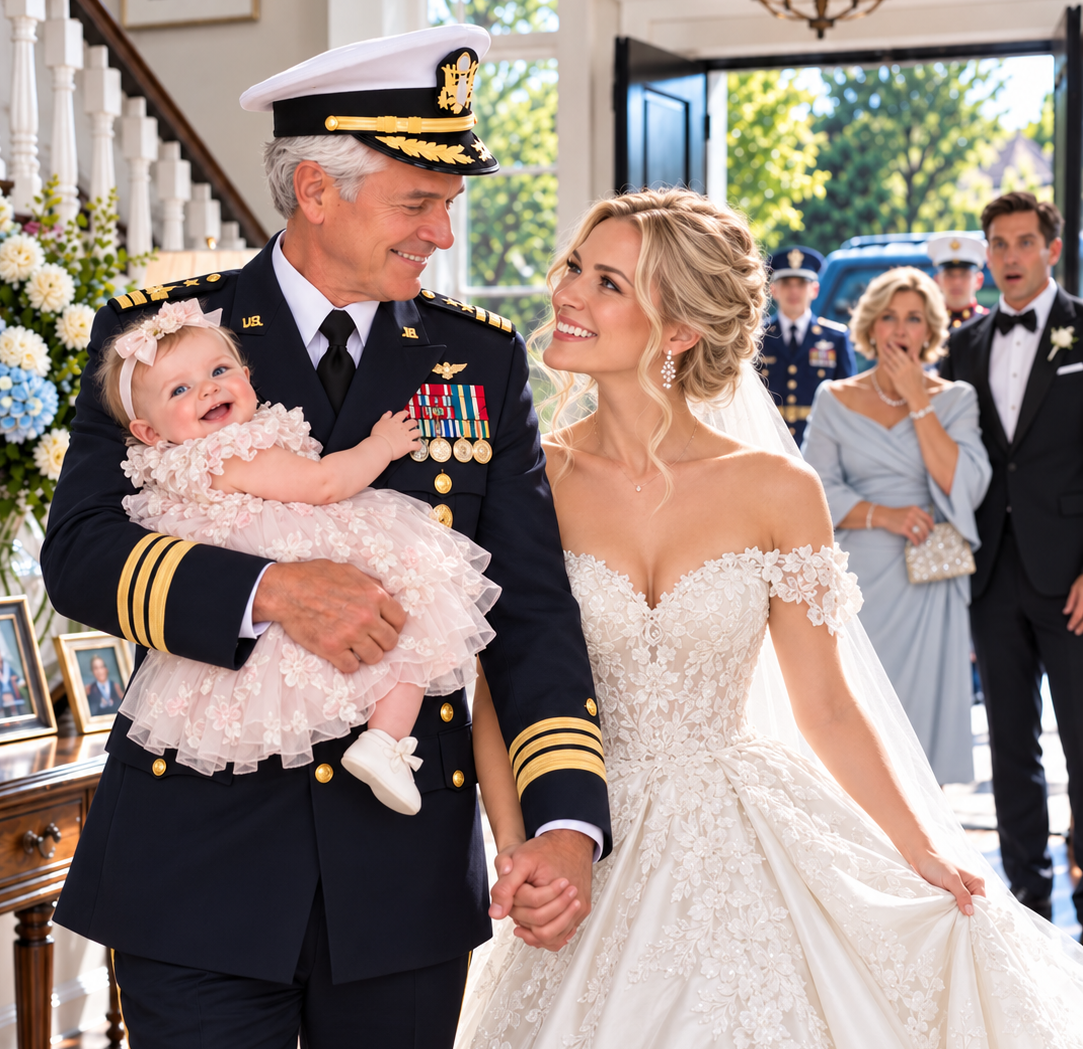
I asked him to take me to the hospital. He asked if I was sure. I told him that was exactly why I needed a doctor. He promised he’d be home in “two hours, maybe three,” and he told me to call if anything changed. Fifteen minutes later, I called. Then I called again. The third time, it went straight to voicemail. I gave birth with a nurse holding my hand and a stranger’s kindness in my ears. The man who walked into my hospital room before sunrise wasn’t my husband. It was the one person he had spent six years teaching me not to trust.
Part One: The Pressure at the Kitchen Counter
By thirty-eight weeks, I had learned to do everything slowly.
I walked slowly. I lowered myself into chairs slowly, one hand on the armrest and one on my belly. Even laughing had become a careful thing, because every sudden movement felt like a reminder that my daughter could decide to arrive at any moment.
What nobody teaches you is how quickly one ordinary evening can change the direction of your whole life.
My name is Natalie Hayes. Back then, I was Natalie Whitmore, and I lived with my husband, Grant, in a pale gray house on a quiet street in Carlsbad, about forty minutes north of downtown San Diego.
From the outside, we looked like people who had gotten everything right. Grant worked in commercial real estate and closed deals the way other men played golf. I was an architectural designer on maternity leave from a small firm in Encinitas. The nursery was finished. Tiny dresses hung in the closet on padded hangers. A packed hospital bag had been sitting beside our bedroom door for almost two weeks, with my phone charger, a going-home outfit, and a pair of fuzzy socks my best friend had sworn I would thank her for.
That Saturday evening, Grant stood at the hallway mirror, fixing his cuff links.
His mother, Lorraine, was turning sixty-five. She had booked the private room at a waterfront restaurant in La Jolla, and Grant had been talking about it for weeks.
I had planned to go. I’d even laid out a navy maternity dress that still fit if I didn’t breathe too deeply.
But around six-fifteen, while I was standing at the kitchen counter pouring a glass of water, I felt something I hadn’t felt before.
It wasn’t pain, exactly. It was a deep, low pressure, like a fist tightening somewhere I couldn’t reach.
I stopped. My hand went to my stomach on its own.
A few seconds later, it came again. Not overwhelming. Just different. Different enough that the hair on my arms stood up.
“Grant?”
He didn’t turn around. “Yeah?”
“I don’t think I should go tonight.”
He sighed, the small sigh I knew too well. “That’s fine. Stay home and rest. I’ll tell Mom you’re tired.”
“No,” I said. “I mean I think we might need to go to the hospital.”
That got his attention. For about three seconds.
Then he looked at his watch.
“Tonight?”
I almost laughed. “I don’t exactly get to schedule this.”
Another wave came, and I gripped the edge of the counter until it passed. Grant watched me from the hallway, cuff link still in his fingers.
“Dr. Patel said you’d feel uncomfortable near the end,” he said.
“This isn’t the discomfort I’ve been having.”
“Are you sure?”
I stared at him.
“No, Grant. I’m not sure. That’s why I’m asking you to take me in so someone who is sure can look at me.”
He didn’t reach for the hospital bag.
He reached for his suit jacket.
That single movement told me more than any argument could have.
Part Two: The Dinner He Couldn’t Miss
To understand that moment, you have to understand Lorraine Whitmore’s sixty-fifth birthday.
She had been planning it for four months. Twenty-four guests. White orchids flown in from a grower in Hawaii. A three-course menu she had tasted twice. A custom cake shaped like the house she grew up in. Her sister was coming from Phoenix. Two of Grant’s college friends were flying in from Denver because Lorraine had personally called their mothers.
Grant was giving the toast. He had practiced it in the shower all week.
“Natalie,” he said now, sliding his arm into the jacket, “Mom has people here from out of town.”
I blinked at him. “And?”
“And I can’t disappear twenty minutes before dinner. She’d never let me hear the end of it.”
For a moment I honestly thought I had misheard him.
“I’m your wife,” I said slowly. “I’m thirty-eight weeks pregnant with your daughter. And I’m telling you something feels wrong.”
He rubbed his forehead. “I’m not saying nothing’s happening. I’m saying we don’t know yet. You had that false alarm two weeks ago, remember? We sat in triage for four hours and they sent us home.”
That was true. But two weeks ago, I’d felt tightness. Tonight felt like my body was trying to tell me something in a language I didn’t speak.
“Then let’s go find out,” I said.
His phone buzzed on the side table. He glanced at it, and I saw the name on the screen: Mom.
He didn’t answer it, but he picked it up and put it in his pocket. Then he walked toward the front door.
Something inside me went very cold and very quiet.
“You’re actually leaving.”
He turned around with his hand on the doorknob.
“I’ll give the toast, stay through dinner, and come straight home. Two hours. Three at most.” He held up his phone. “If anything changes, call me.”
I looked him straight in the eye.
“I’m calling you now, Grant. I’m standing right here, calling you.”
He had nothing to say to that.
He opened the door anyway.
“Try to rest,” he said. “Put your feet up. Please don’t work yourself up over this.”
And then he was gone.
I stood alone in the kitchen and listened to his car back out of the driveway, turn at the corner, and fade into the sound of the neighborhood sprinklers.
I didn’t know it yet, but that was the last evening I would ever spend waiting for Grant Whitmore to choose me.
Part Three: Three Calls and a Voicemail
I tried to do what he said. I sat on the couch with my feet up and timed the pressure on my phone.
Eleven minutes apart. Then nine. Then seven.
But it wasn’t only the timing that frightened me. My daughter, who had kicked me every evening like clockwork for two months, had gone strangely still. I pushed gently on my side the way the nurse had taught me. I drank cold orange juice. I lay on my left side and waited.
Nothing.
Fifteen minutes after Grant left, I knew I couldn’t stay home.
I called him. It rang five times and went to voicemail.
I waited two minutes and called again. Same thing.
On the third try, it didn’t ring at all. It went straight to voicemail, the way a call does when someone has looked at your name on the screen and pressed the button on the side of the phone.
I sat there staring at the screen.
For six years, I had defended Grant.
When my friends said he seemed distant, I told them he was under pressure at work. When he missed my cousin’s wedding for a client dinner, I told everyone the deal was too big to lose. When he skipped my twenty-week ultrasound because Lorraine needed help choosing patio furniture, I told myself it was only one appointment and the baby wouldn’t remember.
When Lorraine made small remarks that left me feeling like a guest in my own marriage, I convinced myself that keeping the peace was more important than being right.
I had become an expert at explaining other people’s behavior.
But sitting alone on that couch at thirty-eight weeks, with my daughter too quiet and my husband’s phone switched off, I finally had no explanation left.
I called 911.
My voice shook as I told the dispatcher what was happening. She was calm and kind, and she stayed on the line with me, asking me to unlock the front door and sit near it, telling me the paramedics were six minutes away, then four, then pulling onto my street.
One of the paramedics, a broad-shouldered man named Ruben, picked up the hospital bag from beside my bedroom door without being asked.
“This yours?” he said.
I nodded. It was the first time all evening that someone had reached for it.

Part Four: “Is Your Husband Coming?”
At Pacific Crest Medical Center, everything moved fast.
Nurses strapped monitors around my belly. Someone put an IV in my arm. A doctor I’d never met, Dr. Okafor, watched the screen with a crease between her eyebrows, then told me my daughter’s heart rate was dipping during contractions and they wanted to keep a very close eye on her.
“You did the right thing coming in,” she said. “Don’t let anyone tell you otherwise.”
Between questions, a young nurse with a dark braid and a name tag that said Jessa asked the question I had been dreading.
“Is your husband on his way?”
I looked up at the ceiling tiles.
“He’s at his mother’s birthday dinner.”
Jessa paused for half a second. Just half a second. Then she reached over, squeezed my hand, and didn’t let go until the next contraction passed.
That small kindness from a stranger almost undid me.
The hospital tried Grant twice more. No answer.
Around nine, a woman from admissions came in with a clipboard.
“Mrs. Whitmore, is there anyone else we can contact for you? Another emergency contact?”
There was. I had listed him years ago and never changed it, mostly because I hadn’t thought about it.
Rear Admiral Thomas Hayes, United States Navy, retired.
My father.
Part Five: The Man She Stopped Calling
My father spent thirty-four years in the Navy. I grew up on bases in Virginia, Hawaii, and San Diego, with early mornings, pressed uniforms, and long stretches when he was on the other side of the world and my mother and I counted down the days on a paper calendar taped to the fridge.
Everyone else saw the admiral. The straight back. The quiet voice that made rooms go silent.
I remembered a different man.
The father who taught me to change a tire in a Navy Exchange parking lot before he’d let me drive alone. The father who once flew from Norfolk to San Diego overnight because I’d sounded “off” on a phone call during my sophomore year of college. The father who held me for an hour after my mother’s funeral and didn’t say a single word, because he knew there weren’t any that would help.
He was also the father who had never trusted Grant.
He never made a scene about it. He was too disciplined for that. But at our engagement dinner, when Grant spent the whole evening on his phone and then let me pay because he’d “forgotten his wallet in the car,” my father had quietly asked me, “Does he ever ask how you are?”
I’d been furious. I told him he was overprotective. I told him no man would ever be good enough for him.
He said, “That’s not true, Nat. I just want one who thinks you’re good enough for him.”
After that, I stopped telling him when things were hard. Our weekly calls became monthly. Monthly became birthdays and holidays. He lived twenty-five minutes away in Coronado, and some months I didn’t see him at all.
The hospital reached him at 9:20 p.m.
He told me later that he listened to everything the woman on the phone could share. Then he asked one question about me and one question about the baby.
Then he said four words.
“I’m coming right now.”
He was at the nurses’ station in thirty-one minutes. Jessa told me later that he walked in wearing a faded Navy sweatshirt and reading glasses pushed up on his head, and that he asked, very politely, whether his daughter wanted him in the room or in the hallway.
“She’ll want you here,” Jessa told him.
She was right.
Part Six: While He Raised His Glass
At almost the same moment, Grant was sitting beside his mother in a private dining room overlooking La Jolla Cove.
I know what happened that night because, much later, one of his college friends told me. He said he’d felt sick about it ever since.
Grant’s phone had buzzed again and again in his pocket. Lorraine noticed.
“Is that Natalie again?”
Grant glanced at the screen. “Yeah. And now some number I don’t know.”
“Probably spam,” Lorraine said. Then she lowered her voice. “Honey, first babies are always late. Everyone knows that. She’s anxious and she wants attention, and she knew how much tonight meant to me.”
Grant hesitated. Just for a moment.
Then he turned his phone face-down on the white tablecloth.
“I’ll deal with it after dinner.”
Lorraine smiled and lifted her champagne glass. “Good. Tonight is about family.”
After dinner, there was cake. After cake, there was a second bottle of champagne and a long story from Lorraine’s sister about their childhood in Tucson. By eleven, Grant had had too much to drink to drive, and Lorraine insisted he sleep in the guest room at her house a few minutes away. He plugged his phone in, still on silent, and went to bed.
Hours later, he would remember the words tonight is about family very differently.
Because while he was blowing out candles beside his mother, his own family was being born.
Part Seven: Before 2 A.M.
The hours after that are a blur of beeping monitors and the sound of my father’s voice.
He sat beside the bed and let me squeeze his hand so hard I left marks. He didn’t once say “I told you so.” He didn’t ask where Grant was. When Dr. Okafor said they might need to move to an emergency C-section if my daughter’s heart rate dropped again, he stood up, put his forehead against mine, and said, “You were always tougher than me. Show them.”
In the end, I didn’t need surgery. A little before two in the morning, after one last push that felt like it split the world in half, the room filled with a thin, furious cry.
She was healthy. Six pounds, eleven ounces. Tiny, warm, and absolutely perfect.
When Jessa laid her on my chest, every sound in the room seemed to fall away.
I stared down at her wrinkled face and her impossible little fingers, and I felt something shift inside me that has never shifted back.
I had planned to name her Amelia Rose Whitmore. Lorraine had suggested the Rose, after her own mother, and I’d agreed the way I agreed to most things.
But holding her, a different thought came to me, clear as a bell.
For years, I had believed that protecting my marriage meant accepting disappointment. I had mistaken patience for surrender. I had mistaken silence for peace.
Looking at my daughter, I suddenly pictured her twenty-five years from now, standing in some kitchen, gripping some counter, begging a man to take her seriously.
And I asked myself what I would tell her.
The answer came instantly.
Never beg anyone for the bare minimum.
So how could I teach her that if I kept doing it myself?
Part Eight: The Question Nobody Had Asked Me in Years
My father stepped out while the nurses cleaned us up. When he came back, the room was dim and quiet, and the baby was asleep in the clear plastic bassinet beside my bed.
He stopped in the doorway. For a moment, all the admiral went out of his face.
“Nat,” he said softly.
“Dad.”
He crossed the room and looked down into the bassinet for a long time. Then he pulled the chair close to my bed and sat.
I tried to smile, but my eyes filled.
“I asked him to bring me here,” I said. “I stood in the kitchen and asked him.”
My father didn’t interrupt. He just waited.
“He said his mother’s birthday dinner couldn’t be missed.”
Something hardened in his jaw. But his voice stayed gentle.
“You don’t have to defend him to me, sweetheart.”
I looked over at my sleeping daughter.
“I think I’ve spent six years defending him,” I whispered. “To you. To my friends. To myself.”
He stayed quiet.
“I don’t want her growing up thinking she has to beg someone to show up for her.”
My father leaned forward, elbows on his knees.
“Then what do you want?”
The question caught me completely off guard.
I had expected him to say I told you so. He didn’t.
I had expected him to tell me to leave Grant. He didn’t do that either.
“I don’t know yet,” I admitted.
He nodded. “Then you don’t have to know tonight.”
“You’re not going to tell me what to do?”
“No.”
He took my hand in both of his.
“I can give you a safe place to stay for as long as you want. I can help you find a good lawyer, or a good counselor, or both. I can stand next to you while you figure it out. But this is your life, Natalie. The choice has to be yours. If I make it for you, it won’t hold.”
That was when I finally broke down and cried.
Not because I felt powerless.
Because for the first time in a very long time, someone had reminded me that I wasn’t.

Part Nine: 7:14 A.M.
Grant woke up in his mother’s guest room at 7:14 the next morning and finally looked at his phone.
Six missed calls from me. Four from Pacific Crest Medical Center. Two from a Coronado number he didn’t recognize, because in six years he had never saved my father’s number.
He called the hospital. Whatever they told him got him out of Lorraine’s house in under five minutes, still in last night’s dress shirt.
My phone lit up on the tray table. Grant.
I watched it ring. I didn’t answer.
Then the messages started.
Natalie please call me.
I’m on my way. I didn’t know it was this serious.
Is the baby okay?? Are YOU okay??
And then, a minute later:
Why didn’t you tell me they were taking you to the hospital?
I stared at that last one for a long time.
I had told him. I had stood in our kitchen, holding the counter, and asked him to take me himself. I had called three times. He had sent the third call to voicemail with his own thumb.
And even now, with his daughter five hours old, he was already building a version of the story where he simply hadn’t been told.
I handed the phone to my father.
“I don’t want to talk to him today.”
My father switched it to silent and set it face-down on the windowsill.
“Then today, you don’t.”
Grant arrived at the hospital forty minutes later. My father met him in the hallway outside the maternity ward. I don’t know everything that was said. I know my father didn’t raise his voice, because he never does. I know Grant asked to see me and my father said, “She’s asked for today. Give her today.” And I know Grant stood at the nursery window and looked at his daughter through the glass for a long time before he left.
I’ll be honest. Part of me wanted to call him in. Part of me always will.
But the bigger part of me was holding a newborn who deserved a mother who finally kept her own word.
Part Ten: The Boxes in the Driveway
I didn’t decide anything that day, or the next.
I went home from the hospital to my father’s house in Coronado, to my old bedroom with the window that looks out at the bay. I slept. I fed my daughter. I rocked her at three in the morning while my father made decaf in the kitchen and pretended he just happened to be up.
I talked to a counselor over video. I talked to a family attorney my father’s old chief of staff recommended, a sharp, gentle woman named Margaret Osei who listened for an hour before she said a single word.
And I thought about the last six years.
The birthday dinner hadn’t caused every problem in my marriage. That was the hardest thing to admit. It had simply made all of them impossible to ignore. The missed ultrasound. The forgotten anniversaries that Lorraine somehow always remembered for him. The way every decision in our lives seemed to pass through his mother first. The way I’d gotten smaller and quieter every year so there’d be less of me to disappoint anyone.
On the fourth day, I made my choice.
I wasn’t strong enough yet to go back to that house myself, so I asked my father and my best friend, Priya, to collect what the baby and I needed. Margaret told Grant’s attorney exactly when they would be there, so there would be no surprises.
Grant came home anyway, an hour early.
Priya’s SUV and my father’s truck sat in the driveway. Neatly labeled boxes were stacked by the garage: Nursery. Natalie – clothes. Natalie – work files. My father stood on the front porch with a cup of coffee, as if he’d been waiting for someone.
Grant stopped halfway up the walk.
“Where’s Natalie?”
“Resting with the baby,” my father said.
“Where?”
“Somewhere she feels safe.”
Grant looked at the boxes. “Why are her things outside?”
“Because she asked us to bring her what she and her daughter need.”
Grant came up the steps. “This is between me and my wife.”
My father nodded. “Correct.”
That seemed to throw him.
“Then stay out of it.”
“I intend to,” my father said. “I’m not here with my opinions. I’m here with her instructions.”
Grant shook his head, as if he truly couldn’t make sense of it.
“She’s leaving me over one dinner?”
My father studied him for a long moment.
“Son,” he said quietly, “do you honestly believe this is about a dinner?”
Grant didn’t answer.
Part Eleven: The Envelope
My father handed him a large manila envelope. Inside were the papers Margaret had prepared.
Grant read the first page. His face changed.
“She wants a divorce?”
My father said nothing.
“You did this.” Grant’s voice rose. “You’ve hated me since the day we met.”
“My feelings about you aren’t what matters here.”
“You talked her into it. She’d never do this on her own.”
That was the moment my father finally stepped closer.
“Grant, my daughter stood in your kitchen at thirty-eight weeks pregnant and asked you to take her to the hospital. You looked at your watch. You put on your jacket. And when she called you three times, you turned off your phone.” He let that sit. “Nothing I could ever say would speak louder than that.”
Grant’s eyes dropped to the papers in his hand.
“I made a mistake,” he said.
“Yes.”
“I love her.”
My father looked at him for a long time. When he spoke, there wasn’t any anger left in his voice. Only something closer to sadness.
“Then maybe someday you’ll understand that love shows up most clearly when showing up is inconvenient.”
Grant had no answer.
For perhaps the first time in his life, there was no one standing between him and the consequences of his own choice. Not his mother. Not his charm. Not me.
Part Twelve: What I Finally Said to Lorraine
For the next several weeks, my daughter and I stayed in Coronado.
My father never pushed me to talk about Grant. Instead, he made scrambled eggs every morning, the way he had when I was eight. He walked the baby up and down the hallway for an hour at a time so I could sleep. He left a cup of coffee on my nightstand every morning before he went out to water the lemon tree.
Through small, ordinary things, he reminded me that real care doesn’t always need a speech.
Grant apologized often. Some of his apologies sounded real. Others still had a “but” buried in the middle: but you know how Mom gets, but I really didn’t think it was labor, but you could have tried harder to reach me. He began coming to supervised visits every Saturday. He held his daughter carefully, like something he was afraid to break. I’ll give him that. He kept coming.
Lorraine called me exactly once.
“Natalie, you are tearing a family apart because Grant made one mistake.”
I looked across the room at my daughter, asleep in her bassinet by the window, one tiny fist up beside her ear.
A year earlier, I would have apologized. I would have explained. I would have tried to make Lorraine comfortable.
This time, I didn’t.
“No, Lorraine,” I said. “I’m making sure my daughter grows up knowing that love should never require her to disappear behind someone else’s priorities.”
The line went silent.
“Grant didn’t lose his marriage because he went to your birthday dinner,” I went on. “He lost it because when I told him I needed him, he decided I could wait. And you told him I was only looking for attention.”
I heard her draw a sharp breath. She hadn’t known I knew.
“I hope you had a wonderful birthday,” I said. “Goodbye, Lorraine.”
And I hung up.
Part Thirteen: The Name I Gave Her
The divorce took most of a year. Margaret was patient and precise, and in the end, Grant didn’t contest much. I never celebrated his regret. I wasn’t looking for revenge, and I didn’t need him humiliated.
I only wanted a life where I didn’t have to keep explaining why my feelings deserved to be taken seriously.
One bright afternoon the following spring, I sat with my father under the wooden pergola behind his house. The bay sparkled past the fence. My daughter slept against my chest in her carrier, her breath warm through my shirt.
My father looked over at her.
“So,” he said. “You finally settle on her full name? The hospital’s going to stop accepting ‘Baby Girl’ eventually.”
I smiled.
“Amelia Harbor Hayes.”
He raised an eyebrow. “Harbor?”
I looked down at her.
“For years, I thought home meant keeping everyone together, no matter what it cost me,” I said. “I thought if I just stayed quiet enough and patient enough, it would turn into the thing I wanted.”
My father waited.
“Now I think home is a harbor. It’s the place you come back to when the weather turns. Somewhere you don’t have to beg to feel safe, or heard, or important.” I swallowed. “You taught me that. You were my harbor that night. You’ve always been, even when I stopped calling.”
My father turned his head and looked out at the water for a while.
When he looked back, his eyes were shining.
“Amelia Harbor,” he said. He cleared his throat. “Well. A sailor can’t argue with that.”
I kissed my daughter’s soft forehead.
Months earlier, I had believed the worst night of my marriage had destroyed my future.
Now I saw it differently.
That night had opened a door I’d been too afraid to look at. My father hadn’t walked me through it. He hadn’t dragged me, or pushed me, or made the choice for me.
He’d simply stood beside it long enough for me to remember that I was strong enough to walk through it myself.
What That Night Taught Me
Sometimes the moment that tells you the most about a relationship isn’t a screaming fight. It’s a quiet moment when you ask the person you love to stand beside you, and you realize their convenience matters more to them than your fear.
A beautiful house, a successful career, and a wall of smiling family photos cannot make a relationship healthy if one person has to keep making themselves smaller just to keep everyone else comfortable.
Real support doesn’t mean making someone’s choices for them. Sometimes the greatest gift you can give is a safe place to stand, honest advice, and enough patience for them to find their own courage.
Children may not remember every conversation, but they learn what love looks like by watching who listens, who stays, and who shows up when it isn’t convenient.
An apology can mean something. But words that arrive after the consequences can’t erase the choice that caused them. Trust is rebuilt slowly, through actions, not promises.
And family isn’t defined only by blood, marriage certificates, or a shared last name. It’s revealed in the hard moments, when some people find reasons to leave, and others quietly pull up a chair and stay.
Note: This story is a work of fiction inspired by real events. Names, characters, and details have been altered. Any resemblance is coincidental. The author and publisher disclaim accuracy, liability, and responsibility for interpretations or reliance. All images are for illustration purposes only.


