

Part 1: The Gasp
The first sound I heard when the barn doors opened wasn’t music.
It was a gasp. One big one, from about a hundred and twenty people at the same time, like someone had dropped a tray of glasses.
I was standing behind the side door with my hand on the cold metal latch, so I couldn’t see the aisle yet. But I didn’t need to. I knew exactly what they were looking at.
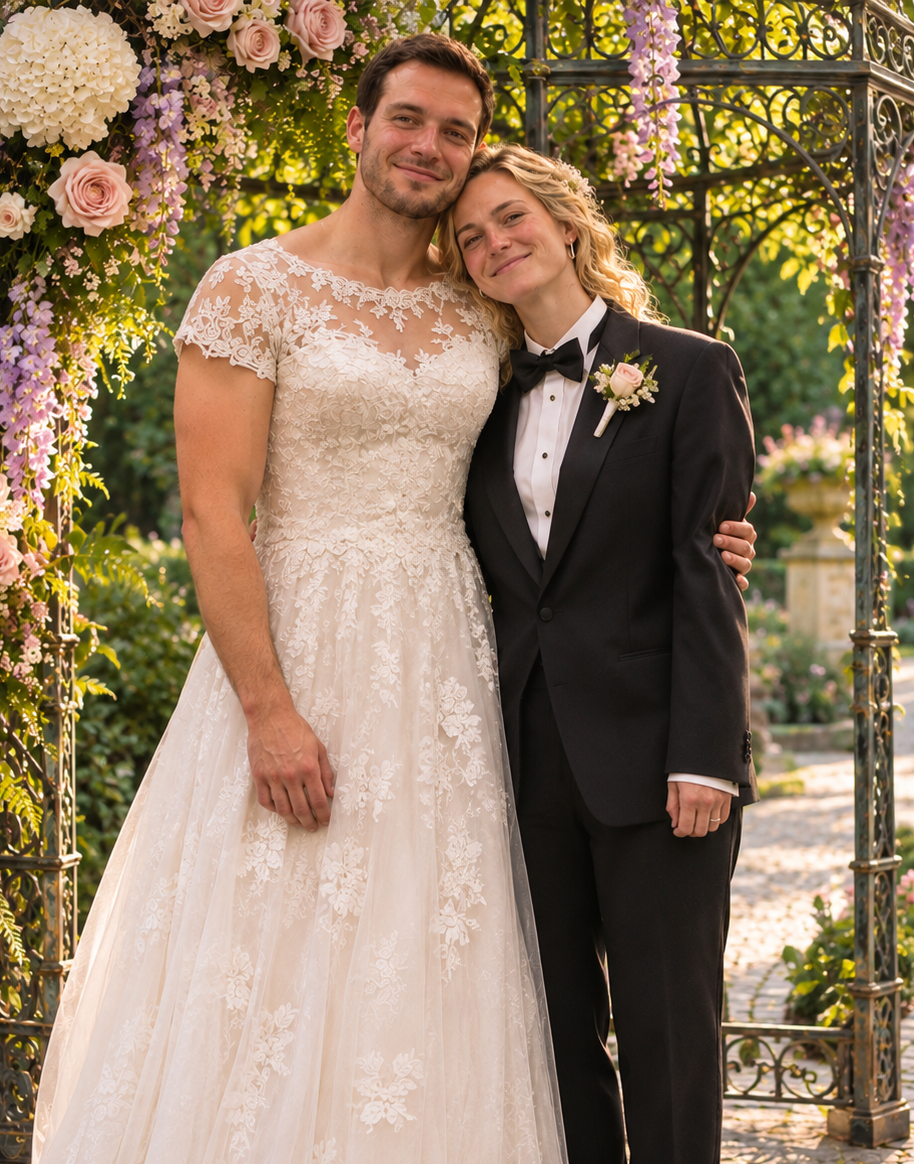
My fiancé, Sutton Hale, thirty-three years old, six-foot-one, kindergarten teacher, was walking toward the altar in an ivory satin wedding gown with a lace jacket and a bouquet of white ranunculus in both hands.
He was also, I found out later, crying before he reached the third row.
“What on earth is he wearing?” someone whispered. I’m pretty sure it was his Aunt Patty.
Then the string trio switched songs, and it was my turn.
I pushed the door open and stepped onto the aisle in a black tuxedo I had rented four hours earlier from a formalwear shop in Beavercreek for $189. The pants were pinned at the ankles with two safety pins. The bow tie was real. My hair was pulled back, and my only jewelry was my grandmother’s pearl earrings, because I couldn’t let go of everything.
If the first gasp was surprise, the second one was something worse.
My mother, Carol Whitaker, was sitting in the front row in the dusty-blue dress she’d bought eight months earlier. She looked at me the way you’d look at a house fire. Across the aisle, Sutton’s father, Ron, sat with his arms folded and slowly shook his head, back and forth, the whole time I walked.
I kept my chin up. I kept walking.
Halfway down, I glanced at the front row on the bride’s side. Next to my mother was one empty white chair with a small hand-lettered sign taped to the back.
Reserved: Flower Girl.
On the seat, propped against a pillow, sat an iPad on a little stand. The screen was dark.
Nobody had asked about it yet.
I reached the altar. Sutton took my hands, and his were shaking.
“You okay?” I whispered.
“Is she watching?” he whispered back.
I looked at the dark screen.
“Not yet,” I said.
That was the question that mattered more than anything else that day. Not what people thought. Not the whispers. Just whether one eight-year-old girl, forty miles away, would open her eyes in time.
I should back up and tell you who we are, so you don’t think we’re the kind of people who do things for attention.
We aren’t. I promise.
I’m Jo Whitaker. I’m thirty-one, and I’ve been a paramedic with the Kettering Fire Department for seven years. I’ve delivered two babies in the back of an ambulance and once talked a man off the roof of a Kroger. I keep granola bars in every jacket I own because somebody always needs one. My friends call me “the calm one.” My mother calls me “the stubborn one.” Same thing, depending on the day.
Sutton is the opposite of me in all the best ways.
He teaches kindergarten at an elementary school in Centerville. He keeps a box of tissues on his desk labeled FOR BIG FEELINGS, and he uses it more than the kids do. He cried at our first date when the waitress told us it was her last shift before nursing school. He cried when I said yes. He cried during a Subaru commercial with a golden retriever in it. He is not embarrassed about any of it.
We’d been together five years. We met when I responded to a call at his school—a little boy had shoved a bead up his nose—and Sutton stood in the doorway holding the boy’s hand, promising him that “Miss Paramedic is the bravest lady in Ohio.”
The bead came out. Sutton asked for my number.
When we finally got engaged, we planned a very normal wedding. That’s important. We weren’t trying to make a statement.
We booked a restored 1890s barn in Lebanon for the second Saturday in October. We had a string trio, a taco bar, and a cake from a bakery in Waynesville that Sutton picked because the lady who owned it gave him a free cookie.
And I had the dress.
I found it at a bridal shop in Dayton on the fourth try. Soft ivory, off-the-shoulder, with a long lace train. It cost $2,340. My mother paid $1,500 of that out of the savings account she’d been adding to since my dad passed away six years ago.
When I came out of the fitting room, my mom put both hands over her mouth and didn’t say anything for almost a full minute.
Then she said, “Your father would have walked you down the aisle in that and never stopped smiling.”
That’s when I understood the dress wasn’t just mine. My parents got married at the Montgomery County courthouse in 1991. My mom wore a borrowed blue dress from her sister. There was no aisle, no music, no photographer. Just a clerk and a twenty-dollar bouquet from a gas station.
She had been waiting thirty-three years to see a wedding done right.
There was one more person who was very invested in our wedding. Her name was Harper.
Harper is Sutton’s niece, his younger sister Megan’s daughter. She was eight that fall, with freckles, a gap in her front teeth, and opinions about everything.
She was also eleven months into treatment for leukemia at Cincinnati Children’s Hospital.
I’ll be careful how I talk about that, because Harper would hate it if I made her sound sad. She wasn’t sad. She was bossy. She ran that hospital floor like she owned it.
And one rainy afternoon in July, she decided she was in charge of our wedding.
Part 2: The Purple Notebook
It started with a purple spiral notebook from the hospital gift shop.
Harper wrote THE WEDDING BOOK on the cover in green marker, and underneath, in smaller letters, by Harper Lynn Gray, age 8, PLANNER.
Every time we visited, there was a new page.
Page one was the cake. (Chocolate, “because vanilla is boring.”) Page two was the music. (“Taylor Swift and that song Grandpa likes about the boat.”) Page three was the flower girl. That page just said ME in giant letters, with three stars around it.
Page four, she wouldn’t let us see.
“It’s a surprise,” she said, holding the notebook against her chest. “You can only see it if it’s an emergency.”
Sutton laughed. “What kind of wedding emergency?”
“A big one,” Harper said. “Like a tornado.”
We promised her she’d be our flower girl. Her doctors said that if her counts stayed steady, a few hours out of the hospital for the ceremony was possible. Megan had been driving back and forth between Cincinnati and her home in Springboro for almost a year. The wedding was going to be the first normal day she’d had in a long time.
Harper practiced throwing petals in the hallway outside her room with paper confetti the nurses cut out for her. She practiced so many times that the night janitor started calling her “Petals.”
Then came the morning of the wedding.
At 7:42 a.m., I was sitting in the bridal suite of the barn’s guesthouse with my hair half-pinned and a cup of coffee going cold on the windowsill. My dress was hanging on the closet door in its garment bag. My maid of honor, Dana, was steaming the veil.
My phone rang. It was Megan.
She didn’t say hello.
“She spiked a fever at four this morning,” she said. “A hundred and two point six. They started IV antibiotics an hour ago. Jo, she’s not coming. They won’t let her leave.”
I’m a paramedic. I know what a fever means for a kid on chemotherapy. It isn’t a small thing. I sat down on the edge of the bed and made my voice go calm, the way I do on calls.
“Is she stable?”
“She’s stable. They’re watching her. She’s okay. But she’s—” Megan’s voice cracked. “She’s crushed. She keeps saying nothing in her book is going to happen now.”
In the background, I could hear a small, hoarse voice say something I couldn’t make out.
“What did she say?”
Megan was quiet for a second.
“She said, ‘Tell them it’s a tornado.’”
Sutton was supposed to be getting ready in the groom’s cabin on the other side of the property. Tradition said I wasn’t supposed to see him before the ceremony.
I walked over there in my robe and sneakers anyway.
He was sitting on the porch steps in sweatpants with his phone in his hand. Megan had called him right after she called me. His eyes were already red.
“She asked me to open it,” he said, before I could say anything. “Page four. She said it’s an emergency now.”
He had the purple notebook on his lap. Harper had sent it home with Megan the week before “for safekeeping,” which in hindsight should have told us something.
He opened it to page four and turned it toward me.
I read it twice.
Then I sat down next to him on the step, and for a few seconds, neither of us said anything. Down by the barn, a man from the rental company was unloading folding chairs from a truck. I could hear them clanking, one after another.
“Okay,” I said.
Sutton looked at me. “Okay?”
“Okay. We’re doing it.”
“Jo, your mom—”
“I know.”
“My dad is going to—”
“I know.” I wiped my face with the sleeve of my robe. “But she’s eight, Sutton. She’s been in that room for eleven months. If we can’t give her this, what was the point of planning any of it?”
He nodded slowly. Then he laughed, a wet, shaky laugh.
“Where am I supposed to find a wedding dress in my size in eight hours?”
I didn’t have an answer. But I knew someone who might.
Dana is the costume manager at a community theater in Dayton. When I walked back into the bridal suite and told her what we needed, she put down the steamer, thought for maybe ten seconds, and said, “Edna.”
“Who’s Edna?”
“Edna Turnblad. From Hairspray. We did it in 2022. The role is traditionally played by a man, and our Edna was six-foot-two. There’s an ivory satin gown in storage that was built for the finale. It’s got a lace jacket. It’s—honestly, it’s gorgeous.”
By 9:15, she was on the highway to Dayton.
By 10:00, Sutton’s best man had driven me to a formalwear store in Beavercreek. The guy behind the counter, who looked about nineteen, asked, “Is this for, like, a costume party?”
“It’s for my wedding,” I said. “I need a tux in a women’s six, and I need it by noon.”
He looked at me for a long second. Then he said, “Yes, ma’am,” and went into the back without another question. I tipped him forty dollars.
There was one more problem, and it was the hardest one.
We couldn’t tell anybody why.
Megan had asked us, very clearly, on the phone that morning.
“Please don’t tell Mom and Dad yet,” she said. “If Mom knows Harper’s on IV antibiotics, she’ll leave your wedding and drive down here and sit in a waiting room she can’t even get past. They only allow two people in the room. She’ll spend your whole day staring at a vending machine.”
“Megan, she’s going to want to know.”
“I’ll tell her tonight. Once the fever starts coming down.” Megan took a breath. “Harper made me promise. She said Grandma has to go to the wedding and dance with Grandpa. She said it’s in the book.”
It was. Page six. Grandma and Grandpa dance to the boat song.
So Linda and Ron Hale had been told only that Harper “had a little temperature” and might not make it. And my mother had been told nothing at all, because my mother can’t keep a secret from Linda for longer than ten minutes.
At 2:00 p.m., Dana walked into the groom’s cabin carrying a garment bag the size of a sleeping bag.
When Sutton came out in that dress, Dana pinned the hem, stepped back, and said, “Well, damn.”
He turned to the mirror. He looked at himself for a long time.
“She’s going to laugh so hard,” he said.
That was the only review that mattered.

Part 3: The Hallway
The vows went fine. Better than fine.
Sutton cried through all of his. I got through mine with only one wobble, at the part where I promised to always be the one who carries the heavy things. Nobody else understood why that line made Sutton squeeze my hands so hard, but they would.
What didn’t go fine was everything that came after.
At the reception, the whispers didn’t stop. They got louder, because now there was an open bar.
I heard pieces of conversations everywhere I walked.
“Why would they do something like this on their wedding day?”
“Is this supposed to be some kind of joke?”
“Carol paid for that dress, you know. Half of it.”
“I always thought Sutton was a little…”
That last one I didn’t hear the end of, because the woman saw me and stopped talking.
I’m used to strangers being upset with me. People scream at paramedics all the time. Somebody once threw a shoe at me while I was trying to save her husband’s life. I can handle strangers.
It was different when it was our own families.
Sutton’s father didn’t say a word to either of us through the entire cocktail hour. He stood by the bar with his back to the room. Sutton’s mother, Linda, kept smiling a thin, polite smile and checking her phone, waiting for an update on Harper that wasn’t coming.
And my mother wouldn’t look at me at all.
At 6:40, I was walking down the narrow hallway toward the restroom when she stepped out of the coat room and stood in front of me.
She had my garment bag over her arm. My dress. Somebody had brought it down from the bridal suite.
“I found this upstairs,” she said. “Hanging in the closet. Like you didn’t even try it on.”
“Mom—”
“Fifteen hundred dollars, Joanna.” Her voice was low and very steady, which was worse than yelling. “That’s six years. Every birthday card your father’s mother sent me, I put the check in that account. I didn’t buy myself a new car. I didn’t go to Florida with the girls from church. Because I wanted you to have the wedding I didn’t.”
“I know.”
“Then tell me why.” She held up the bag. “Just tell me why, and I’ll try to understand. Is it a statement? Is it something Sutton wanted? Is it something about—”
“It’s not about any of that.”
“Then what is it about?”
I could have told her right there. It would have taken thirty seconds. One sentence, and the look on her face would have changed. I wanted it so badly I could feel the words in my mouth.
But I looked at my phone, and there was a text from Megan from three minutes earlier.
Fever’s 100.4 and dropping. She’s still asleep. Doc says let her rest. She wants to watch the speeches. PLEASE wait. Mom can’t know until H is awake.
If I told my mom, she would tell Linda. I knew it like I know my own pulse. And Linda would be in her car in four minutes, still in her corsage, driving to Cincinnati to sit outside a door she couldn’t open. And Harper, who had planned that dance with her grandparents in green marker, would wake up to find out the one thing she asked for didn’t happen.
If I told my mom, she would stop being hurt.
If I didn’t, I’d have to stand there and watch her be hurt, knowing I could fix it.
“I can’t tell you yet,” I said. “I’m sorry. I promised someone.”
My mother looked at me for a long moment. Then she folded the garment bag over her arm, very carefully, the way you fold a flag.
“Your father would be so confused,” she said quietly.
She walked back into the reception.
I stood in that hallway for almost two minutes with my hand on the wall. Then I went back in and sat down next to my husband, who was wearing a wedding gown and holding a plate of tacos, and I didn’t say anything.
He didn’t make me. He just slid his hand into mine under the table.
At 7:06 p.m., my phone buzzed.
She’s awake. She’s asking if she missed it. Call us.
Sutton read it over my shoulder. He put down his fork, stood up, and walked to the front of the room.
There’s a sound a room makes when the groom picks up the microphone while wearing a wedding dress. It’s not quite silence. It’s more like a hundred people holding their breath at the same time and trying not to laugh.
Sutton tapped the mic twice. Then he looked out at everybody.
“I know most of you think we’ve lost our minds,” he said.
A few nervous laughs. Somebody near the back said, “Little bit.” More laughs.
Sutton smiled. “That’s fair. But there’s something important we need to tell all of you. And there’s someone who’s been waiting all day to hear this.”
He nodded at Dana. She walked to the front row, picked up the iPad from the empty flower girl chair, and carried it to the little projector the DJ had set up for our slideshow. She plugged it in.
The screen on the barn wall flickered.
And there was Harper.
She was propped up in her hospital bed in a pink gown with an IV line taped to the back of her hand. Somebody had made her a crown out of a paper plate and gold star stickers. Her cheeks were flushed. Her mom was sitting next to her, holding the tablet steady.
Harper squinted at the screen. Then her whole face changed.
“Uncle Sutton!” she shrieked. “You’re wearing it! YOU’RE WEARING IT!”
Sutton laughed so hard he had to bend over. Then he straightened up and turned back to the room.
“This is Harper,” he said. “Most of you know her. She’s my niece. She’s eight. And for the last eleven months, she’s been fighting leukemia at Cincinnati Children’s, and she has been braver about it than any of us in this room have ever been about anything.”
The barn went very, very quiet.
“Harper was supposed to be our flower girl today. She practiced for three months. The nurses on her floor call her Petals now.” He paused. “At four o’clock this morning, she got a fever. It’s a normal thing in treatment, and she’s going to be okay. But her doctors said she couldn’t leave. And she was heartbroken.”
Across the room, Linda had both hands over her mouth. Ron had turned all the way around from the bar.
Sutton held up the purple notebook.
“Back in July, Harper decided she was planning our wedding. She wrote it all down in here. Cake, music, flower girl. And on page four, she wrote something she made us promise not to read unless there was an emergency.” He opened it. “She called this morning and told us it was a tornado. So we read it.”
He cleared his throat. His voice was already going, but he read it anyway.
“‘Page four. Emergency Wedding Plan. Uncle Sutton has to wear the white dress because he cries at everything and brides are allowed to cry as much as they want. Aunt Jo has to wear the tuxedo because she is the brave one, and the brave one has to be ready to carry me if my legs get tired. If I can’t come, you have to do it anyway so I know it happened.’”
He lowered the notebook.
“So we did it anyway,” he said. “So she’d know it happened.”
I’ve been on a lot of calls in seven years. I’ve been in a lot of quiet rooms. I’ve never heard one as quiet as that barn.
Nobody burst into tears all at once. It wasn’t like a movie. It was smaller than that.
Ron set his beer down on the bar, very slowly, like it was made of glass.
Aunt Patty, the one who’d whispered “What on earth is he wearing?” took off her reading glasses and pressed her fingers against her eyes.
And my mother, at the head table, put her fork down on her plate without a sound. Then she reached under her chair, where she’d left my garment bag, and pulled it into her lap and held it with both arms.
On the screen, Harper was bouncing in her bed as much as an IV line would allow.
“Aunt Jo! Aunt Jo, turn around! Let me see the tux!”
I stood up and did a slow turn. Somebody whistled. Harper clapped.
“You look like a secret agent,” she said, deeply satisfied.
Then she leaned closer to the camera, so close that her face filled the whole barn wall, and said, in a very serious voice:
“Okay. Now Grandma and Grandpa have to dance. It’s page six.”
Part 4: The Boat Song
I don’t think Ron Hale had danced in public since 1987. Sutton told me that later.
But when the DJ found “Sloop John B,” which is apparently what Harper meant by “the song Grandpa likes about the boat,” Ron walked across the barn floor, held out his hand to his wife, and danced with her right in front of that screen.
He was not a good dancer. It didn’t matter.
Harper watched the whole thing with her paper crown sliding down over one eye, singing along to the wrong words. Halfway through, Ron reached over, picked up the iPad from Dana, and danced with it too, holding it up so Harper could see the room spinning. She laughed so hard Megan had to tell her to breathe.
When the song ended, Linda came straight to our table. She didn’t say anything at first. She just took Sutton’s face in both her hands, the way she probably did when he was five.
“You should have told me,” she said.
“Megan asked us not to,” Sutton said. “Harper asked her not to. She wanted you here. She wanted you to dance.”
Linda looked over at the screen, where her granddaughter was now giving the DJ instructions about the next song.
“She’s so bossy,” Linda said, and her voice broke right in half.
Ron came over a minute later. He stood in front of his son for a long time, looking at the satin and the lace jacket and the ranunculus bouquet sitting on the table.
“I shook my head at you,” he said. “The whole way down the aisle.”
“I saw,” Sutton said.
Ron nodded. Then he did something I’d never seen him do in five years. He pulled his son into a hug and held on.
“I’m sorry, bud,” he said. “That’s the bravest thing I ever saw a man do in a dress.”
“It’s the only thing you’ve ever seen a man do in a dress, Dad.”
“Still counts.”
My mother was the last one.
She found me by the dessert table. She was still holding the garment bag.
“I said a terrible thing to you in that hallway,” she said.
“You didn’t know.”
“No. But I didn’t trust you either.” She looked down at the bag. “That’s worse. I’ve known you thirty-one years. You’ve never done one thing in your whole life just to get attention. You run into burning buildings for a living. I should have known you had a reason.”
“Mom, I’m sorry about the money. I really am. I’ll pay you back the fifteen hundred—”
“Don’t you dare.” She took my hand. “Joanna, I wanted you to have the wedding I didn’t get. And I think you just did. It just didn’t look like I pictured it.”
Then she unzipped the garment bag a few inches and looked inside at the lace.
“But I’m not letting this go to waste,” she said. “Somebody’s wearing this dress eventually. Even if it’s you on a Tuesday.”
“Deal,” I said.
Later that night, after the last guests left, Linda and Ron drove to Cincinnati. Megan met them in the hospital lobby at 11:40 p.m. and took them up two at a time.
Harper was asleep by then. The fever broke completely a little after midnight.
There’s a brass bell mounted on the wall outside the oncology unit at Cincinnati Children’s. When a kid finishes treatment, they get to ring it.
On March 14th, five months after our wedding, Harper rang it.
She rang it eleven times, one for every month she’d spent on that floor. Then she rang it a twelfth time “for the wedding,” and the nurses let her, because nobody in that hallway was going to tell Petals no.
We were all there. Megan. Linda and Ron. My mom. Dana. Half of the nurses from the fourth floor.
And me, in my wedding dress.
My mother zipped it up for me in a family bathroom down the hall. Her hands were shaking a little on the zipper, and neither of us said anything about it.
When she finished, she turned me around by the shoulders and looked at me for almost a full minute.
“Your father,” she said, and then she didn’t finish, and she didn’t have to.
Sutton wore a regular black tux this time. He’d rented it from the same shop in Beavercreek. The same kid was working the counter. When Sutton told him what it was for, the kid charged him $50 instead of $189 and said, “Tell the little girl congratulations.”
After the bell, the hospital let us use the courtyard garden for twenty minutes. Our photographer came back for free.
Harper wore a white dress with a yellow sash and carried a basket of real petals this time. Her hair was just starting to come back in soft brown fuzz. She walked down a little stone path between the planters while everybody clapped, and she threw those petals like she was getting paid by the handful.
When she reached the end, she looked up at me in my gown and frowned.
“Aunt Jo,” she said. “You’re wearing the wrong outfit.”
“I know,” I said. “This is the do-over.”
She thought about it. Then she nodded. “Okay. But next time, I’m picking again.”
We have one picture from that day framed in our living room. It’s the four of us—Sutton, me, Harper, and my mom—standing in that garden. My mom’s hand is on the lace of my train. Harper is holding the purple notebook up to the camera.
It’s open to a brand-new page she wrote that morning in green marker.
Wedding #2. Rule: Everybody wears whatever they want. Everybody comes. Nobody whispers.
People still ask about our wedding sometimes. Usually it’s someone who heard the story secondhand. “Wait, you’re the couple who switched outfits?”
I used to explain the whole thing. Now I mostly just say yes.
Because I’ve figured out that the people who need the explanation aren’t really the point. The point was a little girl in a paper crown, forty miles away, who needed to know that the people she loved would keep a promise even when it was hard. Even when it was embarrassing. Even when their own families didn’t understand yet.
Sutton still keeps the tissue box on his desk at school. FOR BIG FEELINGS.
He told his kindergarten class about the wedding last month. One little boy raised his hand and asked, “Mr. Hale, did you look pretty?”
Sutton said, “I looked brave.”
Then he paused, and added, “But mostly I looked like somebody who loves his niece.”
That’s the only thing anybody ever really needed to know.
Would you have kept the secret from your own mother if a child had asked you to?
Disclaimer: This story is a work of fiction inspired by real-life themes. Names, characters, places and events are fictionalized, and any resemblance to real persons is purely coincidental. It does not represent any person or organization and does not encourage inappropriate behavior. Images are for illustration purposes only.


