

Part 1: The Call at 11:42
I work double shifts at Mercy General so my boys have a roof over their heads and food in the fridge. And every single shift, somewhere under the charting and the call lights and the coffee, I carry the same quiet fear.
What if something happens while I’m gone?
On a Tuesday in early October, it finally did. Just not the way I had pictured it.
My phone buzzed in my scrub jacket at 11:42 a.m. I was in Room 7, adjusting an IV for a retired mail carrier who wanted to tell me about every dog that had ever bitten him.
I almost ignored it. I had three more patients waiting, and my break wasn’t until two.
But something tugged at me. I excused myself, stepped into the hallway, and looked at the screen.
Unknown number.
I answered anyway.
“Ms. Porter? This is Officer Benny Ruiz with the Millbrook Police Department. First, your children are safe. But I need you to come home. Your older son was involved in a situation this morning, and I’d rather explain it in person.”
I pressed my back flat against the wall.
“Are they okay? What happened? Is Logan hurt?”
“Nobody’s in danger right now, ma’am,” he said. “But it’s important you get here as soon as you can.”
Then the line went quiet. He’d hung up before I could ask anything else.
I stood there with the phone in my hand, staring at a laminated hand-washing poster like it might explain something.
Your older son was involved in a situation.
I had spent two years trying not to hear a sentence like that.
Part 2: Twenty Minutes of the Worst
I told my charge nurse, Denise, that it was a family emergency. She took one look at my face and said, “Go. I’ve got your rooms.”
I didn’t even take off my badge. It was still clipped to my chest, swinging against my ribs, when I pulled out of the employee lot.
It’s a twenty-minute drive from the hospital to our house on Sycamore Lane. I ran two red lights on the way. I didn’t notice either one until I was already through it.
And I used every one of those twenty minutes to imagine the worst.
My oldest, Logan, was seventeen. In fairness to him, his “record” was about as dramatic as a library fine.
When he was fourteen, a group of his friends set up a bike race down Maple Street. It ended with three boys swerving inches away from a parked Buick. An officer lined them all up in the hardware store parking lot and gave them a lecture loud enough for half the town to hear.
Logan still says it was the most embarrassing ten minutes of his life.
Then, at sixteen, he skipped school to watch his best friend, Tyler, play in a regional soccer tournament two towns over. He didn’t tell anyone until he got home that night, sunburned and guilty.
That was it. That was the whole history.
But Millbrook is a small town, and small towns have long memories. People remember the boy on the bike. They remember the boy who skipped school. And lately, it had felt like people were watching Logan a little more closely than they watched other kids his age.
A few months earlier, an officer had even pulled him aside for questioning about some broken windows at the middle school. It turned out to have nothing to do with him or anyone he knew.
That night, I sat across from him at the kitchen table.
“Promise me this won’t happen again,” I said. “I mean it, Logan. You’re my rock. Andrew and I are counting on you.”
He looked at me for a long moment.
“Okay, Mom. I promise.”
And I believed him. I always believed him.
But believing someone doesn’t make the fear go away. It just teaches it to be quieter.
On that drive home, it wasn’t quiet at all.
Part 3: The Boy Who Never Complained
I should explain how our family works, because it matters.
My husband, Mark, died two years ago. A heart attack at forty-four, in the garage, on a Saturday morning while he was looking for a socket wrench. Andrew was barely a year old. Logan was fifteen.
After that, the math of our lives changed overnight.
There was one income now, a mortgage that didn’t care about grief, and a toddler who needed care while I worked. So I picked up double shifts. And Logan, without anyone asking, picked up the rest.
On school days, Andrew went to Little Acorns, the daycare at the end of our block. Logan picked him up every afternoon at 3:15. I never had to remind him. Not once.
On days without school—teacher workdays, holidays, summer—Logan stayed home with his brother so I didn’t have to pay for an extra day of care. At $62 a day, that extra day was the difference between paying the electric bill on time and paying it late.
That Tuesday was a teacher in-service day. So Logan had Andrew.
He never complained about it. Not once in two years.
I remember one evening, coming home late and standing in the kitchen doorway, watching Logan negotiate with Andrew over a single baby carrot. Andrew was going through a phase of refusing to eat anything orange, and he was treating that carrot like it had personally insulted him.
Logan was patient. He made the carrot talk. He made it dance across the plate. Eventually, Andrew ate half of it just to make it stop.
“You’re really good with him,” I said.
Logan shrugged. “He’s easy.”
He wasn’t easy. No two-year-old is easy. But that was Logan. He never made a big deal out of the things he carried.
And that was exactly what scared me on the drive home.
Because if Logan was carrying something heavy enough for the police to get involved, I had no idea what it was.
My hands were so tight on the steering wheel that my knuckles ached.
I turned onto Sycamore Lane.
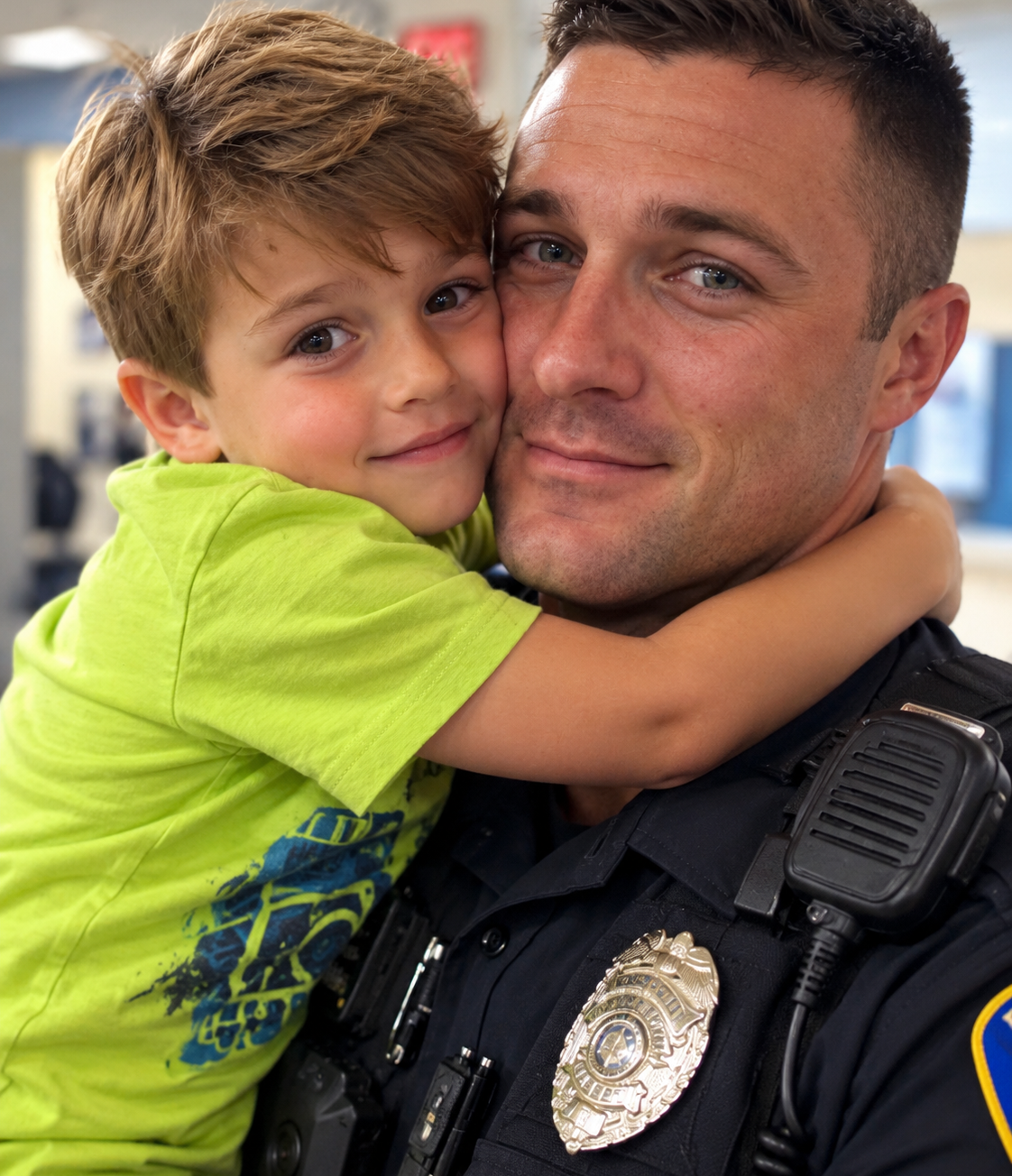
And the first thing I saw was a police officer standing in my driveway, holding my baby.
Part 4: A Cop in My Driveway
I recognized him right away.
Officer Benny Ruiz had been on the Millbrook force for as long as I could remember. He coached Little League in the summer. He bought the same two-pack of donuts at the gas station every morning.
And he was holding Andrew.
My son was asleep on his shoulder, mouth open, one small fist still wrapped around a half-eaten graham cracker.
I didn’t get out of the car right away. I couldn’t. I needed to sit there for a few seconds and make sense of what I was looking at before my body did anything.
Andrew was fine. He was safe. He was asleep.
Then where was Logan?
I got out and crossed the driveway faster than I’ve moved since nursing school.
“Officer, what’s going on?”
He nodded toward the sleeping boy on his shoulder. “This is your son, right? Andrew?”
“Yes. Where’s Logan? What happened?”
“Ma’am, we need to talk about your older son.” He paused, and his voice softened. “But I want you to know right now—it’s not what you’re expecting.”
I didn’t know what to do with that sentence. My mind had spent twenty minutes building a very specific picture, and that sentence didn’t fit anywhere in it.
Officer Benny turned toward the front door, still carrying Andrew, and I followed him inside.
Part 5: “Your Son Didn’t Do Anything Wrong”
Logan was standing at the kitchen counter with a glass of water in his hand.
He looked at me the way he used to when he was seven and something had gone wrong at school. That particular expression, the one where he was trying very hard to look calm and not quite managing it.
It made my stomach drop.
“Mom? Hey. Why are you home?”
“That’s exactly what I’m asking you, Logan.”
Officer Benny rested a hand briefly on my shoulder.
“Ms. Porter, just give me one more minute. I promise this’ll make sense.”
He laid Andrew carefully on the living room couch and tucked the fleece throw around him. Then he came back into the kitchen, picked up the glass of water Logan had set down, took a long sip, and placed it back on the counter like he’d been thirsty for an hour.
Then he looked straight at me.
“Your son didn’t do anything wrong.”
I stared at him. “What?”
“He’s right, Mom,” Logan said quietly.
My brain refused to catch up. I had been so sure of one thing for twenty straight minutes. Now the two people in front of me were handing me a completely different version of the day, and I couldn’t make the pieces fit together.
“Then why are you here?” I asked the officer.
Officer Benny glanced at Logan. “Why don’t you tell her?”
That’s when I noticed Logan’s fingers. They were trembling. Just slightly. He’d pressed them flat against the counter to hide it.
“I mean,” he said, eyes on the floor, “it really wasn’t a big deal.”
“It was a big deal,” Officer Benny said.
“Logan.” My voice came out sharper than I meant it to. “Just tell me. What happened?”
He rubbed the back of his neck.
“I took Andrew for a walk. Just around the block. He wanted to go see the Jacksons’ dog.”
“And?”
“And on the way back, we were passing Mr. Henson’s house.”
Part 6: Four Houses Down
I knew exactly who he meant.
Walter Henson lived four houses down from us in a gray ranch house with a chain-link fence and a porch swing he never sat on anymore. He was in his late seventies. He waved at me every time I drove past. And sometimes, when Andrew toddled by, he’d pass a butterscotch candy through the fence and wink like it was a secret between them.
“We were right by his fence,” Logan said, “and I heard this thud. Like something heavy hitting wood.”
“Mr. Henson lives alone,” Officer Benny said gently. “He has a heart condition.”
“He was on the porch, Mom.” Logan’s voice dropped. “On the ground. He wasn’t really moving.”
I didn’t have to try to picture it. I could see it.
My seventeen-year-old on the sidewalk, holding his little brother’s hand. An old man down on his porch. Half a second to decide.
“I picked Andrew up and put him inside the gate,” Logan said. “Right by the fence, on the grass, where I could see him. I told him, ‘Don’t move. Stay right there. Count the cars for me.’ And then I ran up the steps.”
From the couch, Andrew stirred at the sound of his name, sighed, and resettled into the cushions.
The graham cracker was gone now. I later found it crushed into the lining of Officer Benny’s jacket pocket.
“I called 911,” Logan said. “The lady stayed on the phone with me the whole time.”
Officer Benny took over.
“He followed every single instruction they gave him. Checked Mr. Henson’s breathing. Kept him talking. Got his head turned the way they said. And he didn’t leave his side for a second.”
I looked at my son. He was staring at the floor again, his jaw set hard, the way it gets when he doesn’t want anyone to see his face.
“I just didn’t want him to be alone, Mom.”
That sentence settled into the kitchen and stayed there.
Then Officer Benny said the part that made me reach for the back of the nearest chair.
“Ms. Porter, I talked to the paramedics. If Logan hadn’t done what he did, when he did it, Mr. Henson would not have made it.”
I gripped the chair so hard the wood bit into my palm.
I thought about every night I had lain awake wondering if I was losing Logan. If he was becoming someone I couldn’t reach anymore. Every morning I’d watched him walk out the door and quietly counted the hours until I knew he was home.
All that time, I had been afraid of who my son might become.
And this morning, he had been four houses away, keeping a man alive on his front porch.
Then the nurse in me caught up with the mother in me.
“Wait. Andrew.” My voice cracked. “He was out there by himself while all this was happening?”
Officer Benny shook his head.
“Not for long. My partner and I were on patrol two streets over. Logan had told dispatch he had a toddler with him, so they radioed us right away. We pulled up in under three minutes. The first thing I saw was your little guy sitting in the grass by the fence, counting out loud. He’d gotten to ‘eleven’ about six times.”
Despite everything, I laughed. It came out wet and shaky.
“The ambulance took Mr. Henson to Mercy,” he went on. “My partner, Officer Dale, stayed with Andrew on the porch while I helped Logan. Once everything calmed down, I drove them both home. I know your family, so I figured it was better if I stayed and explained everything myself.”
Part 7: What Officer Benny Remembered
At that moment, Andrew slid off the couch, padded into the kitchen in his dinosaur socks, and wrapped both arms around Logan’s leg.
No reason. No explanation. Just the way toddlers do.
Logan looked down at him and ruffled his hair.
I stood there looking at my two boys in our kitchen, and I couldn’t look anywhere else.
Officer Benny picked up his cap from the counter. Then he turned to me.
“I remembered what you said to me at Kroger last month,” he said. “In the cereal aisle. You told me you were worried about Logan. That you didn’t know if you were doing any of this right.”
I had said that.
I’d run into him while I was comparing the price of two boxes of Cheerios, and somehow, standing there with a coupon in my hand, I ended up telling him far more than I’d meant to. About Mark. About the double shifts. About how I was scared the town had already decided who Logan was.
“That’s why I called you myself,” he said. “You deserved to hear this part. Not from the neighbors. Not tomorrow. Today.”
He settled his cap on his head.
“You don’t need to worry about him as much as you think, Ms. Porter. He’s figuring things out. He’s turning into the kind of young man people can count on.”
Then he nodded to Logan, gave Andrew a little salute, and let himself out.
The screen door clicked shut behind him.
I crossed the kitchen and wrapped my arms around Logan before I’d fully decided to.
He went stiff at first, the way teenage boys do when their mothers hug them without warning. I held on anyway. Just a little longer than usual.
And then I felt his arms come up around me.
“Hey,” he said. “It’s okay, Mom.”
I pulled back and looked at him. Really looked at him. He was taller than me now. When had that happened?
“I thought I was the one holding everything together, sweetheart,” I said. “I thought I was the only one keeping this family standing up.”
Logan was quiet for a moment. He had a look on his face I hadn’t seen in a long time. Open. A little tired. Completely honest.
“No, Mom,” he said. “We both are.”
Part 8: The Humming
That evening, after Andrew had polished off a plate of chicken nuggets and fries and fallen asleep on the couch again, I sat at the kitchen table and watched Logan rinse the dishes.
Around 7:30, my phone buzzed. It was a text from a coworker on the cardiac floor.
Your neighbor Mr. Henson is stable. He keeps asking for “the Porter boy.” Says he owes him a whole bag of butterscotch.
I read it twice. Then I set the phone face down and didn’t say anything yet. I wanted to give it to Logan at the right moment.
Logan didn’t notice. He was standing at the sink with his sleeves pushed up, and he was humming.
Low and easy, under his breath. A song I half-recognized from somewhere I couldn’t place. Maybe the radio. Maybe something Mark used to play in the garage.
I sat very still and listened.
And it hit me that I hadn’t heard Logan hum in over a year.
Somewhere in all the noise—the grief, the bills, the exhaustion, the worrying—that small, ordinary sound had slipped out of our house without my noticing. And now it was back. Quiet. Unhurried. Like it had just been waiting for the right moment to come home.
I didn’t interrupt him. I stayed at the table until the last plate was in the rack.
After Mark died, there were so many nights I lay awake wondering how I was going to raise two boys alone. Wondering if I was enough. Wondering if I was doing any of it right.
For two years, all I could see was what might go wrong. Who Logan might become if I failed him. What the town might decide about him before he got the chance to decide for himself.
I was so busy watching for the worst that I almost missed what was standing right in front of me.
When Logan dried his hands and turned around, I slid my phone across the table.
He read the text. He didn’t say anything. But the corner of his mouth went up, just a little, and he went back to the sink to wipe a counter that was already clean.
He was humming again.
My boys were going to be okay.
More than okay.
They were going to make me proud. One of them already had.
Have you ever spent so long worrying about someone that you almost missed who they were becoming?
Note: This story is a work of fiction inspired by real events. Names, characters, and details have been altered. Any resemblance is coincidental. The author and publisher disclaim accuracy, liability, and responsibility for interpretations or reliance. All images are for illustration purposes only.


