

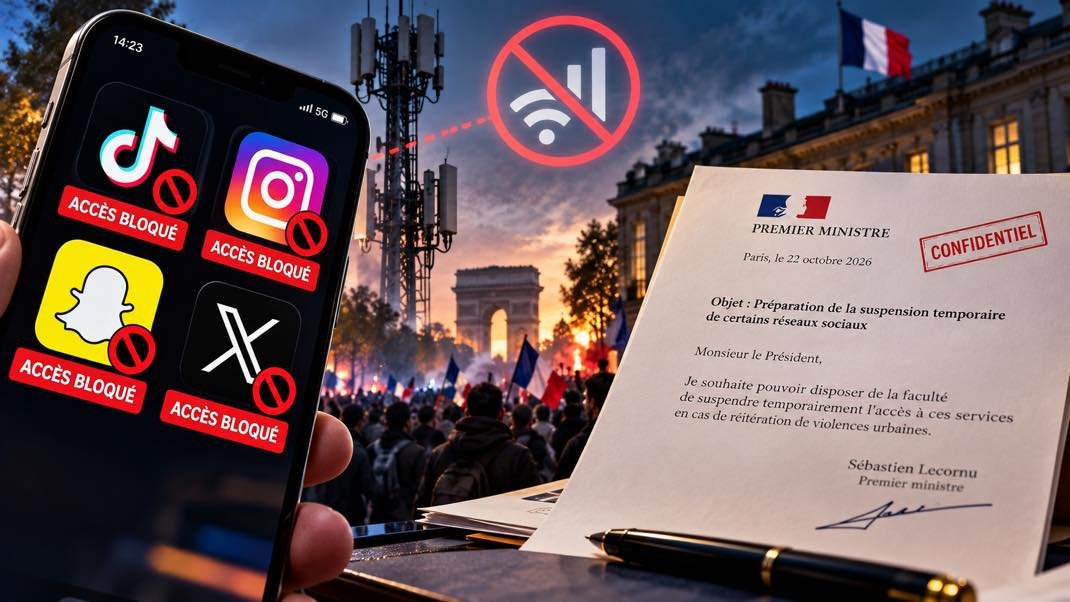
The French government had prepared to temporarily suspend several important social networks during the October 24 mobilization. A confidential letter sent two days earlier by Prime Minister Sébastien Lecornu to the directors of Orange, SFR, Bouygues Telecom and Free asked the operators to technically anticipate a possible blocking of TikTok, Instagram and Snapchat. Then X would have joined the list.
Considered DNS filtering for several hours
Matignon justified this preparation by the role attributed to the platforms in organizing the violence that occurred during the demonstrations of October 17. Sébastien Lecornu wanted “to be able to temporarily suspend access to these services in the event of recurrence of urban violence”.

The blocking scenario was mainly based on DNS filtering, giving priority to 4G and 5G connections. However, this method can be easily bypassed with certain VPNs or alternative DNS resolvers. Operators also reportedly explained that it would be difficult to quickly implement precise targeting of mobile networks or certain geographic areas.
The precedent of the blocking of TikTok in New Caledonia
The main difficulty remains legal. In April 2025, the Council of State annulled the TikTok block decided in New Caledonia in May 2024. The jurisdiction does not prohibit any cut, but requires that it be essential, limited in time and that no less restrictive measure can immediately respond to the situation.
The debate over a possible suspension of TikTok in France is not new. Given the uncertainties linked to the tensions of that day, the operators would have demanded an official, signed and reasoned decision before any intervention.
The lockdown was ultimately never triggered on October 24. However, the context favored alternative solutions: Bitchat, the Bluetooth messaging supported by Jack Dorsey, made great progress in France.


