

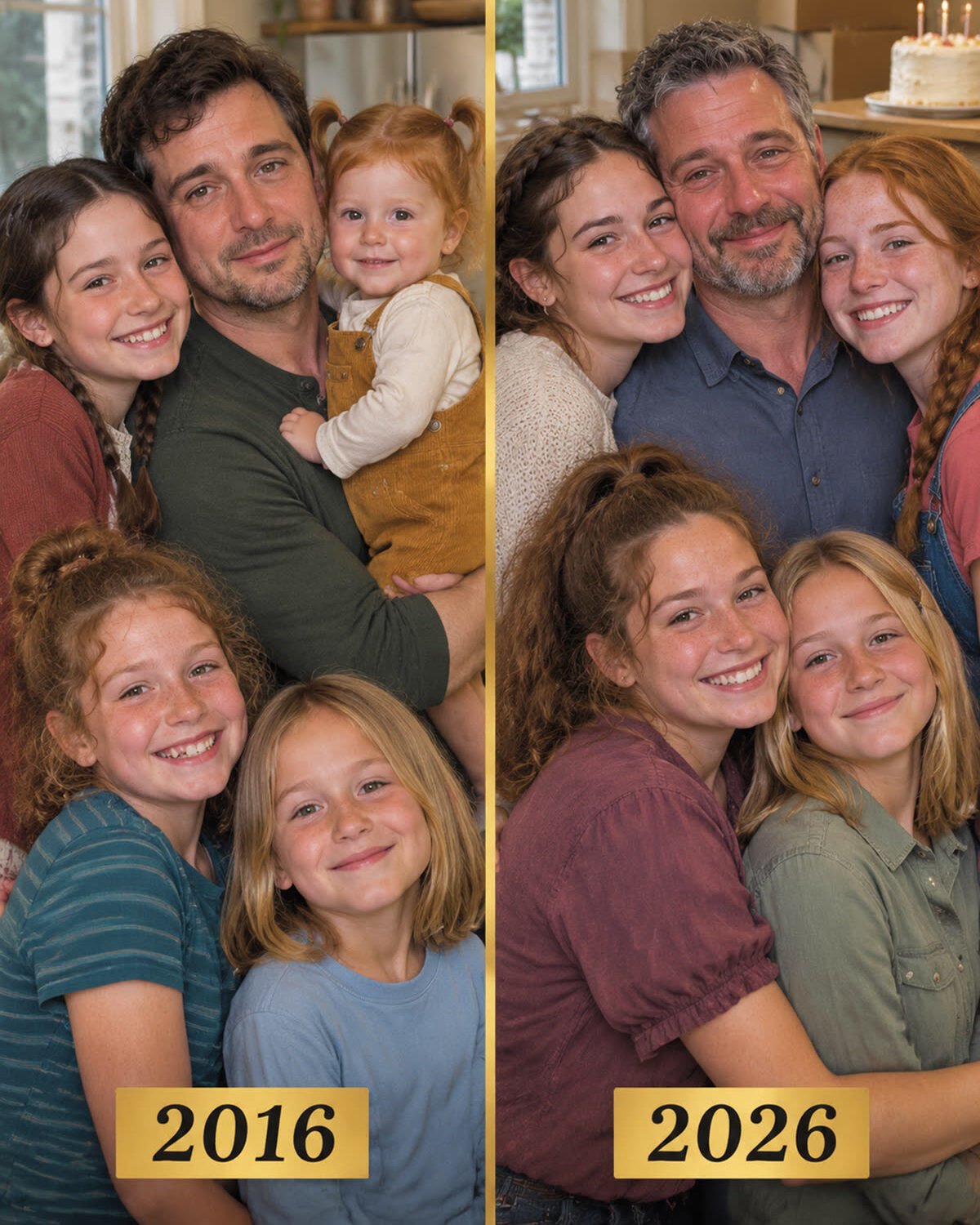
Part 1: The Empty Side
The first thing I noticed was Emma’s backpack in the middle of the stairs. She was six, usually careful with her things, and she was sitting three steps above it with her hands pressed between her knees.
“Daddy,” she said, “Mommy said she’s not coming back.”
I gave a short, foolish laugh. I was still holding my lunch cooler, still thinking about the supply order I had forgotten to place before leaving the repair shop.
“She probably meant she wouldn’t be back before dinner.”
Emma shook her head. “She took the big suitcase.”
Upstairs, Caroline’s side of the closet stood open. Her good shoes were gone, along with the blue suitcase we had bought for a vacation we never took.
Her wedding ring lay on the dresser beside a folded sheet of paper.
Don’t look for me; I want to live on my own.
I read it three times. Then I checked the bathroom, as though my wife might be behind the shower curtain and this could still turn into an argument rather than the end of our marriage.
Sophie appeared in the doorway holding three-year-old Grace. At nine, she already had the solemn expression she wore when she thought an adult was about to need help.
“Lucy’s making toast,” she said. “Grace said she was hungry.”
“Okay.” I put my cooler down carefully. “Okay, sweetheart.”
There were four children downstairs who needed dinner, and I could not remember how to make my hands work.
That evening, I called Caroline until the calls went straight to voicemail. I called her sister, two coworkers, the emergency rooms, and finally the police.
I told the officer about the note, but also about our daughters. People did not simply walk away from four children, I said.
He listened without correcting me. That kindness frightened me more than anything else he could have said.
My sister, Beth, stayed with the girls while I drove streets Caroline had no particular reason to be on. At 2:17 a.m., I found myself outside the grocery store where she liked to shop, staring at dark windows.
For several weeks, uncertainty kept hope alive. Maybe she was in trouble; maybe somebody had frightened her; maybe the woman who had packed school lunches that morning would call and explain.
Then the officer contacted me. Caroline had been located, she was safe, and she had confirmed that she had left voluntarily.
She was living in another state with a man.
I sat in my truck outside our house after that call. Through the kitchen window, I could see Sophie arranging apple slices on four small plates while Lucy argued with Emma about whose turn it was to feed the cat.
I cried until my chest hurt. Then I washed my face with water from a bottle and went inside.
They had already lost their mother. They could not lose their father to the chair in front of the television, or the bottom of a bottle, or the belief that nothing mattered anymore.
But staying required more than opening the front door.
On Monday, Grace’s daycare called because nobody had packed her spare clothes. On Tuesday, I discovered that Emma’s permission slip had been due the previous Friday.
By Wednesday, I had burned a pan of pancakes and put Sophie’s school shoes on the wrong feet while trying to answer a call from my manager.
“Dad,” she said gently, looking down, “I think these are arguing.”
It was the first time any of us had laughed since Caroline left. I stood at the counter afterward, holding the spatula, afraid to move in case the laughter disappeared.
My manager let me start earlier and leave in time for school pickup. Beth covered the gap before daycare opened, and a neighbor recommended an after-school program with a sliding fee.
None of that made me a heroic single father. It made me a father with a calendar taped to the refrigerator and several people willing to answer when I called.
The legal work took longer. After Caroline was formally served, she did not contest the divorce or my request for sole custody.
The final order included child support. Nothing arrived, and the enforcement paperwork became another folder I kept beside school records and medical bills.
I saved every letter. I also learned that waiting for money that might not come was not a household budget.
One afternoon, Sophie brought me a field-trip form and said she did not need to go.
“Why not?” I asked.
“It costs money.”
The trip cost $18. I had been discussing an overdue utility bill with Beth the night before, thinking the girls were asleep.
I sat beside Sophie at the kitchen table. “Money is my job to worry about. Your job is to go look at dinosaur bones and tell me whether the museum gift shop is a scam.”
She smiled, but she did not let go of the form.
“If I go,” she asked, “who helps you with the others?”
That question changed something in me. I had been so relieved that she was capable that I had nearly mistaken her help for something she owed.
“Not you,” I said. “You’re their sister, Sophie. You’re not their other parent.”
It took more than one conversation to make her believe me. I hired a sitter for occasional evenings, accepted Beth’s offers before a crisis, and learned to say that I could not work every extra shift.
That first Christmas, Grace dragged a dining chair across the kitchen floor while I drained the potatoes.
“One more,” she told me.
“We’ve got everybody, honey.”
She pointed at the chair. “Mommy might be hungry when she comes home.”
I put down another plate. I could not bring myself to tell a three-year-old that nobody was coming.
* * *
Ten years later, on the Saturday we moved into our new house, all four girls crowded around a cake they had kept hidden in a neighbor’s refrigerator.
Sophie was nineteen, Lucy seventeen, Emma sixteen, and Grace thirteen. Across the frosting, in blue letters that leaned slightly uphill, they had written a sentence I could not read aloud.
You were always enough, Dad.
I was still hugging Grace when somebody knocked.
Sophie went to the door. When she returned, her eyes were wet.
“Daddy,” she said, using a name she had mostly outgrown, “someone’s here for you.”
I stepped onto the porch and saw Caroline standing beside the boxes we had not yet carried inside.
For a moment, neither of us spoke. Then she looked past me toward our daughters and said, “There’s another girl you need to know about.”
Part 2: Beyond the Open Door
I pulled the front door almost closed behind me, leaving a narrow gap. Inside, somebody switched off the music.
“What are you doing here?” I asked.
Caroline held the strap of her handbag with both hands. “I came to explain.”
“After ten years?”
“I know how that sounds.”
“No,” I said. “You know how it sounds to say it. You don’t know what it was like to wait that long to hear it.”
She looked down. Her hair was shorter, and there were lines beside her eyes that I did not remember, but it was her ordinary expression that unsettled me.
I had imagined this meeting so often that I expected recognition to arrive with some warning. Instead, my former wife stood on my porch while a moving receipt fluttered under her shoe.
“How did you get this address?”
“Beth.”
I stared at her.
“I called her earlier this week,” Caroline said quickly. “She wouldn’t give me your number. She told me you were moving, and said she would ask whether you wanted a letter.”
“Then how—”
“I found the property record. Your name was on it.” She swallowed. “Beth mentioned Saturday. I thought everyone would be here.”
“So you knew this was a celebration.”
She nodded once.
The decision was so familiar that I almost missed it: Caroline had decided what she needed and arranged the rest of us around it.
“I thought if I waited for the right time, I would never come,” she said.
“You could have written. You could have let me decide when to tell them.”
“You’re right.”
I had wanted those words for years. Now they seemed terribly small.
Behind the door, I heard a floorboard creak. I turned and found Sophie standing in the opening.
“Give me a few minutes,” I said. “Please stay with your sisters. I’m not inviting anyone inside without talking to all of you.”
Sophie looked at Caroline, then back at me. “Don’t tell her we’re fine just to make this easier.”
“I won’t.”
After she closed the door, I led Caroline to the far end of the porch. There was nowhere private inside our new home that I wanted to give her.
“The man the police found you with,” I said. “Was he your boyfriend?”
“Yes.”
Even after ten years, the uncomplicated answer hurt.
She told me they had met through work. He traveled, took her to restaurants, and listened when she complained that she no longer knew who she was outside our family.
“He made it seem possible to start over,” she said.
“And we were what you needed to leave behind?”
“That’s what I told myself then.”
“You told yourself four children would understand a suitcase?”
Her eyes filled, but she stayed quiet.
The relationship had lasted less than a year. Within months, the man who had loved hearing about her unhappiness had grown tired of living with it.
He asked her to leave before their first anniversary together. Caroline rented a room, found another job, and eventually moved into a small apartment.
I waited for the next part. An accident, an illness, something that might explain why the silence continued long after the adventure ended.
“And then?” I asked.
“I worked.”
“You were alone?”
“Yes.”
“With a telephone?”
She flinched. “Adam.”
“It’s a question.”
“Yes.”
I looked out at the driveway. Lucy’s bicycle leaned against the garage, its basket full of cleaning supplies she had carried over from the old house.
“Why didn’t you call?”
“At first, I thought you would tell me never to come back. Then I thought the girls would ask questions I couldn’t answer.”
“They asked them anyway.”
Caroline pressed her lips together.
“Emma asked whether mothers could stop loving people if they were bad,” I said. “She was six. I had to explain that she hadn’t caused something I didn’t understand myself.”
“I never stopped loving them.”
I let the words sit between us until she looked away.
“What did that love do for them?” I asked.
She wiped her cheek. “Nothing they could see.”
“Nothing they could use.”
A car passed slowly, the driver searching for a house number. For a few seconds, both of us watched it as though its arrival required our attention.
“I kept putting it off,” Caroline said. “I would tell myself I’d call after I found a better job. After I had some money. After I knew what to say.”
“Did you ever send any money?”
“No.”
“Birthday cards?”
“No.”
She was not defending herself. Somehow, that made it harder to keep my voice steady.
I remembered Lucy at eleven, learning to check the mailbox without letting the others notice. I had caught her once and she had pretended to be looking for a library notice.
Caroline had missed that, too: not just the birthdays, but the careful ways our daughters learned to hide wanting her.
“Four years after I left,” she said, “I met someone else.”
“Is that what this is about? You need me to sign something?”
“No. Our divorce was already final.”
She explained that his name was Daniel. They met through friends in 2020 and married the following year.
“He knew I’d been married,” she said.
Something in the way she stopped made me look directly at her.
“What didn’t he know?”
Her fingers tightened around the handbag strap.
“I told him I didn’t have children.”
For several seconds, I could hear the refrigerator running through the kitchen window behind us.
“You told him they didn’t exist?”
“I thought if I told him the truth, he would never see anything else when he looked at me.”
“Then he would have been looking at the truth.”
She nodded, crying openly now.
I thought of the school forms that asked me to list another parent, the family-tree project Emma had quietly folded shut, the empty seat at every performance.
We had spent years learning how to live with Caroline’s absence. Somewhere else, she had made that same absence sound like a life without obligations.
“You mentioned another girl,” I said.
Caroline took a breath that trembled all the way out.
“Daniel had a daughter. Her mother had died several years before we met.”
I waited.
“She was eight when I came into her life,” Caroline said. “I helped raise her.”
Part 3: The Photograph She Kept
For a moment, I misunderstood her on purpose. I pictured occasional dinners, a child visiting on weekends, some distant arrangement that would not mean what she had actually said.
“She lived with you?” I asked.
“Yes.”
“And you went to school meetings?”
Caroline nodded.
“Birthdays? Doctor’s appointments?”
“Adam, please.”
“I need to understand which things you could do for her that you couldn’t do for them.”
She covered her mouth. I looked away long enough to get my voice under control.
The other girl had done nothing wrong. Whatever Caroline had given her—comfort, stability, someone to sit beside her when she was sick—was something a child deserved.
But so had my children.
“When Lucy broke her wrist,” I said, “I took Emma and Grace to the emergency room with us because Beth was out of town. Sophie missed rehearsal so she could come straight there after school.”
Caroline lowered her hands.
“I’m not telling you that because we survived something extraordinary. Families handle broken wrists every day. I’m telling you because you were somewhere doing ordinary things for another child while ours kept wondering why they weren’t worth a call.”
“They were worth it.”
“Then why?”
She stared at the porch boards for so long that I thought she would refuse to answer.
“Because she didn’t know,” she said finally.
I waited.
“She didn’t look at me and remember what I’d done. She thought I was kind. When she needed me, I could help her without having to explain anything first.”
I leaned back against the railing.
“You could be a good mother as long as nobody reminded you whose mother you already were.”
“I wanted to believe I could still be a good person.”
“You could have started by calling your daughters.”
“I know.”
“You knew then.”
She closed her eyes. “Yes.”
That answer stripped away the last explanation I had been saving for her. She had not been unable to understand what she owed them; she had been unwilling to endure what doing it would cost her.
Caroline opened her handbag and removed a photograph in a cloudy plastic sleeve.
I recognized our old couch before I recognized the day. Sophie sat on one arm with a missing front tooth, Lucy and Emma leaned against Caroline, and Grace slept with one fist caught in her mother’s blouse.
I had taken it a few months before she left.
“You kept that?” I asked.
“It was in a box with some things from before.”
Before. Ten years of marriage and four daughters reduced to a place she had once lived.
“Why are you showing it to me?”
“Daniel found it in February. We were sorting things for storage, and his daughter saw it.”
“How old is she now?”
“Fourteen.”
Only a year older than Grace. I fixed my eyes on the photo rather than let that comparison carry me somewhere I could not return from.
At first, Caroline had said the children were relatives. But the girl noticed Sophie’s resemblance to her and asked why Caroline had never mentioned them.
Daniel began asking questions, too. A story that Caroline had maintained through omission finally required more lies than she could keep straight.
“I told them,” she said.
“Everything?”
“Enough that they understood.”
“That isn’t what I asked.”
She looked at me. “I told them I left four daughters with their father and never contacted them again.”
I nodded once.
“Daniel moved into the spare room. A few weeks later, he asked me to stay somewhere else.”
“And his daughter?”
Caroline looked down at the photograph.
“She asked if I would have left her, too.”
I said nothing.
“I told her she was different. The situation was different.” She stopped, hearing herself. “It was the wrong thing to say.”
“Yes.”
“She said that being ashamed wasn’t a reason to keep hurting people. She wanted to know whether I’d even apologized.”
There it was: not a sudden discovery that our daughters needed her, but the collapse of a life that had depended on hiding them.
“Did you come here to get them back?” I asked.
“I came to make things right.”
“With which family?”
She did not answer quickly enough.
“I know I can’t fix this in an afternoon,” she said.
“That wasn’t the question.”
Her shoulders dropped.
I pointed toward the photograph. “If Daniel had never opened that box, would you be standing here?”
Caroline drew in a breath. For the first time since she arrived, she seemed to resist the sentence that might make her sound better.
“I don’t know,” she whispered.
Behind me, the front door opened.
Sophie stepped outside and closed it carefully. She had washed her face, but the skin beneath her eyes was still pink.
“Emma wants to know how much longer,” she said.
“I’m sorry,” I told her. “I should have checked on you.”
“We’re together. Grace is frosting over the part of the cake she poked.”
For a moment, I could almost see the kitchen: Lucy pretending not to watch the door, Emma standing rigidly beside the counter, Grace concentrating on a repair she could actually make.
Sophie turned toward Caroline.
“Is it really you?”
“Yes, sweetheart.”
Sophie’s jaw tightened at the word. Caroline seemed to notice, because she did not use it again.
“Why are you here?”
“I wanted to explain why I left.”
“Then explain.”
Caroline glanced at me. I stayed where I was.
She told Sophie that she had been unhappy, that she had met someone, and that leaving had been a selfish decision. She did not mention being overwhelmed or needing to find herself, and I was grateful she spared our daughter those burdens.
Sophie listened with her arms folded.
“Why didn’t you ever call?” she asked.
“I was afraid you wouldn’t want to hear from me.”
“I was nine.”
“I know.”
“No. I mean I was nine. I didn’t have some adult opinion about whether you deserved another chance. I wanted my mom.”
Caroline began crying again.
Sophie looked at the photograph in her hand. “Why do you have that out?”
“Her husband found it,” I said.
My daughter turned toward me. “Her husband?”
Caroline told her about Daniel, then about his daughter. I watched Sophie’s expression change as she worked through the dates.
“You raised another girl?”
“I helped raise her,” Caroline said quietly.
Sophie stared at her.
“We needed someone too.”
“I know, Sophie.”
My daughter took one step closer to me, then stopped.
“Before you ask to see my sisters,” she said, “there’s something you need to hear about the day you left.”
Part 4: The Places We Kept
Caroline went still. So did I.
Sophie looked toward the driveway, gathering herself. “You told me to be good for Dad. Do you remember that?”
“Yes,” Caroline said.
“I thought you meant if I was good enough, you’d come back.”
I turned toward my daughter. Over the years, we had talked about Caroline at the dinner table, in the truck, and in a counselor’s office, but I had never heard that particular sentence.
“Sophie,” I said softly.
She shook her head without looking at me. She needed to finish.
“So I tried. I got Grace dressed. I made sure Emma had her reading book. When Lucy got angry, I told her to stop because I thought you might hear about it somehow.”
Caroline pressed the photograph against her coat.
“Dad kept telling me I didn’t have to do all that,” Sophie continued. “And I believed him eventually. But you could have fixed that part with one phone call.”
“It wasn’t your fault,” Caroline said.
“Then why didn’t you tell me that when I was nine?”
There was no answer that could reach backward and find the child who had needed it.
I put my hand on Sophie’s shoulder. She leaned into it just enough that I knew she wanted it there.
“I’m telling you now,” Caroline said. “None of you caused this. Not one thing you did made me leave.”
Sophie wiped her cheek with the heel of her hand.
“I know that now. Dad made sure we knew.”
For the first time that afternoon, Caroline looked directly at me without asking me to help her.
“Thank you,” she said.
I could not answer that. Raising my daughters was not a favor I had performed for the person who left them.
Sophie looked at the photograph again.
“Does she know about us? Your stepdaughter?”
“She does now.”
“Is she okay?”
The question startled Caroline. It did not surprise me.
Sophie had always been able to find the person in a room who had the least control over what was happening.
“She’s hurt,” Caroline said. “And angry with me.”
“She should be angry with you. Not herself.”
“I know.”
“Make sure she knows that.”
Caroline nodded.
Then Sophie drew a long breath. “But you don’t get to come back because your other family doesn’t want you anymore.”
“I didn’t come only because of that.”
“Would you have come otherwise?”
Caroline looked at me, then back at our daughter.
“I want to believe I would have.”
“That’s not an answer.”
For several seconds, nobody spoke.
“You’re right,” Caroline said finally. “I left because I wanted to. I stayed away because I was afraid to face what I’d done. And I came here because I couldn’t keep pretending it hadn’t happened.”
Sophie’s face crumpled, but her voice remained clear.
“You didn’t lose us, Mom. You left us.”
Caroline reached toward her, then stopped before making contact.
“I’m sorry.”
“I’m not ready to forgive you.”
“I understand.”
“And I can’t tell you whether I ever will.”
Caroline lowered her hand. “I understand that, too.”
Through the kitchen window, I saw Emma move past the table. There were five plates on it, the mismatched ones we had decided to keep until we could afford a full new set.
Caroline followed my glance.
“Do they ever ask about me?”
I thought about answering gently. Then I remembered Sophie asking me not to make this easier by pretending.
“Grace used to set an extra plate for you every Christmas.”
Caroline’s eyes widened.
“She thought you might come home hungry.”
“Does she still?”
“No.”
“When did she stop?”
“When she was eight.”
I remembered standing beside the cabinet while Grace put the plate away herself. She had said she wanted more room for the people who were eating with us.
I had gone into the pantry afterward and stayed there until I could speak normally.
“I missed everything,” Caroline said.
“Yes,” I answered. “You did.”
She looked toward the door. “Could I see them?”
“I’ll ask. But you need to be prepared for no.”
She nodded.
I went inside alone. Lucy stood at the counter beside Emma, and Grace was turning the cake stand a little at a time to inspect her repair.
“She’d like to know whether you want to speak with her,” I said.
“Do we have to?” Emma asked.
“No.”
“Will you be upset if we don’t?” Lucy asked.
“Not with you.”
Grace put down the spatula. “I don’t know what I’d say.”
“You don’t have to decide today.”
Emma shook her head first. Lucy followed, and Grace came over to stand beside me.
“Not today,” she said.
I returned to the porch and gave Caroline their answer exactly as they had given it. I did not soften it, and I did not add anything to punish her.
“Can I leave my number?” she asked.
“Yes. You can send a letter through Beth if she agrees. No more arriving without warning.”
“All right.”
“And don’t ask them to make you feel better about what happened. If they want contact, we’ll work out what feels safe. If they don’t, you need to respect that.”
Caroline nodded and took a small notebook from her bag. Her hand trembled as she wrote.
Before she tore out the page, I added, “Giving you a chance to apologize is not the same as promising you a place in their lives.”
“I understand.”
This time, I thought perhaps she did.
She handed me the paper. Then she held out the photograph.
“Would you like this back?”
I looked at Sophie.
“Keep it,” my daughter said. “But don’t hide us again.”
Caroline put it carefully into her bag.
She apologized once more. Sophie did not answer, and Caroline did not ask her to.
Then she walked down the driveway, got into a parked car, and left our celebration without ever stepping inside the house.
For ten years, I had imagined that knowing why would relieve something. Instead, I felt tired in a way that reached past sleep.
But one thing had become clear. Caroline had not left because our daughters were difficult to love, and she had not stayed away because I had failed to find the right words to bring her home.
She had made choices. My daughters had spent enough years treating those choices as questions about themselves.
Sophie touched my arm.
“Dad, are you okay?”
“Not completely,” I said. “But I think I will be.”
She slipped her hand into mine, something she had not done in years, and we went inside.
Grace hugged me first. Then Emma joined her, and Lucy complained that we were blocking the cake while wrapping her arms around us anyway.
“Is everything okay?” Grace asked against my shirt.
“Not everything,” I told her. “But we’re okay.”
Sophie picked up the cake knife.
“Can we finally eat this? I need everyone to appreciate that I did the lettering before you cut straight through it.”
Lucy said the lettering looked like it had survived a minor earthquake. Sophie told her she could have the smallest piece.
Their voices rose around me, familiar and imperfect. I pulled out a chair before my knees could decide to stop holding me.
The house was not the reward for being a good father. It was simply a house we could afford at last, with enough bedrooms and a back step that needed fixing.
The life worth celebrating was already inside it.
I folded Caroline’s number and put it in the kitchen drawer. Nobody asked me to throw it away; nobody asked me to leave it on the counter.
Then we sat down together.
Five chairs. Five plates. For tonight, every seat was filled.
Sophie passed me the first slice of cake, then glanced toward the drawer.
“Dad,” she asked quietly, “what do we do if she calls tomorrow?”
Should Adam encourage his daughters to reconnect with Caroline, or support them in deciding whether they want contact at all?
Disclaimer: This story is a work of fiction inspired by real-life themes. Names, characters, places and events are fictionalized, and any resemblance to real persons is purely coincidental. It does not represent any person or organization and does not encourage inappropriate behavior. Images are for illustration purposes only.


