

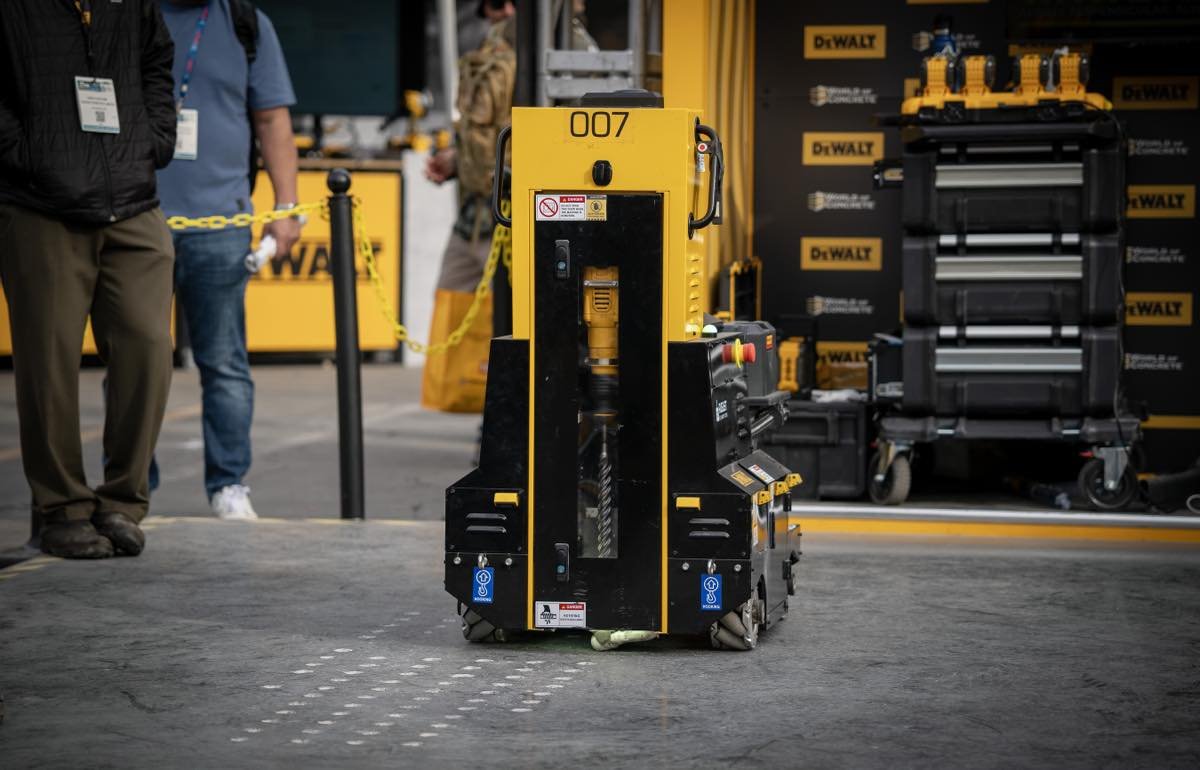
The DALE autonomous robot has already surpassed more than 385,000 holes in concrete on real data center sites, with a claimed accuracy of over 99%. Developed by DEWALT and August Robotics, the machine is no longer a simple demonstrator: its manufacturer now details an evaluation that covers 44 construction phases and claims that it can work up to ten times faster than a traditional method.

A specialized robot instead of a versatile humanoid
DALE stands for Top-down Autonomous Design and Execution. Its function is deliberately limited: identifying the intended locations on a slab, moving to them and then vertically drilling the holes necessary for the installation of equipment and networks. In a data center, this operation must be repeated thousands of times to fix supports, cable trays or other technical elements.
This specialization largely explains the reported figures. The robot does not have to understand an entire work or manipulate very different objects. Automates a repetitive, physically demanding task that requires precision. This is a very different approach than general humanoids, whose learning often involves simulated environments (read: DexForce trains its humanoid robots in virtual worlds).
DEWALT introduces DALE as the first down drilling robot capable of operating fleets. Therefore, several units can be assigned to the same project to distribute the work areas. However, the company does not provide in its announcement the number of machines currently deployed, the average duration of a mission or the exact conditions under which the maximum speed was measured.
Accumulated results in 44 construction phases
The new element is quantified feedback. According the DEWALT press releaseDALE participated in 44 phases of data center construction. The company attributes a cumulative reduction of more than 300 weeks in the schedules of these projects, as well as an accuracy of more than 99% in more than 385,000 wells.
The term “cumulative reduction” is important. This does not mean that a single work has won almost six years. DEWALT adds up the time saved across multiple phases and multiple sites. The press release also does not provide the calculation method or an independent audit. Therefore, these data remain manufacturer-reported results, even if their magnitude indicates much more advanced use than a single test.
The promise of speed addresses a very specific problem. Buildings intended for supercomputing concentrate a large amount of wiring, cooling and power supply. An error of a few centimeters in a series of holes can complicate the next steps. Automating positioning and drilling can reduce rework while keeping workers away from the noise, dust, and vibrations that come with this task.
Concrete automation, but still difficult to compare
DALE is now included in TIME’s 2026 Best Inventions selection, in the robotics category. The distinction motivated the publication of these results, but it does not in itself transform the machine into a new construction standard. No prices, business model, operating costs or international implementation schedule are specified. It is also unclear how much of the site preparation remains manual and how the robot reacts when the slab, digital plan or real environment does not match perfectly.
However, the case illustrates a measurable evolution in robotics: The machines that are gaining ground do not necessarily look like humans. They often focus on a limited operation, with a known workspace and an easy-to-control outcome. This logic is consistent with other automated construction experiments, such as using parts printed in recycled material for a 12-meter bridge, where innovation has less to do with spectacle and more to do with repeatability.
DEWALT says DALE has already entered the market and is optimized for data centers. However, the press release does not name any customers or sites, does not detail availability by country, and does not announce sales intended for the general public. Therefore, at this point, the robot should be considered as an industrial solution deployed in a professional environment, whose public performances still come solely from its designers.


