

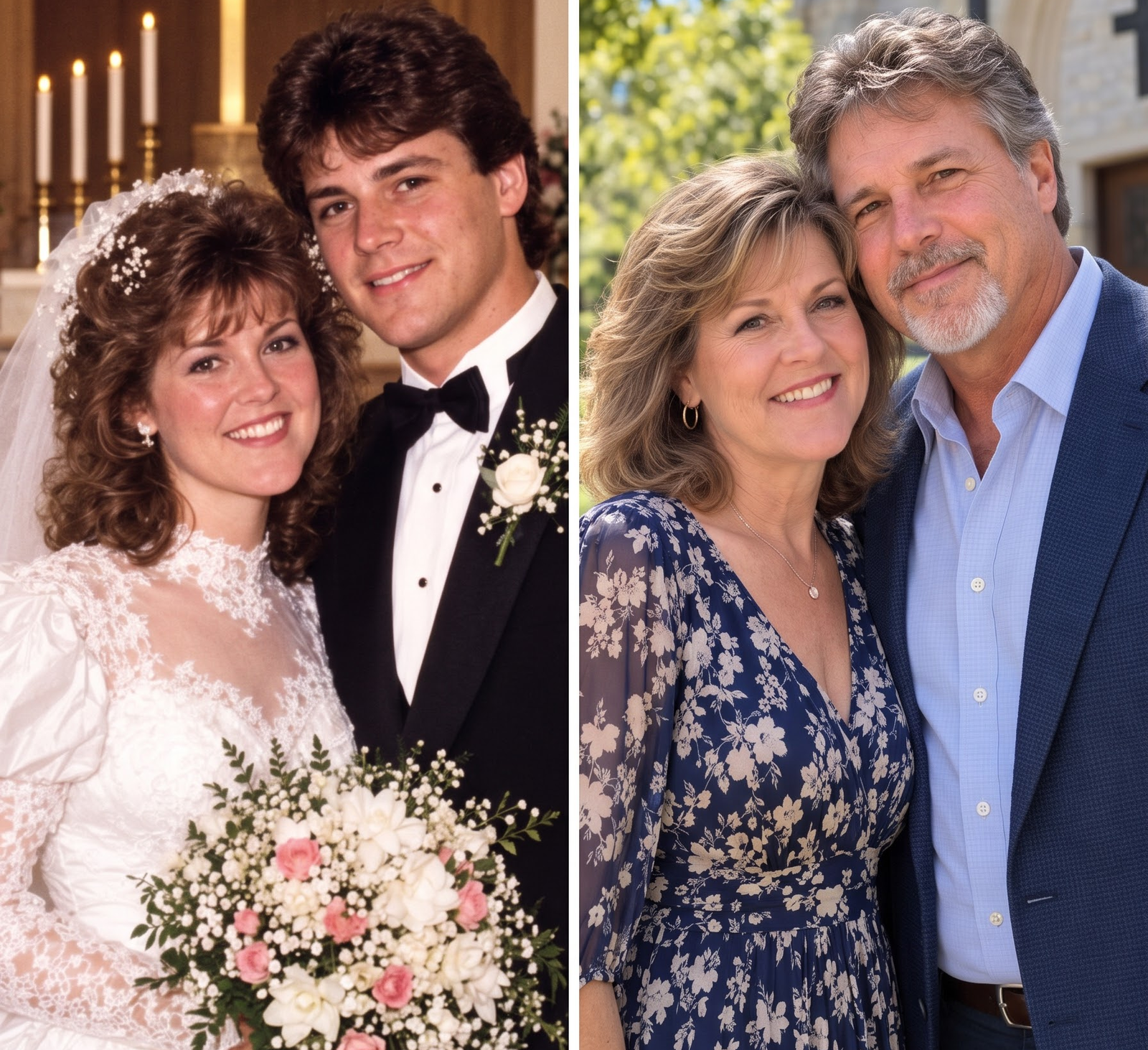
I married Thomas at nineteen and spent four decades believing I knew every corner of his heart. Every corner except one – a narrow closet at the end of our hallway that he never let me open. When he died, I told myself I’d leave it alone. I lasted ten days. What I found inside shattered the man I thought I’d married – and then, piece by piece, showed me the man he really was.
Part 1: The Door at the End of the Hall
Every marriage has a room you don’t go into.
For most couples, it’s a figure of speech. A subject you step around. A name you don’t say at Thanksgiving. For Thomas and me, it was an actual room – a narrow closet at the end of our upstairs hallway, with a brass lock and a door painted the same soft cream as the walls, as if it were trying very hard not to be noticed.
In thirty-nine years of marriage, I never once saw that door open.
I married Thomas when I was nineteen. He was twenty-two, tall and quiet, with big careful hands and a laugh that seemed to surprise even him. We started with nothing – a one-bedroom apartment over a laundromat, two wobbly secondhand chairs that didn’t match, and dreams far bigger than our checking account.
We built our life one brick at a time. Thomas worked for the county water department for thirty-one years. I kept books for a dental office downtown. We bought a two-story house on Linden Street with a crooked porch and a maple tree out front. We paid off the mortgage early and saved for retirement. We did all the boring, sensible things people do when they want a steady life.
And it was steady. That was what I was proudest of.
I used to tell my friends, “We don’t have secrets. We don’t have time for them.”
I believed that. I said it with a little smile, as if I’d figured out something the rest of the world hadn’t.
I was a fool.
The closet was the only exception, and I’d made my peace with it long ago.
The first time I noticed, we’d been in the house maybe a month. I went to put towels away, and the knob wouldn’t turn.
“Tom? This one’s locked.”
He came upstairs, took the towels gently from my arms, and put them in the bathroom cabinet instead.
“That’s just old paperwork, Margaret,” he said. “Tax stuff. My parents’ things. Nothing interesting.”
“Then why lock it?”
He kissed my forehead. “Because if I don’t, you’ll put towels in it.”
I laughed. He laughed. And that was that.
Over the years, I asked maybe a dozen more times. Always lightly. Always half-joking. And the answer never changed.
“Just old paperwork. Nothing interesting.”
When you’re married that long, you trade certain curiosities for peace. You stop poking at small mysteries because you trust the man holding the key. So I stopped asking.
I used to call that trust. Now I’m not so sure.
Part 2: The Quiet After
Thirty-nine years after I said “I do” in my aunt’s backyard, I stood under a black umbrella in the rain and watched them lower my husband into the ground.
“A heart attack,” the doctors said. He’d been raking leaves on a Tuesday morning. “It was very quick,” the young doctor told me, as if that were a gift.
“At least he didn’t suffer,” people whispered at the wake, pressing casseroles into my hands.
I nodded. I thanked them. But people say that like it’s supposed to cushion the fall, and it doesn’t.
Grief after four decades isn’t loud. It doesn’t scream or throw dishes. It lives in small places – the second coffee mug you still take down without thinking, the cold side of the bed, the permanent vacancy across the dinner table.
We never had children. After the second miscarriage, the doctors used words like unlikely, and Thomas held my hand in the hospital parking lot and said, “Then it’s you and me, Maggie. That’s enough for me.”
So when he died, the house emptied out completely. No son to sleep on the couch. No daughter to help sort his things. Just me, the maple tree, and the quiet.
And the closet.
After the funeral, I kept busy. I folded his Sunday shirts for the church donation box. I boxed up his sweaters, pressing my face into the gray cardigan he wore every winter until the smell of him made my knees buckle.
And every time I walked toward our bedroom, that cream-colored door seemed to grow heavier. Louder. As if it were watching me pass.
At first, I told myself it would be disrespectful to look. Whatever Thomas kept in there belonged to him. If he’d wanted it buried, I should let it stay buried with him.
Then I found his keyring in his work jacket and tried every key. House. Car. Shed. Mailbox.
None of them fit.
That was the moment something shifted in me. He hadn’t just locked that door. He’d hidden the key somewhere I would never find it.
People don’t hide the key to their tax returns.
On the tenth night of being a widow, I got up at three in the morning, walked down the hall in my nightgown, and pressed my palm flat against that door.
“What did you keep from me, Tom?” I whispered.
The door said nothing.
The next morning, I called a locksmith.

Part 3: The Letters
He arrived just after ten – a young man with a heavy tool belt, a faded ball cap, and the bored expression of someone who’d opened a thousand doors and never found anything worth talking about behind them.
He knelt and went to work. I stood against the wall with my arms wrapped around myself, feeling like a criminal. Like any minute, Thomas might come up the stairs and ask what on earth I thought I was doing.
It took less than two minutes.
The metallic click of the lock giving way echoed down the narrow hall like a gunshot. The door groaned as it swung open, and the air that rolled out was thick with dust and the sour-sweet smell of old paper.
No skeletons hung from hooks. There were just cardboard boxes, stacked neatly and labeled in Thomas’s small, square handwriting with nothing but a year. 1987. 1991. 1996. And on the top shelf, pushed all the way to the back, sat a heavy metal strongbox.
“You want me to pop that one too?” the locksmith asked.
I swallowed. “Please.”
He pulled it down and started working on it. I sank to the floor and dragged the first box toward me.
Inside were bundles of letters tied with rough brown twine, the envelopes yellowed and soft with age. They were addressed to Thomas – not at our house, but at a post office box downtown. A post office box I never knew existed.
I unfolded the top letter.
Tom, the check came yesterday. Thank you. I didn’t know how I was going to cover the cleats and the league fee both this month. He doesn’t know where the money comes from. I told him it’s from an old friend of his father’s. I hope that’s all right. He asks about you sometimes. – M
I read it three times.
He asks about you sometimes.
In that single heartbeat, I understood that I should have forced this door open while Thomas was alive to answer me – or never opened it at all.
My skin went cold. I picked up the next one with fingers that didn’t feel like mine.
Tom, you don’t have to keep doing this. I know what it costs you to send it. But if you’re going to keep helping, we need to talk about how long we’re going to keep the truth from him. He’s not a little boy anymore. He deserves to know who you are to him. – Marilyn
Marilyn.
There it was. A name.
He deserves to know who you are to him.
There was only one way to read that. Thirty-nine years of marriage, and my mind landed where every betrayed wife’s mind has landed since the beginning of time.
Thomas had a son.
A secret child with a woman named Marilyn. A whole second life I was never invited to see.
I thought of every Saturday he said he was going to the hardware store and came home three hours later with one box of screws. I thought of the hospital parking lot. It’s you and me, Maggie. That’s enough for me.
Had it been enough because he already had a son somewhere else?
“I was nineteen when I married you,” I muttered to the empty hallway. “When did you even find the time?”
The locksmith glanced over, then quickly looked away, the way strangers do when they realize they’ve wandered into something private.
Part 4: Tommy
A sensible woman would have put the letters back and poured herself a very large glass of wine.
But I needed to see the whole ugly shape of it.
I tore through the bundles, scanning return addresses. Most were from Marilyn, the same looping handwriting spread across years.
Then my hand closed on an envelope that was different. Thinner. Cheap gray paper. And the return address, stamped in stiff block capitals, made me stop breathing.
State Correctional Facility.
I ripped it open.
Tommy, you shouldn’t be writing to me. Mom and Dad changed your name and moved you away to protect you from what I did, don’t you get that?
I blinked. Changed your name?
“Almost there,” the locksmith called out.
I nodded absently and kept reading.
I’m glad you reached out, though. It gives me a chance to apologize. I should’ve been a better role model for you, Tommy. If I could go back, I’d be a better big brother. – Steve
Big brother.
On our very first date, Thomas told me he was an only child. I remember because I felt sorry for him – I came from a loud family of five. He said his parents moved around a lot, that his childhood was “just ordinary,” and whenever I asked more, he changed the subject so smoothly I never noticed.
How many layers of lies were packed into this one small closet?
I grabbed another prison envelope. Then another. And then I found one that made me go perfectly still.
Tommy, I heard from Marilyn. She came to see me. She’s pregnant. I don’t know what kind of father I can be from in here. But if that baby comes into this world carrying my last name, he deserves better than what I gave him. Please look out for them if you can. – Steve
I read it once. Then I pulled Marilyn’s letters back out and laid them side by side on the hardwood like pieces of a puzzle.
He doesn’t know where the money comes from. I told him it’s from an old friend of his father’s.
And slowly, the pieces began to shift.
Marilyn wasn’t Thomas’s lover. She was his brother’s girlfriend. And the boy with the cleats and the league fees wasn’t Thomas’s son.
He was Steve’s son. Thomas’s nephew.
For years, my husband had been quietly paying to raise a child who wasn’t his, for a brother he swore didn’t exist.
But why hide something so decent? What had his brother done that was so terrible Thomas couldn’t even say his name?
A loud metallic bang snapped me out of my thoughts.

Part 5: The Best Arm in the County
The locksmith had forced the strongbox open.
There was no money inside. No jewelry. Just old newspaper clippings folded in half, a worn leather catcher’s mitt cracked at the fingers, a few scuffed baseballs with faded red stitching, and a framed photograph lying face-down.
“Oh, wow,” the locksmith said, the boredom gone from his face. He unfolded the top clipping. “I know this guy!”
I leaned in, my knees pressing into the hardwood.
The clipping showed a young man in a crisp white uniform standing in the batter’s box, eyes fixed on the pitcher. The bleachers behind him were packed, every face turned his way.
“My dad used to sneak into those games when he was a kid,” the locksmith said. “Talked about him my whole life. Said this guy had the best arm in the county. People drove in from three towns over to fill the bleachers and watch him pitch. He was twenty-two, and the scouts were already calling. He was going places.”
“What happened?” I whispered.
His face darkened. “He got in a bad wreck one night. He’d been drinking. The other driver died. He went to prison, and just like that, it was over. My dad said people stopped talking to that family overnight. Crossed the street when the mother walked by. Small town. Nobody forgave anybody for anything.”
I took the clipping. Then I turned over the photograph.
The same young man, a few years younger – fifteen, maybe – grinning into the sun in a baseball jersey, his arm slung around a skinny boy of about nine in a ball cap two sizes too big. The boy was looking up at him with pure, uncomplicated worship. Behind them stood an older couple, beaming with pride.
I knew that little boy’s face. The careful mouth. The ears that stuck out just slightly. The crooked front tooth I’d kissed for thirty-nine years.
The little boy was Thomas.
At the bottom of the strongbox lay a folded legal document with a county seal – a petition to change the name of an entire family. Thomas’s original last name was typed there in plain black ink. A name I’d never heard in four decades of marriage.
And everything clicked into place.
My husband hadn’t been a cheater. He’d been a sixteen-year-old boy whose world collapsed in one night. Whose parents, drowning in shame, changed their name and fled to escape the whispers – dragging their younger son with them and teaching him never, ever to speak of where he came from.
He’d been handed a secret that wasn’t even his. And he’d carried it so well that he never told his own wife.
“It’s a shame,” the locksmith said quietly, packing up his tools. “One bad night, and a whole life’s gone. The family just vanished after that. And Steve never made parole. Bad heart, my dad said. He died in his cell about twelve years in. Alone.”
I thought of those prison letters. Please look out for them if you can.
He hadn’t died completely alone. Not if Thomas kept writing.
I paid the young man, pressed an extra twenty into his hand, and let him out.
Part 6: The Weight He Carried
I sat on the hallway floor until the sun sank below the horizon, reading every word in those boxes.
The story came together in pieces. Thomas had been sixteen when the crash happened. Within a year of the move, he’d started writing to his brother in prison – secretly, without telling his parents. Steve tried to push him away at first. But Thomas kept writing. He sent paperback westerns and baseball box scores clipped from the paper.
Marilyn had found out she was pregnant a few weeks after Steve’s arrest. When Steve begged his little brother to look out for them, Thomas was barely seventeen. He started with whatever he could spare from a part-time job at a gas station. By the time he married me, he’d opened a post office box downtown. And my steady, predictable Thomas – who argued with me over the price of name-brand cereal – sent a check every single month until that boy turned eighteen.
Every Saturday “trip to the hardware store.” Every stretch of “overtime.” It was all there.
Tucked among the letters was a folded program. Westbrook High School Commencement. Dated a weekend in May, twenty-six years ago – a weekend Thomas had told me he was at a water-treatment conference. I remembered him coming home that Sunday night quiet and red-eyed.
He’d gone to the boy’s graduation.
I pressed that program to my chest and finally let myself cry – not the stiff, polite tears of the funeral, but the kind that come from somewhere deep and old.
“Why?” I asked the empty closet. “Why did you think you had to carry this by yourself?”
But the answer was all around me, in stacks of yellowed paper.
His parents might have thought they were protecting him – and maybe they were. But mostly, they’d taught him to be ashamed. To believe that the people you love can become a stain you have to hide. That if anyone found out where you came from, they’d cross the street, too.
Even me.
He’d carried the weight of a brother he loved but couldn’t claim. He’d stepped up for a nephew whose mother needed help. He’d done it with his whole heart.
And he’d done it all in the dark.
Near midnight, in the very last box, I found one final letter in Thomas’s handwriting. It was dated six weeks before he died, and it had never been sent.
Maggie,
I’ve started this letter a hundred times. I keep thinking I’ll tell you tomorrow. I’ve been thinking that for thirty-nine years. I had a brother. His name was Steve, and he was the best person I knew until the night he wasn’t. There’s a young man out there with his eyes, and I’ve been trying to do right by him. I never told you because I was afraid you’d see where I came from and look at me differently. That was never fair to you. If you’re reading this, I ran out of tomorrows. I’m sorry. The key is taped under the bottom drawer of my workbench. It always was.
All my love. Always.
Tom
I laughed out loud – a wet, broken laugh, alone on the floor in the dark.
“You stubborn, stubborn man,” I whispered. Then I said it louder, so the house would hear.
“Not anymore, Tom. You don’t have to carry it anymore.”

Part 7: His Eyes
I copied the return address from Marilyn’s most recent letter. Then it took me two full days to find the courage to use it.
Twice I got as far as the car and turned back. What if they slammed the door in my face? What if I was about to do the exact thing Thomas had spent his life afraid of?
On the third morning, I packed the strongbox’s contents into a sturdy box, set it on the passenger seat, and drove across the county.
The address led to a small, neat house with a basketball hoop over the garage, a child’s bike tipped over in the grass, and a lawn that badly needed mowing.
I knocked before I could change my mind.
A man in his mid-forties opened the door, wearing a work shirt with a dish towel slung over one shoulder.
And he had Thomas’s eyes.
Not similar. Thomas’s eyes. The same warm brown, the same crinkle at the corners, the same patient, watchful look I’d woken up to for thirty-nine years.
“Can I help you?” he asked.
“I… are you Marilyn’s son?”
His eyes narrowed. He glanced at the box in my arms, then back at my face. “My mother passed three years ago,” he said carefully. “Who’s asking?”
Three years. That was why the letters had stopped. That was the quiet sadness in Thomas that spring – the one he’d blamed on his knee.
I took a breath. “My name is Margaret. I was married to Thomas.”
The man went completely still. The dish towel slid off his shoulder.
“My Uncle Tom?”
“You knew about him?”
He nodded slowly and stepped back to let me in. “Mom told me the truth when I was twenty-one. Before that, I thought some old friend of my dad’s felt sorry for us.” His name was Danny, he told me, and he rubbed the back of his neck as he spoke. “She said Uncle Tom didn’t want any credit. He just wanted to make sure I could go to college and have a real shot at things.”
I gave a small, sad laugh. “That sounds exactly like him.”
His expression softened. “He came to my graduation, you know. Stood in the very back of the gym, by the doors, like he was ready to bolt if anyone noticed him. Afterward, he shook my hand and said he was an old friend of my father’s. I didn’t realize who he was until Mom told me, three years later.” He swallowed hard. “I always wished I’d hugged him instead.”
I set the box on his kitchen table and slid it toward him.
“These belong to you.”
He lifted the flaps. Inside were the mitt, the baseballs, the clippings, the photograph, and every one of Steve’s letters from prison.
“They were your father’s,” I told him. “Your uncle kept them locked away for almost forty years because he refused to let his brother be forgotten. He loved Steve, even when he couldn’t say it out loud. Not even to me. You should have them.”
Danny lifted the mitt and ran his thumb along the cracked leather. Then he slid his hand inside.
It fit.
He sat there with his father’s glove on his hand, and his shoulders began to shake.
“Thank you,” he managed.
“Don’t thank me,” I said, covering his free hand with mine. “Thank your uncle. He did all the heavy lifting. I just finally opened the door.”
Part 8: The Open Door
When I got home that evening, the hallway didn’t feel narrow or dark anymore.
I stood in front of the closet. The door still hung open, the shelves nearly bare.
For thirty-nine years, I’d walked past that locked door without asking the hard questions. I’d convinced myself my silence was trust. A gift to my husband.
But standing there, I finally admitted the truth. Maybe it wasn’t trust at all. Maybe it was fear – fear of finding out the man I loved wasn’t who I thought he was.
And the cruel, beautiful irony was that Thomas had been afraid of the very same thing. Afraid that if I ever saw inside, I’d stop loving him.
Two people, side by side in the same bed for four decades, each protecting the other from a truth that would only have brought us closer.
That night, I went down to the garage, pulled out the bottom drawer of his workbench, and turned it over. Taped underneath with yellowed masking tape was a small brass key.
I carried it upstairs and set it on the closet shelf, right in the middle, where anyone could see it.
I never locked that door again. Not because I don’t believe in a private life, but because I finally understood that silence and shame don’t have to be the same thing. Thomas spent his whole life confusing the two, because the people who raised him taught him to.
Now a copy of that old photograph hangs in the hallway beside the closet. Two brothers in the sun – one with the best arm in the county, one looking up at him like he hung the moon. When visitors ask who the boys are, I tell them. Every word.
Last Saturday, Danny called.
“My son’s pitching his first Little League game this afternoon,” he said, a little shyly. “He’s nine. He’s using his grandfather’s glove.” He paused. “You’re family, Margaret. If you want to be.”
So I went.
I sat in the rickety bleachers on a bright autumn afternoon and watched a skinny nine-year-old in a ball cap two sizes too big wind up and throw, with a worn leather mitt on his hand and a family history he’ll never have to hide.
He struck out the first batter.
Danny whooped and threw both fists in the air. And I clapped until my hands stung, laughing through tears I didn’t bother to wipe away.
My Thomas was never a man with two lives. He was an honorable man who looked after his family the only way he knew how – quietly, faithfully, and alone.
I wish he’d told me while he was still here to hear me say, Oh, Tom. Of course I would have understood.
He never got that chance.
But he spent his whole life making sure his brother’s boy got a real shot. And the least I can do now is make sure that family never has to stand in the back of the gym again.
Note: This story is a work of fiction inspired by real events. Names, characters, and details have been altered. Any resemblance is coincidental. The author and publisher disclaim accuracy, liability, and responsibility for interpretations or reliance. All images are for illustration purposes only.


