

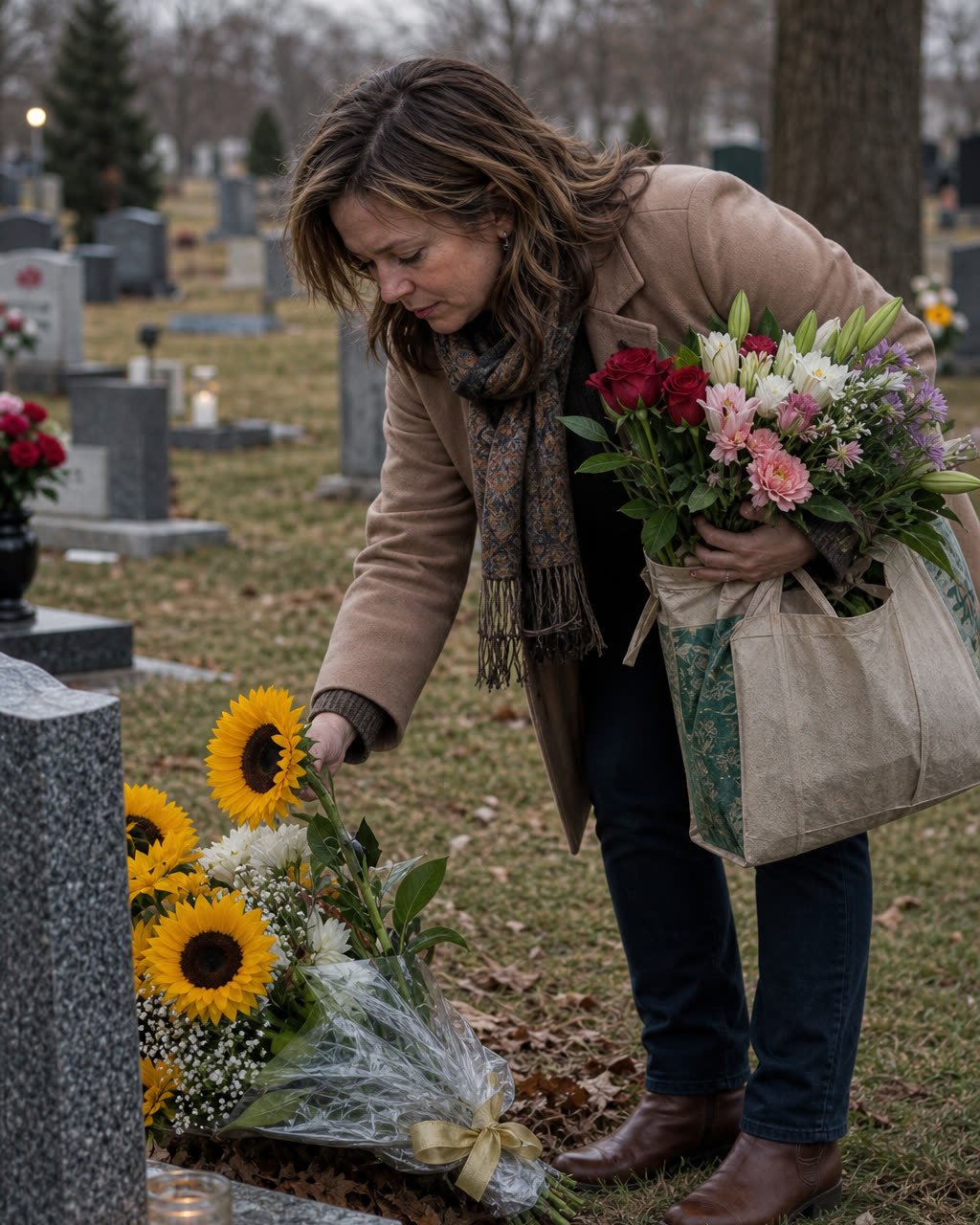
Part 1: The Sunflower in Her Hand
“Don’t touch that.”
I said it before I knew I was going to, and my voice cracked across the quiet rows of Willow Creek Cemetery like a dropped plate. The woman kneeling at my son’s grave went perfectly still, one hand wrapped around a sunflower stem. My sunflower. The one I had set in a jar beside Edward’s headstone less than a day earlier.
It was 8:40 on a gray Thursday morning in October. I had come back for nothing but my pruning shears, which I’d left in the grass like a careless teenager. I had not come back to find a stranger at the one square of ground I still had left to tend.
She looked about sixty, in an olive wool coat with frayed cuffs. A canvas tote sat beside her knee, so stuffed that roses, carnations and fat green lily buds spilled over its edge. Water dripped from the bottom and darkened the toes of her shoes.
I had watched her work her way down the gravel path toward me. A pink carnation from one grave. A white rose and a sprig of greenery from the next. These were not the browned, drooping bouquets the groundskeepers haul off in a wheelbarrow. She was choosing the fresh ones, the ones still beaded with rain.
“Give it back,” I said.
She stood slowly and held out the sunflower with both hands, the way you return something borrowed. She didn’t argue, and she didn’t invent an excuse. Somehow that unsettled me more than a lie would have.
“How many graves?” My voice shook, and I hated it. “How many did you take from this morning?”
“I’m sorry,” she said, to the grass more than to me.
“I brought these for my son. Yesterday was his thirty-fifth birthday.” I pulled the stem against my coat. “This is all I can still do for him, and you’re out here filling a bag to sell on some street corner?”
She glanced at the headstone, at the name carved in plain block letters, and her face changed in a way I couldn’t read. Not guilt exactly. Something closer to recognition.
Edward Hale. Seven months gone. In March he had been driving home from a job in the rain, a wet road and a driver who ran a light, and the police officer who knocked on my door at 9:15 that night had taken off his hat before he said a word.
I was sixty-three years old, thirty-one of those years spent as the secretary of Fairmont Elementary, and I had never once felt so completely unprepared for a sentence.
Yesterday I’d skipped the birthday cake. Cake was for a table with two chairs. Instead I bought a bundle of sunflowers at the Kroger on Dunmore Street, because that was what Edward always brought me.
He never used a vase or fancy paper. The flowers came in supermarket plastic, wedged under his arm beside the red toolbox he carried everywhere.
“For the prettiest girl on the block,” he’d announce at my back door.
“You’re only saying that because you want lunch.”
“Can’t it be both?”
I always made him a ham sandwich. I had a sandwich’s worth of manners left in me, and that was about all.
At the grave yesterday I’d arranged the flowers in a jar and talked to him for an hour. I told him the kitchen faucet was dripping again and I could almost hear his answer, patient and a little amused.
“Mom, why didn’t you just call me?”
Now a woman with wet hands stood where I had knelt, and I could feel the old anger rising, the kind with nowhere to go.
“Put the bag down,” I said. “Every one of those goes back where it came from.”
“Yes. I will.” She swallowed. “But please, first, will you come with me? I live across the street. Ten minutes.”
“Absolutely not.”
“Please.” Her eyes dropped to my hands, to the sunflower I was strangling. “You need to see something.”
Then she shifted the tote on her arm, and a small spiral notebook slid out of the pocket of her coat and landed open on the gravel between us.
I should have looked away. I’m not a person who reads other people’s things. But the page was ruled in neat columns, names on the left, dates on the right, and the top line was in careful blue ink.
Edward Hale. March 9.
The ninth was the day we buried him. And I had not said his name aloud to this woman, not once.
Part 2: The Locked Door
I did not follow her at once.
I stood there on the gravel with my heart going like a trapped bird, looking from the notebook to the woman and back. She didn’t snatch it up. She only waited, hands open at her sides, the way you stand near a dog you don’t want to frighten.
“You wrote his name down,” I said.
“Yes.”
“Before today.”
“Yes.” She closed her eyes briefly. “I can explain all of it. Not here, though. Not with the whole path watching.”
The whole path consisted of a groundskeeper far off on a mower and one crow on a lamp post. I understood what she meant anyway. Some things need a door that closes.
“Are you selling these?” I asked. “Tell me that much, right now.”
“I’ve never sold a single stem.”
I wanted to call her a liar, and the word was right there. But I had spent thirty-one years watching children lie to a school secretary, and I knew the sound of it. This wasn’t that sound.
The sensible thing was to walk to my car and phone the cemetery office. That was what Edward would have told me to do, with his careful, protective frown. He worried about me living alone in a house with four bedrooms and one working faucet.
But sensible would have left me with a name in a notebook and no answer, and I’d had enough of questions I couldn’t ask anyone.
“All right,” I said. “Here is how this goes. You carry that bag. I walk behind you. If I don’t like what I see in the first two minutes, I leave, and the next call I make is to the police.”

“That’s fair.”
“And the flowers go back today. All of them.”
“Today,” she agreed. “I promise.”
“What’s your name?”
“Monica.”
“Sansa.” I didn’t offer a last name. I took out my phone, texted my neighbor Dolores the address of the blue-shuttered house across from the gates, and wrote, If you don’t hear from me by ten, call someone. Monica watched me do it and didn’t say a word against it.
That small act of caution made me feel steadier than any speech could have. If I was being foolish, I was at least being foolish with a witness.
Her house sat at the end of Cedar Lane, narrow and tidy, with weathered blue shutters and a porch swing missing one chain. A ceramic frog guarded the mat. Everything about it was so ordinary that I felt faintly silly for having been afraid.
Inside, it smelled of cut stems and something sharper underneath, a chemical sweetness like new nail polish. A sitting room with a knitted afghan folded over the sofa arm. A clock on the wall that had stopped at 4:10.
She led me down the hallway without speaking and stopped before a door at the very end. It had a deadbolt, the shiny new kind, the kind you put on a door when something inside matters.
“What’s in there?” I asked.
Monica took a brass key from her pocket. Her fingers were trembling, and I realized they had been trembling since the cemetery.
“The reason I took the flowers.”
She turned the key, reached in and switched on the light, and I stepped into the doorway and forgot what I was going to say.
A whole wall of shelves ran floor to ceiling, and on every shelf sat small wooden boxes, each one draped with a square of white cloth. Beneath each box was a paper tag in tidy handwriting. Names. Dates. Under the window stood a workbench cluttered with tweezers, silicone molds, rubber gloves, drying racks of pressed petals and bottles of clear liquid.
It looked like the workshop of a very patient watchmaker. It did not look like the den of a thief.
“What is all of this?”
Monica didn’t answer. She was watching me, and I understood she was waiting for me to find it myself.
My eyes traveled along the second shelf, tag by tag, and stopped at the fourth one. A single word in her careful hand.
Edward.
I turned to face her, and my voice came out thin and cold.
“This isn’t the first time you’ve taken his flowers.”
“No.”
“How long?”
“Since a few weeks after his funeral.”
I crossed my arms against my chest. They were the only wall I had.
“May I show you?” she asked quietly.
I nodded once, because I did not trust my mouth. Monica stepped to the shelf and took hold of the white cloth. She lifted it the way you would lift a sheet from someone sleeping.
Part 3: What Was Under the Cloth
Under the cloth sat a clear rectangle of resin, about the size of a deck of cards.
Layers of dried petals floated inside it, suspended like something caught in amber. Yellow, white and a pale, dusty blue. Through the middle of them ran a thin ribbon the color of a robin’s egg, curling gently in the glass.
I knew that ribbon before my mind had finished looking at it.
I had cut it from an old spool in my sewing drawer, a spool left over from some long-ago school craft fair. It was the first bunch I carried to Edward’s grave after the funeral, and my hands shook so badly that I tied two knots instead of one. A week later it was gone, and I’d crawled around the headstone on my knees, certain the wind had stolen it into the grass.
Now there it was behind glass, faded at the edges, its two clumsy knots still showing.
I reached out, stopped, and leaned closer instead. The air in the room had become very thin.
“Where did you get that?” I whispered.
Monica rubbed her thumb along the edge of the bench.
“From his grave.”
For months I had pictured that ribbon tangled in weeds beyond the cemetery fence. I’d even said a small apology to it. And all that time it had been here, in a locked room, under a clean white cloth.
“Why would you take that?”
“I wanted to keep it safe.”
“For whom?”
Her eyes dropped.
“For you. Eventually.”
“You don’t know me.”
“No.”
“You never met Edward.”
“No.”
“Then what made you think you had any right?”
She had no answer, and I didn’t expect one. I turned back to the block, because my eyes would not leave it. Near the end of the ribbon was a tiny dark smudge, a speck of ink where I had set the ribbon down on top of a grocery list the morning I tied it.
I had made that mark. Nobody on earth could have copied it. If I’d harbored the smallest doubt, that smudge erased it.
Beneath the block, tucked under the lip of the wooden box, lay a folded square of paper, yellowed along its creases. I recognized my own handwriting through the back of it.
I unfolded it with both hands.
During my second visit to the cemetery, I’d slipped a note in among Edward’s flowers, because I couldn’t bear to say the words out loud. I had torn the page from the pad on my kitchen table, and it held a single sentence.
The kitchen is too quiet without your radio on, Eddie.
Edward had owned a battered portable radio, held together with electrical tape, and he carried it into my house every time he fixed anything. Old rock and roll, turned up loud, and he sang along terribly, flat on every note. I used to shout at him to turn it down while he was under the sink.
What I wouldn’t give now to be shouting that.
The sob took me by surprise. It came up from somewhere beneath my ribs, and I pressed the note against my coat and bent over it right there beside a stranger’s workbench. Monica did not touch me, did not speak. She stood still and let me cry, and later I would give her credit for that.
When I could breathe again, I wiped my face with the back of my wrist and straightened.
“Did you read this?”
The silence lasted a little too long.
“Yes.”
“You shouldn’t have.”
“I know.”
“Those words weren’t meant for you.”
“I’m sorry, Sansa.”
I shoved the paper deep into my coat pocket. Leaving it in this room had never been an option. Whatever I decided about the rest, that sentence was mine.
Monica pulled a chair out from the bench.
“Would you like to sit down?”
“No.”
She accepted that and stepped back. I let my gaze run along the shelves, the dozens and dozens of draped boxes, each with a stranger’s name beneath it, and a chill moved over my skin that had nothing to do with the cold.
“How many families have you done this to?”
She flinched as if I’d slapped her.
“I don’t know the exact number.”
“You’ve been taking from people’s graves without asking them.”
“Yes.”
“Why?”
Instead of answering, Monica walked to the far end of the bench and opened a drawer. She took out a small, lopsided block of resin no bigger than a matchbox, one pink petal floating crooked inside it.
She held it in her palm like something alive.
“This was the first one I ever made,” she said. “Those petals came from the flowers left for my daughter.”

Part 4: Why She Did It
“Your daughter,” I repeated.
“She died nine years ago.” Monica turned the block over in her fingers. “Her name was Lily. She was twenty-two.”
The room was so quiet that I heard the ticking of a pipe somewhere in the wall. I had been ready for many answers. I had not been ready for that one, and it took the heat out of my anger the way a hand takes the heat out of a stove.
“After the funeral I went to her grave every Sunday,” Monica went on. “I’d bring daisies, because she liked daisies. And a week later they’d be gone, hauled off by the cemetery crew. I understood that. They have rules and a schedule. But I hated it. I hated it so much I couldn’t see straight.”
She set the crooked block on the bench between us.
“So I started drying a few of the petals from what I brought her. I watched videos at night. I bought molds and resin and ruined more pieces than I finished. That one took me three tries.”
“And then?”
“And then I started seeing the other graves.” She lifted one shoulder. “Bouquets left out in the rain. Cards tucked in the stems with the ink running. I’d think, somebody loved that person enough to stand here with it. Somebody might want to keep a little of it.”
“So you took it.”
“Just a few stems from each.”
“Without asking.”
“Without asking.” She did not look away. “Yes.”
I ran my finger along the edge of the tag marked Edward. The ink on it was a little faded already, which meant she had written it months ago. I did the arithmetic without wanting to. She had been standing at my son’s grave back in the spring, in the rain, while I was home unable to get out of bed.
“What was the plan?” I asked. “Once you finished them?”
“To give them back.”
“How?”
“In small wooden boxes.” She nodded at the shelf. “I copied names and dates off the headstones so I could keep each family’s flowers apart. I meant to leave the boxes at the graves a few days before the anniversaries.”
I stared at her. It was a gentle idea. It was also a bewildering one.
“And you believed people would understand who left them? That they wouldn’t be frightened?”
“I planned to put a note inside.”
“And if the cemetery staff threw the boxes away?”
Monica said nothing. A muscle moved in her jaw.
“Have you left any already?”
“A few.”
“Did anyone find them?”
She turned toward the window, where the light was thin and silver on the glass.
“I don’t know.”
That was the answer that frightened me most. Somewhere in town, a grieving mother might have picked up a mysterious box from her daughter’s grave and thought it was cruelty, or worse, a sign.
I shook my head and made myself speak plainly. I was the woman who had once suspended a boy for three days over a stolen lunch money envelope, and I could still deliver a firm sentence.
“You have to stop. Not only with Edward. With everyone.”
“I will.”
“And that bag of flowers goes back today.”
“Yes. Of course.”
I looked at the block under the cloth again. Part of me wanted to put it in my pocket and walk out with it. Another part was still furious that something so private had been made without my knowing.
“May I keep my note?” I asked.
“It’s yours. It always was.”
I pushed it deeper into my pocket and studied the blue ribbon one more time.
“I need time to think about the rest.”
“Take as long as you need.”
So we did the next part together, which I would never have believed an hour before. We carried the soggy tote back across the road, and I pointed out every grave where I’d seen her stoop. She slid the stems back into the vases, one by one, and the ones she couldn’t place we took to the cemetery office.
A tired woman in a green vest listened to Monica’s confession with a pen frozen above her form. Taking flowers without a family’s permission was against the rules, she said evenly. And any box left at a grave without approval would be cleared away like everything else.
Outside, I stood once more before Edward’s headstone. The birthday flowers were still there, the jar a little crooked, and I put the rescued sunflower back among them. My pruning shears lay half hidden in the grass near the base, exactly where I’d left them.
I picked them up. Monica waited several steps behind me, her hands knotted in front of her coat.
“May I finish Edward’s box?” she asked.
I looked at the yellow petals trembling in the wind.
“Not yet.”
“All right.”
At home, I laid the note on the kitchen counter and smoothed it flat. The faucet dripped into the sink, patient as a clock. Under the cabinet sat Edward’s red toolbox with its washers, the wrench, and the screwdriver with the chewed yellow handle.
I took out the wrench, held it for a long minute, and put it back. Then I found a plumber’s number on a refrigerator magnet and called to book an appointment.
Afterward I opened my sewing drawer. The old spool of blue ribbon was there, nearly empty. I held it up to the window, and I knew I’d made a decision after all, though I wasn’t sure I wanted to admit it.
I picked up the phone and dialed the number Monica had written for me on the back of a seed packet. It rang twice, and I still had no idea what I was going to say.
Part 5: The Box on the Windowsill
She answered on the second ring, as if she’d been holding the phone.
“Sansa?”
“I’ve been thinking about Edward’s flowers.”
She said nothing. I could hear her breathing, and a faint ticking that I realized was the stopped clock’s neighbor, some other clock that still kept time.
“Would you finish it?” I asked.
“Yes.” The word came out of her like air from a tire. “If you want it. Only if you want it.”
“I do. But nothing else added to it. Not one thing.”
“Nothing.”
“And Monica.”
“Yes?”
“Ask people before you touch their flowers again. Every time.”
“I will,” she said. “I promise, Sansa.”
I drove over before sunset, with the heater rattling and a grocery bag on the passenger seat. Monica opened the blue door before I could knock. She’d put on a clean cardigan, and her hair was combed, and I understood how nervous she was by how carefully she had dressed.
In her sitting room, on the coffee table, a small wooden box waited with its lid open. The resin block lay inside on a bed of folded white linen. The original blue ribbon curved through the petals, my crooked double knot still visible, and nothing about it had been changed.
“Thank you,” I said.
She laced her fingers together to stop them shaking.
“I went to the cemetery office this afternoon. They told me I can offer preservation privately, if a family contacts me themselves. If they ask. I won’t touch another flower unless someone invites me to.”
“That sounds better.”
“I should have done it that way from the start.”
She didn’t ask me to say it was all right, and I didn’t. Some things are not all right, and the kindest thing I could give her was not pretending otherwise. But I let my shoulders lower a little, and she saw it.
I lifted the box. It was lighter than I’d expected.
“I think Edward would have liked the ribbon,” I said. “He’d have told me it was the wrong color for a boy. And then he’d have worn it.”
A small smile touched her mouth, the first I’d seen on her.
“Would you tell me about him sometime?” she asked.
I turned the question over. A day ago she’d been a thief on a gravel path. Today she was a woman with a daughter named Lily and a drawer full of crooked petals, and I didn’t know yet what to call her.
“Maybe,” I said. “Not today.”
“Maybe is more than I expected.”
On the way home I stopped at the same Kroger on Dunmore and bought a single sunflower, wrapped in plain plastic, because a bunch felt like too many and one felt exactly right. The clerk asked if it was for a special occasion. I told her it was for the windowsill.
In my kitchen I set the wooden box beside the sink, where the evening light came in low and gold. I stood the sunflower in a jelly jar next to it. The blue ribbon glowed inside its glass as if someone had lit it from behind.
Behind me, the faucet went on dripping.
Out of habit, I unlocked my phone and my thumb drifted to Edward’s name. For one reckless second I was going to call and tell him about the leak, and he’d say something kind and teasing, and I’d put sandwich meat on the counter.
I opened my photographs instead. There he was in the kitchen, grinning, a stain across his shirt, the red toolbox tucked under one arm and sunflowers under the other. I spread the picture wider with two fingers until his face filled the screen.
“You would have fixed it before I finished complaining, Eddie,” I said.
Then I set the phone down next to the flowers, filled the kettle, and listened to the drip, drip, drip behind me, a sound that for once did not feel like an ending.
If you were Sansa, would you have forgiven Monica, or would you have walked away from that locked room?
Disclaimer: This story is a work of fiction inspired by real-life themes. Names, characters, places and events are fictionalized, and any resemblance to real persons is purely coincidental. Images are for illustration purposes only.


