

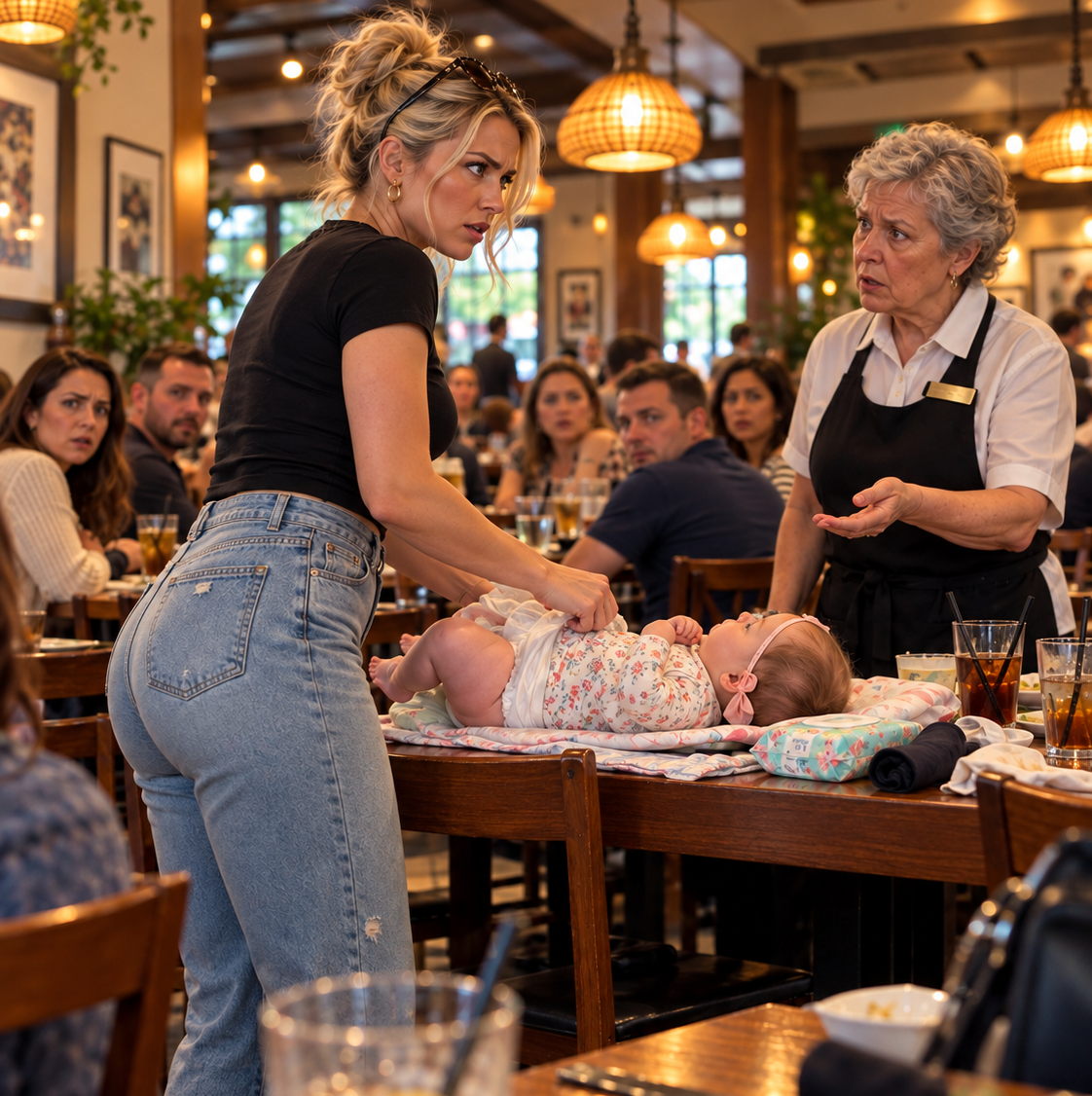
Part 1 — The Moment the Restaurant Fell Silent
“You can’t be serious! You have absolutely no right to do that!”
The woman sprang from her chair so abruptly that it nearly toppled backward.
Every conversation in the restaurant seemed to stop at once.
A few customers turned in their seats. Someone near the window lowered a fork halfway to his mouth. Even the soft music playing overhead suddenly seemed unusually loud.
At the center of the commotion stood Melissa, a young mother holding her baby against her hip, staring furiously at something two employees had just brought into the dining room.
Beside them was Dorothy, our sixty-four-year-old waitress.
She looked nervous, but for the first time since the trouble began, she wasn’t standing there alone.
Melissa pointed an accusing finger directly at me.
“You! This was your idea, wasn’t it?”
I calmly placed my glass of iced tea on the table.
“As a matter of fact, it was.”
Her eyes widened.
“Are you deliberately trying to embarrass me?”
Before I could respond, my two-year-old daughter, Amaya, looked up from her plate of dinosaur-shaped chicken nuggets.
“Mommy, why is that lady shouting?”
I gently brushed a crumb from her cheek.
“She’s having a difficult afternoon, sweetheart.”
Amaya considered this seriously.
Then she whispered, loudly enough for several nearby customers to hear, “Does she need a nap?”
The gentleman at the next table coughed into his napkin, desperately trying not to laugh.
Melissa’s face flushed.
“You think this is funny?” she demanded. “You’re going to regret treating me this way!”
I didn’t raise my voice.
I didn’t argue.
I simply looked at her and waited.
Because there was something Melissa still didn’t understand.
She thought I was an ordinary customer who had decided to interfere in her business.
She had no idea that I was the manager of the very restaurant she was threatening to destroy with a video.
And she certainly hadn’t expected me to defend an employee she had spent the last twenty minutes trying to intimidate.
But to understand how our peaceful Saturday lunch turned into such a spectacle, I need to go back to the beginning.
Part 2 — A Simple Lunch With My Little Girl
My name is Kaylani. I’m thirty-four years old, married, and the mother of two wonderful children.
My husband, Ben, and I have a seven-year-old son named Noah and a two-year-old daughter named Amaya.
For the past six years, I’ve managed a family restaurant that has been part of our community for nearly two decades.
Working in hospitality has taught me a great deal about human behavior.
I’ve encountered customers who complained that their soup was too hot, their drinks were too cold, or their food arrived too quickly.
One gentleman once insisted his medium-rare steak should not have any pink in the middle.
Another demanded compensation because the restaurant’s air-conditioning was apparently making his ice water colder.
After enough years in this business, you develop patience for almost anything.
Or so I believed.
That particular Saturday, I wasn’t supposed to be working.
Ben had taken Noah to a baseball game, leaving Amaya and me with the entire afternoon to ourselves.
I wanted to do something special with my little girl, so I asked her where she would like to have lunch.
Her answer came immediately.
“Dorothy’s restaurant!”
I smiled.
Technically, it was the restaurant where I worked, but in Amaya’s mind, it belonged entirely to Dorothy.
And I understood why.
Dorothy had been part of our team for eleven years.
At sixty-four, she was one of our most experienced employees, and she possessed a remarkable ability to make people feel welcome.
She had raised three children, was now a proud grandmother of five, and seemed to have an almost unlimited supply of patience.
She remembered regular customers’ favorite meals.
She kept crayons in her apron for restless children.
She noticed when elderly customers needed a little extra assistance and somehow managed to offer help without ever making anyone feel uncomfortable.
She wasn’t simply a waitress.
To many of our customers, she was part of what made the restaurant feel like home.
When Amaya and I walked through the door, Dorothy spotted us immediately.
“Well, look who’s here! My favorite little customer!”
Amaya rushed toward her, holding up two fingers.
“I’m two now!”
Dorothy opened her eyes dramatically.
“Two? Are you sure? I could have sworn you were twenty!”
Amaya burst into giggles.
“No, Dorothy! I’m still little!”
“Then we’d better make sure you eat a good lunch so you can grow nice and strong.”
“Chicken nuggets!” Amaya announced.
“And perhaps some vegetables?”
My daughter shook her head with enormous determination.
“No vegetables.”
Dorothy glanced at me with a knowing smile.
“I see the negotiations are going about as well as usual.”
I laughed.
We settled into a comfortable booth, ordered our lunch, and spent the next twenty-five minutes enjoying an ordinary afternoon.
Amaya told me a long, complicated story about a purple dinosaur that apparently lived in our backyard.
Dorothy stopped by occasionally to refill my tea and admire my daughter’s drawings.
Everything was peaceful.
Then a woman entered carrying a baby, a large diaper bag, and a smartphone attached to a handheld stand.
I barely noticed her at first.
She looked like any other mother trying to manage lunch with a young child.
And I knew how exhausting that could sometimes be.
Dorothy welcomed her warmly and showed her to a table a short distance from ours.
The baby appeared to be about eight months old.
He caught Amaya’s attention immediately.
When he smiled at her, she proudly held up one of her dinosaur nuggets as though introducing him to a new friend.
The woman ordered a chicken sandwich and lemonade.
Before Dorothy walked away, she asked a question.
“Excuse me, where’s the restroom?”
Dorothy pointed toward the hallway.
“Just past the kitchen entrance, on your right. There’s also a family restroom with a changing station if you need it.”
The woman gave a brief nod.
I heard the exchange because our tables were close together.
I also knew the changing station was perfectly usable.
I’d taken Amaya there shortly after we arrived.
It was clean, supplied with disposable liners, and conveniently located away from the dining area.
There was no reason for anyone to struggle to find a suitable place to change a baby.
At least, that was what I thought.
A few minutes later, I discovered just how wrong I was.
Part 3 — What She Did at the Dining Table
The first sign that something was wrong was the smell.
I was helping Amaya rearrange the chicken nuggets on her plate when an unpleasant odor drifted toward our booth.
At first, I assumed someone’s baby needed a diaper change.
Nothing unusual about that.
Babies have needs, and parents deal with them wherever they happen to be.
But when I looked toward the next table, I couldn’t believe what I was seeing.
The woman had laid her baby directly across the restaurant’s dining table.
His pants were off, his diaper was open, and she was cleaning him just inches away from the food she had ordered.
For several seconds, I simply stared.
Surely she wasn’t going to finish changing him there.
But she was.
She reached into her diaper bag, pulled out another wipe, and continued as though she were sitting at home in her own nursery.
Around us, other customers began noticing.
An older gentleman paused with his burger halfway to his mouth.
Across the aisle, a woman leaned toward her husband.
“Is she really changing a diaper where people are eating?”
He looked over, then slowly pushed his plate away.
The young mother seemed completely unconcerned.
Dorothy noticed the situation and approached with the same gentle expression she used whenever she needed to handle something delicate.
“Excuse me, ma’am,” she said quietly. “I’m sorry to interrupt, but we can’t have diapers changed on the dining tables.”
The woman didn’t look up.
“My baby needed a clean diaper.”
“Of course,” Dorothy replied. “I understand completely. We have a family changing area just down the hallway. I’d be happy to show you.”
The woman gave a sharp laugh.
“So now mothers are supposed to disappear into bathrooms just because their babies have needs?”
Dorothy looked startled.
“No, ma’am. That’s not what I’m saying. We simply need to keep the surfaces where food is served sanitary.”
The woman rolled her eyes.
“Unbelievable. I had no idea this restaurant was so unfriendly toward parents.”
I had been listening quietly, hoping the situation would resolve without further argument.
But that accusation was too much.
I turned toward her.
“I’m a mother too,” I said. “I used that changing area with my daughter a little while ago. It’s clean, and Dorothy is only trying to help.”
The woman stared at me as though I had committed some terrible offense.
“Well, good for you. You raise your child your way, and I’ll raise mine my way.”
I kept my voice calm.
“Of course. But everyone here deserves to enjoy their meal at a clean table.”
Her expression hardened.
Instead of responding, she finished dressing her baby, lifted him upright, and settled him safely against her side.
For a moment, I hoped that would be the end of it.
Then she picked up her smartphone.
And pointed the camera directly at Dorothy.
“What’s your name?” she demanded.
Dorothy instinctively stepped back.
“Ma’am, I’d rather you didn’t record me.”
“Oh, I’m absolutely recording this,” the woman announced. “People need to know how you treat mothers in this place.”
The waitress looked increasingly distressed.
“I only explained where the changing station was.”
“Then say it again!” the woman snapped. “Go ahead. Tell everyone watching why you think parents should be ashamed of taking care of their children.”
Dorothy’s hands began to tremble.
She had done nothing wrong.
She hadn’t insulted the woman, criticized her parenting, or raised her voice.
She had simply asked a customer to observe a basic hygiene rule.
Yet now she was being treated as though she’d committed some terrible act.
The worst moment came when I saw the woman’s expression change.
She noticed Dorothy’s nervousness.
And she smiled.
It wasn’t a friendly smile.
It was the satisfied expression of someone who believed she had frightened another person into submission.
That was when I decided the situation had gone far enough.
Part 4 — The Phone Camera and My Quiet Decision
I stood and moved closer.
“Dorothy, it’s all right,” I said. “You haven’t done anything wrong.”
The woman’s camera immediately turned toward me.
“Oh, wonderful,” she said sarcastically. “The parenting expert wants to join the discussion again.”
I looked directly at the phone.
“Go ahead and keep recording.”
That caught her off guard.
“What?”
“You’ve been filming, so there’s no reason to stop now.”
She frowned, clearly uncertain how to respond.
I turned toward Dorothy and quietly explained what I wanted her to do.
Her eyes widened.
“Are you certain?”
I nodded.
“Completely. Please ask Kevin to help you.”
Dorothy hesitated for another second before disappearing toward the back of the restaurant.
The woman watched her leave.
Then she gave a short, mocking laugh.
“What a joke. You people really have no idea how to treat customers.”
I returned to my table.
Amaya was still eating happily, apparently far more concerned about her chicken nuggets than the argument taking place around her.
I sat down and began cutting a few pieces into smaller bites.
Across the aisle, the woman continued filming.
“Look at this,” she announced into her phone. “Apparently, a mother can’t even take care of her own baby without being harassed.”
I didn’t respond.
That seemed to irritate her.
“Some restaurants obviously don’t want children around!”
Amaya looked up.
“Mommy, I like babies.”
“I know you do, sweetheart.”
She pointed toward the woman’s little boy.
“That baby’s cute.”
“He certainly is.”
Then she glanced toward his mother.
“But his mommy is very loud.”
A few nearby customers chuckled.
The woman immediately turned toward us.
“Are you seriously teaching your child to make fun of other women?”
I shook my head.
“No. I’m teaching her that we should be considerate of other people.”
She glared at me.
“You’ll be sorry when I put this video online. Everyone will see what kind of place this is.”
“That’s your decision,” I replied.
Her eyebrows drew together.
She was obviously waiting for me to panic.
Most customers who threaten to post negative videos expect a manager or employee to become frightened.
They expect apologies, free meals, or special treatment.
And sometimes, businesses do react that way.
No one wants to become the subject of an angry online post.
But I had learned something important during my years in hospitality.
A complaint isn’t automatically justified simply because someone records it.
And protecting your employees matters just as much as keeping customers happy.
The woman checked her phone, then looked toward the kitchen.
“Where did that waitress go?”
I took another sip of tea.
“She’s taking care of something.”
“Did you tell her to get security?”
“No.”
“Call the police?”
“No.”
“Then what exactly is she doing?”
I smiled.
“Making sure families know what facilities are available to them.”
She narrowed her eyes.
“What is that supposed to mean?”
“You’ll see.”
For the next few minutes, she kept glancing toward the kitchen doors.
Her confidence began to slip.
She had expected an argument.
Instead, she was getting silence.
She had expected Dorothy to retreat in fear.
Instead, the waitress was returning with assistance.
Then, finally, we heard wheels moving across the tile floor.
And the restaurant’s attention shifted toward the hallway.
Part 5 — The Surprise She Never Saw Coming
Dorothy emerged from the back with two employees.
One was Kevin, our assistant manager.
The other was Tyler, a younger staff member who was carefully pushing a large folding unit on wheels.
It took him a moment to maneuver it around the tables.
Melissa stared at the unusual object.
“What is that supposed to be?”
Nobody answered immediately.
Then Tyler turned it slightly, revealing the sign Kevin had attached to the front.
In large, cheerful letters, it read:
NEED TO CHANGE A DIAPER? WE’VE GOT YOU COVERED!
Beneath those words was a simple reminder:
Changing facilities are available. Dining tables are for food.
Melissa’s mouth fell open.
Then she leaped to her feet.
“No! You can’t do that!”
The object was our portable baby-changing station.
We had purchased it about six months earlier after a customer suggested that larger family gatherings might benefit from an additional changing option.
It was a sturdy folding unit with a wipe-clean surface and compartments for supplies.
Normally, we kept it in storage and set it up in a designated private family area during special events.
It was designed specifically to make dining with babies more convenient.
Kevin had brought it out so customers could see that it was available.
And Melissa was absolutely furious.
“Are you trying to make me look ridiculous?” she demanded.
Kevin maintained his professional smile.
“Not at all, ma’am. We’re simply showing our customers that we provide appropriate facilities for families with babies.”
“I never asked for any of this!”
Dorothy spoke carefully.
“You mentioned that you felt the restaurant wasn’t welcoming to parents. We wanted to make sure you knew there were suitable changing facilities available.”
Melissa turned toward me.
“You arranged this, didn’t you?”
I stood.
“Yes.”
Her face tightened.
“And who exactly gave you the authority to do something like this?”
I looked directly at her.
“My name is Kaylani. I’m the manager of this restaurant.”
She blinked.
Then blinked again.
“Wait. You’re the manager?”
“Yes. I’ve managed this place for six years.”
She looked down at my casual sweatshirt, then back at my face.
“But you’re sitting here having lunch!”
“That’s right. Today happens to be my day off.”
A customer nearby laughed softly.
Melissa seemed almost offended by the idea that a restaurant manager might eat at her own workplace.
She turned quickly toward Kevin.
“Is that true?”
He nodded.
“Absolutely. Kaylani is my boss.”
The woman’s face became bright red.
“So this was all some kind of setup?”
I shook my head.
“No. I came here to have lunch with my daughter. I didn’t plan for any of this.”
I glanced toward the table where she had changed her baby.
“That decision was yours.”
Someone behind me gave a quiet chuckle.
I continued before the conversation could become another shouting match.
“Listen, I understand that being out with a baby isn’t always easy. Sometimes children need attention at inconvenient moments. Every parent in this restaurant understands that.”
For the first time, Melissa didn’t immediately interrupt.
“But there is a difference between meeting your child’s needs and disregarding the health and comfort of everyone around you.”
She folded her arms.
“My baby needed changing.”
“And nobody objected to that,” I replied. “The problem was where you chose to change him.”
Kevin gestured toward the hallway.
“We have a changing station in our family restroom. This portable unit can also be set up in our designated family space whenever it’s needed.”
Melissa frowned.
“Well, nobody told me that!”
Dorothy looked genuinely confused.
“I explained where the family restroom was when you arrived, ma’am.”
A woman at a nearby table spoke up.
“She did. I heard the whole conversation.”
Melissa glanced around.
For the first time since the argument began, she seemed to realize that the other customers had heard more than she wanted them to hear.
She looked at Dorothy again.
“Well, I still felt embarrassed when you came over to my table.”
Dorothy nodded sympathetically.
“I’m sorry the conversation made you uncomfortable. I was only trying to help.”
I stepped beside the waitress.
“It’s understandable to feel embarrassed when someone points out a rule you weren’t expecting. But Dorothy was doing her job, and she spoke to you respectfully.”
Melissa pressed her lips together.
I continued.
“We welcome children here. We welcome parents. But we also have a responsibility to maintain clean dining areas and protect our staff from mistreatment.”
Kevin pointed toward the table Melissa had been using.
“We’ll need to clean and sanitize that surface before it can be used again. You’re welcome to finish your meal at another table, or we can package it for you.”
For a few seconds, Melissa said nothing.
The dining room had already begun returning to normal.
People resumed conversations.
Silverware clinked against plates.
Her audience was slowly disappearing.
Then she lifted her phone again.
“I’m still going to post this video.”
I shrugged.
“You’re free to make that decision. Just remember that your recording also includes Dorothy offering to show you the changing area.”
Melissa glanced at her screen.
I watched her expression change.
She appeared to be remembering the conversation that had started everything.
Her phone had captured Dorothy’s polite explanation.
It had captured the refusal to use the changing station.
And it had captured the way she had spoken to an elderly employee who was simply trying to do her job.
Finally, Melissa lowered the phone.
“I’d like my check,” she said quietly.
Kevin nodded.
“Of course.”
As she gathered her belongings, Dorothy stepped closer.
“Would you like some help carrying your diaper bag? You’ve already got your hands full.”
Melissa hesitated.
For a moment, I wondered whether she would snap again.
Instead, she handed Dorothy the bag.
“Thank you.”
It wasn’t an apology.
But her voice had softened.
And sometimes, a change in someone’s attitude begins with a very small moment.
Part 6 — What Happened After She Left
Melissa paid for her lunch at the front counter.
Before leaving, she glanced back toward the portable changing station.
“Are you seriously going to keep that sign?”
I smiled.
“I think it’s a useful reminder.”
She shook her head, adjusted her baby against her shoulder, and walked out.
As soon as the door closed, Kevin turned toward me.
“Kaylani, next time you’re off, could you possibly stay away from the restaurant?”
I laughed.
“Believe me, Kevin, that was the plan.”
Tyler wheeled the portable station back toward storage while Kevin arranged for the dining table to be thoroughly cleaned and sanitized.
A few customers stopped to compliment the staff.
The older gentleman who had been eating a burger approached us with a smile.
“I’ve been going to restaurants for more than sixty years,” he said, “and I don’t think I’ve ever witnessed anything quite like that.”
I chuckled.
“Neither have I.”
He glanced toward the family restroom.
“Those changing facilities are actually a great idea. I wish restaurants had offered things like that when my twins were babies.”
Dorothy brightened.
“You have twins? How old are they?”
“Forty-eight.”
She laughed.
“Well, hopefully they’ve outgrown the changing table by now.”
The gentleman shook his head solemnly.
“You’d be surprised how much trouble those two can still cause.”
We all laughed.
It was the kind of easy laughter that makes a difficult afternoon feel a little lighter.
But when the gentleman returned to his table, Dorothy grew quiet.
She looked at me.
“Kaylani, you really didn’t have to step in. I know you’re supposed to be spending time with Amaya.”
I gently squeezed her hand.
“I wasn’t going to sit there and watch someone treat you that way.”
Her eyes became watery.
“I thought she was going to get me fired.”
That surprised me.
“Dorothy, why would you think that?”
She looked down.
“She kept saying she was going to post the video. And people can make something look very different online.”
I understood.
Even when employees follow every rule, the threat of public complaints can make them question themselves.
Especially when someone is aggressively holding a camera in their face.
“Listen to me,” I said. “You’ve been helping take care of this place for eleven years. I know your character, and I know how you treat our customers.”
She gave a small smile.
“You’re not in trouble,” I continued. “You’d practically have to ruin every meal in this building before I’d even consider letting you go.”
Dorothy looked thoughtful.
“Well, I did drop two plates last Tuesday.”
I stared at her.
“Two?”
She pressed a finger to her lips.
“Kevin promised not to mention it.”
I slowly turned toward Kevin.
He had already started retreating toward the kitchen.
“Kevin?”
He disappeared through the swinging doors.
Dorothy and I burst out laughing.
At that moment, Amaya climbed down from her booth and came running toward us.
She wrapped both little arms around Dorothy’s knees.
“Don’t be sad, Dorothy.”
The waitress bent down and hugged her gently.
“I’m not sad anymore, sweetheart.”
Amaya studied her face.
Then she walked back to our table, picked up half a chicken nugget, and offered it to her.
“For you.”
I gasped dramatically.
“Dorothy, you have no idea what an honor that is. She doesn’t share chicken nuggets with anyone.”
Dorothy accepted the offering as though it were an expensive present.
“Then I’ll treasure it.”
Amaya beamed.
For the first time that afternoon, everything felt normal again.
I thought that was the end of the story.
But on Monday morning, something unexpected arrived in my inbox.
It was an email from Melissa.
When Kevin forwarded it to me, I assumed it would contain another complaint.
Maybe a demand for a refund.
Perhaps a warning about an online review.
Instead, the subject line was simple.
An Apology About Saturday
I opened it.
Melissa explained that she had arrived at the restaurant feeling exhausted and frustrated.
She admitted that she’d become defensive when Dorothy approached her.
And she acknowledged that the way she had spoken to the waitress was inappropriate.
Then she shared something I hadn’t expected.
When she returned home, her husband had watched the video.
He hadn’t reacted the way she anticipated.
Instead of supporting her complaint, he’d asked a straightforward question.
Why hadn’t she simply used the changing station?
Melissa wrote that she’d tried to explain why she felt the waitress had been unfair.
But later, she watched the recording again by herself.
This time, without the anger of the moment, she noticed something she’d overlooked.
Dorothy had never insulted her.
She had never criticized her as a mother.
She had simply offered a practical solution.
Melissa admitted that the more she watched, the clearer that became.
She apologized for frightening Dorothy and asked me to pass along her message.
I printed the email and took it to the restaurant floor.
Dorothy was preparing a table when I approached.
“Something came for you,” I told her.
She put down the napkins and read the message.
For a long moment, she didn’t speak.
Then a warm smile spread across her face.
“Well,” she said, “isn’t that something?”
I smiled.
“Would you like to send a reply?”
She nodded.
“Please tell her I appreciate the apology.”
Then she paused.
“And tell her she’s always welcome to come back.”
I raised an eyebrow.
“Really?”
“Of course.”
Dorothy gave me the same gentle smile I’d seen her offer hundreds of customers.
“Everyone has a bad day, Kaylani. It matters what people do afterward.”
Then she added with a mischievous little grin:
“Just remind her where the changing station is.”
Part 7 — The Lesson That Stayed With Us
The incident eventually inspired a change at our restaurant.
The following week, Kevin and I decided to make our family facilities even easier to find.
We moved the portable changing unit into a designated family room beside the restrooms, where parents could access it conveniently and privately.
We also installed a new sign near the entrance.
It read:
LITTLE GUESTS WELCOME — CHANGING FACILITIES AVAILABLE.
It wasn’t intended as a warning.
It was simply a way to make families feel comfortable from the moment they walked through the door.
A few days later, a young father came in carrying a baby girl.
He noticed the sign and approached Dorothy.
“Excuse me, could you tell me where the family room is?”
“Certainly,” she said brightly. “Right this way.”
When he saw the changing facilities, his entire expression relaxed.
“Oh, thank goodness,” he said. “I was worried I’d have to change her in the car.”
Dorothy smiled.
“No need for that. We’ve got everything you need.”
I happened to be nearby and watched the exchange.
It made me think about what had happened with Melissa.
Her accusation had been unfair.
Her treatment of Dorothy had been unacceptable.
But the incident had still led to something worthwhile.
We had improved a service that mattered to our customers.
And someone who had initially behaved badly had eventually recognized her mistake.
I couldn’t help feeling that perhaps the best outcome wasn’t that Melissa had been embarrassed or proven wrong.
It was that she’d taken the time to reconsider what had happened.
And that Dorothy, despite everything, had chosen kindness over resentment.
Those were the lessons I wanted my children to learn.
Respect is not about getting everything your own way.
Being a parent doesn’t mean the rules stop applying to you.
And kindness doesn’t mean allowing someone to mistreat you or the people around you.
Sometimes the strongest response is simply to remain calm, speak clearly, and stand up for what is right.
Of course, I didn’t expect my two-year-old daughter to understand all those ideas.
But apparently, Amaya had absorbed more of that Saturday afternoon than I realized.
The following weekend, Ben took us out for breakfast.
We settled into a booth at another family restaurant, and Amaya immediately began studying the menu.
When the waitress approached, my daughter looked up with an unusually serious expression.
“Excuse me,” she said.
The waitress smiled.
“Yes, sweetheart?”
Amaya held her menu against her chest.
“Do you have a special table for baby poo-poo?”
Ben nearly spilled his coffee.
The waitress paused, then laughed.
“We certainly do. There’s a changing table in the restroom.”
Amaya nodded approvingly.
“Good.”
Then she opened her menu again and announced:
“Because food tables are for pancakes.”
Ben slowly turned toward me.
“Kaylani?”
I tried not to laugh.
“Yes?”
“Would you like to explain where our daughter learned that?”
I lifted my coffee cup.
“Management training.”
He stared at me for a moment.
Then he burst out laughing.
Amaya, pleased that everyone seemed to agree with her, returned to deciding whether she wanted pancakes or waffles.
And I sat there smiling.
After six years of managing a restaurant, countless staff meetings, and more difficult customer situations than I could remember, my two-year-old had somehow explained one of our most important rules better than I ever could.
Dining tables are for food. Changing tables are for babies. And every person, whether a customer or an employee, deserves to be treated with respect.
Sometimes the most important lessons really are that simple.
Note: This story is a work of fiction inspired by real events. Names, characters, and details have been altered. Any resemblance is coincidental. The author and publisher disclaim accuracy, liability, and responsibility for interpretations or reliance. All images are for illustration purposes only.


