

Part 1: The Lunch That Came Back
The first thing I noticed was that Bram was holding the lunchbox level, carefully, as though he had been told not to spill anything. The second was the time: 9:18 a.m.
My daughter had left for school less than an hour earlier. The blue lunchbox was supposed to be with the man she had been feeding for three months, not on my doorstep with its shoulder strap wound around his wrist.
“Where’s Chloe?” I asked before he could introduce himself.
“At school. I watched her go through the gate.” He lifted the bag slightly. “I’m Bram. I think you know about me.”
I did, although until that morning he had existed mostly in stories told across our kitchen counter. He disliked soft apples, liked crossword puzzles, and believed oatmeal cookies had been unfairly damaged by their association with raisins.
He was older than I had imagined. His silver hair was combed back, his jacket had a carefully repaired cuff, and he looked uncomfortable standing so close to someone else’s welcome mat.
“How did you find our house?”
He turned the handle toward me. Beneath it was the label I put on anything our family might lose: last name, address, phone number.
“I tried calling first,” he said. “It went to voicemail.”
My phone was upstairs beside the laundry basket. I had been enjoying the sort of ordinary morning that only becomes precious afterward.
“Has something happened?”
He looked at the lunchbox rather than at me.
“There’s something she’s too terrified to tell you.”
I took the bag from him. It was still heavy, the ice pack hard against the side, and that small, unexplained weight frightened me more than his words.
“Is someone hurting her?”
“She hasn’t told me that anyone is. But she’s having a much harder time than she wants you to know.”
I stepped back and opened the door wider. “Then you’d better come in.”
He stayed where he was. “Maybe the porch would be all right.”
So I sat on the bench beside the door, leaving space for him without asking again. In my lap, the blue lunchbox smelled faintly of the orange Chloe had peeled before breakfast.
* * *
Three months earlier, I had caught my fifteen-year-old daughter eating cold spaghetti with a serving spoon while standing in front of the refrigerator.
“There are bowls,” I said.
She swallowed. “That seems like a lot of commitment.”
I laughed, then noticed the empty cracker sleeve on the counter and the peanut butter jar beside it. This had become a pattern: home from school, backpack dropped, food disappearing before she had taken off her shoes.
“What happened to your lunch?”
“I ate it.”
“The pasta salad?”
“Yeah. It was good.”
I had packed a turkey sandwich. I let the refrigerator door close between us.
“Chloe.”
She studied the spoon. “You’re going to make it a thing.”
“That depends on what the thing is.”
It took several minutes before she told me about the man at the bus shelter two blocks from school. She had seen him there one cold morning, rubbing his hands together while people moved around him.
“I asked if he’d eaten,” she said. “He said he was considering his options.”
“And you gave him your lunch.”
She nodded.
“How many times?”
Her silence answered before she did. “Most days.”
I pulled out a kitchen chair. She sat reluctantly, braced for the lecture she had already written for me in her head.
“Honey, I’m glad you noticed someone needed help. I’m not glad you decided your own lunch was optional.”
“I can eat here.”
“You also need to eat there.”
She rubbed a spot on the table with her thumb. “I didn’t want you to tell me to stop.”
That stung because I could imagine myself doing exactly that—offering a donation to an organization, making a quick rule, solving my own worry without asking what mattered to her.
Instead, I asked his name.
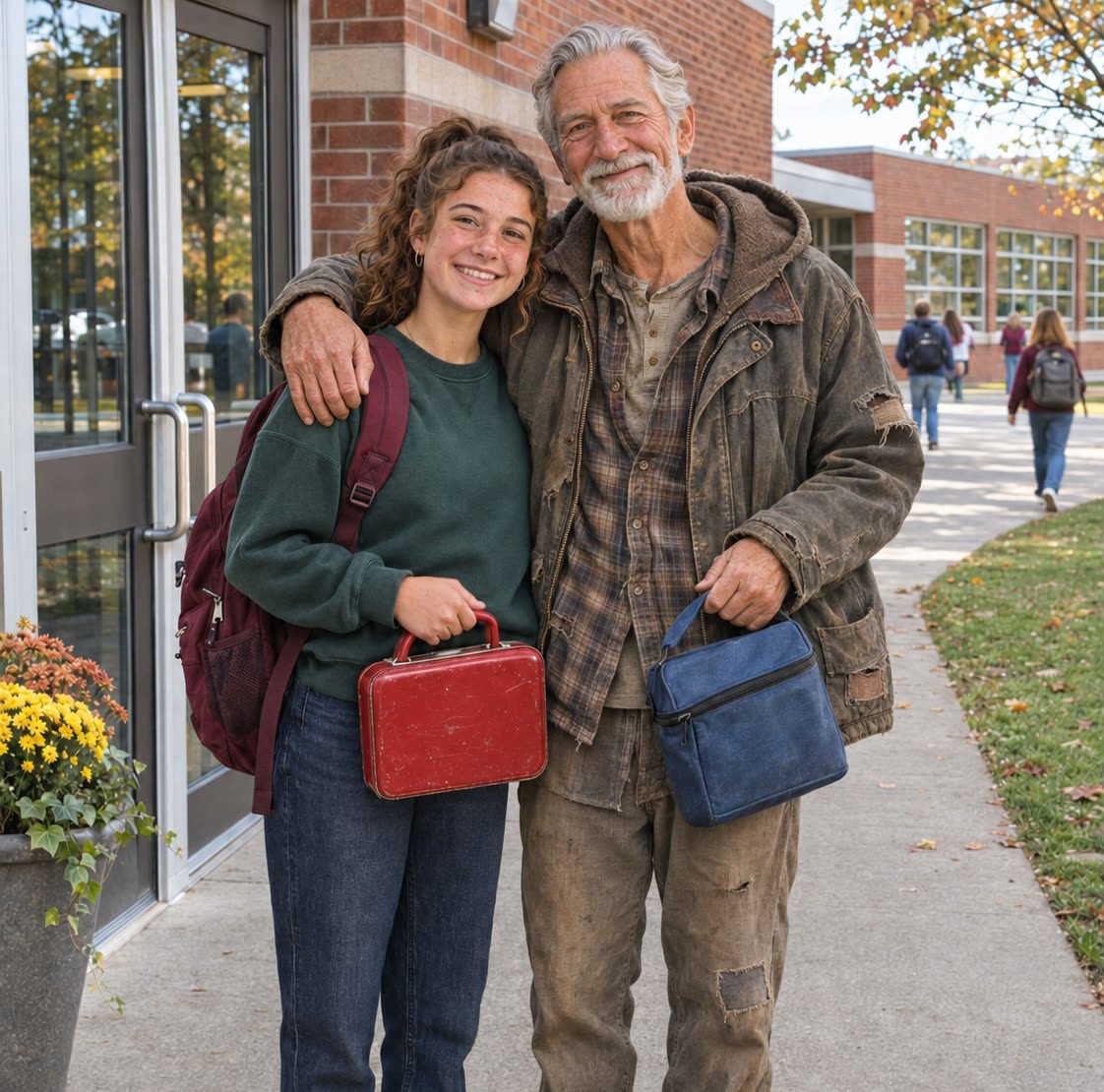
The following morning I packed two lunches. Hers went into the red box she had chosen in seventh grade; his went into an old blue insulated bag with a working zipper and a lopsided handle.
“Same sandwich?” I asked.
Chloe stood in the kitchen doorway. “You’re serious?”
“Does Bram have any allergies?”
“I’ll ask.”
“And I’d like to meet him sometime. Public place, daylight, no going anywhere alone. Being kind doesn’t mean we stop being careful.”
She nodded quickly, then came over and leaned against me while I sliced an apple.
That afternoon she reported that he had no food allergies, disliked yellow mustard, and thought I was a better negotiator than she was.
For the first two weeks I reminded her to keep her own food. Then the arrangement became ordinary enough that I stopped checking.
My husband, Kenny, began buying the mustard Bram liked. Sometimes he put an extra banana beside the lunchboxes before leaving for the maintenance shop where he supervised a small crew.
“Tell your friend the banana budget is getting out of hand,” he told Chloe.
“He’ll demand an audit.”
I liked hearing her laugh. Since she had started at Westbridge Academy that fall, the laughter had become less frequent, though I had explained that away as the natural exhaustion of a more demanding school.
Chloe had worked hard to get into Westbridge. A partial scholarship helped, and Kenny and I covered the rest by postponing a few things and picking up extra work when we could.
She had wanted its science labs and small classes. We had wanted to give her a place where being curious would make her feel at home.
At parent conferences, her teachers called her conscientious, mature, and easy to have in class. I carried those words home like evidence that we had chosen well.
When she started coming home ten or fifteen minutes later, she said Bram talked a lot. I reminded her to answer her phone, and that was the extent of my concern.
Once, I suggested inviting him to a weekend lunch at the park. Chloe said she would ask, then told me he wasn’t comfortable with it yet.
I accepted that. I thought I was respecting his boundaries.
I never wondered whether my daughter was also grateful not to have the two parts of her life meet.
* * *
That morning, before Bram came to our door, Chloe had quietly moved her oatmeal cookie into his lunchbox.
I caught her and moved it back.
“There are enough cookies for both of you.”
“He appreciates them more.”
“Your father ate four standing over the sink last night. Apparently appreciation runs high in this house.”
She smiled, but the smile vanished when Kenny came downstairs discussing an extra Saturday shift with someone on his phone.
After he hung up, he kissed her forehead. “Chemistry test today?”
“Tomorrow.”
“You’ll do great.”
She adjusted the strap of her backpack. “You don’t have to say that every time.”
He raised his hands. “All right. You’ll do adequately.”
That earned him a real smile. I remembered it clearly now because I had used it to dismiss the moment that came afterward, when she stood holding both lunches and seemed unable to leave.
On the porch, I looked at Bram. “Tell me exactly what happened.”
He sat at the other end of the bench, leaving a careful distance between us.
“She brought the food like always. Asked whether I had somewhere dry for tonight. Then she gave me this and said I should keep it.”
“Why?”
He pressed his palms together.
“Because she said she wasn’t coming back for it.”
Part 2: The Things We Praised
For a few seconds I heard nothing except a delivery truck reversing somewhere down the street. I looked at the lunchbox as if opening it might explain what he meant.
“Not coming back where?” I asked.
“To the shelter after school. She said she was going to the office to ask how to leave Westbridge.”
Relief came first, sharp and embarrassing. She was not missing; she was not somewhere I could not reach.
Then the rest of it landed.
“She can’t withdraw herself. She’s fifteen.”
“I know that. I’m not sure she does.”
“She loves that school.”
Bram did not argue. Somehow that was worse.
“She worked for it,” I added, hearing how defensive I sounded. “She studied all summer for the entrance assessment.”
“She told me.”
Those three words exposed a space in my daughter’s life I had assumed belonged to me.
I got my phone from upstairs and found his missed call. I called Chloe, though students were required to keep their phones put away during lessons, then sent a message.
Mom: You’re not in trouble. Please call me when you’re allowed. Dad and I need to talk with you today.
I called Kenny next.
“Can you leave work?” I asked.
“What happened?”
“Chloe’s safe. But we need to go to school.”
He asked no further questions until I had finished explaining. Then he said he would meet me at home in fifteen minutes.
On the porch, Bram had stood up.
“I’ve caused enough upset,” he said. “You’ve got what you need.”
“No, I have one sentence. Please help me understand it.”
He looked uncomfortable. “I don’t want to turn everything she’s ever said into a report.”
“And I don’t want to walk into her school and make this worse because I’m guessing.”
He considered that, then sat again.
“She’s been stopping after school longer than she told you. Not hours. Ten minutes, sometimes twenty. Some days she needs a little while before she can put on the face she brings home.”
I thought of the pantry door opening before her backpack touched the floor. I had noticed hunger because hunger was easy to solve.
“What do you do?”
“Mostly sit. Sometimes we count things.”
He took a folded piece of paper from his pocket. There were two columns of tally marks beneath the words “Red Cars” and “City Buses.”
“She says I need a hobby,” he said. “I say she needs to stop changing the rules when she’s losing.”
“Why count cars?”
“Gives her something outside her own head to pay attention to. It helped me once. I asked if she wanted to try.”
There was no claim to special wisdom in his voice. He sounded like a man explaining why he had offered someone a chair.
“Did she tell you she was afraid to come home?”
“Not afraid of you. Afraid of disappointing you.”
I shook my head automatically. “We’ve never told her she had to be perfect.”
“I didn’t say you did.”
I remembered the report card on our refrigerator. The way Kenny and I told relatives how well she was doing, how independent she was, how she never gave us any trouble.
All true things, or so I had thought. None of them invitations to tell us otherwise.
“Why today?” I asked.
Bram looked toward the road. “Because today she said she could survive three more years if she had to. Then she said she didn’t think it was fair to make you pay for that.”
Kenny pulled into the driveway while I was still holding the folded tally sheet.
He listened without interrupting. When Bram repeated the part about paying, Kenny’s face changed.
“She heard me talking about Saturday,” he said.
“She’s heard more than one Saturday,” I said.
We had discussed tuition at the kitchen table. Compared bills. Said we could manage if the car held together another year.
We had never meant any of it as a burden for Chloe to carry. We had simply forgotten that hearing a conversation was not the same as understanding it.
Bram turned the paper over in his hands.
“I tried telling her there are things parents choose. She said you’d choose her even if it hurt you, so somebody had to be sensible.”
Kenny sat on the porch step.
“That sounds like her,” he said, and for the first time it did not sound like praise.
* * *
Twenty-five minutes later, we checked in at Westbridge’s front office. I had called ahead and asked to see the counselor with Chloe, explaining that we were concerned about her well-being and a possible request to withdraw.
Bram had offered to wait outside. We asked him to come in, then made clear that Chloe could decide whether he stayed for the conversation.
The receptionist gave him the same visitor form she gave us. I was grateful for that small, unremarkable courtesy.
Ms. Alvarez met us in the hallway. She had a soft voice and the hurried expression of someone making room in a full schedule.
“Chloe’s teachers haven’t reported any concerns,” she said once we were seated. “She’s one of our easiest students.”
“I think we’ve all been relying on that,” I said.
Her expression changed. She closed the folder in front of her.
“Tell me what you’ve noticed.”
We did. She asked whether Chloe had mentioned being unsafe or wanting to hurt herself, and Bram answered carefully: she had not, but the way she spoke about enduring school had worried him.
“I’ll ask her directly and privately as well,” Ms. Alvarez said. “We don’t have to guess.”
That steadied me. Someone could ask the frightening question without turning it into an accusation.
A few minutes later, Chloe appeared in the doorway carrying a hall pass.
She looked at Kenny, then me, then Bram in the chair nearest the door. Her face went still before it crumpled.
“You told them.”
Bram stood. “I told them you needed help.”
“I trusted you.”
“I know.”
“No, you don’t.” Her voice broke. “You were the only person I didn’t have to explain everything to.”
He took that without defending himself.
Ms. Alvarez asked whether Chloe wanted him to step outside. Chloe nodded without looking at him, and he left quietly.
I pulled the chair beside me out a few inches.
“You don’t have to tell us everything at once,” I said. “But we’re here.”
She stayed standing.
“Am I in trouble?”
“No,” Kenny said.
“Not for wanting to leave?”
“Not for wanting to leave.”
She looked at him for a long moment, testing whether the words could hold her weight.
Then she sat and opened her backpack. From the pocket where she kept spare pens, she took a folded sheet of paper worn soft at the corners.
“I wrote it because I knew I wouldn’t say it right.”
I unfolded it carefully. There were crossed-out beginnings, an apology about the scholarship, and a promise to find weekend work when she was old enough.
Halfway down, one sentence stopped me.
I’ll get a job and pay you back.
Before I could look up, Chloe gripped the edge of her chair.
“Please read all of it before you tell me I have to stay.”
Part 3: The Cost Of Silence
I read every word. Kenny leaned close enough to read with me, and neither of us spoke until I folded the paper along its existing creases.
The letter did not describe one terrible incident. It described a hundred small moments Chloe had decided were too ordinary to bring home.
Lunch tables where seats were saved for people who never arrived. Weekend conversations she could not join because the trips cost more than she knew we could spare.
A class group chat she learned about six weeks late. Lab partners chosen before she had finished putting down her backpack.
She had friends at her old school, she wrote, but their schedules had drifted apart. At Westbridge she was useful for notes, polite in class, and almost always alone.
“Why didn’t you—” I began, then stopped.
Chloe’s shoulders rose anyway. She had heard the rest before I said it.
I set the letter on my lap. “I’m sorry.”
She looked confused. “For what?”
“For making being strong sound like the thing I loved most about you.”
Her mouth trembled.
“I was proud of you,” I said. “I am proud of you. But I think I talked so much about how well you handled everything that I forgot to ask whether you wanted help handling it.”
“You did ask how school was.”
“And I let ‘fine’ be enough because I wanted it to be true.”
She wiped her face with her sleeve. Ms. Alvarez pushed the tissue box within reach without interrupting.
“I hate lunch,” Chloe said. “That sounds stupid.”
“It doesn’t,” Kenny said.
“Classes are okay. Sometimes they’re really good. But then the bell goes, and everybody knows where they’re going except me.”
She told us about trying a table in September and being asked whether she was waiting for someone. She had said yes because it felt less humiliating than saying she hoped to sit there.
After that, she ate in the library when it was permitted. When it wasn’t, she finished quickly in a corner of the cafeteria and walked the hall until the next class.
“And every time you asked about the labs, I could tell you something good. So I did.”
Kenny rubbed his hands over his knees. “What did you think would happen if you told us the rest?”
“You’d fix it.”
We both went quiet.
“You’d call somebody. They’d make somebody sit with me. Then everyone would know.”
Ms. Alvarez leaned forward. “We won’t arrange friendships behind your back. We can talk about options, and you can tell us what would help and what would make things harder.”
“Can I actually leave?” Chloe asked.
“A transfer is something your parents can explore with you. It takes planning, and we’d need to look at courses and timing. But you are allowed to ask.”
Chloe looked at Kenny.
“What about the money?”
He took a breath before answering.
“The overtime is my decision. Some of it is for school, some is for the truck, and some is because I have a bad habit of saying yes when the shop is short. None of that is a bill I’m keeping for you.”
“But if I hadn’t come here—”
“We’d still have expenses. We’d still make choices. You’re allowed to cost us something. Money. Time. Sleep. Worry.” His voice thickened. “You’re our kid. You’re supposed to.”
I touched the folded letter.
“You don’t owe us for being ours, sweetheart.”
She cried then, not quietly or neatly. Kenny moved his chair closer, and she leaned against his shoulder while I held her hand.
We did not make her choose a school that morning. We agreed that she could take the rest of the day off, that we would investigate both staying and transferring, and that no one would call another student’s parent without discussing it with her first unless safety required it.
Ms. Alvarez spoke with Chloe alone for several minutes while Kenny and I waited in the hall. Afterward, Chloe agreed to regular check-ins and to tell an adult if her distress became frightening or unmanageable.
The counselor also mentioned a small art club that met at lunch twice a week.
“It isn’t a cure,” she said. “It’s a room with something to do while you get to know people. You don’t have to try it.”
“Maybe,” Chloe said.
It was the first answer she had given that sounded like a choice rather than a defense.
Outside the office, Bram rose from a bench when he saw us. He had folded his visitor badge into a precise rectangle.
Chloe stopped.
“I’m still mad.”
“I figured,” he said.
“You should have told me you were coming.”
“I should have told you I couldn’t keep that particular secret. You’re right.”
She had clearly expected an argument. When none came, she looked away.
“I didn’t tell you everything so you could tell everybody else.”
“I didn’t tell them everything. And I won’t. But I couldn’t be the person helping you hide how bad it had gotten.”
Chloe rubbed the strap of her backpack between two fingers.
“Next time, ask me first.”
“If it can wait, I will,” he said. “If I think you’re unsafe, I’ll get help. I won’t promise you something I can’t do.”
She nodded once, unhappily, but she stayed beside him when we walked outside.
* * *
Early that afternoon, we stopped at a sandwich shop with outdoor tables. Bram initially said he would leave us to our family business.
“You haven’t eaten,” Chloe said.
“Neither have you.”
She glanced at me. I lifted the red lunchbox from the car.
For the first time that day, her mouth almost curved.
We bought coffee and soup, then ate the food I had packed that morning. The sandwiches had become a little flattened, but Bram pronounced the mustard situation satisfactory.
When I asked whether there was something practical we could help him with, he shook his head.
“You’ve got enough on your plate.”
Chloe lowered her sandwich.
“Don’t.”
He looked at her.
“You don’t get to do that,” she said. “Not after today.”
He leaned back and let out a breath. “Apparently I’ve made a persuasive argument against myself.”
After a moment, he explained that his wallet had been stolen months earlier. Replacing his identification required records, fees, appointments, and somewhere reliable to receive mail.
He had done seasonal building maintenance before a long stretch without steady work. Losing his rented room had made each next step harder, and he disliked repeating the whole account whenever he asked for help.
“I can fill out forms,” he said. “I just need the forms to stop asking for things I’m filling out other forms to get.”
Kenny found an outreach center nearby and called before we drove over. A worker confirmed that Bram could come in to ask about mail service and document assistance, though there would be no same-day housing placement.
“I didn’t ask for a house,” Bram said when Kenny relayed that.
“I know. I wanted you to have the actual information, not a promise I made up.”
Bram considered him, then nodded.
The visit took over an hour. Chloe and I waited in the car while Kenny sat in the lobby, available if Bram wanted help but not beside him at the intake desk.
When Bram came out, he carried a folder with an appointment card clipped to the front. There was still a great deal to do, but the next step had a date, a time, and a person’s name.
In the parking lot, Chloe opened the blue lunchbox and found the cookie Bram had saved.
She broke it in half and offered him the larger piece.
“We discussed this,” he said.
“I ate my lunch.”
“An alarming development.”
She laughed, then looked down at the crumbs in her palm.
“Can I ask you something without you deciding what I mean?”
He nodded.
“If I leave Westbridge, will you think I gave up?”
Part 4: Room For What Comes Next
Bram brushed a crumb from the front of his jacket before answering. I was grateful he did not rush to reassure her.
“I don’t know enough about schools to choose one for you,” he said. “But leaving something that isn’t working and giving up on yourself aren’t the same thing.”
“What if I’m just bad at making friends?”
“Then that might be something you learn. Doesn’t mean you have to learn it in the hardest possible room.”
She considered that, turning the remaining piece of cookie between her fingers.
“And if I stay?”
“Then I hope it’s because you find reasons to stay. Not because you think suffering makes you worth the tuition.”
I looked away for a moment. Kenny stood beside me, holding the car keys so tightly that the metal had left little marks in his palm.
On the drive home, nobody asked Chloe what she had decided. She fell asleep against the window before we reached our street.
* * *
The following morning, Chloe came downstairs carrying her red lunchbox from the drying rack.
“I can pack them,” she said.
I moved aside, though it took more effort than it should have. Part of me wanted to prove my love by doing every small thing for her.
Instead, I sliced an apple when she asked me to and let her decide how many crackers went into each container.
“Bram said he’d be at the shelter?” I asked.
She nodded. “Unless it rains. Then the covered entrance by the library.”
“Do you want me to walk with you?”
“Not today.”
I swallowed the anxious answer that rose first.
“Okay. Text when you get to school.”
She paused with one hand on the blue lunchbox.
“Are you going to ask me if I’m miserable every day now?”
“Probably in my head.”
That earned a small smile.
“Out loud, I’ll try asking questions you can actually answer.”
She nodded. “Okay.”
That evening, I asked who she had worked with in chemistry rather than whether school had been good. She told me her assigned partner had done the calculations while she set up the experiment.
“Was that all right?”
“Yeah. We were fine.”
I let that answer stand. Learning to listen, I discovered, also meant not demanding a revelation every time she spoke.
Kenny and I changed some habits without making announcements about them. We discussed detailed bills when Chloe was not in the room, not because money was shameful, but because our unfinished worries did not need to become her instructions.
When a tuition statement arrived, we explained the actual plan once: what the scholarship covered, what we had budgeted, and what choices were ours to make.
“You can know how a family budget works,” Kenny told her. “You don’t have to become responsible for ours.”
She asked three practical questions. He answered all three without saying that she should simply stop worrying.
That mattered more than another speech would have.
* * *
The next Tuesday, Chloe tried the art club. She almost turned around at the door because everyone appeared to know one another.
Ms. Alvarez did not usher her in or announce that she needed friends. She simply handed her a stack of paper she had been bringing to the room and asked whether she could carry half.
Inside, a girl named Maya was struggling to cut a straight border for a display.
“You any good with these?” she asked, holding up a ruler.
“Not socially,” Chloe said. “Pretty reliable with stationery.”
Maya laughed. Chloe told me that part twice.
Nothing remarkable happened afterward. No sudden invitation to a sleepover, no crowd gathering to discover how wonderful my daughter had been all along.
But the following Thursday, Maya moved her backpack from an empty chair when Chloe entered. Chloe sat down before she could talk herself out of it.
She still wanted to explore a transfer.
For one foolish second, I almost said, “But you’ve made a friend.” I caught myself before turning one decent lunch into evidence against everything she had told us.
“Then we’ll keep looking,” I said.
The nearby public high school offered a science sequence that could accommodate most of her courses. There were scheduling questions, records to review, and an orientation visit to arrange.
We also asked Westbridge what support would look like if she stayed. Ms. Alvarez helped Chloe identify a teacher she felt comfortable approaching and clarified that she could check in before a problem became a crisis.
For the first time, the decision was not a choice between enduring everything and throwing everything away. It was work we could do together.
* * *
Two weeks after Bram came to our house, Kenny drove him to his document appointment. Bram had asked for a ride three days ahead instead of apologizing for needing one at the last minute.
He received a confirmation for one replacement record and a list of what the next office would require. The outreach worker helped him apply for a fee waiver and explained a possible opening in a transitional housing program.
Possible was not promised. Bram repeated that distinction when Chloe asked how it had gone.
“But the mail arrangement is sorted,” he added. “That part’s real.”
“And you have another appointment?”
“Yes, supervisor.”
She ignored the joke. “Do you have a way to get there?”
“Bus pass. In my folder.”
She nodded, satisfied, and returned to cutting an apple at our kitchen counter.
He had finally accepted an invitation to lunch at our house, with all three of us there. He asked before taking a chair, then stood again when I said the soup needed another few minutes.
“Bram,” I said, “the chair isn’t timed.”
He looked at me, then sat.
Over lunch, he asked Kenny about the rattling window in the back door. He listened to the description and suggested a worn latch rather than a warped frame.
He was right. The following weekend, with Kenny beside him, he helped replace it using a small part from the hardware store.
I thanked him without saying anything about repayment. He accepted without pretending it had been nothing.
Chloe watched that exchange more closely than either of us expected.
Later, when I offered to help her organize the school information, she said yes without adding that she could do it herself.
* * *
The following Friday, I picked Chloe up outside Westbridge after a counselor appointment. Bram was waiting near the public sidewalk because she had asked him to be in a photograph for her art project.
The assignment was about everyday objects that carried a story. She had chosen the lunchboxes.
“Faces are optional,” she explained, checking the camera she had borrowed from the school. “I can just do your hands.”
“My hands have never had professional representation,” Bram said. “What are the terms?”
“One cookie.”
“Insulting. Two.”
“One and a half.”
They settled it with grave formality.
I took one photograph of them together after Chloe asked whether I would. She stood beside him with her red lunchbox; he held the blue one, and they were both smiling at something she had said just before I pressed the button.
It was not evidence that everything was fixed. It was a picture of two people who had learned something important about accepting what they kept trying to give away.
As we turned toward the car, Maya and another girl came out carrying a roll of poster paper.
“Chloe,” Maya called. “We’re putting the display up Monday. You coming at lunch?”
Chloe glanced at me, then back at her.
“Yeah,” she said. “I’ll come.”
I did not praise her for being brave. I unlocked the car and let the invitation belong to her.
Bram started toward the bus stop.
“Need a ride?” I asked.
“No, I’m all right.”
He took another step, then stopped.
Chloe was watching him over the roof of the car. She raised one eyebrow.
He sighed. “Actually… yeah.”
When he climbed into the passenger seat, Chloe’s backpack was on the floor by his feet. I reached down, moved it to the back seat, and made room.
Nobody thanked anybody for a while. We talked about traffic and the art display and whether the blue lunchbox zipper could survive another school year.
It was the most ordinary conversation we had ever had together.
* * *
Three weeks after that first knock, I stood beside Chloe outside the public high school’s counseling office. She had chosen to visit before deciding whether to transfer at the end of the term.
There were still difficult lunches at Westbridge. There were also two girls who expected her on Mondays, a chemistry teacher she liked, and reasons to think carefully rather than run.
Bram had his own appointment that morning. Before we left home, a message arrived from the outreach center’s phone.
Bram: Both of us asking questions today. Seems excessive. Report back when you’re done.
Chloe smiled and typed a reply.
Chloe: Only if you do.
Now she stood holding a folder of course descriptions, moving her thumb along its edge.
“What if I pick wrong?” she asked.
“Then you tell us. We look at what’s happening, and we work out the next step.”
“Even if you think I should’ve known?”
“Especially then.”
She leaned her shoulder against mine for a moment, the way she had in the kitchen the morning I packed the second lunch.
“Will you come in with me?”
“If you want me to.”
She nodded, then looked at the closed office door. Behind it waited a school she did not know, questions none of us could answer yet, and a choice she no longer had to make alone.
Then the handle turned, and someone called her name.
How can we make it easier for the people we love to tell us they need help before they reach their limit?
Disclaimer: This story is a work of fiction inspired by real-life themes. Names, characters, places and events are fictionalized, and any resemblance to real persons is purely coincidental. It does not represent any person or organization and does not encourage inappropriate behavior. Images are for illustration purposes only.


