

Part 1: The White Envelope
“Ross, did you pay for somebody’s groceries last Friday night?”
Mr. Jenkins didn’t look up when he asked. He stood behind his desk in the cramped back office of the station, a stack of delivery invoices under one palm and a plain white envelope under the other, lining them up edge to edge the way men do when they’re about to say something unpleasant.
Twenty-three years in a factory teaches you what that tone means. Somebody was about to get written up, and I was the only somebody in the room.
“Four dollars,” I said. “It came out of my own wallet, not the register. I rang it clean, I swear on my kids.”
He finally looked at me. “Sit down, Ross.”
I sat. The chair had one short leg and rocked under me the way it always did, and I gripped the armrests and waited for the speech.
Let me back up, because that Thursday only makes sense if you know what my Friday nights looked like.
My name is Ross Whitaker. I’m forty-nine. My wife, Lydia, teaches second grade and still brings home laminating sheets like they’re souvenirs. We have two kids: Caleb, sixteen, whose feet grow half a size every season, and Josie, twelve, who keeps a running list of things we can’t afford and reads it aloud at dinner as a joke. We also have a three-bedroom ranch house that’s one bedroom too small and a mortgage that doesn’t care.
For twenty-three years I ran a press at Hallman Tool & Die. Then one Tuesday in March, we clocked in at six like always, and by noon there was a chain on the gate and a sheet of paper zip-tied to the fence announcing a bankruptcy filing. Grown men stood in that parking lot holding lunch pails like they’d forgotten the way home.
I spent eleven months knocking on doors after that. I sent out résumés until the printer ran dry, and I heard “overqualified” so many times it started to sound like a diagnosis. A hiring manager at a distribution center, a kid of thirty with a lanyard, told me they wanted someone with “more runway.”
I almost said something I would have regretted. Instead, I thanked him for his time.
So I took the overnight shift at the Quik Stop off Highway 52. It’s the kind of place truckers pull into for coffee and a bathroom, where the light over the ice machine flickers and the whole building smells like the roller grill. The radio plays the same three songs, and after a few weeks you stop hearing them.
That Friday followed the usual rhythm. Two truckers came through around nine, grumbling about a weigh station. A teenager bought an energy drink and a bag of jerky at ten. After ten-thirty, the place went still, the way it does when the highway has nothing left to give.
I was behind the counter restocking cigarettes, half listening to a talk show, when the door chimed at 11:30.
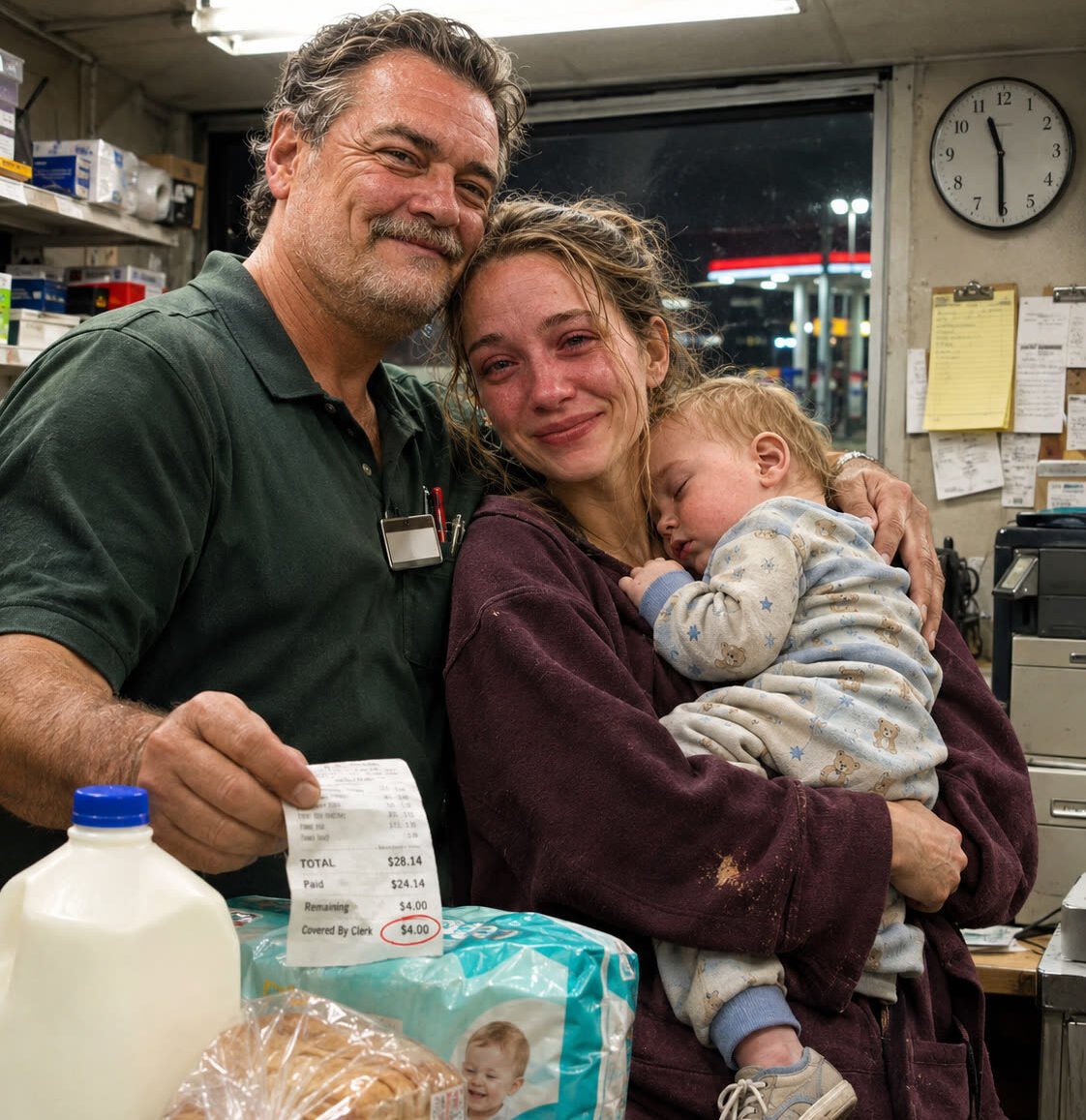
She came in shoulder first, because her arms were full. A little boy, maybe three, was asleep against her neck, his hands hanging limp, one sneaker dangling from his foot.
She walked the aisles like she was moving through a church. Her ponytail was sliding loose, her gray sweatshirt had a stain on the cuff, and her eyes had that scraped-hollow look I recognized from the mirror. She took a small carton of milk, a loaf of white bread, and a box of diapers.
Nothing else. No gum, no candy for the kid. I noticed, because Lydia and I did that same math for months.
She set everything on the counter with one hand, easing the boy higher on her shoulder. He stirred and sighed but didn’t wake.
“Fourteen seventy-two,” I told her.
She unzipped her purse. Out came a fold of wrinkled bills and a handful of quarters. She counted them, then counted again, her lips moving.
The third time, her chin started to shake.
“I’m four dollars short.” Her voice was barely there. “Could I… can I put the diapers back?”
I’ll be honest about something. Those four dollars were not nothing to me. They were the gas money I’d budgeted to get through the weekend, and I’d been counting my own singles that very afternoon.
But I looked at that boy’s dangling sneaker, and the math stopped mattering.
“It’s fine,” I said. “I’ve got it.”
She stared at me like I’d spoken another language.
“It’s late,” I said, peeling four ones out of my wallet and feeding them into the drawer. “Just get home safe, okay?”
She nodded fast, twice, three times. She hooked the bag over her free wrist and hurried out into the cold. Through the window I watched her buckle the boy into an old sedan with one headlight dimmer than the other, and then the taillights shrank down the access road and the station went quiet again.
I figured that was the end of it.
Now, in Mr. Jenkins’s office, a week later, he pushed the white envelope across the desk with two fingers.
“This came for you this morning,” he said. “Handwritten. No stamp, no return address.”
My name was on the front in tall, careful letters. Not Ross Whitaker. Just Ross, and under it, Night Shift. Whoever wrote it had read my name tag.
“Go on,” Mr. Jenkins said. He was leaning on the desk, arms crossed, watching me with an expression I couldn’t read.
My fingers felt thick as I tore the flap. Inside was a folded sheet of paper, and tucked beneath it was a check.
I read the amount once. Then again. Then a third time, counting the zeroes with my thumbnail like a kid.
Five thousand dollars. Made out to me.
The note was short. “Dear Ross, you don’t know us, but you met our daughter at your register last Friday night. You were kinder to her than you will ever realize. Thank you for helping her get home safely.”
Below the signature, in smaller writing, was an address on the other side of town and one more line.
“Please come Sunday at noon. There is something we need to tell you about that night, and we would rather say it to your face.”
Part 2: Sunday at Noon
I don’t remember the drive home from work that morning. I remember the envelope riding on the passenger seat, and how I kept glancing at it at every red light, as if it might slip out the window and take its zeroes with it.
Lydia was at the kitchen counter cutting crusts off sandwiches for the kids’ lunches. She looked up when I came in, and whatever she saw on my face made her set the knife down.
“Ross? You’re white as paper. What happened?”
I didn’t answer. I put the envelope on the counter and let her pull out the check herself.
Her hand flew to her mouth. “Oh my God.”
“Read the note.”
She read it once, slowly, then again with her lips moving the way Emily’s had at the register. So I told her everything: the sleeping boy, the diapers, the four dollars, the way the woman had looked like someone holding her breath.
“I’m not cashing it,” I said. It came out sharper than I intended. “It feels wrong, Lydia. Like I’m getting paid for being a decent human being.”
“You’re not getting paid. You’re being thanked.”
“Same thing, when it’s five thousand dollars.”
“It is not the same thing, and you know it.” She stepped around the counter and took both my hands. “Ross, listen to me. When the plant closed, you didn’t complain once. You took the first job anyone would give you and you never made us feel small about it. I am so proud of you.”
I looked at the floor. “I didn’t do it for this.”
“I know you didn’t.” She pulled me into a hug that smelled like peanut butter. “That’s exactly why you deserve it.”
I didn’t sleep much that week. I worked my shifts and watched the door chime every time someone walked in, half expecting that old sedan with the dim headlight. Caleb caught me staring at the check on the fridge one night and said, “Dad, you look at that thing like it’s a bomb.” Josie asked whether it might be a scam, which was a fair question, and one I’d asked myself in the dark more than once.
But scammers don’t invite you to lunch. And scammers don’t write “get home safely.”
Sunday arrived faster than I wanted. I changed shirts three times, and finally Lydia took the blue one out of my hands and told me to stop fussing and go. She kissed me at the door and slipped a folded paper napkin into my pocket. When I checked it at a stop sign, she’d written on it in marker: Be yourself.
The address led me to Maple Ridge, a neighborhood I’d only ever driven through on the way somewhere else. Wide lawns. White fences. Hedges trimmed so square they looked drawn with a ruler. I parked my dusty hatchback behind a silver SUV and sat there for a full minute with my hands on the wheel, feeling about nineteen years old.
An older couple was already waiting on the porch, like they’d been watching the street.
The woman had a silver bob and a lavender sweater, and she was smiling before I even opened my door. The man beside her was tall and broad, with close-cropped gray hair and a navy cardigan, and he came down the steps with his hand already out.
“You must be Ross,” he said.
“Yes, sir.”
His grip was firm and dry. “Robert Hale. This is my wife, Margaret. Please, come in. We’ve been looking forward to this all week.”
Margaret didn’t wait for me to reach the porch. She came down and hugged me right there on the walkway, which caught me flat-footed, and I stood there with my arms half raised before I remembered how to hug back.
“Thank you for coming,” she said into my shoulder. “Thank you for everything.”
The house smelled like roast chicken and warm bread. There was a framed school photo on the hallway wall of a girl with a gap-toothed grin, and a more recent one beside it of a young woman with chestnut hair. I knew her at once, even in a graduation gown, even smiling.
They led me to a dining room with a long oak table set for three. Nobody touched the food. For a while the only sound was the tick of a clock in the next room.
Then Robert cleared his throat and folded his hands.
“Ross,” he said, “before we say anything else, you should know that the woman you helped last Friday didn’t run short of money by accident.”
Part 3: What Emily Left Behind
Margaret reached over and covered her husband’s hand with hers. I noticed that her fingers were trembling.
“Our daughter, Emily, was married for six years,” Robert said slowly. “The first two were fine. After that, her husband started making the world smaller.”
“Smaller?” I asked.
“First it was her friends. He had opinions about every one of them until she stopped calling. Then it was her job. Then it was us.” Robert’s jaw worked. “He kept her phone on his plan and checked it. He kept the bank cards in his name. Every time we called, there was a reason she couldn’t talk.”
Margaret wiped the corner of her eye with a napkin. “We saw our grandson, Daniel, maybe four times in two years. Four. I counted them on the calendar.”
I thought about the little boy’s dangling sneaker and felt my stomach turn over.
“Something changed in her this fall,” Robert went on. “We don’t know exactly what. She just decided. Her husband was away at a conference out of state, and she had one night, so she packed a bag, a blanket, and Daniel, and she left.”
“She used cash only,” Margaret said. “She was afraid a card would show up on a statement and he’d find out where she was. She took what she’d saved in a coffee can over eight months. Eight months of quarters and ones.”
I remembered the wrinkled bills. The quarters. The way she’d counted them three times.
“She was driving here,” Robert said. “Forty minutes from your station. But Daniel ran out of diapers, and she’d promised herself she wouldn’t knock on our door empty-handed. She was ashamed, Ross. Ashamed that she’d let it go on so long.”
“So she stopped at the first light she saw,” Margaret whispered. “Yours.”
Nobody spoke. I stared at the grain of the oak table, and I felt something I hadn’t expected, which was guilt.
“I have to be honest with you both,” I said finally. “When she came in, my first thought wasn’t noble. I was tired. I’d been on my feet since six that evening, and for one second I was annoyed, because I figured she was another person who couldn’t pay, and I’d have to deal with it.”
Robert tilted his head. “And then?”
“And then I saw the boy’s shoe.” I shrugged, embarrassed. “That’s all it was. A shoe.”
Margaret smiled through her tears. “Do you know what she told us when she finally walked through that front door? She sat on that hallway bench with Daniel asleep in her lap, and she couldn’t stop crying. She kept saying, ‘There was a man at the gas station. He told me to get home safe.’”
She pressed her napkin to her mouth for a moment.
“She said it was the first time in years that someone treated her like a person instead of a problem.”
My throat closed. I looked at the window so I wouldn’t have to look at her.
“That’s why we sent the check,” Robert said quietly. “You gave our daughter her dignity back at the exact moment she believed she’d lost it. A man behind a counter did that. A stranger.”
I shook my head. “Mr. Hale, I can’t take five thousand dollars for four dollars and a sentence. It isn’t right. Anybody would have done the same.”
“Not everybody did,” Margaret said gently. “You did. That matters more than you think.”
“With respect, ma’am, I’d feel like a fraud.”
I stood up. I didn’t mean it as a protest, exactly. It was just pride, the stubborn kind that had carried me through eleven months of rejection, and it wouldn’t let me sit still while someone handed me charity.
I reached into my jacket for the check. I’d brought it with me, folded in the napkin Lydia had written on.
“Please,” I said, setting it on the table. “Give it to Emily. She needs it more than I do.”
Robert looked at the check. Then he looked at me, and something in his face softened, almost like he’d expected exactly this.
“Sit down, son,” he said. “You haven’t heard why it’s five thousand.”
Part 4: Get Home Safe
I sat. Robert pulled open the drawer of a sideboard behind him and took out a thick envelope, worn soft at the corners. On the front, in Margaret’s handwriting, were four words.
For Emily. When she calls.
“Two years ago,” Robert said, “we stopped trusting that she’d be able to ask for help. So Margaret and I started putting a little aside every month. Not much. Whatever we could. We told ourselves that when the night finally came, she wouldn’t have to choose between leaving and being able to eat.”
Margaret nodded. “We kept it in that drawer. We looked at it every Sunday and prayed we’d be able to use it.”
“Five thousand dollars?” I said.
“Almost to the dollar,” Robert said. “And she never called. She just showed up one night, on her own, with a bag and a coffee can of quarters. The money was sitting right here, and she didn’t need to touch it, because she had a place to sleep and parents who’d been waiting.”
His voice thickened.
“She told us she didn’t want it. She said, ‘Give it to the man at the gas station. He’s the one who made it possible for me to walk through the door.’ We argued about it. She won.”
I felt the weight of that settle on me. This wasn’t a reward or a gesture. It was a daughter’s decision, made from a place of fear and then relief, and I had been standing in the way of it for ten minutes.
I looked at the check lying on the oak table, and I thought of Josie’s list, and of Lydia’s hands around mine in the kitchen. I thought of how many times that month I’d stood in front of an empty coffee can of my own.
Pride is a strange thing. It feels like strength right up until you realize it’s just another way of refusing to receive.
“Where is she now?” I asked. “Emily?”
Margaret glanced at Robert. “She’s at a support group this afternoon. She goes on Sundays. She didn’t feel ready to sit across from you today. She wanted to, but she was afraid she’d only cry, and she hates crying in front of people.”
“Good,” I said. It surprised all three of us.
“Good?” Robert asked.
“She doesn’t owe me a visit.” I picked up the check, finally, with both hands. “I’ll take this on one condition. Don’t tell her she has to thank me, and don’t make her feel she’s in my debt. If one day she wants to say hello, I’ll be at the station. If she never does, that’s all right, too.”
For the first time all afternoon, I didn’t wait for anyone to tell me what to do. I just said it, and I felt steadier for it.
Margaret came around the table and held my face between her hands like I was one of her own. “You’re a good man, Ross.”
Then she left the room and came back with something small. It was a sheet of construction paper, creased from folding, covered in thick green crayon.
“Daniel drew this on Saturday,” she said. “He wanted you to have it.”
It was a picture of a gas pump with a smiling face, and beside it a stick figure in a very large hat. Underneath, in wobbly letters his mother had clearly helped him make, were three words: GAS STATION MAN.
I laughed, and it cracked halfway. I folded the drawing into my jacket pocket, over my heart, where I could feel it against my ribs.
We finally ate. Roast chicken, warm bread, a green bean casserole Margaret apologized for twice. We talked for three hours about Daniel’s obsession with garbage trucks, about Caleb’s feet and Josie’s list, about the factory and the long eleven months, and about how life sometimes knocks you down harder than you saw coming. Robert had lost a business at fifty-three, and he told me about it without a trace of pity, the way one man tells another how he got a scar.
They listened to every word like it counted. I can’t remember the last time that happened.
At the door, Margaret hugged me again. “Small kindnesses,” she said, “the ones we do without thinking, are the ones that matter most. They come from who we really are, not who we’re trying to be.”
I drove home slowly, the window cracked open, the late sun low and gold across the road. I kept thinking about how small that Friday had felt to me, four crumpled singles, and how large it had landed on the other side of the counter.
Lydia was waiting on the couch, her feet tucked under her, pretending to grade spelling tests. She set the pen down the moment I walked in.
“Well?”
I sat beside her and took her hand. “I thought I was doing one small thing that night,” I said. “Turns out it was kindness finding its way back to me.”
She leaned her head on my shoulder. “That’s how it works sometimes. You give what you can, and the world remembers.”
I held on to that check for two days before I finally deposited it. Part of me still half expected the bank teller to laugh. Instead, she asked if I’d like to open a savings account.
It changed things for us, at least for a while. We caught up on the electric bill and the property tax, and we fixed the transmission on Lydia’s car. Caleb got shoes that fit without anyone sighing, and Josie crossed three items off her list and taped Daniel’s drawing to the fridge beside it, no explanation needed.
But the money wasn’t what stayed with me. What stayed was that picture in my pocket, and a sentence I’d said aloud for the first time in my life: I’ll take it.
I still work the night shift off Highway 52. I still ring up truckers and teenagers and people just passing through, and the radio still plays the same three songs. But I look at faces differently now. When someone comes through that door worn thin by the day, I slow down.
Last Friday, at 11:30, the bell over the door chimed. A man in a rain-soaked jacket stood at my counter, patting his pockets, eleven cents short on a coffee.
I smiled and waved the cents away.
“Just get home safe, okay?”
Somewhere on the shelf behind the register, tucked beside the lottery tickets, a green crayon drawing watched over the till.
If you were in Ross’s place, would you have accepted the check, or would pride have made you walk away?
Disclaimer: This story is a work of fiction inspired by real-life themes. Names, characters, places and events are fictionalized, and any resemblance to real persons is purely coincidental. Images are for illustration purposes only.


