

Part 1: The Shoebox With the Orange Ribbon
The shoebox was not hidden well. It sat under my grandmother’s bed behind a pair of flattened slippers, its corners worn soft as old flannel, a strip of faded orange ribbon holding the lid shut.
I almost pushed it back.
I hadn’t come into her bedroom for boxes. I had come for fabric. A sheet, a scarf, a curtain, anything I could turn into a costume in the next ninety minutes, while my wife and kids took Grandma for a walk around the block to buy me time. Well, the walk was my lie. The ninety minutes were real.
Then the ribbon slipped loose under my thumb, and the lid lifted by itself, the way old things do when they’ve waited long enough.
On top lay a pencil drawing on yellowed notebook paper. A woman in a long gown scattered with stars. A pointed hat. A wand with a little burst at the tip. Across the top, in a child’s uneven capitals, someone had written: EVELYN. HALLOWEEN. AGE 9.
I sat down on the edge of the mattress. Natalie was somewhere down the hall, opening closets and muttering. I didn’t call her yet.
To explain why I was robbing my own grandmother’s bedroom on Halloween afternoon, I have to go back further than that day. I have to go back to when I was six.
My parents died in a car accident on a wet Tuesday in March. I remember almost nothing about the weeks after. People spoke in soft voices. Casseroles arrived and nobody ate them. Adults crouched in front of me and asked questions they already knew I couldn’t answer.
What I do remember is Grandma Evelyn standing in the doorway of my old bedroom with a suitcase in each hand, saying, “Well. Let’s go home, then.”
She was fifty-one. Widowed. She worked mornings at a bakery on Fulton Street and cleaned offices three nights a week. We lived in a two-bedroom house with a roof that leaked above the back porch and a furnace that groaned all winter like it was losing an argument with itself.
She kept white envelopes in a kitchen drawer, each one labeled in blue ballpoint. GAS. LIGHTS. GROCERIES. SCHOOL. When one got thin, another one had to pay for it. I understood that even at six. Kids in tight houses learn arithmetic early.
So I never understood October.
Every October, our little house turned rich in fabric. Not actual rich. But it felt that way. Grandma hauled me through church rummage sales, thrift stores, and clearance bins, flipping through racks with the focus of a surgeon. Then she’d set up her sewing machine on the kitchen table, a loud beige machine that sounded like a lawn mower with a cold, and she would make something impossible.
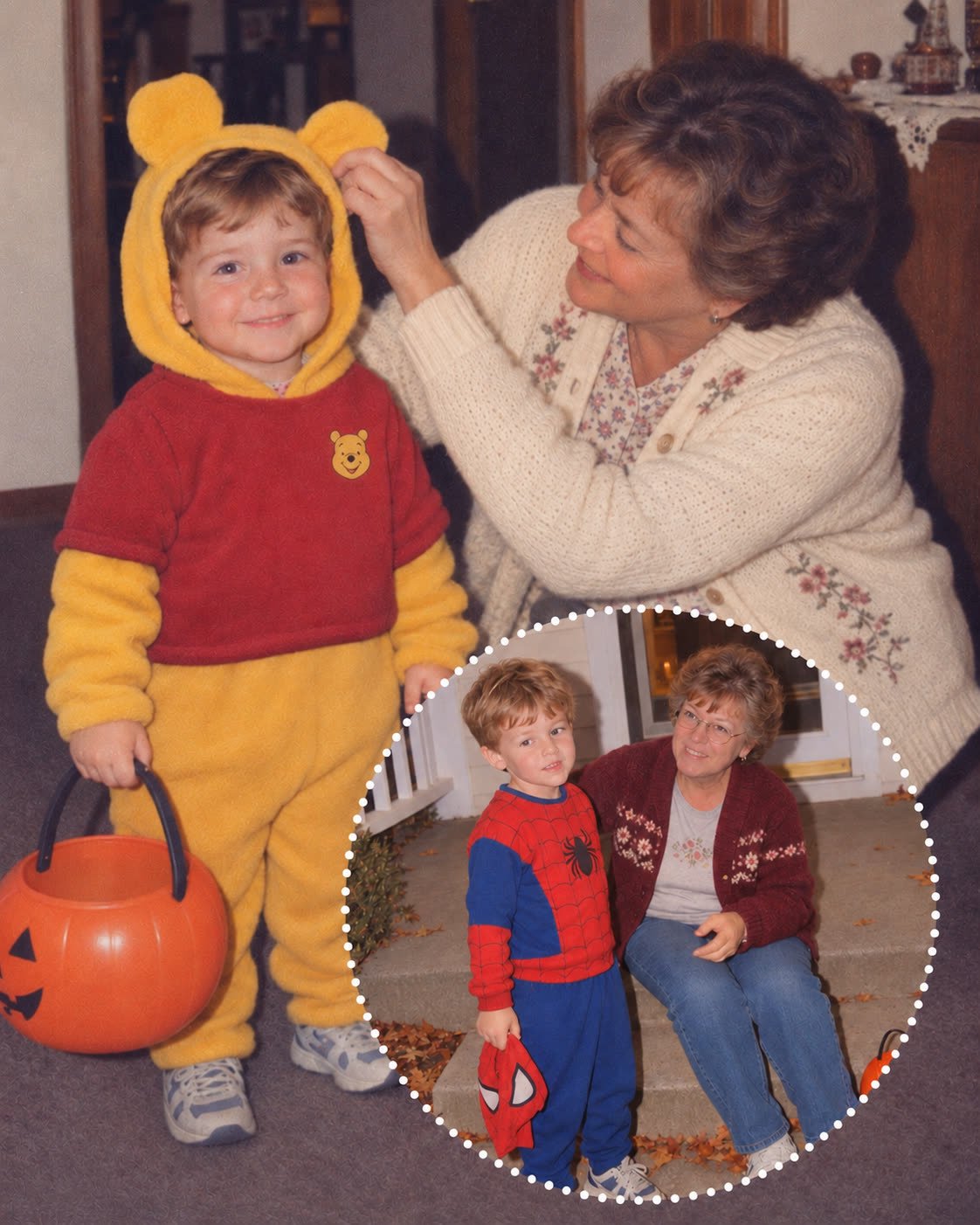
When I was seven, I wanted to be Spider-Man. The store version cost forty-four dollars. That was more than the gas envelope held that month.
Grandma bought a red long-sleeved shirt, blue sweatpants, and a bottle of black fabric paint. For three nights I fell asleep to the sound of her humming at the table, drawing webs by hand, one line at a time.
The lines wobbled. I didn’t care. I walked into school feeling like I’d been cast in a movie.
At eight, I was a pirate in a coat she’d cut from a burgundy curtain. At nine, a robot built from cardboard boxes, aluminum foil, a dryer vent, and two bicycle lights. At ten, a knight in silver-painted armor. Then a mad scientist. A vampire. A scarecrow. A ghost of Christmas past, which even then I knew was the wrong holiday. Ten years in a row, until I was sixteen and finally too proud to knock on doors for candy.
Every year I asked her the same question, usually while she had pins in her mouth.
“Grandma, how come you never buy my costumes like the other parents?”
And every year she took the pins out, smiled, and said, “Because yours are one of a kind, sweetheart.”
I believed her. Why wouldn’t I? To me, Halloween was candy and porch lights and Grandma pretending she didn’t recognize me.
“Good heavens,” she’d say when I came down the stairs. “Who is this terrifying stranger in my house?”
“Grandma. It’s me.”
“I don’t know. You look suspicious.”
Then she’d make me turn in a slow circle, inspecting every seam. “Very suspicious.”
I laughed every time.
What I didn’t know, what I never thought to ask, was how many of those nights she sewed past midnight after finishing a shift scrubbing other people’s floors. I never counted the sweaters she didn’t buy for herself. I never wondered why she always stayed home and handed out candy instead of walking me around the neighborhood.
I was a kid. Kids take magic as a given. But I was a teenager, too, and then an adult, and I still never asked. That part I carry.
Now I was thirty-four, sitting on her bed with a nine-year-old girl’s drawing in my hands. That girl was my grandmother. And somewhere downstairs, only an hour earlier, she had answered a simple question from my daughter in a way that cracked something open.
I had come into this room to give her a gift. I had no idea the box under her bed was about to tell me what the gift was supposed to be.
Part 2: The Question Sophie Asked
Our whole family had arrived at Grandma’s house around two that afternoon.
She still lives in the same place. The roof has been replaced, finally. The furnace lost its argument years ago and now purrs like a cat. The kitchen table is still there, and so is the beige sewing machine, though she barely uses it. Arthritis has crept into her fingers, and her eyes tire quickly.
Grandma Evelyn is seventy-nine. Her hair is silver and curls tight around her face. She wears small round glasses and a teal cardigan every day from October to April, and she greets my children as though they were visiting dignitaries.
Sophie, eight, had on her store-bought witch costume, a purple hat nearly as wide as her shoulders. Caleb, five, was a green dinosaur with felt spikes down the hood.
Grandma examined both of them like a judge at a county fair.
“Excellent cape,” she told Sophie, with a solemn nod.
Then she squinted at Caleb. “And I’m expected to believe there is a dinosaur in my living room?”
Caleb roared as loudly as a five-year-old can.
Grandma clutched her chest. “Dear Lord, somebody call the zookeeper.”
He laughed so hard he nearly dropped his plastic pumpkin bucket.
After lemonade and sugar cookies, Grandma went to the cabinet and pulled out a photo album with a cracked blue cover. She owns dozens. This one was my private childhood museum of Halloween.
“Look at your daddy,” she told the kids.
She tapped a photo of me at seven in the red shirt, blue sweatpants, and hand-drawn webs. My mask hung off one ear.
Sophie studied it. “Dad, your mask looks weird.”
“Thanks.”
“It does.”
“I made that mask,” Grandma said.
Sophie flipped sides faster than a politician. “I mean, it’s vintage.”
“Nice save,” I told her.
We worked through the album page by page. Me the pirate. Me the knight, squinting under a silver cardboard helmet. Me the robot.
Caleb lost it at the robot. “You look like a microwave!”
“I looked terrifying.”
“A microwave with legs!”
Grandma laughed so hard she had to take off her glasses and wipe her eyes. It was a good moment. One of those afternoons you don’t realize is delicate until it breaks.
Sophie looked up from the album. “Grandma, what did you dress up as when you were little?”
Grandma stopped laughing. Not dramatically. The way a clock stops when its battery gives out, between one second and the next.
“Oh,” she said.
Sophie waited. Children are merciless at waiting.
Grandma closed the album, slowly, and laid her palm flat on the cover. “I never really did.”
“Never?”
“No, honey.”
“Why not?”
She shrugged, a small, practiced shrug. “My parents didn’t believe in spending money on costumes.”
I frowned. “You never told me that.”
“There wasn’t much to tell.”
But there was. It came out in pieces, answered in plain sentences to a curious eight-year-old, because a child’s questions don’t carry the weight of an adult’s.
Grandma grew up with four brothers and sisters. Her father worked in a machine shop. Her mother took in laundry and ironed other families’ shirts in the kitchen. They were never hungry, but nothing extra ever came into that house, and her father considered Halloween foolishness.
“People spend good money so children can beg for candy?” she said, in a gruff voice that I realized was his.
So every October thirty-first, Grandma pulled a kitchen chair up to the front window and watched. Cowboys. Fairies. Ghosts in bedsheets. Whatever kids wore in the nineteen-fifties, parading by in the dusk with paper bags.
“Did you ever ask for a costume?” Sophie asked.
“Once.”
“What happened?”
“My father said I already owned clothes.”
Caleb looked personally insulted on her behalf. “But those aren’t Halloween clothes.”
“I know, sweetheart.”
“Were you sad?” Sophie asked.
Grandma took a moment. I watched her pick the answer up and set it down, like a woman choosing which dish to carry.
“A little,” she said. Then she tapped the brim of Sophie’s witch hat. “But I got over it.”
I stared at the closed album in her lap. Ten costumes. Ten Octobers of midnight stitching, bargain-bin scraps, and bike lights wired into cardboard. And I understood something at thirty-four that I had missed from age seven to now.
She hadn’t only been making costumes because we were poor.
She had been giving me something she once wanted and never got.
I felt ashamed at how long it took me. Twenty-eight years. I had never asked her a single question about her own childhood. I had assumed Grandma was born as Grandma, already holding the sewing machine.
I cleared my throat. “Grandma, would you mind taking these two trick-or-treating tonight?”
She blinked. “Without you?”
“My stomach’s been off since the drive.”
“You looked fine five minutes ago.”
“I’m delicate.”
Natalie coughed hard into her sleeve to cover a laugh. Grandma rolled her eyes at the ceiling.
“Men,” she said. Then she stood and held out both arms. “All right. Come on, monsters.”
Sophie grabbed one hand and Caleb the other. At the door Grandma looked back over her shoulder.
“If you eat the good candy before we get back, I will know.”
The door shut. The house went quiet.
Natalie turned to me with her arms crossed. “Okay. What is going on?”
“I’m giving Grandma a Halloween costume.”
Her face softened all at once. “Oh.”
“I have maybe ninety minutes.”
“With what?”
“I have absolutely no idea.”
We split up. Natalie took the hall closets. I took Grandma’s bedroom, feeling like a thief and a fool in about equal measure.
That’s when I found the shoebox, and the drawing, and the little girl who wanted to be a star-covered woman more than half a century ago.
I lifted the drawing aside. Beneath it was another. And another. I thought I knew everything I was about to see.
I was wrong. At the bottom of the box, folded into thirds, was a sheet of paper in handwriting I knew better than my own. It was not a child’s.
Part 3: Ninety Minutes and One Crooked Hat
I carried the whole stack into the hallway and called for Natalie in a voice I didn’t recognize.
She came out of the linen closet with a pillowcase in her hand. “What?”
I handed her the first drawing. She read the title at the top, and her mouth fell open.
“Oh my God.”
There were more. A nurse in a starched cap. A movie star with a feather boa. A fairy with wings like dragonflies. A witch with a long gown that swept the floor. Each one was drawn by the same careful child’s hand, and each was labeled with a name and an age. Age eight. Age nine. Age ten. Age eleven.
Every October, from the front window, she had drawn the costume she wasn’t going to get. And then she’d kept them, for seventy years, in a shoebox tied with ribbon.
Natalie sat on the hallway floor beside me. Neither of us said anything for a while.
Then I unfolded the last sheet. A single line was written across the top in my grandmother’s adult handwriting, small and slanted.
“Costumes I wanted but never got. Silly old things.”
Beneath it was a sketch, cleaner than the rest. Drawn with a ruler, with careful shading in the folds. A long dark blue gown, a cape lined in silver stars, a tall pointed hat, a short wand. The title was printed across the top in capital letters.
MIDNIGHT WITCH.
I swallowed. “I know what we’re making.”
Natalie looked around the hallway as though the materials might be hiding behind the picture frames. “With what?”
As if on cue, I spotted the corner of an old dark blue bedspread folded on the top shelf of the linen closet. It had a tear down one side and hadn’t been on a bed since the Clinton administration.
“Grandma is going to murder me,” I said.
“Probably.”
“It’s a really good bedspread.”
“It’s a really torn bedspread.”
We took it anyway.
From a storage bin in the spare room, we pulled a tangle of silver Christmas garland. From the coat closet, a black scarf with a cigarette burn she’d never thrown out. From the junk drawer, a stapler, a glue stick, a roll of tape, and one spool of black thread. From the garage, a flattened cardboard box.
Then we stood in the kitchen and looked at the beige sewing machine.
“Do you know how to use it?” Natalie asked.
“No.”
“Great.”
“Do you?”
“Not even a little.”
“Excellent.”
We watched one tutorial on her phone. Then a second one, in which a woman with very calm hands said “now simply guide the fabric” as though she were describing how to pet a cat. We gave up on the full gown after about eleven minutes.
“The dress isn’t happening,” I said.
“No.”
“A cape, then. A cape and a hat.”
“A cape and a hat,” she agreed, and rolled up her sleeves.
The clock on the stove read 5:12. Grandma had left at 4:50 with a promise of an hour, maybe an hour and a half if Caleb negotiated for extra houses, which he always did.
I cut the bedspread into a long rectangle while Natalie traced stars onto the back of old wrapping paper. Silver stars, her idea. We snipped them out one at a time and sewed them along the edges, badly, in a way that would make a seamstress weep.
At 5:40, the needle went through my thumb.
I said a word I will not repeat here.
“Your grandmother did this for ten years?” Natalie asked, pressing a paper towel against my finger.
“Apparently without swearing.”
“Impossible.”
“That’s the secret, I think. She had patience. And she didn’t have an audience.”
“And she didn’t have you, bleeding on the cape.”
“I’m not bleeding on it.”
“A little.”
I checked. A little.
Natalie built the hat out of cardboard, rolled into a cone and taped at the seam, then wrapped in the black scarf and secured with the stapler. It leaned left. She tried to correct it. It leaned further left. After the third try she patted the brim like a nervous horse and said, “It has character.”
For the wand, I wrapped a wooden spoon in tinfoil and glued a cardboard star to the tip. It looked exactly like a wooden spoon wrapped in tinfoil with a star on it.
At 6:25, we stepped back and looked at the table.
The cape was crooked. The stars were uneven, some of them upside-down. The hat tipped to one side as if listening to a secret. The wand could have stirred soup.
It was perfect.
I know that sounds ridiculous. But I looked at that wrinkled pile and understood, finally and completely, why my seven-year-old self had never once noticed that his webs wobbled. It wasn’t craftsmanship. It was the sheer, stubborn fact that someone had stayed up to make it.
Then I heard voices on the front walk.
Caleb’s high laughter. Sophie, announcing something about a full-size candy bar. And under them, the creak of the porch step and Grandma’s voice, in the tone she uses when she is trying not to sound out of breath.
“They’re back,” Natalie hissed.
We looked around the living room. Fabric scraps on the couch. Silver paper confetti on the rug. Thread trailing down the side of the end table like a spider’s idea of a party.
“Oh, no,” I said.
We cleaned like criminals destroying evidence. Natalie swept scraps into the pillowcase. I shoved the sewing machine toward the wall. She hid the cape and hat in the hall closet while I stood guard like an amateur.
The front door opened before we finished.
“Well,” Grandma announced, stepping through with a candy bucket in one hand, “your children now have enough sugar to survive until Easter.”
Sophie ran in first. “Dad! I got a full-size candy bar!”
“I got two!” Caleb yelled.
Grandma set down the bucket and looked around. The living room was tidier than she had left it. Which was the problem.
Her eyes narrowed. “What did you do?”
“Nothing.”
“You’ve worn that face since you were six.”
“What face?”
“The guilty one.”
I hadn’t realized I was still holding the shoebox against my chest. I lifted it slightly, as if I could explain with it.
Her expression changed.
Not anger. Something stranger. The look of someone who opens a door in her own house and finds a room she doesn’t remember building.
“You found that,” she said quietly.
“I did.”
Part 4: The Midnight Witch
For a few seconds, nobody in that living room said anything. Even Caleb, who had been halfway through a speech about a candy swap, stopped with his mouth open.
Grandma looked at the box. Then at the drawing of the star-covered gown that lay on top, because I had set it there on purpose.
Then she laughed, soft and unsteady. “Oh, goodness.”
Sophie stepped closer. “What is that?”
“Something I drew when I was about your age.” Grandma reached out and touched one corner of the paper.
Sophie studied the picture. “You wanted to be that?”
“Apparently.”
“That’s cool.”
“It was a very long time ago, sweetheart.”
“Not long enough,” I said.
Natalie slipped into the hallway and came back with the cape draped over one arm and the lopsided hat held in both hands, as if it were a cake.
Grandma stared. Her mouth opened. Then closed.
I held up the cape by its shoulders. “It’s not great.”
Grandma said nothing.
“Actually,” Natalie said, “it’s pretty bad.”
“Thank you.”
“The stitching is offensive.”
“You’re helping.”
Grandma lifted one finger and touched a single silver star near the hem. It hung by two threads. Her hand was shaking, just slightly.
“You made this?”
“Yes.”
She turned to me. “Why?”
I almost laughed. “Seriously?”
Her eyes filled. “Oh, sweetheart.”
“Don’t do that.”
“Do what?”
“Cry before you even put it on.”
She laughed through it, one hand pressed against her cheek. “I’m seventy-nine years old.”
“So?”
“So I’m a little old for trick-or-treating.”
Sophie gasped, genuinely scandalized. “No, you’re not.”
Caleb nodded with the gravity of a small judge. “You can use my bucket.”
That did it. Grandma cried, quietly, with her fingers over her mouth and her eyes on the cape. I felt, for a second, like I was six again, standing in a doorway with a suitcase in front of me and someone holding my hand.
I said, “You gave me ten Halloweens that you never had.”
She shook her head. “No. I gave you what I could.”
“You gave me more than you could afford.”
“That’s different.”
“How?”
She looked at me as though the answer was so obvious it was almost rude to ask.
“Because you were mine.”
I had to look at the carpet for a moment.
Sophie broke the silence by holding up the hat in both hands. “Grandma, you have to wear it.”
“Do I?”
“Yes.”
“It’s crooked.”
“That’s the best part.”
So she put it on.
The hat leaned left. The cape dragged a little along the floor. The silver stars curled at the edges like the corners of old photographs. Grandma walked slowly to the hallway mirror, and the rest of us stayed where we were.
She stood and looked at herself for a long moment without smiling. Just looking. It was the look of someone checking a memory against its reflection to see whether they match.
Then she touched the brim.
“I wanted one almost exactly like this,” she said.
“I know.”
Her head turned. “What?”
I held up the drawing. She looked at it. She looked at me.
“You little snoop.”
“You raised me.”
“Poorly, apparently.”
We all laughed, and that loosened something in the room. When the laughter died down, she wiped under her glasses with a knuckle and asked, very casually, “Are there any houses left?”
Sophie looked horrified. “There are tons.”
Grandma raised an eyebrow at me. “Well?”
“What?”
“You coming?”
“My stomach made a miraculous recovery.”
“How convenient.”
We went back out into the dark.
I won’t forget that walk. Grandma wore the whole outfit, the hat tipped, the cape sweeping the sidewalk, the foil spoon in her hand. At the first house she stopped at the bottom of the driveway while the kids ran up.
“Grandma!” Sophie called. “Come on!”
She shook her head. “I’m only supervising.”
The woman at the door, about my age, noticed the costume. “Love the witch.”
“Thank you,” Grandma said.
The woman held out her candy bowl. “Want one?”
Grandma froze. “Oh, no. I’m fine.”
“Come on. It’s Halloween.”
Grandma glanced at me. I shrugged. “Your call.”
It was the only thing I said all night that was exactly right. She had spent seventy years being told what she already owned. This one, I wasn’t going to answer for her.
She climbed the steps. The woman dropped a chocolate bar into her palm.
“Happy Halloween.”
Grandma looked at it. “Thank you,” she whispered.
She held on to it for three more houses. At the fourth, she unwrapped it and took one small bite.
“Is it good?” Sophie asked.
“Very.”
By the end of the street, she was saying “trick or treat” along with the kids. Quietly at first, then loud enough that a neighbor in a skeleton hoodie pretended to jump. One woman gave her extra candy because, as she put it, “first costumes deserve a bonus.” Sophie had told her the whole story in about thirty seconds. Children have gifts.
At the corner house, an older man leaned on his porch rail and eyed the cape. “You know, you might be slightly over the recommended age.”
Grandma smiled, perfectly straight-faced. “I’ve been waiting 70 years. I’m making up for lost time.”
He gave her two candy bars.
We got home around nine. The kids dumped their buckets across the living room rug and began trading with the intensity of Wall Street. Grandma sank onto the couch in her cape and refused to take off the hat.
I sat beside her. “Good Halloween?”
She watched Caleb negotiate a lollipop, then looked at the album still open on the coffee table. “The best one.”
I laughed. “You used to say that every year.”
“Did I?”
“Every single one.”
She leaned against my shoulder. “Well. I meant it every year.”
A little later, she picked up the old drawing again. “I’d forgotten I kept these.”
“Why did you?”
She considered. “I suppose part of me liked imagining.” Then she smiled. “And once I started making yours, I didn’t need them so much.”
That hit me harder than anything else that night.
All those years I’d thought Grandma made Halloween magic because she was talented, or because she loved to sew, or because we couldn’t afford store costumes. All true. But there was another truth sitting underneath. Every costume she made for me was also an answer to the little girl by the window. She couldn’t rewrite her own childhood, so she rewrote mine.
Before we left, Sophie hugged her tight. “Grandma?”
“Yes?”
“Next Halloween, can we make our costumes instead of buying them?”
“I don’t sew as well as I used to.”
Sophie shrugged. “Dad can do it.”
Grandma and Natalie both burst out laughing. I pointed at the crooked hat on Grandma’s head.
“Did you see what I made tonight?”
“Yeah.”
“And you’re still asking?”
Sophie thought it over. “Grandma can supervise.”
“Much better,” Grandma said.
The next October, that’s exactly how it went. Grandma sat at the kitchen table with her glasses low on her nose while Sophie built butterfly wings out of coat hangers and tissue paper, and Caleb turned into an astronaut with a foil helmet. She couldn’t do every stitch anymore, and she didn’t have to. She showed them how to pin fabric, how to reuse cardboard, how to fix a mistake instead of throwing the whole thing away.
When the kids asked what she was dressing up as, she disappeared into her bedroom. She came back wearing the same dark blue cape. The same lopsided hat.
Most of the silver stars were new. She had re-sewn them herself, one by one, with tiny, perfect stitches.
“I improved it,” she announced.
I looked at the straight lines. “You didn’t like my work?”
“I love you very much.”
“That’s not an answer.”
She smiled. “It’s the answer you’re getting.”
I still keep every photo from my childhood. Spider-Man. Pirate. Robot. Knight. Vampire. But my favorite Halloween picture isn’t any of mine anymore. It’s Grandma at seventy-nine, wearing a crooked witch hat and a blue cape, a candy bucket in one hand, my kids on either side of her, and the widest smile I have ever seen on her face.
When I was little, she told me my costumes were special because they were one of a kind. It took me almost thirty years to understand she was never talking about the costumes. She was talking about the love that made them.
Disclaimer: This story is a work of fiction inspired by real-life themes. Names, characters, places and events are fictionalized, and any resemblance to real persons is purely coincidental. Images are for illustration purposes only.


