

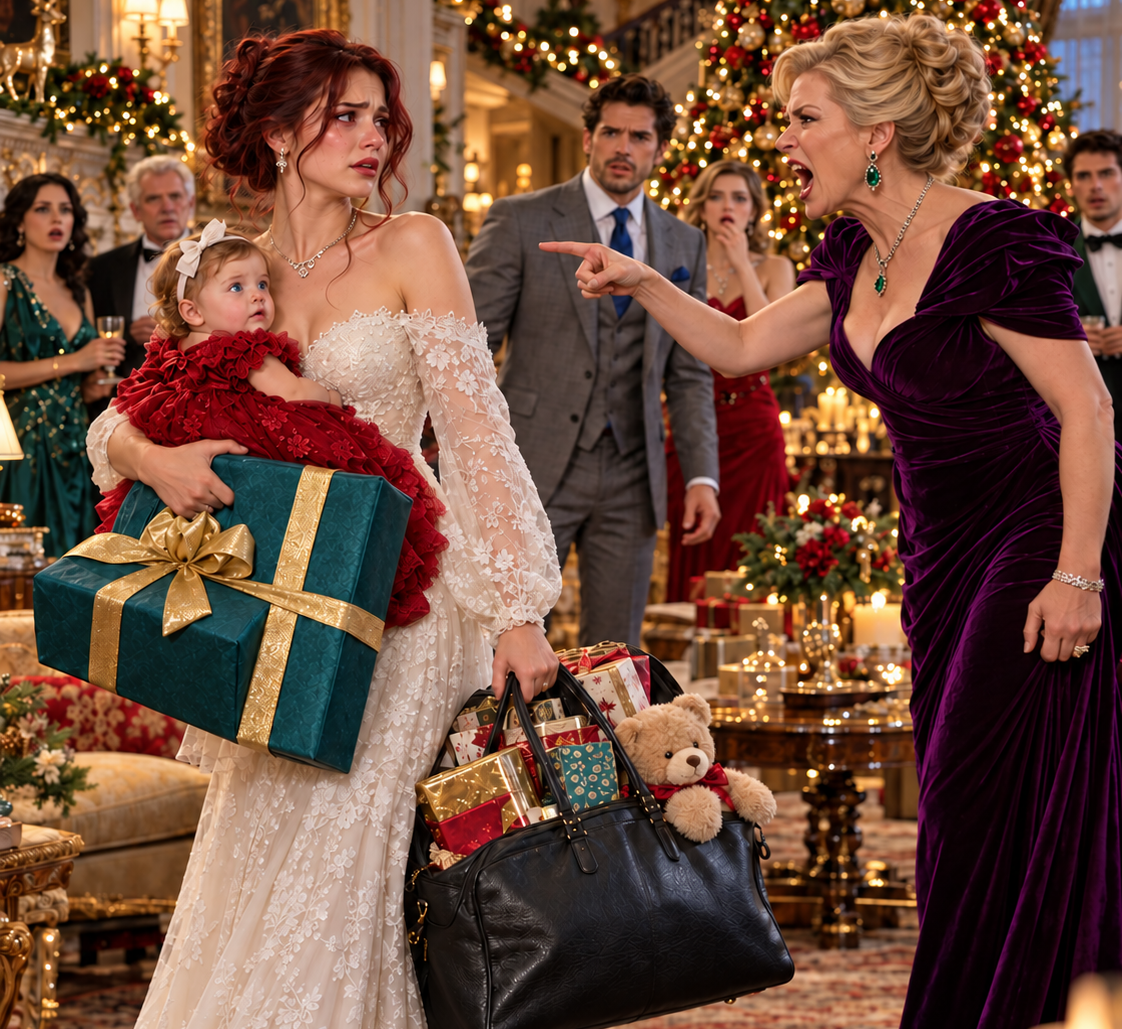
On Christmas Day, in front of twenty-two relatives, my mother looked at my eight-month-old daughter and said something I will never forget. I didn’t yell. I just picked up every present with Lily’s name on it and said, “This is the last Christmas my daughter will ever spend in this house.” My mother laughed. She thought I was bluffing. By New Year’s Day, she knew I wasn’t.
Part 1: The Red Velvet Dress
On Christmas Day, my mother made a remark about my eight-month-old daughter in front of our entire family.
For a few seconds, I was so stunned that I couldn’t speak.
Then I stood up, collected every present under the tree with my baby’s name on it, and said quietly,
“This is the last Christmas my daughter will ever spend in this house.”
My mother laughed.
She thought I was being dramatic.
But when my husband picked up the diaper bag and followed me toward the door, her expression changed.
And before New Year’s Day, she would find out that I meant every word.
That morning, as I buttoned my daughter, Lily, into her little red velvet dress, I kept repeating three promises to myself.
This year would be different.
My mother would be kind.
And if she wasn’t, I would simply ignore her.
Looking back, I should have known the third promise was the dangerous one. I had spent almost thirty-six years ignoring my mother. It had never once made anything better.
Lily sat on our bed between two folded blankets, kicking her socks off as fast as I could put them back on. She was eight months old, but strangers usually guessed five. She had narrow wrists, round cheeks, and a body that still looked impossibly small to me.
There was a reason for that.
Lily arrived six weeks early, on a rainy Tuesday in April. For twenty-three days, the neonatal intensive care unit at Nationwide Children’s Hospital in Columbus became our whole world. Instead of bringing my baby home, I learned which alarms meant “adjust the sensor” and which ones meant “get the nurse.” I memorized feeding times. I watched oxygen numbers the way other people watch the stock market.
Even now, certain smells pulled me back. Hand sanitizer. Warm formula. Coffee going cold in a paper cup beside a vinyl chair.
But that was behind us. At her last checkup, Dr. Patel had smiled at the growth chart and said, “She’s following her own curve, and it’s a good one.”
Lily smiled easily. She loved Motown. And whenever my husband made his ridiculous fish face, she laughed so hard her whole body shook.
To me, she was perfect.
Evan appeared in the doorway with the diaper bag over one shoulder and an armful of wrapped gifts.
“You’re thinking about your mother,” he said.
“I’m thinking about socks.”
“You’re thinking about your mother while holding socks.”
I didn’t argue.
He kissed Lily’s forehead. “It’s one afternoon. Dinner, presents, pictures. We’re home by seven.”
“You think she needs an argument to start a problem? She once turned a conversation about mashed potatoes into a forty-minute lecture about my posture.”
“Then we keep our coats by the door.”
To anyone driving past, Christmas at my parents’ house in Westerville, Ohio, looked like a greeting card. My mother, Carol Hale, made sure of that. White lights on the porch. Matching stockings. Three cinnamon candles burning at all times. She took dozens of photos every year and posted the best ones with captions like Blessed beyond measure.
But growing up with Carol taught me that beautiful decorations don’t make a warm house.
There was always a remark waiting somewhere.
When I was ten, she looked at my school picture and called it “unfortunate.” At sixteen, she told me my homecoming dress made my arms look “sturdy.” When I got a partial scholarship to Ohio State, she asked why Northwestern hadn’t wanted me. When I introduced Evan, she studied him for an uncomfortable moment and said, “Well. He seems dependable.”
She said it the way you’d describe a used dishwasher.
When Lily came early, I thought the fear might finally soften her. It didn’t. My mother visited the NICU exactly once. She stayed eleven minutes, said hospitals made her feel ill, and left before the nurse finished explaining Lily’s feeding tube.
After we brought Lily home, the questions started. Is she gaining enough? Are the doctors worried about her size? Are you sure you’re feeding her correctly?
Every question came wrapped in concern. Every conversation left me defending myself.
Halfway to my parents’ house, my phone buzzed.
“Don’t forget the green bean casserole. And put a bow in Lily’s hair. We need nice pictures.”
Not Merry Christmas. Not Drive safe.
I looked back at Lily, who was chewing on the ear of her stuffed reindeer, and I promised myself no one would ruin her first Christmas.
The driveway was full. My brother Mark’s Tahoe. My aunt’s Camry. Grandma Ruth’s old beige Buick in its usual spot by the mailbox.
Inside, it smelled like turkey, pine, and my mother’s expensive gardenia perfume. Twenty-two people were crammed into the living room.
“Oh my goodness, look at her!”
“That little dress!”
My sister-in-law, Jenna, reached her first. She had three kids of her own and had brought me lasagna twice a week while Lily was in the hospital. She never once treated my daughter’s size as something that needed explaining.
“Come here, gorgeous,” she said, and Lily grabbed her finger and grinned.
For forty minutes, I actually relaxed. My cousins asked about milestones. Mark handed Evan a beer. Lily went from lap to lap like a tiny celebrity. I sat on the arm of the sofa and thought, Maybe I worried for nothing.
Then I saw my mother standing in the dining room doorway.
She wore a pressed white blouse and snowflake earrings. Her eyes moved from Lily’s dress to her small hands, then to her face.
She smiled.
I knew that smile.
She walked over to Jenna, who was holding Lily by the tree, and said, loud enough for the whole room:
“Careful with that one, Jenna. She’s not built like your three. Look at those little arms—she’s still the size of a newborn.”
A few people laughed politely.
Then my mother turned toward me, still smiling.
“I keep telling Natalie, some women just aren’t built to carry a baby all the way. Lily got the short end of that.” She tilted her head at my daughter. “Let’s just hope that’s the only thing she ends up behind on. We’ll put her in the back for pictures so it doesn’t look like we’re holding a doll.”
The room went still. Someone’s fork tapped a plate.
Jenna’s arms tightened around Lily.
And Lily, who had no idea what had just been said about her, reached up and patted Jenna’s cheek with one tiny hand.
I couldn’t move.
It wasn’t that my mother had said something cruel. She had done that my whole life.
It was that she had aimed it at the one person I had sworn, in a hospital room at three in the morning, that I would always protect.
And in that moment, I understood something I’d spent decades avoiding.
I could keep pretending my mother’s words didn’t hurt me. But I would not teach my daughter to do the same.
I stood up.
I walked to the tree and started picking up every present with Lily’s name on it. The pink box from my aunt. The soft package from Grandma Ruth. The big one with the silver bow my mother had wrapped herself.
Evan saw my face and came to help without a word.
“What are you doing?” my mother asked.
I picked up the last gift and turned to her.
“This is the last Christmas my daughter will ever spend in this house.”
She laughed. A short, light laugh, the one she used when I was being “sensitive.”
“Oh, Natalie. Sit down. It was a joke.”
I took Lily from Jenna, who whispered, “Go,” so softly only I heard it.
Evan picked up the diaper bag. He walked beside me toward the front door.
That was when my mother’s smile started to slip.
Because this time, I wasn’t asking her to understand.
I wasn’t waiting for an explanation.
For the first time in my life, I was choosing my daughter’s peace over my mother’s approval.
And I had no idea yet that the real reason behind her words had been sitting in that house for almost forty years.
Part 2: Twenty-Two Witnesses
Nobody followed us outside.
The cold hit my face as I buckled Lily into her car seat. My hands were shaking so badly that it took me three tries to get the chest clip closed. Evan loaded the presents into the trunk and slid into the driver’s seat.
He didn’t start the car right away.
“You okay?”
“No.”
“Do you want to go back in?”
“No.”
He nodded once and pulled out of the driveway.
We drove in silence for almost four miles. Lily fell asleep before we reached the highway, her reindeer tucked under her chin.
Finally, I said, “Did I just ruin Christmas?”
Evan kept his eyes on the road. “Your mother called our daughter a doll in front of twenty-two people and suggested she’s going to be slow. You didn’t ruin anything. You just stopped pretending.”
I leaned my head against the window and cried for the first time that day. Quietly, so I wouldn’t wake Lily.
My phone started buzzing before we got home.
The first text was from my mother.
“That was incredibly embarrassing. Everyone is upset. Call me when you’re ready to apologize.”
The second was from my father.
“Nat, please call. Your mom didn’t mean it the way it sounded.”
The third was from Jenna.
“I’m so sorry. You did the right thing. Mark agrees, even if he’s too chicken to say it yet. Kiss that baby for me.”
I read Jenna’s text four times.
By eight o’clock, the family group chat, which my mother had named “Hale Yeah Family!!” years ago, had fourteen new messages. My aunt Diane wrote that Christmas was “about forgiveness.” A cousin I hadn’t spoken to since his wedding posted a GIF of a woman fainting. My mother wrote nothing in the group.
She didn’t have to.
At 9:47 p.m., she posted a photo on Facebook. It was the Christmas tree, gaps visible where Lily’s gifts had been. The caption read:
Some people only care about their own feelings. Praying for my daughter tonight. A mother’s heart breaks quietly. 🙏
Within an hour, it had sixty-three likes and comments from women at her church.
Sending you hugs, Carol.
Kids these days are so sensitive.
She’ll come around. They always do.
I set the phone face down on the kitchen counter.
Evan was standing at the sink, washing a bottle. “She posted something, didn’t she?”
“She’s praying for me.”
“Generous.”
I almost laughed.
My father called the next morning at 8:15. Tom Hale had worked thirty-one years as a building inspector for the city of Columbus. He was gentle and steady and had spent most of my childhood standing slightly behind my mother, the way you stand behind a door in a storm.
“Hi, sweetheart.”
“Hi, Dad.”
“How’s my granddaughter?”
“She’s good. She ate sweet potatoes for the first time. She hated them.”
He chuckled. Then he went quiet. “Nat, your mother’s very upset.”
“I know. I saw the post.”
“She shouldn’t have posted that.”
“She shouldn’t have said what she said.”
He let out a long breath. “No. She shouldn’t have.”
It was the first time I could remember my father admitting my mother was wrong. I waited for the but.
It came.
“But she wants you there on New Year’s Day. For brunch. Like always.”
New Year’s Day brunch was my mother’s other great tradition. Eggs Benedict, mimosas, the whole family at the long table. For as long as I could remember, nobody had missed it.
“She said,” my father continued carefully, “that if you bring Lily and apologize in front of everyone, she’ll put this behind her.”
I closed my eyes.
“She’ll put it behind her.”
“I know how it sounds.”
“Dad, did you hear what she said about Lily?”
Another long silence.
“I heard it,” he said. “I’ve been hearing things like that for forty years, honey.”
He said it so quietly that I wasn’t sure he’d meant to say it out loud.
“Then you know I’m not coming.”
“Nat—”
“I’m not apologizing for protecting my daughter. And I’m not bringing her back there. I meant it.”
He didn’t argue. He just said, “Okay,” in a voice that sounded very tired, and asked me to send him a picture of Lily hating sweet potatoes.
I sent three.
The next two days were the hardest.
My mother didn’t call me. She called everyone else. My aunt Diane called to tell me my mother had “cried all night.” My cousin Kayla texted that I was “making Grandma Carol look bad on Facebook,” even though I hadn’t posted a single word.
Mark finally called on the evening of December 27th.
“Hey.”
“Hey.”
“Jenna says I’m a coward.”
“Are you?”
He sighed. “Probably. Look, Nat, I’m not calling to tell you to apologize. Mom’s been doing this since we were kids. You just always got more of it than I did.”
“Why do you think that is?”
“I don’t know,” he said. Then, after a pause, “Grandma Ruth might. She left early on Christmas. Right after you did. She didn’t even stay for pie.”
That was strange. Grandma Ruth never left before pie.
“She say anything?”
“Just one thing. When Mom said that line, the ‘some women aren’t built for it’ thing, Grandma set her coffee down and said, ‘Carol. Not again.’ Then she got her coat.”
Not again.
I hadn’t heard it. I’d been too busy walking out the door.
The next morning, December 28th, at 10:30, my phone rang. The caller ID said GRANDMA RUTH – LANDLINE.
My grandmother was eighty-four. She still lived alone in the same small brick house in Delaware, Ohio, where my mother grew up. She still played bridge on Thursdays and still drove that beige Buick at exactly the speed limit.
“Natalie,” she said. “Are you home today?”
“Yes. Is everything okay?”
“No,” she said. “It hasn’t been okay for a very long time. And that’s my fault, not yours.”
My heart started to pound.
“Grandma, what’s going on?”
“There’s something you should know about your mother,” she said. “But not on the phone. I’ll be there at one.”
She hung up before I could ask anything else.
Part 3: The Cedar Box
Grandma Ruth arrived at 12:56.
She was wearing her good wool coat and carrying a small cedar box under one arm, the kind people used to keep handkerchiefs in. She hugged me at the door longer than usual. Then she crossed the living room, sat on the edge of our couch, and held out her hands.
“May I?”
I gave her Lily.
My grandmother looked at my daughter for a long time. Lily stared back and then grabbed a fistful of her pearl necklace.
“You are a strong little girl,” Grandma Ruth said softly. “Don’t let anybody tell you different.”
Evan brought her coffee with two sugars, the way she liked it, then quietly took Lily to the nursery for her nap. He looked back at me from the hallway. I nodded.
When we were alone, Grandma set the cedar box on the coffee table.
“Did your mother ever tell you that you had a brother before Mark?”
I stared at her.
“No.”
“No,” she repeated. “I didn’t think so.”
She opened the box.
Inside, on a folded piece of yellowed tissue paper, was a tiny knitted cap. Pale blue. Small enough to fit over my fist. Beside it lay a hospital bracelet, the plastic gone cloudy with age.
I picked it up. The typed letters were faded but readable.
BABY BOY HALE
DOB 03/09/1987
3 LBS 1 OZ
March 9th.
Every year on March 9th, my mother went to bed early with a “migraine.” Every year on March 9th, my father left the house before breakfast and didn’t come home until afternoon. I’d always assumed he was visiting his parents’ graves at Oak Grove Cemetery.
He was. But not only theirs.
“His name was Daniel,” my grandmother said. “He came eleven weeks early. He lived six days.”
I couldn’t speak.
“Your mother was twenty-six,” she went on. “She’d had a perfect pregnancy until she didn’t. They did everything they could at the time. It was 1987. Babies that small, back then…” She shook her head. “Your father held him. Your mother couldn’t. She was too sick after the delivery. By the time she was well enough to sit up, he was gone.”
I set the bracelet back on the tissue paper very carefully, the way you’d put back something that might break.
“Why didn’t anyone tell me?”
“Because your mother made us promise. She took every picture out of the albums. She gave away the crib. When you were born three years later, she told everyone she was starting fresh.” Grandma Ruth looked down at her coffee. “And because I was ashamed.”
“Of what?”
She was quiet for so long that I thought she might not answer.
“Two weeks after the funeral,” my grandmother said, “your mother came to my house. She sat at my kitchen table and asked me what she’d done wrong. Whether it was something she ate. Whether she’d worked too hard at the bank. Whether it was her fault.”
She turned her cup slowly on the saucer.
“And I told her the thing my own mother told me after I lost a baby in 1959. I said, ‘Some women just aren’t built to carry a baby all the way, Carol. It’s nobody’s fault. It’s just how you’re made.’”
The words landed in the room like a dropped plate.
Some women just aren’t built to carry a baby all the way.
My mother had said it to me in front of twenty-two people three days earlier. Word for word.
“I thought I was comforting her,” Grandma Ruth said. “That’s what I told myself for years. But I saw her face when I said it. I watched her believe it. And I never took it back.”
“Grandma…”
“When she got pregnant with you, she was terrified. She weighed herself every morning. She wouldn’t let anyone throw her a shower until she was thirty-eight weeks. And when you were born healthy, seven pounds, nine ounces, she just—” Grandma’s voice cracked for the first time. “She started picking at you. Your hair. Your smile. Your arms. As if she had to keep finding something wrong before the world did.”
I thought about my school picture. My homecoming dress. Every comment I’d spent my life trying to understand.
“Mark got less of it,” I said slowly. “Because he was a boy.”
“Because he didn’t look like her,” my grandmother said. “You did. You do.”
I stood up and walked to the window because I didn’t know what else to do with my body.
Outside, our neighbor’s inflatable snowman was slowly sagging in the cold.
Pieces I had never understood started clicking into place.
The questions about Lily’s weight, asked with an intensity I’d always taken as criticism.
The eleven minutes in the NICU, and how she’d stood near the door the whole time, not looking at the incubator, saying hospitals made her ill.
March 9th.
And on Christmas Day, the way her eyes had moved from Lily’s dress to her small wrists before she said anything at all.
“When Lily came early,” Grandma Ruth said behind me, “I knew. I knew what it would do to her. I should have said something then. Instead, I sat in that living room on Christmas and heard my own words come out of my daughter’s mouth, aimed at my great-granddaughter.”
She stood up, a little unsteadily, and came to stand beside me.
“I said, ‘Not again,’ because I’ve heard her say it before. To herself. Over the phone, after your first ultrasound. She told me, ‘I hope Natalie’s built better than I was.’ And I said nothing. I’ve been saying nothing for thirty-nine years.”
I turned to her. Her eyes were wet, but she wasn’t crying. Ruth Gallagher had never been a crier.
“Why are you telling me now?”
“Because you did on Christmas what I should have done in 1987,” she said. “You stood up. And I don’t want you to go back because you feel sorry for her. But I don’t want you to stay gone because you don’t know the truth, either.”
She put the blue cap back in the box and closed the lid.
“What you do with it is your choice, sweetheart. Not mine. And not hers.”
After she left, I sat on the nursery floor next to Lily’s crib and watched my daughter sleep for almost an hour.
I thought about a twenty-six-year-old woman sitting at a kitchen table, asking her mother if it was her fault.
I thought about a baby boy who weighed three pounds and one ounce.
And I thought about my mother’s voice on Christmas, light and amused, saying my daughter looked like a doll.
All of it was true at the same time.
That was the hardest part.
Because now I understood why my mother had said it.
And I still didn’t know if understanding was supposed to change anything at all.
Part 4: What It Costs
That night, I told Evan everything.
We sat at the kitchen table with two mugs of tea going cold. He listened without interrupting, the way he always did. When I finished, he was quiet for a while.
“That’s awful,” he finally said. “For her. For your dad. For your grandma.”
“I know.”
“And it still doesn’t make what she said okay.”
“I know that too.” I pressed my palms against my eyes. “That’s the problem. Part of me wants to drive over there right now and hug her. And part of me wants to make sure she never says another word about Lily as long as she lives.”
“Those aren’t opposites,” Evan said.
I looked at him.
“You can feel sorry for her and still keep the door closed until she does the work,” he said. “Grief explains it. It doesn’t give her a free pass to pass it down.”
Pass it down.
My grandmother’s mother to my grandmother. My grandmother to my mother. My mother to me.
And on Christmas Day, my mother to Lily.
Four generations of women told, in one way or another, that their bodies had failed.
I thought about Lily at sixteen, standing in front of a mirror in a homecoming dress, hearing a voice in her head that wasn’t her own.
“No,” I said out loud.
Evan raised an eyebrow.
“It stops with me,” I said. “That’s the choice. Not whether I forgive her. Whether this ends here.”
There was a cost, and I knew it.
If I held the line, I would lose New Year’s brunch, Christmas Eve candlelight service at my mother’s church, birthday dinners at Olive Garden, the whole shape of the family calendar I’d lived inside since I was born. I would probably lose my aunt Diane and half my cousins, who would believe my mother’s version because it was easier. I would put my father in the middle of a fight he’d been avoiding for forty years.
And I would have to watch my mother’s Facebook page fill with prayers for the daughter who broke her heart.
If I gave in, I’d get all of it back by Friday. I just had to stand at the long table, hold Lily on my hip, and say I was sorry.
And then I would have to hear the next remark. And the one after that.
And one day, Lily would hear them too, and understand them.
On December 29th, I wrote my mother a letter.
Not a text. Not a Facebook comment. A real letter, on the cream-colored stationery Grandma Ruth had given me for my birthday years ago and I’d never used.
It took me four drafts and most of the evening. The final version was one page.
Mom,
Grandma Ruth came to see me. She told me about Daniel.
I am so sorry. I’m sorry you lost him. I’m sorry you couldn’t hold him. I’m sorry about what Grandma said to you afterward, and that you carried it alone for thirty-nine years. If I had known, I would have tried to understand you sooner.
But I need you to hear this, too.
What you said about Lily on Christmas was not a joke. It was the same thing someone said to you when you were at your most broken. You know how much it hurt, because you’ve been hurting from it my whole life. And you said it anyway, to my daughter, in front of everyone.
I will not bring her back to your house, and I will not apologize for leaving.
Evan and I are hosting New Year’s Day at our house this year. Brunch is at eleven. Everyone in the family is invited, including Dad.
You are invited, too, on one condition. Don’t come to make peace with me. Come only if you’re ready to say, out loud, that Lily is not too small, not behind, and not a mistake. If you can’t say that yet, I’ll understand. But then please don’t come.
I love you. That has never been the problem.
Natalie
I read it to Evan. He nodded and said nothing, which meant it was right.
The next morning, December 30th, I drove to my grandmother’s house in Delaware and asked her to deliver it.
“You could mail it,” she said.
“She’d throw it away unopened. She won’t throw it away if it’s from you.”
Grandma Ruth looked at the envelope in my hand for a long moment.
“No,” she agreed. “She won’t.”
Then I sent a message to the family group chat. I rewrote it eleven times before I pressed send.
Hi everyone. I’m not going to discuss what happened on Christmas here. But Evan and I are hosting New Year’s Day brunch at our house this year at 11 a.m. Pancakes, bacon, too much coffee. Every single one of you is welcome. No hard feelings either way.
For two hours, nobody responded.
Then Jenna wrote: We’ll be there. I’m bringing the cinnamon rolls. Mark’s bringing the mimosas and an apology.
Mark wrote: Confirmed on both.
My cousin Tyler, who was nineteen and who had once been told by my mother that he “dressed like a gas station attendant,” wrote: Count me in. Can I bring my girlfriend?
Aunt Diane wrote nothing.
Neither did my mother.
My father called that night at 10:40, after my mother had gone to bed.
“Your grandmother came by,” he said. “She gave your mom your letter.”
My heart thudded. “Did she read it?”
“She read it in the kitchen. Then she went into our bedroom and closed the door. She hasn’t come out except to get water.”
“Dad, I’m sorry. I didn’t mean to—”
“Don’t,” he said. “Don’t you apologize.”
I heard him take a breath.
“Nat, I’ve been going to Oak Grove every March 9th for thirty-nine years. Alone. Your mother has never come with me. Not once. She wouldn’t even let me say his name in the house.” His voice wavered. “I let her decide how all of us were going to carry it. And look where that got us. Look what it did to you.”
“Dad.”
“I’m coming to your brunch tomorrow,” he said. “Whether she does or not. I already told her.”
I sat down on the stairs.
My father had never, in my entire life, gone anywhere my mother refused to go.
“What did she say?”
“She didn’t say anything,” he said. “She just looked at me like she’d never seen me before.”
Part 5: New Year’s Day
On New Year’s morning, I woke up at 5:50 and couldn’t go back to sleep.
I made pancake batter. I fried two pounds of bacon. I set our dining table, which only sat six, and then pushed it against a borrowed folding table from our neighbor, Mrs. Okafor, and covered both with a white tablecloth so it looked almost like one long table.
At 10:15, I dressed Lily in the red velvet dress again.
“Second chance,” I told her.
She tried to eat the button.
Jenna and Mark arrived first, with three kids, a dozen cinnamon rolls, and two bottles of champagne. Mark hugged me hard at the door and said, into my hair, “I should’ve said something on Christmas. I’m sorry.”
“You’re here now.”
“Jenna made me practice that in the car.”
“I can tell.”
Tyler came with his girlfriend, a quiet nursing student named Priya who took one look at Lily and said, “Oh, she was a NICU baby? My little sister was too. Thirty-one weeks. She’s in tenth grade now and runs cross-country.”
I could have hugged her.
My father came at 10:58. He wore his good sweater and carried a poinsettia. He handed it to me, then stood in the doorway, looking around our small, crowded, noisy house like a man stepping off a boat onto solid ground.
Then he saw Lily on Evan’s hip and his whole face changed.
Grandma Ruth came last, at 11:20, and took the most comfortable chair as if she’d reserved it. Lily went to her immediately.
By noon, there were sixteen people in our house. It was loud. The pancakes were uneven. Somebody spilled orange juice on the carpet. Mark’s youngest, Owen, fed half a cinnamon roll to the dog next door through the fence.
It was the best family meal I could remember.
But every time a car slowed on our street, I looked at the window.
And every time, it wasn’t her.
By three o’clock, most people had gone. Jenna stayed to help with dishes. My father sat on the floor with Lily, stacking plastic cups so she could knock them down. Grandma Ruth dozed in her chair.
“She’s not coming,” I said quietly to Jenna at the sink.
“Maybe not today,” Jenna said. “But you meant what you wrote. That’s what matters.”
I nodded. I tried to believe it.
At 4:40 p.m., the doorbell rang.
Evan answered it.
He turned and looked at me over his shoulder, and I knew before he said a word.
My mother stood on our front porch.
She wasn’t wearing makeup. I had never in my life seen my mother leave the house without makeup. Her hair was pulled back in a plain clip. She was wearing an old navy coat I didn’t recognize, and she was holding the small cedar box against her chest with both hands.
She looked smaller than I’d ever seen her.
“Hi, Natalie.”
“Hi, Mom.”
Behind me, I heard my father stand up.
She didn’t try to come in. She just stood on the welcome mat, gripping the box.
“I almost didn’t come,” she said. “I sat in the car at the end of your street for an hour and ten minutes.”
“I saw a car,” Evan said gently. “I thought it was a neighbor.”
My mother almost smiled. Then she didn’t.
“I read your letter nine times,” she said. “I kept trying to find the part where you were being unfair. So I could be angry.” She shook her head. “I couldn’t find it.”
I didn’t say anything. I’d learned, in the last week, that I didn’t have to fill every silence.
“When they put Lily in that incubator,” my mother said, “and I walked into that room, the machines were the same. The beeping. The smell. Everything. It was 1987 again. I stood by the door for eleven minutes and all I could think was, It’s happening again, and it’s my fault, because she got it from me.“
Her voice was steady, but her hands weren’t.
“Every time I looked at Lily after that, I saw him. And I was so afraid. And I don’t know how to be afraid. I only know how to find what’s wrong before somebody else does.” She swallowed. “I’ve been doing it to you since the day you were born. I told myself it was for your own good. It wasn’t. It was for mine.”
My eyes stung. I didn’t look away.
“On Christmas,” she said, “I heard my mother’s voice come out of my mouth. And I heard myself laugh after it. I’ve been hearing that laugh for a week.”
Behind me, Grandma Ruth had woken up. She didn’t say a word. She just pressed her hand flat against her chest.
My mother looked past me, into the living room, where Lily was sitting on the rug in her red dress, holding a plastic cup in each hand.
“Lily is not too small,” my mother said. Her voice broke on the word small. “She is not behind. She is not a doll. She is not a mistake.” She took a breath. “And neither were you. And neither—” she looked down at the cedar box, “—neither was I. I’m so sorry, Natalie. I’m sorry for Christmas. And I’m sorry for all the years before it.”
It was the first real apology I had ever heard my mother give.
No but. No if you were hurt. No I was only joking.
I wanted to throw my arms around her. I wanted to tell her it was all okay.
But it wasn’t all okay. Not yet. And Lily deserved more than one good afternoon.
“Thank you,” I said. “I believe you mean it.”
She nodded, waiting.
“Here’s what I need,” I said. My voice shook, but I kept going. “You don’t comment on Lily’s body. Not her size, not her weight, not how she looks in pictures. Ever. If you’re worried about her health, you ask me, privately, and you take my answer. The first time it happens, we leave. No arguments, no second chances that day.”
“Okay.”
“And Mom, I think you need to talk to someone. A real counselor. About Daniel. Not for me. For you.”
That one landed hard. I watched her absorb it. For a second, I saw the old Carol rise up, the one who would have said, I don’t need a stranger telling me how to feel.
Then she looked at my father, standing in the hallway behind me.
“Tom found one,” she said quietly. “Last night. A grief counselor in Worthington. I have an appointment on the eighth.”
My father’s eyes were wet. “She asked me to find one,” he said. “At two in the morning.”
My mother held out the cedar box.
“Your grandmother said you’d seen this,” she said. “I’d like you to keep it. I’ve kept it in the back of my closet for thirty-nine years. I don’t want it in the dark anymore.”
I took it with both hands.
“Can I come in?” she asked. Then, quickly, “Just for a few minutes. I won’t stay.”
I stepped aside.
She walked into our living room and stopped a few feet from the rug. Lily looked up at her with total, uncomplicated curiosity.
My mother turned to me.
“May I hold her?”
In thirty-five years, my mother had never once asked me for permission to do anything.
“Yes,” I said.
She knelt down slowly, her knees cracking, and picked Lily up the way you’d lift something you were afraid to break. Lily studied her face, then reached up and grabbed one of her earrings.
My mother laughed. Not the light, sharp laugh from Christmas. A real one, wet and surprised.
“She’s strong,” my mother whispered.
“She is,” I said.
My mother held her for nine minutes. Then she handed her back, kissed my cheek, and left before the sun went down, just like she’d promised.
One Year Later
That was almost a year ago.
My mother kept her appointment on January 8th. She’s gone every other Thursday since. She doesn’t talk to me about what happens there, and I don’t ask. But in February, she called me and said, “My counselor says I’m allowed to stop apologizing every phone call,” and I laughed for the first time in a long time with her.
On March 9th, my parents drove to Oak Grove Cemetery together for the first time in thirty-nine years. Evan, Lily, and I met them there. It was cold and gray and the ground was still hard. My mother placed the little blue cap on a small, flat stone that read DANIEL THOMAS HALE. She stood there for a long time with her hand on my father’s arm.
Then she took it back, wrapped it in fresh tissue paper, and gave it to me again.
“I want it with you,” she said. “So somebody in this family keeps it in the light.”
She has broken the rule once. In May, at Lily’s first birthday party, she looked at the cake and said, “Well, she certainly won’t need a big slice—” and stopped. Mid-sentence. She closed her mouth, looked at me, and said, “I’m sorry. That was the old voice. Can I try again?”
I said yes.
She said, “She can have the biggest slice she wants.”
Lily, it turned out, wanted most of the cake. On her face.
Her aunt Diane still doesn’t speak to me. Two of my cousins unfollowed me. The Facebook post from Christmas is still up. I’ve learned to live with all of it.
Last night was Christmas.
There were no gaps under our tree this year. There was a pile of presents with Lily’s name on them, and she spent most of the morning ignoring all of them in favor of a cardboard box.
We hosted. Twenty people crowded into our small house. The turkey was slightly dry. Grandma Ruth won at Uno and pretended not to gloat.
My mother arrived at two o’clock with a green bean casserole and no instructions.
Lily, who is twenty months old now and still smaller than most kids her age, toddled straight across the living room toward her in a little red velvet dress, one size up.
My mother put down the dish, crouched to Lily’s level, and opened her arms.
But first, she looked at me.
Just for a second.
Asking.
I nodded.
It had been the last Christmas my daughter ever spent in that house. I meant every word, and I kept my promise.
What I didn’t know, standing at that front door a year ago with my arms full of presents, was that leaving wasn’t the end of the story.
It was the only way to give my mother a door she could finally walk through.
Have you ever had to choose between keeping the peace and protecting someone you love? What would you have done in my place?
Disclaimer: This fictional story is for entertainment only. It does not represent any person or organization and does not encourage inappropriate behavior. Created with AI assistance.


