

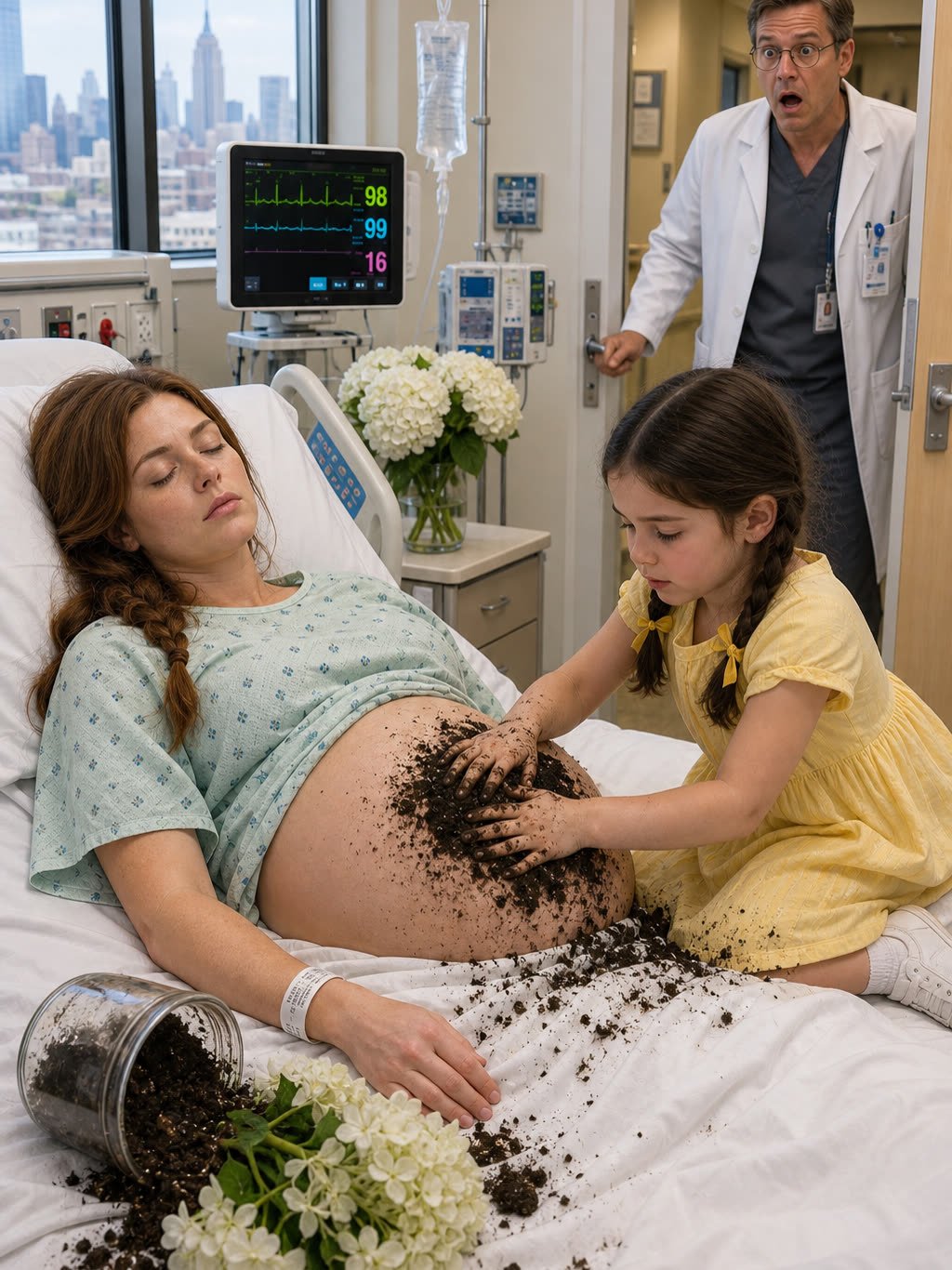
The jar was small enough to fit in a seven-year-old’s two hands, and it held dirt from a town no map at St. Mary’s could name. “Wake up, Miss Rachel,” she whispered, pressing it to my wife’s belly. After eight months of silence, Rachel’s fingers curled. Then her eyes opened, locked on the child, and she gripped my wrist: “The people who did this to me are still inside this hospital.”
Part 1: The Jar of Dark Soil
Room 312 had a smell I could have picked out blindfolded. Floor wax, warm plastic, and the sweet, sad scent of the hydrangeas I replaced every Sunday.
It was a gray Tuesday in March, a little after four. Rain was ticking against the window, and the monitor above my wife’s bed was doing what it had done for two hundred and forty-some days. Green line. Blue line. Numbers that never surprised anyone.
I was reading aloud from a paperback with a cracked spine, the third mystery in a series Rachel loved. I had read it once already, back in October, and I started it again because I couldn’t stand the quiet.
“Chapter nine,” I told her. “The butler finally lies about the timeline. You called that on page forty, remember? You made me bet you a dinner.”
Nothing. Her chest rose and fell. Under the blanket, the curve of our son pressed against her gown, and now and then I felt him shift when I laid my palm there. That was the only conversation I got.
Rachel was thirty-two years old. She had been unconscious since July, and she had been twenty-four weeks pregnant when she went under. Now she was almost thirty-two weeks, and everyone at St. Mary’s Medical Center spoke about the baby in careful, conditional sentences.
Dr. Halloran, the neurologist, had been the kindest of them. Two weeks earlier he had pulled a stool up next to me in the hallway and taken off his wire glasses.
“Owen, I want you to be prepared,” he said. “It’s very possible this baby will be born before his mother wakes up.”
“Possible,” I repeated.
“Possible,” he agreed. “I won’t tell you more than I know.”
I had gone home that night and stood in the nursery doorway for an hour. The crib was assembled, white, with a mobile of paper cranes Rachel’s sister had folded. I had a mortgage on a two-bedroom in Clintonville, a job teaching high school shop that paid fine until the medical bills began, and a stack of insurance letters on the kitchen counter that I opened with my eyes half closed.
I did not stop reading to her, though. That was the one thing nobody could bill me for.
“Excuse me.”
The voice was small and perfectly steady. I looked up.
A girl stood in the doorway. Seven, maybe, with dark hair in two tidy braids tied off with yellow ribbon, wearing a cotton dress so faded the yellow had almost gone to cream. Her white sneakers were wet, and she held a glass jar with both hands, the way you carry something that might spill.
“Hi, sweetheart.” I closed the book on my thumb. “Are you lost? Who are you here with?”
“My name is Inez,” she said. “My grandma cleans at night. I’m not lost.”
“Okay, Inez. But this isn’t a good room for visiting. Why don’t we find a nurse and get you back to your grandma?”
She didn’t move. She lifted the jar so I could see it. Inside was dark, damp soil, the kind that clumps in your fingers after a rain.
“This is special dirt,” she said. “It’s from the town where my great-grandma grew up. My grandma says it can help her.”
She nodded toward the bed.
I should have walked her out. Every sensible part of me knew it. But eight months had worn the sensible parts down to thin paper.
“How could dirt help my wife?” I asked. It came out softer than I meant.
Inez thought about it as if the question deserved real thought.
“My great-grandma always said the earth remembers how to heal,” she said. “Especially mothers.”
The rain thickened against the glass. Down the hall a cart rattled past and kept going. Nobody came to the door.
I have gone over that moment more times than I can count, and I still can’t explain what I did. I had spent months listening to people with letters after their names tell me what was likely. This was a child with a jar, and she looked at me like I was the one who needed convincing.
“Just a little,” I heard myself say. “Okay?”
“Just a little,” she agreed.
She set the jar on the edge of the mattress, unscrewed the lid, and scooped out a small handful. The soil was cool and smelled like a creek bank after a storm. She stepped to the bed, rose on her toes, and laid it gently on the high curve of Rachel’s belly, right over the blanket’s edge.
Then she leaned close to my wife’s ear.
“Wake up, Miss Rachel,” she whispered. “Your little boy is waiting for you.”
One second.
Two.
Three.
Rachel’s index finger twitched against the sheet.
I thought I had imagined it. I had imagined it before, a hundred times, in the long hours after midnight. But then the whole hand moved, the fingers curling slowly inward, as if closing around something I couldn’t see.
“Rachel?” My voice cracked in half. “Rachel!”
The monitor above her shrieked. Her heart rate leapt, then leapt again, and the alarm brought footsteps pounding in the hall. A nurse burst in, then two more, then Dr. Halloran, still holding a chart, his glasses sliding down his nose.
“Check her vitals!” he barked. “Now!”
Someone pulled me back by the elbow. I let them. I stood against the wall with my hands over my mouth and watched my wife’s eyelids flutter like moth wings.
Then they opened.
Eight months of dark, and her eyes opened gray-green and wet and wildly, impossibly present.
I stepped forward. “Rach, it’s me. It’s Owen. I’m here, baby.”
She didn’t look at me.
She didn’t look down at her belly, or at the doctors, or at the ceiling. She stared across the room at the small girl in the faded dress, and the color drained from her face so fast that a nurse reached for the oxygen.
Her hand shot out and locked around my wrist. Her grip was weak, but it shook with something stronger than strength.
“Don’t let them take our baby,” she rasped. The words came out like gravel dragged over concrete.
“Take him? Who, Rach? Who would take him?”
Her eyes slid toward the open door, toward the busy corridor beyond it, and when she spoke again her voice dropped so low that only I could hear.
“The people who did this to me,” she said, “are still inside this hospital.”
Part 2: The Girl Who Wasn’t on Any List
The next forty-eight hours came apart in my memory like wet newspaper. Blood draws, scans, a neurologist from Cleveland on a speakerphone, a respiratory therapist who cried and apologized for crying. They called it spontaneous neurological recovery, which was a polite way of saying nobody had a better word.
Dr. Halloran stood at the foot of her bed on the second morning, flipping through printouts as if one of them might change its answer.
“The swelling has resolved far faster than any model predicts,” he told me, lowering his voice. “Her speech is coherent. Her memory seems intact. And the baby looks strong.”
“So what do I do?”
“You hold her hand,” he said, and he almost smiled. “I’d say that’s what you’ve been doing all along.”
But Rachel would not tell me what she meant.
I had asked her three times. The first time she said she was too tired. The second time she looked at the glass panel beside the door, where nurses passed back and forth like fish in a tank, and shook her head slightly.
The third time she whispered, “Not until I know who’s listening.”
I didn’t push. I had waited eight months for her to speak at all, and I wasn’t about to spend her first words on an argument.
Still, the question sat in my chest like a swallowed stone. And on the afternoon of the second day, it got heavier.
A knock came, and the chief of medicine, Dr. Gerald Pryor, stepped in. He was a tall man in his early sixties, silver hair combed back, a gray mustache trimmed to the millimeter. He had a bouquet of white roses in one hand and the warm, practiced smile of a man who had delivered hard news in many hallways.
“Mrs. Whitfield. What a wonderful surprise.” He set the roses on the windowsill. “We were all praying, you know.”
Rachel didn’t answer. Her hand, resting on the blanket, closed slowly into a fist.
“Owen,” he said, turning to me, “you’ve shown extraordinary devotion. Whatever you need, you let me know.”
“Thank you, Dr. Pryor.”
He lingered a beat too long. His eyes moved over Rachel’s face, then over the monitor, as if checking a number he had expected to see lower. Then he patted the footboard twice and left.
When the door clicked shut, my wife exhaled a breath she seemed to have been holding for the whole visit.
“Rach,” I said carefully, “was that him? Is that who you were talking about?”
Her eyes flicked toward the glass panel. She shook her head once, a tiny motion. Not here.
I filed it away. I’m a shop teacher. I know the difference between a crack you can ignore and one that means the whole beam is about to go.
Three weeks later, on a Thursday morning, our son was born.
I wish I could describe that room properly. The lights were bright, the doctors were calm, and Rachel gripped the rail with white knuckles and swore at me in two languages, one of which I think she invented. Then there was a cry, thin and furious, and a nurse laid a slick, red-faced baby on my wife’s chest.
His lungs were remarkable. His fists were small and angry. He opened his eyes just long enough to glare at the whole world, then closed them.
“Theo,” Rachel breathed. “Theodore Owen Whitfield.”
“You’re sure?”
“I picked it in the dark,” she said, and laughed, and wept, and did both at once.
I kissed the top of her head, and I don’t think I have ever felt so unmade and so whole at the same time.
That night, the storm came back. A spring rain stitched itself across the window of the maternity wing on the third floor, and Theo slept in his clear bassinet with a little knit cap pulled down over his ears. Rachel lay on her side, watching him breathe.
Eventually she said, “Owen? I need to tell you something about the coma.”
I pulled my chair close and laced my fingers through hers. “Anything.”
“The doctors say I probably wasn’t aware of anything.” She swallowed. “But I was. It wasn’t sleep. It was like being locked in a room with no walls, no light, no floor. I couldn’t move. I couldn’t even find my own hands. I thought I had died and nobody had told me.”
“God, Rach.”
“But somebody came,” she said. “A little girl.”
The hair stood up on my arms.
“She sat with me in that dark. I never saw her face, exactly, but I always knew she was there. She held my hand. She sang me songs, half in English and half in Spanish. She told me about a river with white flowers along the bank, and how babies can feel love before they’re ever born.”
Rachel’s voice thinned. “And she said the same thing over and over. ‘Don’t give up, Miss Rachel. Your husband is crying. You have to go back to him.’”
I couldn’t speak. The room tilted.
“Rachel,” I finally said, “I saw her. Her name was Inez. She came in with a jar of dirt and put it on your belly. She wore a yellow dress. She said her grandmother cleans here at night.”
Her eyes went wide. “You saw her. Then I didn’t make her up.”
“I saw her with my own eyes.”
She pressed the back of her hand to her mouth. I stood so quickly the chair scraped.
“I’m going to find them,” I said. “Both of them. I want to say thank you properly. I want to bring that kid a ridiculous amount of ice cream.”
“Owen, wait.”
But I was already at the door.
The elevator took forever. On the second floor I turned toward Room 204, the cramped supply room where the night cleaning crew gathered. I had passed it in the small hours more times than I could count, usually with a vending-machine coffee going cold in my hand, and I had always heard low voices and the squeak of a mop bucket behind the door.
I pushed it open.
The room was empty. Not tidy, not cleared out for the evening. Empty. Bare shelves, bare floor, and a pale rectangle on the wall where a bulletin board used to hang. The air had the flat, undisturbed taste of a room nobody had used in years.
I stood in the doorway until my ears rang.
Then I went downstairs to the lobby, where Gloria worked the front desk on the night shift. She had a reading chain of tiny beads around her neck and a way of looking at you over her glasses that made you feel like the only person in the building.
“Gloria,” I said, trying to sound like a man with a normal question, “I’m looking for a cleaning lady named Rivera. She works nights. Sometimes she brings her granddaughter, Inez. The girl wears yellow.”
Gloria stopped typing. She took off her glasses.
“Rivera?” she said slowly. “Honey, I’ve worked this desk for fourteen years. We don’t have a Rivera.”
“She’s older, Hispanic, quiet. The little girl was in my wife’s room.”
“Our night custodian is Walt Dempsey. He’s been here a dozen years, and he’s about as far from a grandmother as you can get.” She tapped a few keys, frowning. “And the hospital doesn’t allow kids on night shifts, Owen. Not ever. That’s a hard rule.”
I laughed, because there was nothing else to do. “I talked to her. She was in the room for five minutes.”
“I’m pulling up payroll right now,” Gloria said gently. “I’m looking at every name. There’s no Rivera.”
I backed away from the counter. My mind kept offering me reasonable explanations, like a clerk offering receipts, and none of them fit what I had stood and watched.
I took the stairs back up, two at a time, because I couldn’t stand the elevator. When I walked into our room, Rachel was sitting up with Theo against her chest, her face turned toward me, bright with hope.
“Did you find her?”
I closed the door slowly. “There’s no record of her, Rach. Or her grandmother. Gloria says no one named Rivera has ever worked here.”
The hope slid off her face. She looked down at our son, and then her gaze drifted past my shoulder to the window.
I turned around.
The rain had fogged the glass. And in the fog, perfectly clear, was a small handprint, five little fingers and a round palm, smeared with mud.
My stomach dropped through the floor.
Because the print wasn’t on the inside of the window.
It was on the outside.
And we were on the third floor.
Part 3: The Woman in the 1997 Photograph
I called security before I let myself think. Two officers arrived within minutes, one tall and tired, the other young enough that his badge still looked new. A nurse followed, carrying a flashlight she never needed.
They examined the window. They leaned out as far as the frame allowed and shone light down the brick.
“No ledge,” the older officer said finally. “No balcony, no gutter. Nothing a person could stand on, sir. Nothing a kid could climb.”
“Then how did a handprint get there?”
He gave me a look that was almost sympathy. “We’ll pull the exterior camera footage. That’s all I can promise.”
They wiped nothing. They took photographs. They left, and the quiet that came after was thicker than before.
Rachel hadn’t moved. She was holding Theo so tightly I worried she might wake him, and she was shaking in small fast tremors, like a wire in the wind.
“Owen, step away from the window,” she whispered.
I stepped back. “What is it?”
“The girl told me something else. In the dark.” Her voice wobbled. “She said never to forget the river of white flowers. I told myself it was just a dream. But you said she mentioned a river, too.”
I had. In the first minute, with the jar in her hands, Inez had said something about a river. I hadn’t thought about it again until that moment.
“I need to know who she was,” I said.
“So do I.”
I didn’t sleep. At seven the next morning, I was at the front desk again. Gloria had barely hung up her coat.
“The hospital keeps old staff records somewhere, right?” I asked. “Archives, personnel files, yearbooks, anything?”
She studied me for a long second. Whatever she saw made her stop arguing with me.
“Come on,” she said.
The administrative office was in the basement, behind a fire door that stuck. It smelled of dust and old toner. Gloria turned on a lamp and began working through gray file boxes with the economy of someone who had done this before, though I suspected she had not.
“Hospital’s been here since 1951,” she muttered. “Staff photos started in the sixties. Hold this.”
I held the box. She lifted out a manila folder, then another, then stopped.
“Oh,” she said, very quietly.
She laid a photograph on the desk, glossy with age. It was dated 1997 in blue ink, and showed an older woman in a gray cleaning uniform, hair pinned up, a mop propped against her shoulder. She wasn’t smiling for the camera. She was smiling at something just beyond it, with the soft crinkled eyes of a grandmother.
Beneath the picture, in neat typing: Rosa Rivera, Environmental Services.
My blood turned to cold water.
“That’s her,” I said. “That’s Inez’s grandmother. I never saw her, but I know it. I know it the way I know my own street.”
“Owen.” Gloria turned the folder toward the light. “This woman passed away in 1998. Almost thirty years ago.”
I sat down on a box. I don’t remember choosing to.
“And her granddaughter?” I managed.
Gloria’s fingers moved through the pages with the care of someone defusing something. At the back of the file was a yellowed index card clipped to a memorial notice. She read it twice before she read it aloud.
“Rosa raised her granddaughter, Inez, after the child’s parents died in a car accident. The two of them walked the creek behind the east wing almost every evening.” She swallowed. “Inez died the winter after her grandmother. Pneumonia. She was seven years old.”
Seven.
The same age as the girl who had put dirt on my wife’s belly and asked me, in a perfectly reasonable voice, to trust her.
My legs felt like wet sand. I put a hand on the desk to steady myself, and Gloria put a hand on my shoulder, and for a minute neither of us said anything at all.
“There has to be a mistake,” I finally said.
“I’d love for there to be a mistake,” she said. “I’d love for a lot of things.”

That afternoon, I walked back into Rachel’s room with a photocopy of the photograph folded in my jacket. I handed it to her without a speech. I couldn’t have given one.
She stared at it for a long time. Then her face crumpled, and she pressed her fingertips to the woman’s gray uniform as though she could feel it.
“Owen,” she said. “It’s her. She’s the woman who stood behind Inez in the dark. I never saw her face, but I felt someone standing behind the girl with her hand on her shoulder. Always. The same way she’s standing in this picture.”
I sat on the bed and wrapped my arms around her, and we stayed like that until the light changed in the window.
Then Theo began to fuss in his bassinet, a thin, hungry cry. Rachel shifted to lift him out, and stopped with her hand halfway there.
“What?” I said.
She pointed.
Beside the pillow, where there had been nothing five minutes before, lay a single white flower. A hydrangea blossom, small and perfect, the petals still beaded with water as if it had just been picked.
Neither of us had put it there.
“Owen,” Rachel whispered. “Look under it.”
I lifted the blossom. Beneath it was a folded piece of notebook paper, soft with damp, the kind children use in second grade. I opened it with fingers that wouldn’t quite behave.
It held one sentence in big, careful, pencil-pressed letters.
Now you can hold him, Miss Rachel.
Rachel’s hand flew to her mouth. She lifted Theo against her shoulder and pressed her face to his cap and wept without making a sound.
I should have left it there. I should have let the moment be what it was. But I’m a man who checks the back of every board for knots, and I turned the paper over.
There was writing on the back, too.
A date, in the same wobbly child’s hand. It took me a breath to place it. It was the exact day Rachel woke up.
And beneath the date, in a completely different handwriting, slanted and old and strong, was a second message.
Owen, the girl kept her promise. Now you must keep yours.
I read it once. Twice. A strange ringing started in my ears.
Because I knew those words. I knew the rhythm of them. They were nearly the same ones my mother had said to me in a hospice bed in Dayton, nine years earlier, on the last night I ever heard her voice.
And I had never told them to anyone.
Not to Rachel. Not to my brother. Not to a single living soul.
Part 4: The Bench by the River Walk
I sat beside Rachel’s bed that night with the folded note in my hand, listening to Theo breathe. The hospital hummed its low electric hum. Around three in the morning, my wife’s voice came softly out of the dark.
“Owen. I remember something else.”
I turned. Her eyes were open, fixed on the ceiling.
“Before the girl ever came,” she said, “there were other voices in the room. A man and a woman. They talked right over me, like I was furniture.” Her throat worked. “I could hear every word. I just couldn’t answer.”
“What did they say?”
“The man said, ‘Keep her under until the baby’s born. After that, it won’t matter what she remembers.’”
The room went very still.
“Who was it, Rachel?”
“I know the woman’s voice,” she said. “It was Dale Pruitt. The charge nurse on this floor. And the man was Dr. Pryor.”
I thought of the white roses on the windowsill. I thought of the warm hand patting the footboard, and the glance at the monitor.
Months before, Gerald Pryor had stood in a hallway not forty feet from where I sat and told me, in that gentle voice, to prepare myself to raise a son alone. He had even put a hand on my shoulder. I had thanked him for it.
“Why?” I asked, and my own voice sounded far away. “Why would he do this to you?”
“Because I found out what he was doing.”
Rachel had worked at St. Mary’s for six years as a pharmacy auditor. It was a quiet, unglamorous job, matching dispensing logs against billing records, and she was very good at it. Last summer she noticed that controlled medications were disappearing from the system on paper. Doses were being logged for patients who had never received them. Then the insurance billing for those patients had been quietly inflated to cover the gap.
“It was thousands of entries,” she said. “Every one signed under Dr. Pryor’s authorization number. I couldn’t believe it at first. I thought it was a software error.”
“What did you do?”
“I took it to him,” she said, and laughed, a dry painful sound. “I thought he’d want to know. I thought he’d be horrified.”
“And?”
“He thanked me. He said he’d handle it personally. He even told me to go home and rest because of the baby.” Her fingers tightened on the sheet. “Two days later I collapsed in the parking garage, and the next thing I knew, I was in that dark.”
“The hospital told me you fell in the stairwell.”
“I didn’t fall. I remember a sharp sting in the side of my neck. That’s all.”
A cold, steady anger settled over me. It wasn’t the hot kind that makes a man shout and punch a wall. It was the kind that sits down quietly and starts making a list.
“Do you have proof?” I asked. “Anything that would stand up?”
“I made copies before I went to him. Every record, on a flash drive.” She frowned hard. “I didn’t trust my locker, or my desk, so I hid it somewhere on the grounds. But when I try to remember where, it’s like grabbing smoke.”
“Rachel, think. What was around you?”
“Water,” she said slowly. “White flowers. The girl kept talking about the river of white flowers.”
We looked at each other.
“The memorial garden,” I said.
Behind the east wing of St. Mary’s was a small landscaped courtyard with a dry creek bed of smooth stones, lined with white hydrangeas. The staff called it the River Walk. In good weather, Rachel ate her lunch there almost every day.
At six that morning, I crossed the wet lawn with Gloria beside me. I had told her everything in the hallway, standing by the vending machines, speaking quickly and low. She hadn’t interrupted once. When I finished she said only, “Let me get my coat.”
The air smelled of rain and cut grass. The hydrangeas were still bare in early spring, but the creek bed of pale stones curved through them like something real.
I was afraid of finding nothing. That’s the truth. I was more afraid of that than of finding the drive and having it be worthless.
Halfway along the stones stood a weathered wooden bench. I had passed it at least a dozen times in eight months of trudging between the parking lot and the east entrance. I had never once stopped to read the little brass plaque on its backrest.
I read it now.
In loving memory of Rosa Rivera, who cleaned these halls, and her granddaughter Inez, who loved the river. Rest easy.
Gloria let out a small broken sound and covered her mouth.
I knelt on the wet ground. The slats of the seat were slick, the underside shadowed and rough. I ran my fingers along the cold wood, feeling for anything that didn’t belong.
My fingertips found tape.
Taped flat to the underside, wrapped in a sandwich bag gone cloudy with months of weather, was a small black flash drive.
For a second I couldn’t breathe.
“She hid it here,” I said. “Rachel hid it under their bench.”
“Maybe it wasn’t an accident that she chose this one,” Gloria whispered.
I didn’t answer. I wasn’t sure I was ready to hear myself agree.
I did not take the drive to hospital administration. Rachel had been explicit about that, and so was every instinct in my body. Instead, I called a woman I had met in the first weeks of the nightmare, Detective Okonkwo of the county sheriff’s office. She was in her fifties, patient and unhurried, and she had taken my report about the parking garage and told me gently that it looked like an accident. I remembered how she had looked at the floor while she said it.
She came that afternoon in a navy blazer with a notebook already open. She sat beside Rachel’s bed and listened for a full hour without once checking her phone.
Then she plugged in the drive.
The spreadsheets were exactly what Rachel had described. Dispensing logs with phantom patients. Billing codes that rose in neat steady steps, month after month. And at the end of every thread, the same authorization number, which Detective Okonkwo checked against a printout and quietly confirmed belonged to Dr. Gerald Pryor.
There was a second folder. Rachel had recorded herself, looking tired and steady, in her own kitchen. She said her name and the date, two days before the garage. She said that if anything happened to her, this was why.
Rachel watched herself on the little screen, and I watched her watch.
The detective closed the laptop slowly.
“Mr. Whitfield, Mrs. Whitfield,” she said, “I’m bringing in the state attorney general’s health care fraud unit. I’ll also need a full statement from you, Rachel, when you’re ready.”
“I’m ready,” Rachel said.
“One more thing.” Okonkwo hesitated at the door. “The night your wife was found, our first review said the garage cameras were down for maintenance. I accepted that. I shouldn’t have.” She looked at me directly. “I’m going to find out who signed the work order.”
She was gone for two days. When she came back, she asked to speak with us both, and she didn’t sit down this time.
“The maintenance order for that night was signed by a facilities technician,” she said. “I’ve seen the signature. I’ve seen the name beneath it.”
“Who?” Rachel asked.
The detective turned to me, and I saw in her face that she already knew I would recognize it.
“Walter Pruitt,” she said. “Dale Pruitt’s husband.”
Part 5: What the Earth Remembers
After that, everything moved fast, the way a landslide does once the first stone gives.
Agents from the attorney general’s office arrived at St. Mary’s within the week, wearing plain jackets and carrying plain boxes. They pulled dispensing records, interviewed pharmacy staff in a conference room with the blinds drawn, and built a timeline on a whiteboard that grew until it covered a whole wall.
Dale Pruitt cracked first.
They told me later that she sat across from two investigators for almost four hours, and for the first three she said nothing. Then she asked for a glass of water, and when it came she put it down untouched and began to talk.
Dr. Pryor, she said, had called Rachel a liability. He had asked Dale to adjust her sedation quietly, carefully, just until things were resolved.
“I thought he meant a few days,” she told them. “Then it was a few weeks. And then it was too late to stop without everyone finding out what I’d already done.”
Nine days after Detective Okonkwo plugged in that flash drive, on a bright Friday morning, Gerald Pryor was arrested at his home in front of his neighbors. He wore a golf sweater and a stunned expression, and he did not ask what the charges were. He already knew them. Insurance fraud. Drug diversion. Conspiracy. Attempted murder.
Dale Pruitt was charged as an accomplice and agreed to testify. Her husband took a plea. The board of St. Mary’s removed three administrators who had ignored internal warnings for years, and the hospital announced an independent review of its pharmacy and nursing oversight. Gloria, who had never asked for a thing, was invited to sit on the committee.
Rachel gave her formal statement in a wheelchair, in a plain interview room with a box of tissues she never touched. Theo slept in a carrier on her lap, his hat crooked. When Detective Okonkwo asked how she wanted her name handled with the press, Rachel looked at the recorder, then at me.
“Use it,” she said. “I’m not hiding anymore.”
Two days before we took Theo home, there was a knock at the door of Room 312.
I opened it. Dale Pruitt stood in the hallway in street clothes, no scrubs, no badge, her blond hair coming loose from a clip. She looked ten years older than the woman who had once checked Rachel’s IV and asked if I needed coffee. Her attorney had told her not to come. She had come anyway.
“I won’t stay,” she said. “I just need to say something to her, if she’ll hear it.”
I looked at Rachel. For the first time in all of it, I did not answer for her. I just stepped aside and waited.
Rachel studied the woman for a long moment. Then she nodded once.
Dale came three steps into the room and stopped, as if the floor might refuse to hold her.
“Rachel,” she said. “I sat beside you every night for months. I told myself you couldn’t feel anything. I told myself a lot of things.” Her voice cracked. “I am so sorry. I know sorry is nothing. I wanted you to hear it from me and not from a lawyer.”
The monitor above the empty bed was dark. Theo made a small sound in his sleep.
“I heard you,” Rachel said evenly. “I heard everything you said in this room. Every night.”
Dale flinched like she had been struck.
“I’m going to tell the truth in court,” Rachel went on. “That’s all I owe anyone. I’m not going to tell you it’s okay.”
“No,” Dale whispered. “It isn’t.”
She left without another word. Rachel held our son a little tighter, and I sat down beside her and put my forehead against her shoulder, and neither of us said a thing for a long while.
We brought Theo home on a Sunday. The nursery was just as I had left it, white crib, paper cranes turning in the draft from the window. Rachel stood in the doorway for a full minute with her hand over her heart. Then she walked in, lifted a crane off its string, and held it against her cheek.
It was a month later, on a warm evening in early May, that we went back to the garden.
The hydrangeas were just beginning to show white. Rachel walked slowly along the stone creek bed, leaning on my arm, her recovery still more stubborn than quick. Theo slept in the carrier against her chest, one tiny fist wrapped in the strap.
When we reached the bench, she lowered herself onto it with a quiet breath of relief. She ran her thumb over the brass plaque.
“I think I always knew where to hide it,” she said. “Even in the dark.”
“The girl knew.”
“Or I knew, and she helped me remember.” Rachel smiled at the metal. “I don’t think I need to decide which.”
I sat beside her. From the inside pocket of my jacket I took something I had been carrying for weeks: the folded note, soft now from handling, with its two different handwritings.
“I never told you what my mother said before she died,” I said.
“Tell me now.”
I looked at the water-stained paper. “She made me promise something. She said, ‘When someone you love is in danger, don’t wait for permission to fight for them. Keep your promise.’”
Rachel was quiet.
“I thought I understood it,” I said. “But for eight months I sat in that room and waited for a doctor to tell me what to do. I let Pryor tell me what to expect. I let him tell me to give up. I let him put papers in front of me.”
“You never signed them.”
“I almost did. Twice, Rachel.”
She took my hand in both of hers.
“But you didn’t,” she said. “And when a little girl showed up with a jar of dirt and no explanation, you let her in. Most men would have called security.”
“I almost did that, too.”
“Almost isn’t what happened.”
I looked down at the note and tried, one more time, to think of how it had reached our room. I have never found an answer, and I have stopped looking. Rachel says it was my mother, passing a message through a child who knew what it was to be left behind. Maybe so. All I know is that when I read those words now, something that had been clenched in my chest for a very long time finally lets go.
We stayed until the sun slid behind the east wing and the windows of St. Mary’s lit up one by one. Theo woke, blinked at the evening, and let out a small, satisfied sigh. Rachel kissed the top of his head.
“Should we leave something?” she asked.
I had brought it without telling her. From my other pocket I took the little glass jar Inez had left on the edge of the mattress that rainy afternoon. It was empty now, except for a few dark grains of soil still clinging to the glass. I set it on the bench next to the plaque. Beside it, I laid a single white hydrangea blossom I had picked from the creek bed.
“Thank you,” Rachel whispered. “Both of you.”
A breeze moved through the garden. The hydrangeas swayed, and for a moment the whole creek bed seemed to ripple, pale and bright, like running water.
Then it went still.
We walked back toward the parking lot together, the three of us, past the east wing where a window on the third floor was still glowing. Somewhere behind us, I could have sworn I heard a child laugh.
I didn’t turn around.
Some things you don’t need to see to know they’re real.
If a stranger appeared with a small jar of dirt and a quiet promise, would you have let her in, or called security?
Disclaimer: This story is a work of fiction inspired by real-life themes. Names, characters, places and events are fictionalized, and any resemblance to real persons is purely coincidental. Images are for illustration purposes only.


