

Part 1: The Cry Behind the Door
I heard my son screaming before I even got the key out of the lock.
He wasn’t fussing, and it wasn’t the thin, wobbly complaint Caleb made when his pacifier slipped. This was the raw, rising cry a newborn makes after he has been crying so long that he’s started to believe nobody is coming.
I shoved the door open with my shoulder. The iced coffee I’d bought for Tessa landed on the entryway table so hard the lid popped and a splash of it ran over my keys. It was brown sugar, oat milk and an extra shot, $6.75 from Bean & Barrel on Glenwood.
“Tessa?”
No answer.
It was 2:25 on a Thursday afternoon, and I wasn’t supposed to be home until at least 5:30. Later that night, sitting under fluorescent hospital lights, I would keep doing the math on those three hours and what they almost cost us.
I followed the crying into the living room.
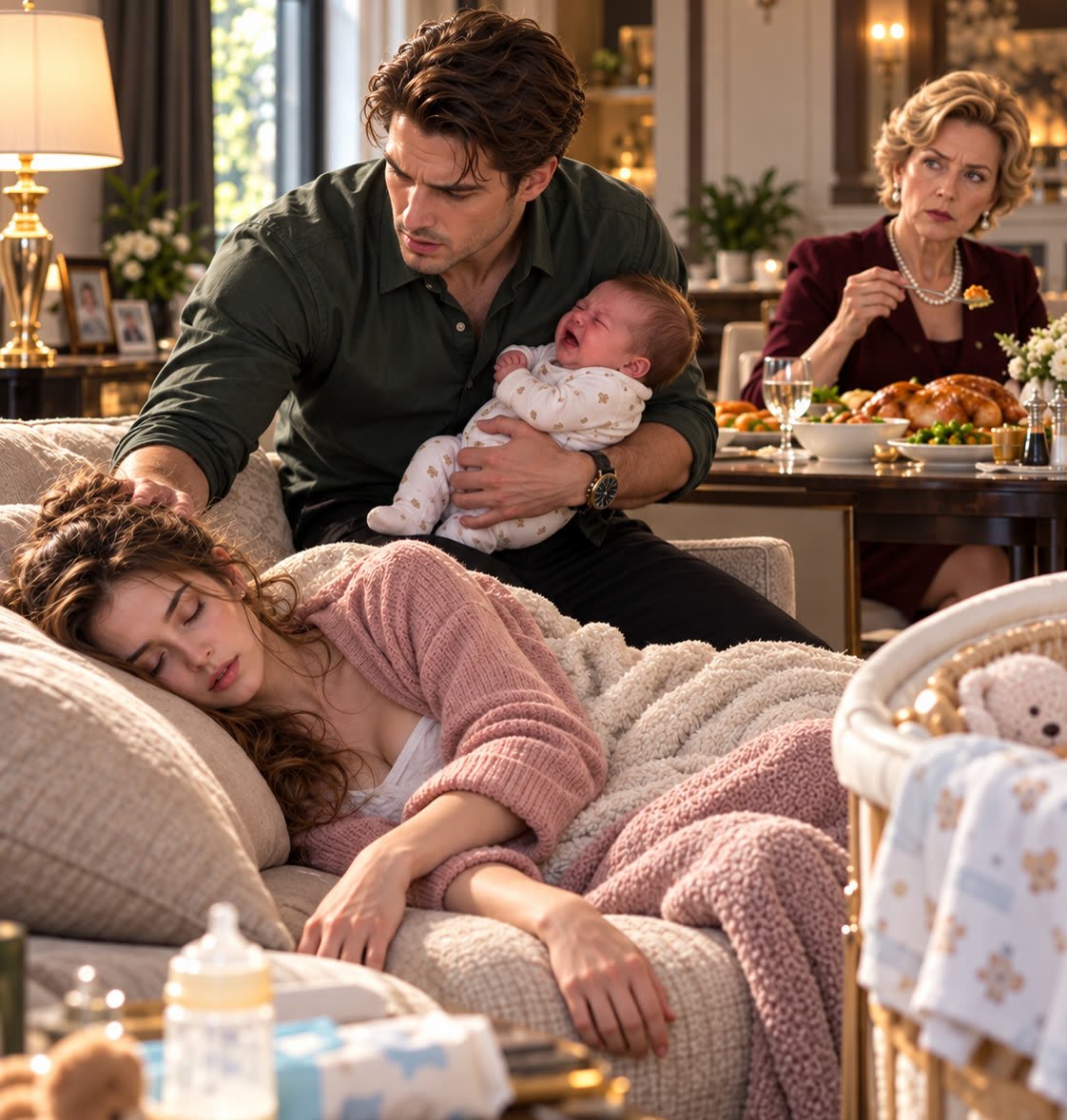
Caleb was in his bassinet beside the sofa. His face was red, his fists were punching at the air, and his mint-green sleeper was twisted around his legs from kicking.
And Tessa was on the sofa.
She was lying across the cushions at an angle no comfortable person would choose, one arm hanging off the edge so her fingertips nearly brushed the rug. Her head was tipped back against the armrest. Her mouth was slightly open.
For half a second, my brain handed me the answer I wanted. She’s asleep. She finally crashed. Good.
Then I said her name again, louder, and she didn’t so much as flinch.
“Tessa. Honey. Hey.”
I dropped to my knees beside the sofa and touched her shoulder. Nothing. I touched her cheek, and her skin was cool and damp in a way that made my stomach turn over.
She was breathing. I could see her chest rise. But when I squeezed her hand and said her name right next to her ear, her eyelids didn’t even flutter.
Caleb shrieked again, and the sound went through me like a nail.
I had my phone out of my pocket and my thumb on the screen when I noticed the smell.
Roasted chicken. Garlic. Rosemary. Warm bread.
It was so out of place that for a second I honestly wondered whether I was the one losing consciousness. Then I heard it, the small, ordinary clink of a fork against a plate.
I turned toward the dining room.
My mother was sitting at our table.
Marjorie Halstead, sixty-three years old, her silver bob perfectly in place and her good burgundy cardigan buttoned to the collar, sat in front of a full dinner as if it were Sunday after church. She looked completely at ease.
A whole roast chicken. Mashed potatoes. Green beans with almonds, a basket of rolls under a folded dish towel, and gravy in the boat Tessa and I had gotten as a wedding present and never once used.
She was chewing.
“Mom?”
She looked up, swallowed, and dabbed the corner of her mouth with a napkin.
“Oh. You’re home early.”
“What happened to Tessa?”
She set the fork down slowly, the way you put something down when you’re planning to pick it back up.
“She’s tired, Owen.”
I need to explain the three weeks before that afternoon. Otherwise none of what I did next makes sense, and some of what I didn’t do makes even less.
I’m a project manager for a civil engineering firm in Durham. I spend my days on stormwater drainage plans and on calls with county officials who never seem to have read the email. Tessa taught third grade at an elementary school in Cary until two weeks before her due date, and she was on twelve weeks of leave, eight of them unpaid.
We’d done the math on that leave at our kitchen table more times than I could count. There was the mortgage on our three-bedroom in North Raleigh and the payment on Tessa’s Subaru. There was also the hospital bill that showed up eleven days after Caleb was born, a balance of $2,318 after insurance, pinned to the fridge under a magnet shaped like a pineapple.
Caleb was born on a Monday, nineteen days earlier, after twenty-two hours of labor. Since then, our lives had shrunk to a loop of feeding, burping, changing and rocking. Laundry, bottles drying upside down on the rack, thirty minutes of sleep that felt like five, and then the next feeding.
Tessa kept the feeding log on a whiteboard stuck to the side of the fridge, in her neat teacher’s handwriting. Each entry had the time, the ounces and whether the diaper was wet or dirty. She’d started it the first night home and hadn’t missed an entry.
She rarely complained. But I’d seen her standing at the kitchen counter holding an empty mug, staring at the cabinet as if it had asked her a question she couldn’t answer.
Whenever I asked if she needed anything, the answer was always the same.
“I’m okay, Owen. I just need a little sleep.”
I believed her. Or I wanted to believe her, which is not the same thing, and I knew the difference even then. Admitting how far underwater she was would have meant asking whether I was doing enough.
My mother had driven up from Fayetteville on Monday, as she put it, “to help.” She’d stay a week, maybe ten days, and Tessa could finally rest.
Tessa had met her at the door with a brand-new key on a little brass tag she’d had engraved at the hardware store. It said GRANDMA. “So you never have to knock,” Tessa told her, and my mother smiled and slipped it onto her ring without saying thank you.
I noticed that, and I decided not to mention it.
That Thursday, a client meeting I’d blocked out until five wrapped up at 1:40 because the county engineer had a family emergency. I sat in my car in the parking garage and thought, I’ll surprise her. I’ll walk in, take the baby, send her to bed for three uninterrupted hours, and bring her the coffee she’s been craving since her second trimester.
I didn’t call ahead. I wanted to see her face.
Now I was staring at my mother across the room, and my wife wasn’t making any face at all.
“She’s not waking up,” I said. “Mom. She’s not responding.”
My mother lifted one shoulder in a small shrug. It was the same shrug she used to give when I told her a teacher had been unfair.
“She hasn’t been sleeping. You know that.”
Caleb’s scream cracked into a hiccup and started again. I scooped him out of the bassinet, and his tiny fist immediately locked onto the front of my shirt. His diaper was soaked through, and his face was hot against my neck.
Through the kitchen doorway I could see the whiteboard. The last entry, in Tessa’s handwriting, said 11:10 — 3 oz — wet.
That was more than three hours ago.
I dialed 9-1-1 and put it on speaker. While it rang, my mother sighed.
It wasn’t a frightened sigh or a worried one. It was the long, put-upon exhale of someone whose meal was being interrupted.
“I just think you’re overreacting.”
I didn’t answer her. I was looking at the rug beside the sofa, where Tessa’s phone lay face-up, just beyond the reach of her dangling hand.
The screen was still lit. It was open to our text thread, and in the box at the bottom, unsent, were six words.
Can you come home? I don’t
Part 2: The Plate in the Trash
“911, what’s the address of your emergency?”
I gave her our street, our house number and the cross street by the elementary school. Then the rest came out in the wrong order: my wife, unresponsive, breathing, three weeks postpartum, a newborn here too.
The dispatcher’s voice was flat and steady in a way I will be grateful for until the day I die. She asked whether Tessa was breathing normally, whether she’d hit her head, and whether anyone had seen what happened.
“Someone did,” I said, and I looked at my mother.
She had stood up from the table and was holding her napkin in both hands.
“When did she get dizzy?” I asked her. “What time, exactly?”
“Owen, I don’t keep a stopwatch—”
“Mom. What time?”
She glanced at the clock over the stove. “A little after one, maybe. She took the bread out and said the room was spinning.”
“And then what?”
“She went and sat on the sofa.”
“Sat? Or fell?”
My mother’s eyes slid away from mine, toward the window, toward the bassinet, toward anything that wasn’t my face. That was all the answer I needed, but I made her say it anyway.
“Did you check on her, Mom? Did you go over there and try to wake her up?”
She folded her arms over the burgundy cardigan.
“I thought she was being dramatic.”
The dispatcher was saying the ambulance was six minutes out. I heard it the way you hear a radio playing in another room.
I didn’t yell, and that surprised me too. Something in my chest just went very cold and very still. All the soft words I’d spent thirty-four years collecting for my mother, words like blunt and old-school and means well, slid off the shelf at once.
“You watched my wife get dizzy,” I said, “and then go down on the couch. You heard my son screaming. And you sat down and ate.”
“Don’t twist this.”
“I’m not twisting anything. I’m saying it out loud.”
“She was breathing, Owen. I could see her breathing.”
“For an hour?”
She didn’t answer.
The dispatcher told me to make sure Tessa’s airway was clear. I shifted Caleb to my left arm and, with my right, eased Tessa’s head and shoulders into a better position. Her hair was damp at the temples, and when she made a small sound, barely a breath, my heart slammed.
Behind me, my mother’s chair scraped.
“You’re seriously having an ambulance come to the house? The neighbors will—”
She started toward the sofa with one hand already reaching out, the way she used to reach for my forehead when I was a kid with a fever.
I stood up and stepped between them.
I didn’t touch her or raise my voice. I just put my body, and my son, between my mother and my wife.
She stopped short with her hand still in the air.
“What are you doing?”
“Don’t touch her.”
“Excuse me?”
“Stay back, Mom.”
I had never in my life spoken to her that way. I had never once stood between my mother and someone she’d decided to criticize. Not my cousin Dana at Thanksgiving, and not Tessa at our own wedding, when my mother told her the dress was “a bold choice for your figure.”
She knew it, and so did I. For a long second we just looked at each other, and there was no conversation about whose feelings needed protecting.
She lowered her hand.
The paramedics came through the front door at 2:34, a woman with a gray braid and a younger guy with a tablet. They moved in that calm, efficient way that makes you realize how much noise you’ve been making.
The woman knelt beside Tessa and spoke to her in a clear, ordinary voice. “Tessa? My name’s Renee. Can you squeeze my hand?” The younger one asked me questions, and I answered while bouncing Caleb, who had finally faded to wet, exhausted whimpers.
When did she last eat?
I didn’t know. I realized, with a lurch, that I didn’t know.
“She’s only exhausted,” my mother said from the dining room doorway. “New mothers get tired. I raised a son on my own, I know what tired looks like.”
Renee didn’t look up. “Ma’am, I’m going to need you to give us some room.”

My mother turned to me. I’d been answering that look my whole life. It meant: Fix this. Tell them I mean well. Tell them who I am.
I said nothing.
And my mother, who had never in my memory backed down in a standoff, took two steps back into the dining room.
It was a tiny thing. But in that moment I understood something I should have figured out twenty years earlier. My mother understood boundaries perfectly well; she just ignored the ones people were willing to bargain over.
While they checked Tessa’s blood pressure and pricked her finger for a glucose reading, my eyes went back to the dining table.
My mother’s plate was still there. There was half a chicken thigh and a crater in the mashed potatoes where the gravy had been, all of it glowing under the light fixture Tessa had picked out the week we moved in.
Tessa had made that meal nineteen days after giving birth. She’d made it while our son was due to eat, and while her body was telling her to stop.
I walked over, picked up the plate and carried it into the kitchen.
“Owen. What are you doing?”
I tipped it into the trash can, all of it, down to the roll with one bite out of it. Then I set the empty plate in the sink and walked back.
My mother stared at me as if I’d set fire to the curtains.
“You will never come into this house again and treat my wife like she’s here to serve you,” I said. My voice was quieter than I expected. “You will not be alone with Tessa.”
“Owen—”
“And until Tessa and I decide otherwise, you won’t be alone with Caleb either.”
Her face went rigid. “You’re choosing her over your own mother?”
“I’m choosing my family.”
“I am your family.”
“Then act like it.” I took a breath. “You’re leaving tonight.”
She opened her mouth, but before anything came out, Renee called my name sharply from the sofa.
I turned.
Tessa’s eyelids were moving. Then, slowly, they opened.
I was beside her in two steps, kneeling with Caleb against my chest. Her eyes wandered across the ceiling, the paramedics and the lamp until they found me.
“I’m here,” I said. “He’s okay. I’ve got him.”
She looked at Caleb, and something in her face loosened. Then her gaze drifted past my shoulder toward the dining room doorway, where my mother stood.
I saw her reaction. It wasn’t anger but something smaller and older, a flinch.
Her fingers found mine. She pulled me down until my ear was nearly at her lips, and her voice was barely a thread.
“Owen… you need to know what happens when you’re not home.”
Part 3: The Translator
They took Tessa to WakeMed North in the ambulance. I followed in my car with Caleb buckled into his car seat, after feeding him in the driveway from a bag of pumped milk Tessa had labeled and stacked in the freezer, each one dated in that same neat handwriting.
Before I left the house, I stopped in the front hall and looked at my mother just long enough to say one sentence.
“Pack your things. When I get back, I want you gone.”
“You cannot be serious, Owen.”
I walked past her, past the iced coffee leaving a sweating ring on the entryway table, and closed the door behind me.
In the ER, they put Tessa in a curtained bay at the end of the hall and hung a bag of IV fluids before I’d even found a place to set down the car seat. A nurse named Priya, with reading glasses pushed up into her hair, checked her blood sugar again and frowned at the number.
“Fifty-two,” she said. “That’s low. When did you last eat, hon?”
Tessa’s voice was hoarse. “Toast. Around six this morning.”
Priya glanced at the clock. It was 3:20. “And you’re nursing? And you’ve been on your feet?”
Tessa looked at me before she answered. I’d replay that look a hundred times over the following weeks, the quick, reflexive glance at my face to see how the truth would land.
“I was cooking,” she said.
The doctor came by forty minutes later. Tessa had severe dehydration and low blood sugar, and her bloodwork showed postpartum anemia. Her hemoglobin was 8.9, low enough that hours over a hot oven with no food or water had simply knocked her out.
It wasn’t a seizure or a stroke. She’d fainted, and because her body had nothing left in reserve, she’d stayed out far longer than a healthy person would.
“She’s going to be okay,” the doctor said. “But she needed someone to notice sooner.”
I nodded as if that sentence wasn’t about me.
My father left when I was eleven.
One Tuesday he was at the dinner table complaining about the Panthers, and by Friday he was living in an apartment in Charlotte with a woman from his office. After that, he was a birthday card that arrived late and a child support check that arrived later.
My mother worked the front desk at a dental practice in Fayetteville, and on weekends she did bookkeeping for a dry cleaner. She came home at 6:30 every night with aching feet, and she cooked every single night: pork chops, meatloaf, spaghetti with jarred sauce she doctored up with sugar.
She never let me make so much as a sandwich. “That’s my job,” she’d say. “That’s what mothers do.”
She also had moods I learned to read like weather. A clipped “fine” meant leave the room, and slamming cabinets meant somebody at work had said something. When she snapped at a neighbor, a teacher or a cashier, I was the one who smoothed it over afterward.
“She’s had a long day.”
“She doesn’t mean it like that.”
“She’s just tired.”
I was translating my mother before I could drive. By the time I met Tessa at a friend’s cookout in Raleigh at twenty-nine, I was fluent.
Sitting in that plastic ER chair, with Caleb asleep at my feet and the IV dripping into my wife’s arm, I started hearing my own translations played back to me. They weren’t the ones about cashiers. They were the ones about Tessa.
“She’s just been doing it longer than us,” I’d said, when Tessa told me Mom had criticized the way she held Caleb in the hospital on day one.
“She’s old-fashioned,” I’d said about the wedding dress.
“Don’t take it personally,” I’d said, about too many things to count.
Every one of those sentences had asked Tessa to carry one more thing so I wouldn’t have to.
Around five, after the second bag of fluids and a turkey sandwich Priya brought from the nurses’ station, a little color came back into Tessa’s face. She held the sandwich with both hands and ate it as if she were afraid somebody would take it away.
I waited until she’d finished half.
“Tess. Why today? Why were you cooking all that?”
She put the sandwich down and ran one finger back and forth along the edge of the blanket. She did that when she was deciding how much to say.
“She asked for a proper dinner. That’s how it started, this morning around nine-thirty.”
“You could’ve said no.”
“I did say no.” Her voice wavered, then steadied. “I said I was exhausted.”
“She said she worked doubles and still cooked for you every night, and I have one baby and a husband who pays for everything. She said a woman who’s home all day and can’t put a meal on the table is letting herself go. And she said you deserve a wife who comes to the table.”
I didn’t say anything, because I didn’t trust my voice.
“So I made the chicken. I started at ten-thirty. Every time Caleb cried, she told me not to pick him up, that I’d ruin him, that he needed to learn I wasn’t going to come running.” She paused. “He cried a lot, Owen.”
“Did you eat anything? Lunch?”
She gave a short laugh with no humor in it.
“I made myself a plate at noon. She said in her house, the cook eats last, that it was how she was raised and how she raised you. So I put it back.”
My hands had curled into fists on my knees, and I made them open.
“When I took the bread out, the kitchen tilted. I told her I felt dizzy and asked her to take Caleb so I could sit for a minute. She said she would after she ate, while it was still hot.”
Tessa swallowed. “I got my phone out to text you. I remember sitting down, and then everything just went gray.”
Can you come home? I don’t.
“Why didn’t you tell me any of this?” It came out softer than I meant, but it was still the wrong question, and I knew it as soon as I said it. “Not just today. Before.”
Tessa looked at me for a long moment. She wasn’t angry, just tired in a way that went far beyond sleep.
“I did,” she said. “You’d tell me what she meant.”
That one landed somewhere under my ribs and stayed there.
“After a while I stopped telling you. I didn’t want to be the reason you two fought. She’s the only family you have left.”
She reached for her phone on the tray table, where I’d put it after picking it up off our rug. “But I started writing things down, so I’d know I wasn’t making it up.”
She unlocked it with her thumb and held it out to me.
“There’s a note called ‘Not crazy.’” Her hand was trembling slightly. “Read all of it. Then tell me if I’m being dramatic.”
Part 4: Not Crazy
The note was long.
It started almost three years earlier, the month after our engagement, and every entry was dated the way she dated everything, with the month, the day and sometimes the time. Some entries were a full paragraph, and some were a single line.
Oct. 14 — Owen’s mom told me at Sunday lunch that I’ll never cook like she does, so I shouldn’t bother trying. Owen said she’s sentimental about her kitchen.
I remembered that lunch. I remembered saying that.
Apr. 2 — Dress fitting. She said it was “a bold choice for my figure,” then told my mom it was a shame I’m not a natural beauty like Owen’s last girlfriend. Owen said she’s old-fashioned.
Jun. 3 — Baby shower. She told my friends from school I was “big as a house” and laughed until Mrs. Delgado changed the subject. Owen was outside getting ice.
I kept scrolling. Caleb stirred in his car seat and settled again, and on the other side of the curtain someone’s monitor beeped in a steady rhythm.
After Caleb was born, the entries came closer together.
Day 2 of her visit — She took Caleb out of my arms and said I hold him like a sack of flour. Wouldn’t give him back for forty minutes while he screamed. Said he needs to learn I’m not the only person in the world.
Day 3 — She threw out the six frozen casseroles the girls from school dropped off. Said Owen deserves real food, not “charity.” Told Owen they’d gone bad.
I stopped reading for a moment. I remembered asking where the lasagnas went, and my mother saying, without looking up, “Freezer burn, sweetheart. I tossed them.”
Day 3, later — She said if I tell Owen any of this, he’ll finally see how fragile I am. She said men don’t stay with fragile women. “His father didn’t.”
I read that one three times.
Then I read the last two entries, both from that morning.
Day 4, 9:41 a.m. — She wants a proper dinner. I said I’m too tired. She said she worked doubles and still cooked for her son every night. I’m going to make the chicken so she stops.
Day 4, 12:52 p.m. — Shaky. Hands feel weird. Made a plate and she said the cook eats last. Owen’s home at 5:30. I can make it to 5:30.

I put the phone face-down on my knee and stared at the floor for a while.
There was nothing in that note I could translate and no softer word for any of it. It was simply what happened, written down by the one person in my life who’d been trying to tell me the truth while I kept explaining it away.
“Tess,” I said finally. “I’m sorry.”
She nodded slowly. She didn’t say it was okay, and I didn’t want her to.
“I should have heard you the first time. Every time.” I could barely get the words out. “I thought keeping the peace meant keeping you two from fighting. But nobody was fighting. You were just being quiet, and I let that be the peace.”
Her eyes filled, but she didn’t look away.
My phone buzzed in my jacket pocket. It was a voicemail from Mom, left at 4:58, and I played it on speaker without thinking.
“Owen, it’s me. Call me when you’ve calmed down. I wrapped up the chicken, there’s plenty left if Tessa’s hungry later. I’m not going to drive back to Fayetteville in the dark like a criminal over a misunderstanding. We can talk about this like adults.”
The message ended, and Tessa and I looked at each other.
For the first time in our marriage, I didn’t tell her what my mother meant.
“What do you want?” I asked instead. “Not what keeps things calm, and not what’s easiest for me. What do you want to happen tonight?”
She was quiet for so long that Priya came in, checked the IV bag and left again.
“I want her out of our house tonight,” Tessa said. “Before I come home. I don’t want to see her.”
“Okay.”
“I don’t want her back until she can say what she did without a ‘but’ in it. And I want to be the one who decides when that is. Not you, not her. Me.”
“Okay.”
She searched my face as if she were waiting for the catch, one of the old excuses: she means well, she’s all alone, she raised me by herself.
It didn’t come.
When the doctor came back to go over the discharge plan, he directed half the questions to me out of habit. It covered iron supplements, fluids, someone else on night feedings for a week and an OB follow-up on Monday. Each time, I turned to Tessa and waited.
For the first time all afternoon, I didn’t answer for her.
They discharged her at 8:40, and I called my mother from the parking garage while Tessa buckled Caleb in with slow, careful hands.
“Is your car packed?”
“Owen, I really think—”
“We’re leaving the hospital now, and we’ll be home in twenty minutes. You need to be gone.”
She wasn’t gone.
Her silver Buick was still in our driveway when we pulled up at 9:05, the porch light on and the trunk open. I parked on the street, left the engine running with the heat on, and asked Tessa to lock the doors.
“I’ll handle it,” I said, and then I caught myself. “Is that okay?”
She nodded once and locked the doors.
My mother was standing in the front hall with her rolling suitcase and her purse over her arm, as if she’d been waiting for an audience. The iced coffee was still on the entryway table. The ice had melted hours earlier, leaving a tall cup of pale beige water with the paper straw collapsed inside it.
“I’m not leaving without speaking to her,” Mom said.
“She doesn’t want to speak to you.”
“She’s turned you against me in one afternoon. Do you see that? One afternoon.”
“She never said one word against you.” I held her eyes. “I just read three years of what you said to her. All she did was write it down.”
For a split second, something cracked across my mother’s face, fear or maybe recognition. Then her expression went smooth again.
“I am your mother.”
“I know.”
She waited, the way she always had, for those four words to do their work.
They didn’t.
I held out my hand, palm up. “The key, Mom.”
She looked at my hand for a long time. Then she worked the shiny new key off her ring, the one with the little brass GRANDMA tag, and set it in my palm. It was warm from her purse.
She rolled her suitcase past me, down the porch steps and across the lawn. But she didn’t turn toward the Buick.
She turned toward the street, where Tessa sat alone in our car with our son.
Before I could reach the bottom step, my mother raised her hand and knocked on the passenger window.
Part 5: Home Early
I was across the lawn in about four strides, but Tessa had already made her choice.
She didn’t unlock the door. She rolled the window down two inches, no more, and looked at my mother through the gap.
“I’m sorry you got sick,” my mother said. She had switched to the soft voice she used on the phone with doctors’ offices. “But you have to understand, I was raised a certain way, and Owen has never—”
“I didn’t get sick, Marjorie.” Tessa’s voice was hoarse, but it didn’t shake. “I got ignored.”
My mother blinked.
“When you’re ready to say that part,” Tessa said, “without the ‘but,’ you can write to me. Not to Owen. To me.”
Then she rolled the window back up.
My mother stood there for a moment with her hand still half-raised. She looked at me over the roof of the car, and I could see her waiting one last time for me to step in and say, Mom, she didn’t mean it like that. She was waiting for me to translate.
“Drive safe,” I said. “Text me when you get to Fayetteville.”
She texted at 10:22. It said only: Home.
The first week was hard in ways I hadn’t expected.
I took five days off, using the vacation I’d been saving for a beach trip we were never going to take with a newborn anyway. I did every night feeding with pumped milk and the formula the pediatrician had okayed. I wrote each one on the whiteboard in block capitals, nowhere near as neat as Tessa’s: 2:10 — 3 oz — wet.
She slept, really slept, for the first time in weeks, six hours and then seven. Her follow-up on Monday showed her hemoglobin climbing, and her OB said she was doing everything right now that someone was letting her.
My mother called four times that first week, and I answered twice. Both times she started with how hurt she was, and both times I said, “Mom, I’m not having this conversation. Tessa asked you to write to her,” and ended the call.
My aunt Carol called from Wilmington to tell me Mom was “devastated” and “all alone down there.” I told her I loved her and that I wasn’t discussing it. It was the first time I’d ever said no to that side of the family without apologizing afterward, and my hands shook when I hung up. Then they stopped.
Tessa and I talked a lot in those weeks, mostly at night at the kitchen table, with Caleb asleep in the swing. She told me about smaller things that weren’t in the note: the tone, the looks, how she’d started dreading the sound of my mother’s Buick in the driveway.
I listened, and I didn’t explain anything. Twice I caught an excuse forming in my mouth, things like she grew up with nothing or she’s scared of being left, and I swallowed it. Maybe those things were true, but they weren’t Tessa’s burden.
Twenty-three days after that Thursday, a letter came.
It was addressed to Tessa in my mother’s careful, slanted cursive, on the cream stationery she kept for sympathy cards. Tessa read it at the kitchen table while I gave Caleb a bottle in the next room and did not hover, which took more effort than I’ll admit.
When she finished, she brought it to me and let me read it.
It was two pages, and most of it was better than I’d expected. My mother wrote that she’d seen Tessa go down and told herself it was nothing, because admitting it was something would have meant getting up. She admitted she’d thrown out the casseroles.
On a line by itself she wrote: I told you Owen would leave you, and that was cruel, and it was about me.
The last paragraph said: I hope someday you’ll understand how hard it was for me raising Owen alone, and why I am the way I am.
“Almost,” Tessa said quietly.
“Almost,” I agreed.
She wrote back herself, by hand, at the kitchen table over two evenings. I didn’t read it until she offered, and I didn’t suggest a single word. She told my mother she appreciated the letter and believed most of it, but that the last paragraph was asking her to carry something again, and she wasn’t going to.
She wrote that my mother could visit for two hours on a Saturday afternoon once Caleb turned three months old, while I was home. Lunch would be takeout, and nobody would be cooking.
The key with the brass tag went into the junk drawer, under the takeout menus and the spare batteries. It’s still there. Tessa knows where it is, and it’s hers to give back someday, or not.
A week later my mother sent one more short note. It said: Thank you. I’ll be there. I won’t bring a thing. It was the first time I’d ever known her to accept terms she hadn’t set herself. She didn’t ask Tessa to tell her it was okay, and Tessa didn’t.
Six weeks after that Thursday, I came home three hours early again.
This time it was on purpose. I’d worked it out with my boss: on Fridays I log off at two and finish my reports after bedtime. My meetings could wait. My wife had done enough waiting.
I stopped at Bean & Barrel on Glenwood and ordered the same drink, brown sugar, oat milk, extra shot, $6.75. The barista, a kid with a nose ring who recognized me by now, wrote TESSA on the cup with a little heart without asking.
At 2:31, I opened the front door.
The house was quiet.
For half a second my heart lurched out of old habit. Then I heard a small, contented gurgle from the living room.
Caleb was in his bassinet, wide awake at nine weeks old, kicking calmly at the mobile the girls from school had sent. On the fridge, the whiteboard was filled with neat handwriting all the way down to 1:45 — 4 oz — wet.
And Tessa was on the sofa.
She was curled on her side under the gray knit throw, one hand tucked under her cheek and her hair coming loose from its bun. A half-finished bowl of oatmeal and an empty water glass sat on the coffee table beside her.
I knelt down very quietly and watched her breathe for a second, just to be sure. I suspect I’ll be doing that for a long time.
She opened one eye.
“You’re home early,” she mumbled.
“I am.” I set the iced coffee on the coaster by her hand, where the ice could stay ice. “Go back to sleep. I’ve got him.”
She smiled without opening her other eye and pulled the throw up to her chin.
I lifted Caleb out of his bassinet. He grabbed a fistful of my shirt, just as he had that first terrible afternoon, and I carried him into the kitchen, past the dining table where nobody was waiting to be served.
I used to think peace was what you got when nobody argued.
Now I know better. Sometimes the quietest person in the room is the one paying for everyone else’s calm. The only way to know is to come home early enough, and listen long enough, to hear what she’s been trying to tell you.
I should have been at work for another three hours.
This time, I was exactly where I was supposed to be.
If you were in Owen’s place, would you have let Marjorie back into your home, and whose terms would you have followed?
Disclaimer: This story is a work of fiction inspired by real-life themes. Names, characters, places and events are fictionalized, and any resemblance to real persons is purely coincidental. Images are for illustration purposes only.


