

Part 1: A Promise In Pink
When I came home from work, my husband was sitting on the hallway floor with a plate of apple slices balanced on one knee. Our daughter’s bedroom door stood open about three inches, and a small hand appeared through the gap just long enough to claim another slice.
“How many is that?” I whispered.
“Four,” Ben said. “Unless she’s passing them to somebody else in there.”
“I can hear you,” Rosie said.
I put down my bag and sat beside him. Through the doorway, I could see one sneaker and the corner of the quilt my mother had made when Rosie moved into her first proper bed.
“Can I come in?” I asked.
“You can stay there.”
Ben shifted the plate so I could have a slice. He had texted me at work that Rosie had had a difficult day, but he hadn’t supplied details she hadn’t given him permission to share.
“Dad said school wasn’t good.”
“I’m not going tomorrow.”
“We can talk about tomorrow,” I said. “First, can you tell me about today?”
The sneaker disappeared. For a moment I thought she had moved away from the door, but then her face appeared in the gap, blotchy from crying.
“They looked,” she said.
I knew what she meant. That morning, while brushing her hair, I had noticed a smooth bare patch above her left ear, about the size of a quarter, and called the pediatrician for an appointment.
Rosie had watched me make the call in the bathroom mirror. I had tried to sound so ordinary that I probably sounded frightened instead.
“Sometimes people look because they don’t understand,” I said.
“Everybody keeps saying things like that.” Her chin trembled. “Like it stops them looking.”
Ben set down the plate. “You’re right. It doesn’t.”
“You said they’d look for a second and then do something else.”
“I did.”
“They didn’t.”
He nodded once. No argument, no explanation about what he had meant, no attempt to turn her day into a lesson she wasn’t ready to learn.
“I’m sorry,” he said. “I should have asked what happened instead of telling you what would happen.”
Rosie opened the door another few inches. Her cap lay on the floor behind her, turned inside out.
“You do it, then.”
“Do what?”
“Make your hair different. Make it pink. The really bright kind. Go somewhere everybody knows you and see if you like everyone looking.”
I expected him to offer some gentler version of the challenge. A pink shirt, perhaps, or a streak that would wash out before work.
Instead, he asked, “How bright?”
She rubbed her nose with her sleeve. “So people can see it from the moon.”
“Okay.”
“You don’t have to say okay because I’m crying.”
“I know.” He waited until she looked at him. “I can’t know exactly what today felt like. But I can find out what it feels like when people stare at my head.”
For the first time since I had come home, she looked interested in something outside her own room.
“All of it?”
“All of it,” he said.
* * *
That evening, Ben came home from the beauty supply store with hair lightener, pink dye, gloves, and instructions he read twice before letting me touch anything. Rosie sat on the closed toilet lid and acted as supervisor.
“You missed the back,” she said.
“That’s because the back belongs to your mother’s department,” Ben said.
“Your department is holding still,” I told him.
The process took longer than Rosie expected. Halfway through, she fetched a library book and read aloud while we waited, stopping occasionally to ask whether the pink would really show.
When we finally rinsed and dried his hair, she stood on a stool beside him and studied their reflections. His hair was so bright that the little bathroom seemed to have acquired another light.
“Well?” he asked.
She touched the edge of her own hair. “People are definitely going to look.”
“Probably.”
“Even at work.”
“Especially at work. Marcus notices when I buy different coffee.”
Rosie smiled, but she didn’t remove her cap for bedtime until Ben had left the room. I reminded myself that a promise kept was a beginning, not a cure.
* * *
Over the next two weeks, we learned that bright hair didn’t stop someone from needing to buy dishwasher tablets or wait at the bank. Ben did both, and when Rosie asked whether anybody had stared, he told her the truth.
A woman at the hardware store had asked what color it was. A teenager had given him a thumbs-up, and a man at the gas station had laughed loudly enough for Ben to hear.
“What did you do?” Rosie asked.
“Paid for my gas.”
“Didn’t you feel funny?”
“Yes.” He passed her the bowl of peas. “I bought it anyway.”
We also met with her teacher. With Rosie’s permission, I explained that she had a medical reason for wearing a cap, and asked that nobody turn taking it off into a classroom achievement.
Her teacher listened, wrote down what Rosie wanted, and said she would address comments about people’s bodies without identifying whose experience had prompted the conversation. Rosie asked if she could still sit with her friend Maya.
“Of course,” her teacher said.
That mattered more to her than any of the reassuring things we adults had prepared to say.
On the Friday before my father’s birthday, a school notice came home: class photographs would be taken the following Monday. Rosie read it twice and slipped it underneath a spelling worksheet.
I saw her do it. I didn’t make her pull it back out.
* * *
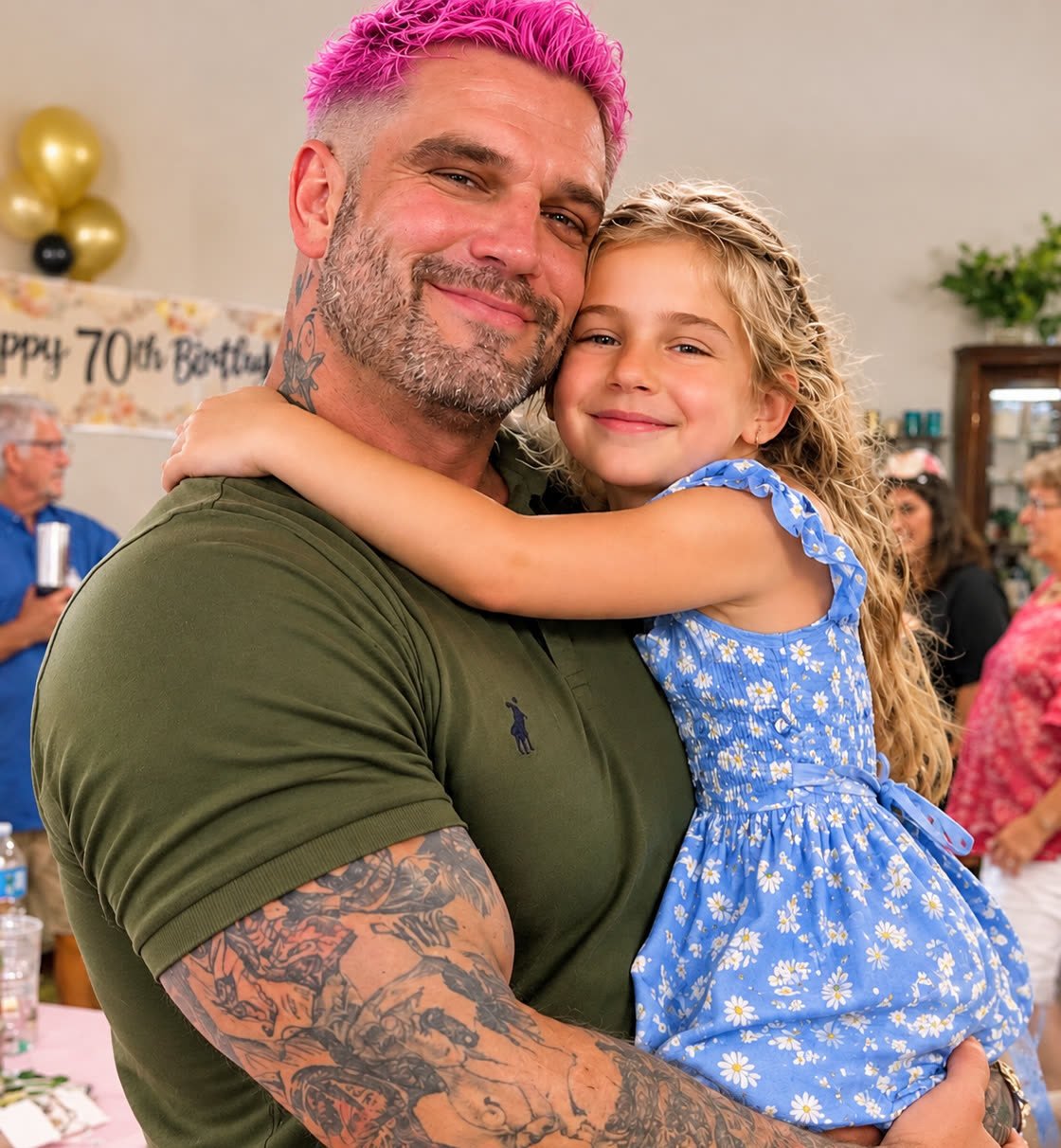
Two weeks after the night in the hallway, we parked outside my parents’ house for Dad’s seventieth birthday. Ben checked his hair in the visor mirror and smoothed a spot he had refreshed that morning with temporary pink spray.
“Think your dad will say anything?” he asked.
“My dad has never met a thought he couldn’t share.”
He put the spray can in his bag beside Dad’s present. Rosie leaned forward from the back seat before I could open my door.
“Are we doing a family picture?”
“Probably. Aunt Beth brought her camera.”
She pressed her palm against her mustard-yellow cap. “Will I have to take this off?”
“Only if you want to.”
“Even if Grandma says hats aren’t for inside?”
“I’ll talk to Grandma.”
Rosie considered that, then shook her head. “Not about everything. I’ll tell them if I want.”
“Just about the hat,” I promised.
She caught my sleeve. “Can you stand next to me?”
“Of course.”
Ben turned in his seat. “Can I have the other side?”
“If you bend down. You’re too tall.”
“That seems fair.”
We went up the walk together, Rosie holding the gift bag by both handles. Dad opened the door before we rang, his smile broad until his eyes reached Ben’s hair.
Then he glanced over his shoulder at the relatives gathered in the hall.
“Did you lose a bet?”
Part 2: The Place Beside Her
Two of my cousins laughed. Ben held out the present as though Dad had asked an ordinary question about traffic.
“Happy birthday, Frank.”
Dad took the bag. “You didn’t have to get me anything.”
“We know,” Rosie said. “That’s how presents work.”
That earned a warmer laugh, and Dad bent to kiss her cheek. I was grateful to her for breaking the moment, then immediately sorry that I had been.
Mom called from the kitchen that she needed someone tall, someone strong, and someone who could explain why she had bought enough rolls for a wedding. Ben raised his hand for the first two.
While he went to help, I followed Dad into the dining room.
“Don’t make the hair the entertainment today,” I said quietly.
He looked surprised. “It was one joke.”
“Then you’ve used it.”
“Sarah, it’s pink.”
“I noticed.”
He glanced toward the kitchen, where Rosie was telling Ben which cupboard held the cake plates. “All right. I won’t interrogate the man.”
It wasn’t quite agreement, but Mom appeared with a bowl in each hand before I could answer. I took one and followed her, already regretting that I had accepted so little.
In the kitchen, I told Mom that Rosie needed to keep her cap on if she chose. Mom looked toward her granddaughter, who was counting forks with great seriousness.
“Is she all right?” she asked under her breath.
“We’ve seen the doctor. She’s okay, but she isn’t ready to talk about it with everybody.”
Mom set down her bowl. “Then she doesn’t have to.”
She didn’t cross the kitchen to hug Rosie or ask a careful, conspicuous question. She simply handed her another fork and said the pile on the left was one short.
I loved her for that.
There were twenty people at the party, though Mom had apparently planned for a bus to break down outside. Every time someone said they were full, she offered a different dish as if fullness might be specific to potatoes.
Ben carried drinks, found an extra chair, and fixed the loose latch on the back door after Mom mentioned it had been sticking. He wasn’t trying to earn his place; he was doing what he always did in a house full of people.
Still, I noticed how often he made himself useful after somebody looked at his hair.
Dad opened our present before lunch. Inside was an old photograph of him and Rosie in his garage, professionally restored from the blurry original on Mom’s phone, along with tickets to a small antique-engine show.
“You remembered that?” Dad asked Ben.
“You said you used to go with your father.”
Dad ran his thumb along the edge of the frame. “That was years ago.”
“The show’s still there.”
For a moment, they stood together over the picture, and I thought the day might settle into something easier. Dad asked about parking, and Ben told him he had already checked the accessible drop-off for Mom’s troublesome knee.
Then my cousin Matt walked past and said, “At least we won’t lose Ben in the crowd.”
Dad laughed before he caught my eye.
Rosie was close enough to hear. She lowered the fork she had been carrying and tucked her free hand under her cap.
I stepped toward her, but she had already turned to help Mom with the cake.
* * *
After lunch, Rosie asked if she could carry the birthday cake into the dining room. Mom inspected her arms with exaggerated seriousness and appointed me to walk behind her.
She moved so slowly that Dad had time to put on his glasses and take them off again before the cake reached him.
“Seventy,” he said, studying the candles. “That’s twenty-nine with forty-one years of experience.”
“Is that why you needed glasses to check?” Rosie asked.
Mom laughed hardest. Dad pulled out the chair beside him and invited Rosie to help with the candles.
“What if I use up your wish?”
“I’ve got plenty saved.”
Beth lifted her camera as they leaned toward the cake. Rosie glanced at Ben, and her fingers rose to the brim of her cap.
Across the table, Matt said, “Seriously, Ben, what does your boss think of that?”
“He thinks I should finish the Henderson estimate by Tuesday.”
A few people laughed. Rosie’s hand dropped into her lap before Beth took the picture.
I watched her smile arrive a fraction late.
Dad cut her a slice with an enormous frosting flower and slid it onto her plate. She thanked him, carried it into the kitchen, and stood at the counter without taking a bite.
I followed, leaving the cake knife beside Mom.
“We can skip the big picture,” I said.
“I don’t want to skip it.”
“Okay.”
She used her fork to divide the flower into small squares. “I just want Dad next to me.”
“He’ll be next to you.”
“And you.”
“And me.”
She looked toward the doorway. “Grandpa likes Dad, doesn’t he?”
The easy answer was yes. The useful answer took me a second longer.
“He does. But some of the things he’s saying today aren’t kind.”
“Dad keeps smiling.”
“Sometimes people smile because they don’t want an argument. It doesn’t always mean something was funny.”
She considered that while cutting another frosting square. “I did that at school.”
I pulled out the chair beside her, but she shook her head before I could ask anything.
“Not now.”
“All right.”
I went to get Ben. He was putting leftover rolls into a bag for my aunt, who insisted she needed only two while holding it open for six.
“She wants us on either side for the picture,” I told him.
His expression changed. “Is she thinking about taking off the cap?”
“She hasn’t said.”
He looked toward the kitchen. “Then I won’t ask.”
Before he went in, I caught his hand.
“I should have shut the jokes down harder.”
“We can still do that,” he said. “But let’s see what she needs first.”
He took her a napkin, and she offered him the largest remaining piece of frosting. When Beth called for the family photograph, Rosie was measuring the space between herself and Ben with her hands.
“This close,” she told him.
“Understood.”
* * *
A few minutes later, we gathered in the living room. Ben carried in Dad’s chair while Rosie held the back, sincerely convinced she was helping with the weight.
“Right here, Grandpa. You get the middle.”
Beth arranged the taller people behind the chair, then handed Mom the camera so she could check the arrangement herself. I stood on Rosie’s left, and Ben took the place on her right.
Dad looked up at him.
“Ben, could you step out?”
I thought he meant someone was blocking the light. “Why?”
“Look at his head, Sarah. It’s my birthday. I want one normal picture.”
The room went quiet enough for me to hear Mom’s bracelet touch the camera.
“He’s my husband,” I said. “He’s family.”
“I’m not disputing that. I’m asking for one photograph without that pink hair in it.”
Ben moved half a step back. I knew the movement: he was preparing to go find dishes to wash while the rest of us pretended nothing had happened.
I put out my hand. “Don’t.”
“I can stand at the back,” Ben said.
“Pink hair at the back is still pink hair,” Dad said.
“Then there won’t be a photograph with us in it,” I said.
Mom lowered the camera. “Frank, enough.”
Dad’s face tightened. “Can I not have one thing the way I want it?”
“Not if the thing you want is leaving someone out,” I said.
Ben glanced down at Rosie, then back at Dad. “There’s a reason I dyed it. Rosie asked me to—”
“Why on earth would she ask you to do that?”
I felt Rosie move beneath my hand. She crossed the small space Ben had opened and took his fingers.
“Grandpa?”
Dad looked at her. “What, sweetheart?”
“Would you leave me out of the picture too?”
“Of course not.”
“Even if I looked different?”
His eyes flicked toward me. For once, I didn’t help him find an answer.
He bent toward her, and Rosie leaned close enough that I nearly missed what she said.
“Daddy did it so I could take my hat off.”
Part 3: What The Hat Held
For a moment, nobody moved. Dad remained bent at the waist, one hand resting on the chair Rosie had helped carry for him.
Ben didn’t explain. He crouched beside her, bringing his bright pink head level with hers, and waited.
Rosie looked at me. I stepped closer, just as I had promised in the car.
“You don’t have to,” I said.
“I know.”
She let go of Ben’s fingers and lifted the cap with both hands. A few strands rose with it before settling around the smooth bare patch above her ear.
Dad stared, then seemed to realize he was staring and looked directly into her face instead. Behind him, Mom placed the camera on the side table.
Rosie held the cap against her stomach.
“Would you like me to tell him what the doctor said?” I asked.
She nodded.
“It’s called alopecia areata,” I said. “Her immune system is affecting some of her hair follicles. It isn’t contagious, and it isn’t something she caused.”
Dad’s mouth opened, but no words came.
“We’re working with her doctor,” I continued. “She feels well. We don’t know exactly what her hair will do next.”
It was the explanation the dermatologist had helped us practice: accurate, short, and free of promises nobody could make.
Dad looked toward Ben, who was still crouched beside Rosie. Then he looked at the cap in her hands.
“I didn’t know,” he said.
“She wasn’t ready to tell everybody,” I said.
I kept my voice level because Rosie was listening. Later, perhaps, I could explain how much I wanted him to understand that kindness should not depend on being given private medical information first.
* * *
Eleven days earlier, Rosie had sat on an examination table swinging her feet without letting her heels touch the cabinet beneath it. The pediatrician had referred us to a dermatologist, who asked Rosie when she first noticed the patch.
“Tuesday,” she said. “Pizza day.”
I had thought I knew the whole story by then. I knew there had been looks, that she had cried in the bathroom, and that Ben had found her cap shoved deep inside her backpack when he picked her up.
Then the doctor asked, “What happened on pizza day?”
Rosie twisted the cap around her fingers.
“I bent down to get my milk. Caleb said, ‘What’s wrong with your head?’”
My stomach tightened.
“Was he close to you?” I asked.
“Across the table.” She looked down. “But he said it loud.”
I remembered asking whether anybody had said something. Rosie had told me they looked, and I had accepted that answer because I was relieved she was talking at all.
“What did you do?” Ben asked.
“I laughed.”
He rested his hands on his knees.
“I thought if I laughed, it would just be a funny thing,” she said. “Then they could eat again.”
The doctor gave her a moment before asking permission to examine her scalp. She described what she was doing before she touched anything and let Rosie hold a small mirror if she wanted to see.
Rosie didn’t want to.
After the examination, the doctor explained the diagnosis and discussed treatment options with us. She was careful about what could be expected and what could not.
“Will it grow back before pictures?” Rosie asked.
The doctor didn’t pretend to misunderstand. “I can’t promise that.”
Rosie looked at Ben’s newly pink hair.
“His doesn’t have to grow,” she said.
“No,” the doctor said gently. “Your dad gets to choose his color. You didn’t choose this. It’s all right to think that’s unfair.”
On the drive home, Rosie asked if she could wear her cap at school. We said we would make sure she could.
Then she asked us not to tell Grandma and Grandpa yet.
“Grandma will ask if it’s better every time,” she said.
Mom would have meant well. That didn’t mean Rosie was wrong.
We agreed that we would tell the people who needed to help keep her comfortable and safe, and that everyone else could wait until she was ready. Ben asked whether she wanted him to change his hair back now that the doctor had explained things.
From the back seat came an immediate answer.
“Not yet.”
* * *
Back in my parents’ living room, Dad lowered himself into the chair. Rosie remained standing in front of him, bareheaded, with Ben beside her.
“Does it hurt?” Dad asked.
“No.”
He nodded, visibly sorting through questions. For once, he seemed to understand that having one did not automatically mean he should ask it.
“The looking hurts sometimes,” Rosie added.
Dad’s eyes closed briefly.
Near the doorway, Matt set down the plate he was holding. “Rosie, I’m sorry I kept making jokes about your dad.”
She looked at him, then at Ben.
“He didn’t like all of them,” she said.
Matt nodded. “I should have noticed.”
Nobody rushed to reassure him. I was glad; Rosie had spent enough energy making other people comfortable.
Dad reached toward her cap, then stopped before touching it.
“May I see it?”
She handed it over. He smoothed the brim once, then placed it carefully on the arm of his chair.
“You can wear this in my house whenever you want,” he said.
“Grandma already said.”
A faint, embarrassed smile crossed his face. “Your grandma usually gets there before I do.”
Mom stayed beside the camera. She didn’t smile for him or turn his words into a rescue.
Dad looked up at Ben.
“You did all that because she asked?”
“She asked me to find out what staring felt like,” Ben said. “It seemed like a reasonable thing to ask.”
“But your work. Going places.”
“I still go.”
There was no sharpness in his voice. That made Dad look away more quickly than an accusation might have.
Rosie took her cap from the chair arm. I thought she was about to put it on, but she only folded the soft crown inward.
“Dad said people would look and then stop,” she told him. “But sometimes they don’t stop.”
“No,” Dad said quietly. “Sometimes they don’t.”
I could see the moment he remembered the front door, the laugh in the hallway, his own voice asking for a normal picture. He rubbed his palms against his trousers.
“Ben,” he began, then stopped.
Ben stood slowly. “We can take a minute, Frank.”
I was grateful for the offer and angry that he was the one making it. Dad had been given several chances that afternoon, and Ben had no obligation to make the next one easy.
Dad looked at Rosie’s uncovered head again, then touched his own silver hair.
“Do you have any pink dye left?”
Part 4: The Photograph We Kept
Ben didn’t answer immediately. I wondered whether he was thinking what I was: that pink hair could become a shortcut around the apology Dad still owed him.
“I’ve got temporary color spray in the car,” he said at last. “It washes out.”
Dad nodded. “Would you put some on mine?”
Rosie looked between them. Her expression was hopeful but cautious, as though someone had offered to mend a favorite toy and she wasn’t ready to hand it over.
“If you want it,” Ben said.
“I do.”
“All right. We’ll do it outside.”
As Ben went to get his bag, I leaned toward Rosie.
“Do you want to come, or stay here with Grandma?”
“Come.”
She picked up her cap before following us. I was glad she did; I didn’t want taking it off once to become a promise she had to keep for the rest of the afternoon.
* * *
A few minutes later, Dad stood on the back porch while I tucked an old kitchen towel around his collar. Ben read the spray instructions again and positioned him away from the open door.
“How bright do you want it?” Ben asked.
“What have you got?”
“One color, Frank. I was trying to be polite.”
Rosie made a small sound that was almost a laugh.
“Then give me what you’ve got,” Dad said.
He shielded his face as instructed, closed his eyes, and held still. The first pass left a startling pink stripe through the silver at the top of his head.
Rosie laughed properly then.
Dad opened one eye. “How is it?”
“You’ve got a road.”
“A good road?”
“A very pink road.”
Ben turned Dad slightly and added another careful pass. I held the towel in place while Rosie watched from the porch step, her cap resting beside her.
“I used to hold the towel when my father cut his hair,” Dad said.
“Did he have pink?” Rosie asked.
“Not once. Missed opportunity.”
She came closer and held the lower corner of the towel so it wouldn’t lift in the breeze. Dad thanked her without making a ceremony of it.
For several minutes, we were occupied with something simple: keeping the spray where it belonged, checking the sides, waiting for it to dry. Nobody asked Rosie to explain how brave she felt.
When Ben finished, Dad used his phone camera as a mirror.
“Well,” he said.
“You don’t have to like it,” Ben said.
Dad studied the screen. “I look like a man who ought to have kept his mouth shut earlier.”
I loosened the towel. “You would look like that with gray hair, too.”
He met my eyes.
“I know.”
Rosie reached for his phone and tipped it so he could see the top. Her small fingers steadied his larger ones around the case.
“It’s bright up there,” she told him.
“Good,” he said. “I asked for bright.”
Before we went inside, Dad stopped Ben with a hand held slightly away from his arm, asking for his attention without presuming contact.
“I need to say something in there,” he said.
Ben nodded. “Okay.”
* * *
When we returned to the living room, nobody cheered. I was thankful for that, too.
Mom had put the cake leftovers in the kitchen, and Beth stood by the window with her camera hanging at her waist. Matt moved aside to let Rosie through.
Dad walked toward his chair, then turned before sitting.
“Ben.”
Ben stopped near the porch door with the spray can still in his hand.
“I shouldn’t have asked you to step out,” Dad said. “You came here to celebrate my birthday, and I embarrassed you in front of everybody. I’m sorry.”
The room stayed quiet.
Dad glanced at Rosie, then deliberately brought his eyes back to Ben.
“I didn’t need to know why your hair was pink to treat you properly. You belonged in the picture before I knew.”
My throat tightened. That was the part I had needed him to understand, and I hadn’t had to put the words in his mouth.
Ben looked down at the can, then set it on a table.
“Thank you for saying that.”
He didn’t tell Dad it was fine. It hadn’t been fine, and accepting an apology didn’t require him to change the afternoon.
Dad nodded once. “I’d like you beside Rosie, if you’re still up for it.”
Ben looked at our daughter. “I told somebody I’d bend down. That offer’s still good.”
Rosie went to him and took his hand.
Mom lifted the camera but waited for Beth, who crossed over to check the settings. Nobody tried to hurry us into looking happy.
Dad bent to Rosie’s level.
“I’m sorry I made you wonder whether I’d leave you out,” he said.
She rubbed the folded brim of her cap between her fingers. “You were leaving Dad out.”
“Yes,” he said. “I was.”
She considered him for a long moment.
“Don’t do it again.”
“I won’t.”
I knew one promise would not untangle every habit Dad had collected in seventy years. But I watched him resist adding a defense, and for that afternoon it was a place to begin.
Beth asked whether everybody was ready to try again.
Rosie looked at the chair in the middle of the room.
“Can I sit there?”
“Absolutely,” Dad said.
He started moving behind it to give Ben room, but Rosie caught his sleeve.
“Stay here, Grandpa.”
He stayed.
I stood close enough that she could find my hand without looking. Ben bent on one side of her chair, and Dad leaned in on the other, their pink heads tilted toward hers.
Beth raised the camera.
“One, two—Ben, a little lower. There.”
“He’s always too tall,” Rosie said.
That was the smile Beth caught.
* * *
That evening, after we got home, Rosie asked to see the photographs on my phone. Beth had sent several, including one where Dad was blinking and another where Ben was looking down because Rosie had told him his sleeve still had frosting on it.
Rosie chose neither of those.
She enlarged the one with everyone looking toward the camera and studied it without speaking. Then she handed the phone to Ben.
“Can we get that one on paper?”
“We can.”
“Not little paper. For a frame.”
He glanced at me. “I think we can manage a frame.”
While he found an online printing service, I emptied her backpack for Monday. The school photograph notice slid out from under the spelling worksheet and landed on the kitchen table.
Rosie saw it.
I left it where it was.
She brought her cap over and set it beside the notice. Then she asked whether her teacher knew she might want it on for some of the pictures and off for others.
“Not yet,” I said. “We can ask what’s possible.”
“Will you tell her I haven’t picked?”
“Yes.”
She nodded, satisfied for the moment, and went to help Ben choose the print size. I sent the teacher a brief message without turning Rosie’s uncertainty into a problem that needed solving that night.
Later, I looked again at the family photograph. Nobody had vanished from its edges to make the rest of us look right.
Rosie’s hat was folded in her lap, and there was a pink head bent toward her on either side.
On Monday, there would be another camera—and this time, the next choice would be hers.
What does a sincere apology require beyond changing your appearance or saying you are sorry?
Disclaimer: This story is a work of fiction inspired by real-life themes. Names, characters, places and events are fictionalized, and any resemblance to real persons is purely coincidental. It does not represent any person or organization and does not encourage inappropriate behavior. Images are for illustration purposes only.


