

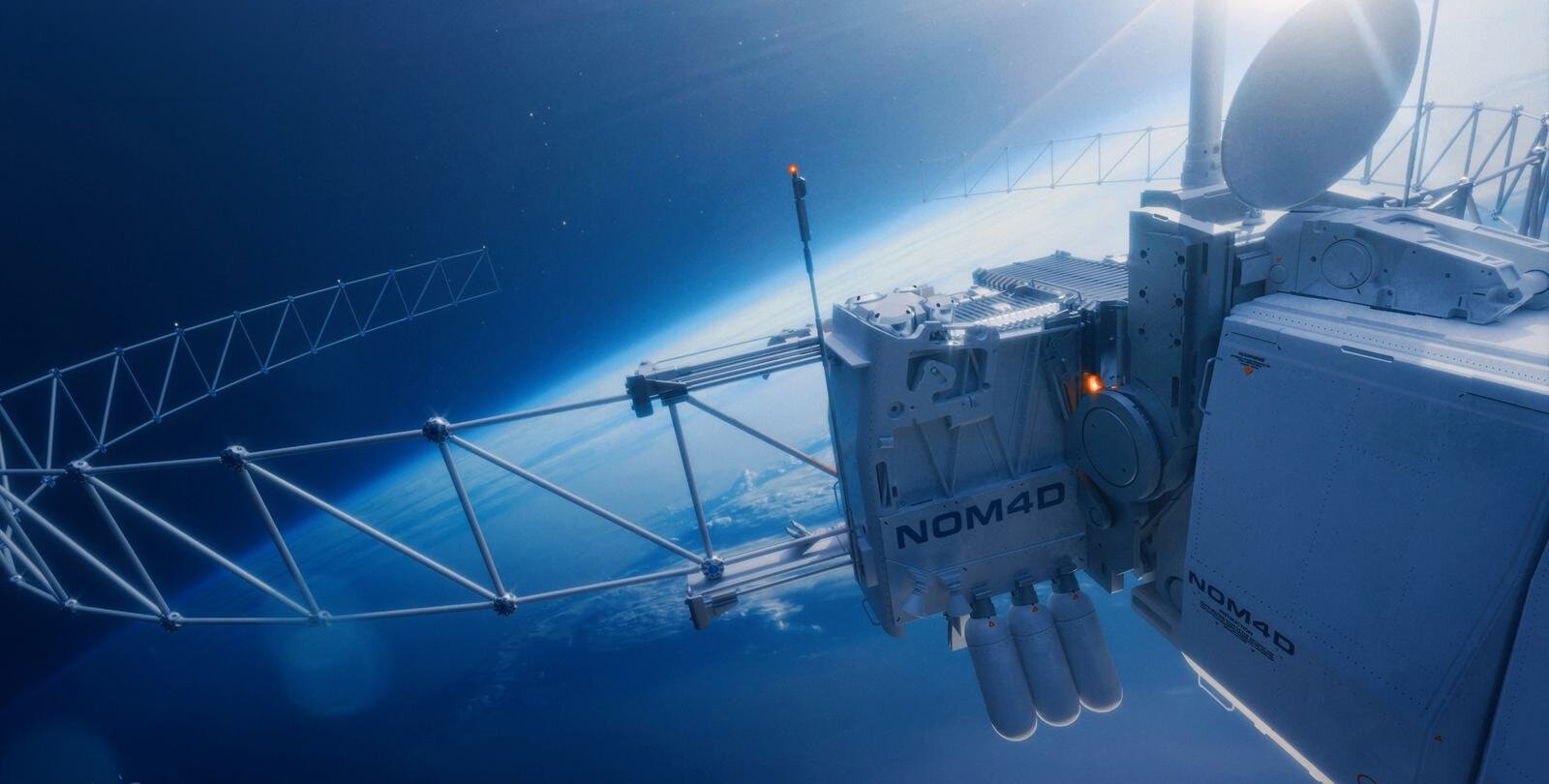
A small Caltech robot automatically assembled a section of structure directly in orbit, a first for DARPA’s NOM4D program. The ASTRA demonstrator did not build a complete space station: it added one element to a 1.4-meter structure. But it validates a method aimed ultimately at antennas, mirrors or solar panels too large to fit in a rocket fairing.

A third section built in space
ASTRA, for autonomous tensioned reflector assembly in space, is a robotic workshop of approximately one cubic meter. It took off on March 30, 2026 aboard SpaceX’s Transporter-16 mission, installed on Momentus’ Vigoride 7 platform. The system included two sections of mesh already assembled, as well as composite fiber tubes, aluminum joints and a thin reflective surface necessary after assembly.
After unlocking the launch pads, the two pre-assembled sections were deployed. The handler then picked up the parts on motorized loaders, placed them, and build a third section in orbit. He also placed a perforated reflective membrane on the mesh. The set was to serve as a demonstrator for an antenna measuring 1.4 meters in diameter.
DARPA presents this operation as the first demonstration of automatic assembly of a structure in space. The robot used remains deliberately simple: it moves along three linear axes and repeats a construction sequence. It is neither a humanoid nor an artificial intelligence that improvises a solution on its own.
Caltech shows how the demonstrator works in an official video.
The demonstration also revealed its limits
The result is more modest than the complete objective. The team was only able to fabricate the first additional section before reaching the mission’s time limits. The orders were sent from the ground and then engineers checked the result using images from eleven cameras. They only had seven or eight daily windows of about fifteen minutes to communicate with the system.
Unforeseen problems required several rehearsals. Fortunately, Caltech had kept a duplicate of the material in the laboratory to reproduce each anomaly and prepare a correction. This problem-solving phase reminds us that a successful scoop does not yet constitute a continuous, autonomous production line.
However, the program provides a concrete answer to a physical limitation. Today, large space structures are folded for launch, like solar panels, or assembled manually from large modules. Therefore, its size remains linked to the diameter of the rocket and the complexity of the deployments. We recently reported on an inflatable station designed to get around this same limitation. NOM4D is exploring the other option: shipping compact parts and then building the location where the equipment will be used.
Antennas several hundred meters in the line of sight.
DARPA aims in the long term for structures of several hundred meters, or even several kilometers. A large radio antenna could become more sensitive, a space mirror could collect more light, and large solar panels could produce more energy. The principle also affects logistics warehouses and habitats, without the agency having yet announced an operational mission.
ASTRA does not demonstrate that these dimensions are already accessible. It demonstrates that a lattice can be manufactured piece by piece in the real environment of orbit, after launch and without the intervention of astronauts. The transition from idea to space prototype took fifteen months according to DARPA.
The NOM4D program still needs to perform another experiment. A team from the University of Illinois will test a resin capable of polymerizing with little energy aboard the International Space Station to make a resistant composite in microgravity. This approach will complement ASTRA’s mechanical assembly by producing material directly in space.


