

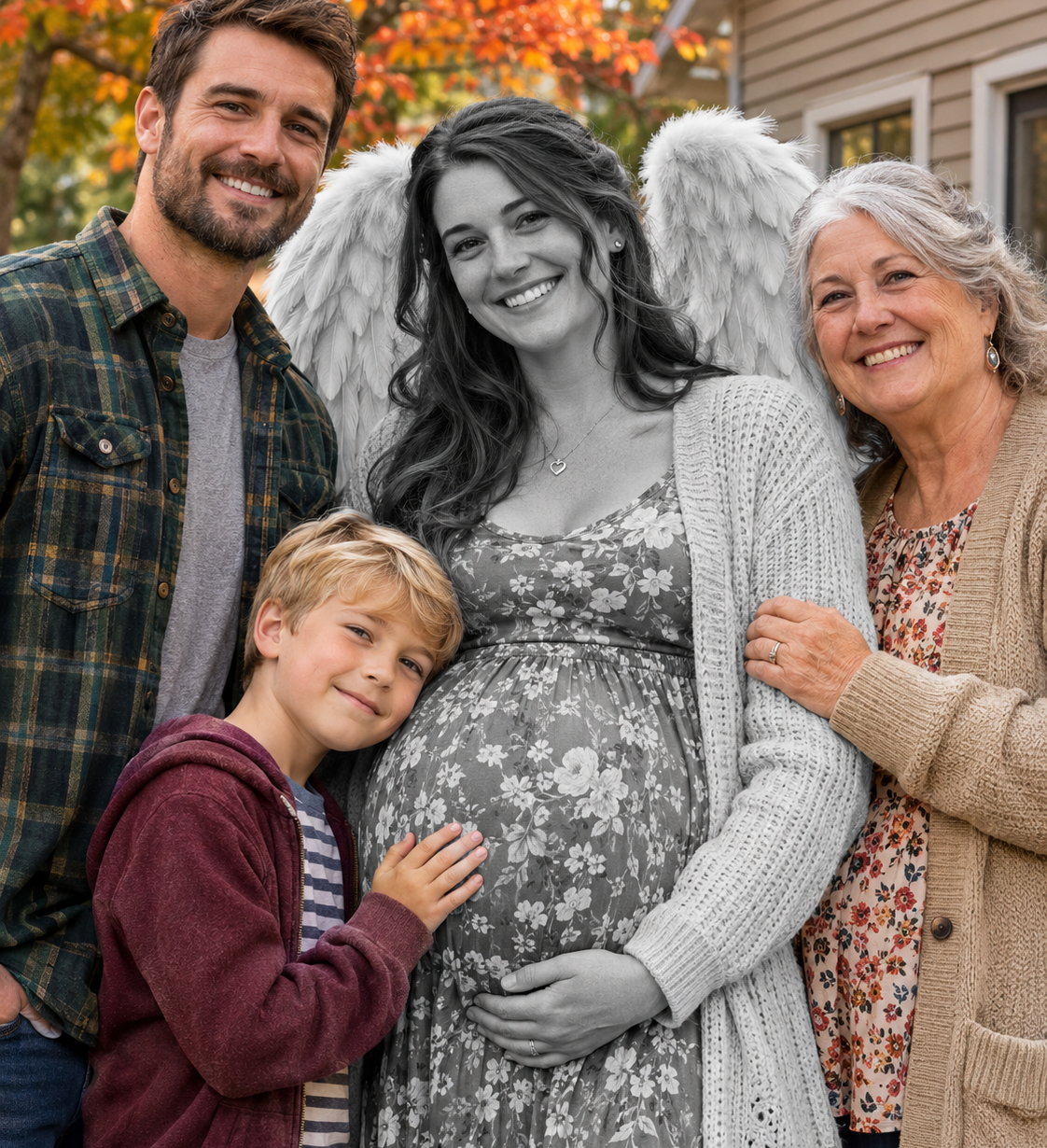
Part 1 — The Phone Call That Changed Everything
For an entire year, I believed my mother was the reason my family had survived.
When my wife and newborn son died on the same night, I was barely capable of taking care of myself, let alone raising my five-year-old boy.
Mom became the person who kept our household running.
She made breakfast, washed clothes, prepared school lunches, and sat with me through evenings when the silence in our home felt unbearable.
I trusted her with everything.
Then, one ordinary evening, a stranger called and made me question the woman who had held our broken family together.
“Mr. Nathan?”
“Yes, speaking.”
“My name is Blakely. I used to work at the hospital where your wife gave birth.”
I immediately stopped what I was doing.
It had been nearly a year since Ellie died, but hearing someone mention that hospital still brought back memories I struggled to face.
“What is this about?” I asked.
The woman hesitated.
“I recently came across a document concerning the night your wife passed away. There’s something about it that I believe you should know.”
My stomach tightened.
“What document?”
She drew a breath.
“Your mother signed paperwork at the hospital that night.”
For a moment, I thought I had misunderstood.
“My mother?”
“Yes. Annie.”
I frowned.
“That can’t be right. My mother was home with my son. She stayed with him while I took Ellie to the hospital.”
There was a pause.
Then Blakely said something that made my heart begin to race.
“According to the records, your mother came to the hospital during the emergency. She received information and signed an acknowledgment form. What concerns me is that the administrative summary doesn’t clearly establish whether you knew about her involvement.”
I gripped the phone.
“Are you telling me my mother made decisions about my wife’s treatment?”
“I’m not saying that. I haven’t seen anything proving she made medical decisions.”
“Then what are you saying?”
“I think you need to ask your mother what happened that night.”
I stood completely still.
A year earlier, a doctor had walked into a hospital waiting area and told me that both my wife and our baby were gone.
I had spent twelve months trying to accept that terrible reality.
Now, someone was suggesting there might be important details I had never known.
“Why are you calling me now?” I demanded. “Why wait a whole year?”
“I didn’t discover the document until several weeks ago during a records review,” Blakely explained. “I reported my concerns internally, but I never received a complete explanation. I no longer work there, and it has continued bothering me.”
“Why would my mother have been involved in anything when I was right there?”
“That is exactly what I couldn’t understand.”
I pressed my hand against the dining table to steady myself.
“Can you send me the document?”
“I’m sorry. I can’t release it. You’ll need to request the records through the hospital.”
“Then why contact me?”
Her voice softened.
“Because if someone had received information about my loved one during an emergency, I would want to know.”
After the call ended, I remained at the table.
Upstairs, I could hear my mother reading Christian his bedtime story.
She had developed a habit of using different voices for every character.
Christian loved it.
Sometimes he laughed so loudly that I could hear him from the kitchen.
That evening, his laughter made my chest ache.
Mom had spent an entire year helping me rebuild enough of myself to become a father again.
She knew which nights I couldn’t sleep.
She knew when I needed company and when I needed quiet.
She knew that sometimes I sat in the garage because Ellie’s gardening gloves were still hanging beside the door.
And yet she had apparently been at the hospital on the worst night of my life without ever mentioning it.
I tried to find a reasonable explanation.
Perhaps the record was wrong.
Perhaps another woman had signed it.
Perhaps Blakely misunderstood what she had seen.
But one question kept returning.
If Mom really went to the hospital that night, why had she never told me?
I opened the hospital’s website and searched for instructions on obtaining a deceased patient’s medical records.
As Ellie’s surviving spouse, I could submit a request with the required documentation.
I completed the forms that evening.
Then I called Blakely again.
This time, I asked how she had found my number.
She admitted that it had appeared in an administrative contact list she’d previously been able to access.
She also acknowledged that she should have handled her concerns through the hospital rather than contacting me directly.
“What exactly did you see?” I asked.
“A family-support document with your mother’s signature. It indicated that she received certain information and materials during the emergency. But I couldn’t tell from the summary whether anyone explained that to you.”
“Did it say she authorized treatment?”
“No. I couldn’t establish that.”
“Did it explain what she received?”
“Not in the version I saw.”
I ended the conversation feeling more confused than before.
Then I heard footsteps on the stairs.
Mom appeared in the hallway, holding the storybook Christian had chosen.
“He’s finally asleep,” she said with a tired smile.
She studied my face.
“Nathan? Honey, what’s wrong?”
I looked at her.
At the woman who had raised me.
At the grandmother who had helped my son survive losing his mother.
Then I asked the question I had never imagined needing to ask.
“Mom, were you at the hospital the night Ellie died?”
Her smile disappeared.
And before she answered, I knew Blakely had been telling the truth.
Part 2 — The Night Our Family Fell Apart
My mother stared at me for several seconds.
Then she lowered her eyes.
“Yes,” she whispered.
That single word made something inside me sink.
“You went there?”
She nodded.
“But you told me you were home with Christian.”
“I was home with him when you left.”
“Then who watched him while you were gone?”
“Celeste. Our neighbor.”
I rubbed my forehead.
“Why would you go to the hospital without telling me?”
“The hospital called. They couldn’t reach you.”
I suddenly remembered my phone dying during the emergency.
At the time, it had seemed like the least important thing happening.
I had been so frightened for Ellie that I barely noticed when the screen went black.
“Why didn’t you tell me afterward?” I asked.
Mom looked toward Christian’s bedroom.
“Please, Nathan. Not here.”
“Did you sign something?”
Her eyes filled with tears.
“Who told you that?”
“Someone who worked there. She found paperwork with your signature.”
Mom took a shaky breath.
“Baby, I can explain.”
“Then explain.”
She opened her mouth, but no words came.
Finally, she whispered, “Please give me a little time.”
I stared at her.
“It’s been a year, Mom.”
She began crying.
And for the first time since Ellie died, I couldn’t bring myself to comfort her.
I went downstairs and sat alone until long after midnight.
Every memory of that night began replaying in my mind.
Ellie and I had met when we were seventeen.
She was the kind of girl who made ordinary afternoons feel like adventures.
She laughed at her own jokes, loved bookstores, and had an impressive ability to convince me that we needed things we absolutely did not need.
We married shortly after graduation.
Neither of us had much money.
Our first apartment was small, the heating system made strange noises, and our furniture looked like it belonged to five different households.
But we were happy.
A few years later, Christian was born.
From the moment Ellie held him, she seemed to discover an entirely new kind of joy.
I remember watching her rock him beside our bedroom window.
“He has your nose,” she whispered.
“And your eyes,” I answered.
She smiled.
“Poor child. He never stood a chance.”
For five wonderful years, our home was filled with the usual chaos of raising a little boy.
Toy cars beneath the sofa.
Drawings taped to the refrigerator.
Bedtime arguments.
Weekend pancakes.
Then, one morning, Ellie handed me a positive pregnancy test.
“Guess what?” she said, struggling not to smile.
I looked at it.
Then at her.
“Really?”
She nodded.
“Christian’s going to be a big brother.”
I swept her into my arms.
When we told Christian, he immediately asked whether the baby would be old enough to play dinosaurs.
Ellie laughed.
“Not right away, sweetheart.”
He looked disappointed.
“Can we teach him?”
“Absolutely.”
When we learned we were expecting another boy, Ellie chose the name Oliver.
She said it sounded gentle but strong.
I loved it immediately.
Throughout the pregnancy, her medical appointments had been reassuring. Nothing suggested we were heading toward a tragedy.
Ellie had already organized the nursery.
Tiny clothes were folded into drawers.
A crib stood near the window.
Christian had personally selected a stuffed dinosaur for his baby brother.
He insisted Oliver would need it on his very first night at home.
Ellie had also begun carrying a small blue notebook.
She used it for shopping lists, reminders, baby names, and little thoughts that occurred to her during the day.
Sometimes she scribbled in it while sitting at the kitchen table.
“What are you writing?” I’d ask.
“Things I don’t want to forget.”
“Like what?”
She would smile.
“That’s for me to know.”
I never pushed.
I assumed she was keeping track of all the little details that came with preparing for another baby.
Then labor began.
Mom came over to stay with Christian while I took Ellie to the hospital.
Before we left, Ellie hugged our son and promised that the next time he saw her, his little brother would probably be with her.
Christian wrapped his arms around her waist.
“Don’t forget my dinosaur.”
Ellie kissed his forehead.
“I wouldn’t dream of it.”
Mom embraced her too.
“Everything will be fine, sweetheart,” she said. “We’ll see you both soon.”
I carried Ellie’s hospital bag to the car.
She complained that I was driving too slowly.
I told her I was trying to avoid every pothole in town.
She laughed.
That was one of the last times I heard her laugh.
At the hospital, everything seemed manageable at first.
Then the atmosphere changed.
I remember a nurse moving quickly toward the door.
Another staff member entering the room.
A doctor asking questions.
And suddenly, people were speaking in urgent voices.
I was told that serious complications had developed.
The medical team needed room to work.
Someone guided me into the hallway.
I remember asking whether Ellie was going to be all right.
Nobody gave me an answer I could hold on to.
Then came the waiting.
I watched people hurry past.
I stared at closed doors.
I tried calling Mom, but my phone battery died.
And somewhere inside those terrifying hours, the life I knew disappeared.
Eventually, Dr. Samuel came to speak with me.
I knew something was terribly wrong before he opened his mouth.
His face told me.
His silence told me.
Then he explained that they hadn’t been able to save Ellie.
Our newborn son hadn’t survived either.
I remember asking him to repeat himself.
Not because I hadn’t heard.
Because I couldn’t understand how both of them could be gone.
I had driven to the hospital with my wife.
I had expected to return home with her and our baby.
Instead, I was being told that neither would ever come home.
The days afterward blurred together.
I remember the funeral.
I remember Christian asking when Mommy would wake up.
I remember standing in Oliver’s nursery, looking at a crib that would never be used.
And I remember Mom holding me while I cried.
She moved into our guest bedroom shortly afterward.
She made sure Christian got to school.
She prepared meals I barely touched.
She reminded me to shower, to sleep, and to come downstairs.
“Your boy still needs you,” she would say gently. “And you don’t have to do this alone.”
Without her, I don’t know how I would have managed those first months.
But now, lying awake a year later, I found myself remembering something else.
I’d asked about Ellie’s belongings after the funeral.
I had wanted her handbag.
Her bracelet.
Her blue notebook.
Mom had told me some things had probably been misplaced during the hospital emergency.
At the time, I was too exhausted to keep asking.
Now I wondered whether she’d known exactly where they were.
And whether my wife’s belongings were only one part of what she’d concealed.
Part 3 — The Signature and the Missing Notebook
The following morning, I visited Celeste.
She lived only a few houses down and had known our family for years.
When I explained why I had come, she looked surprised.
“Annie didn’t tell you I watched Christian that night?”
I shook my head.
“No.”
Celeste invited me inside.
“She called around eleven,” she said. “She sounded frightened. She told me the hospital needed her and asked whether I could stay with Christian.”
“Did she say what had happened?”
“Not exactly. Just that something was wrong and she needed to leave immediately.”
“Was Christian awake?”
“He woke up briefly. I told him Grandma had to run an errand and that I’d be staying with him.”
I looked down at my hands.
“Did Mom come back that night?”
“Early the next morning. She looked terrible, Nathan. I’d never seen her so shaken.”
I thanked Celeste.
Her account confirmed something important.
Mom hadn’t left Christian unattended.
She had made sure he was safe before going to the hospital.
But knowing that did little to ease my suspicion.
Why had she kept the visit secret?
And why had she signed paperwork without ever telling me?
Three days later, the hospital acknowledged my records request and confirmed it was being processed.
I also arranged an appointment with patient relations.
The woman who met me introduced herself as Patricia.
She greeted me kindly and invited me to sit in a small conference room.
“I understand you have questions about your mother’s presence during your wife’s hospitalization,” she said.
“I need to know what she signed. And whether she had any involvement in medical decisions.”
Patricia opened a folder.
“I’ve reviewed the administrative documentation available at this stage. Your mother is not recorded as making treatment decisions for your wife.”
I felt my shoulders loosen slightly.
“Then why was her signature there?”
Patricia turned a document toward me.
At the top were the words:
Family Support and Personal Property Acknowledgment
Beneath them was my mother’s signature.
Dated the night Ellie died.
I stared at it.
“What’s this?”
“An acknowledgment that your mother received information about family-support services and took possession of certain personal belongings.”
I looked up.
“Belongings?”
“Yes.”
“What belongings?”
Patricia consulted another page.
“Clothing, a handbag, and several smaller personal items.”
I leaned forward.
“Can you tell me exactly what they were?”
She studied the inventory.
Then she paused.
“One item was specifically described.”
I waited.
“A small blue notebook.”
For a moment, I could hardly hear her.
The blue notebook.
Ellie’s notebook.
The one she had carried throughout her pregnancy.
The one I’d searched for after her funeral.
The one I assumed had been lost forever.
“Are you absolutely certain?” I asked.
Patricia showed me the entry.
There it was.
A small blue notebook listed among Ellie’s personal effects.
And my mother’s signature acknowledging receipt.
I felt anger rising through my confusion.
“Why wasn’t I told she had taken these things?”
“The administrative notes don’t establish whether that was explained to you,” Patricia answered. “They do indicate that you were offered support services separately.”
“So my mother collected my wife’s possessions while I was here, and nobody made sure I knew?”
“I understand why that concerns you. I can’t tell you why the communication wasn’t documented more clearly.”
I sat back.
For the first time, Blakely’s phone call began to make sense.
She had found a signature in an incomplete summary.
She hadn’t known what it meant.
And neither had I.
But one thing was now certain.
My mother had taken Ellie’s belongings home.
And for twelve months, while I wondered where they’d gone, she had said nothing.
I thanked Patricia and left the hospital.
On the drive home, I kept thinking about Ellie’s blue notebook.
I remembered her sitting cross-legged on our bed, writing something while Christian played nearby.
I remembered her carrying it in her handbag.
I remembered asking about it after the funeral.
Had Mom watched me search for it?
Had she listened while I wondered whether the hospital had misplaced it?
I couldn’t understand how someone who loved me so much could hide something she knew mattered to me.
When I arrived home, Mom was sitting at the kitchen table folding Christian’s school clothes.
She looked up.
“Did you eat lunch?”
It was such an ordinary question.
The kind she’d asked me hundreds of times during the past year.
I placed a copy of the hospital document on the table.
“Where is it, Mom?”
She looked at the paper.
Her hands stopped moving.
“Where’s what?”
“Ellie’s blue notebook.”
She closed her eyes.
“Nathan…”
“Please don’t tell me you don’t know.”
“I wasn’t going to.”
“Then where is it?”
She lowered her head.
“It’s here.”
I stared at her.
“In this house?”
She nodded.
The answer hurt more than I’d expected.
For a full year, I’d slept under the same roof as something Ellie had written with her own hands.
Something she had held.
Something that might contain her last thoughts about the future we’d planned.
And I had never known.
“You let me believe it was gone,” I said.
Mom’s eyes filled.
“I thought—”
“You knew I was looking for her belongings.”
“I know.”
“You heard me asking about them.”
“Yes.”
“Then why didn’t you give them to me?”
She covered her mouth.
“Because I was afraid.”
“Afraid of what?”
Before she could answer, Christian entered the room carrying a toy truck.
“Daddy, can you help me fix this wheel?”
Mom quickly wiped her cheeks.
I turned toward him.
“Of course, buddy.”
I knelt beside my son and examined the truck.
The wheel had come loose.
A small problem.
One I could fix.
I wished everything else were as simple.
After Christian returned to the living room, Mom spoke softly.
“Can we talk after he goes to sleep? Please?”
I looked at her for a long moment.
Then I nodded.
Not because my anger had disappeared.
But because Christian had already lost enough.
He didn’t need to hear another painful conversation he was too young to understand.
That evening, I helped him brush his teeth, listened to his questions about school, and read his favorite bedtime story.
He fell asleep with one hand resting on his stuffed dinosaur.
The same dinosaur he had originally chosen for Oliver.
I stood beside his bed for a moment.
Then I walked downstairs.
Mom was waiting.
Without saying anything, she led me into the guest bedroom.
She reached into her purse, took out a small key, and opened the bottom drawer of her dresser.
Inside was a wooden box.
And when she lifted the lid, I saw pieces of my wife I thought had been lost forever.
Part 4 — What My Mother Had Been Hiding
The first thing I recognized was Ellie’s bracelet.
It was a simple silver chain with a tiny heart charm.
I’d given it to her on our fifth wedding anniversary.
She wore it so often that Christian used to play with the charm whenever she held him.
Beside it lay a photograph from our wedding.
Ellie was laughing.
Her head was tilted slightly toward mine, and I looked as though I couldn’t believe my luck.
Underneath the photograph was the blue notebook.
For several seconds, I couldn’t move.
Mom stood beside me, trembling.
“I’m so sorry,” she whispered.
I reached into the box and lifted the notebook.
The cover was a little worn near the corners.
Ellie’s handwriting was visible on a small label inside.
Seeing it brought back a wave of memories so powerful that I had to sit down.
I ran my thumb across the cover.
Then I looked at Mom.
“Why?”
She sat on the edge of the bed.
“Because I thought I was helping you.”
I shook my head.
“By hiding my wife’s things?”
“After Ellie died, you were barely functioning.”
Her voice trembled.
“You didn’t sleep. You hardly ate. Some mornings, I found you sitting on the bedroom floor, holding one of her sweaters.”
I looked away.
I remembered those mornings.
Some days, grief had felt so heavy that simply standing seemed impossible.
Mom continued.
“Every time you found something that reminded you of her, you fell apart. I thought if I kept some things out of sight, you might have a chance to breathe.”
“So you decided I wasn’t strong enough to have them?”
“No,” she answered quickly. “That isn’t what I meant.”
“But that’s what you did.”
She nodded slowly.
“Yes.”
I looked at the notebook again.
“Why didn’t you at least tell me you had them?”
“I kept meaning to.”
“When?”
“After the funeral, at first.”
Her hands twisted together.
“But you were so devastated. I told myself I’d wait until things settled down.”
“And then?”
“Then Christmas came. Christian kept asking why Mommy wasn’t there. You were struggling again.”
She wiped her eyes.
“So I waited.”
I said nothing.
“Then his birthday came, and you had such a difficult time. I told myself I would give you the box afterward.”
She swallowed.
“But by then, months had passed.”
“And you still said nothing.”
“I was ashamed.”
I stared at her.
“I started worrying that you’d be furious when you learned how long I’d kept it. The longer I waited, the harder it became to tell you.”
Her voice broke.
“I know it was wrong, Nathan.”
For a while, neither of us spoke.
Then Mom said something I hadn’t expected.
“I lost her too.”
I looked up.
Tears were running down her face.
“I know she was your wife. I know your grief is something I can never fully understand.”
She took a breath.
“But Ellie was like a daughter to me. She’d been part of our family since you were teenagers.”
Her face crumpled.
“When you called to tell me she was gone, I felt as though I’d lost one of my own children.”
I realized then that I had spent an entire year watching Mom take care of everyone except herself.
She had cooked.
Cleaned.
Helped Christian with school.
Made sure bills were paid.
Sat beside me through countless terrible evenings.
But I couldn’t remember the last time I’d asked how she was coping.
That realization softened something in me.
It didn’t make her decision right.
But it helped me understand why she’d made it.
I sat beside her.
“Tell me what happened at the hospital.”
Mom nodded.
She explained that someone from the hospital had called our home after the emergency began.
They couldn’t reach me.
She arranged for Celeste to stay with Christian and drove straight there.
“When I arrived, everyone seemed to be rushing somewhere,” she said. “I asked about Ellie. I asked where you were.”
“What did they say?”
“They told me you were nearby and that the doctors were still working.”
She covered her face briefly.
“I waited. I prayed. I kept thinking someone would come out and tell me everything was going to be all right.”
Her voice became barely audible.
“But then someone came and told me Ellie and the baby were gone.”
I closed my eyes.
I remembered hearing those words myself.
No matter how many times I replayed that night, they still seemed impossible.
“I tried to find you,” Mom continued. “But everything was happening so quickly, and I didn’t know what to say. I couldn’t imagine looking at you and telling you what I’d just heard.”
“What about the paperwork?”
“Later, someone asked whether I could collect Ellie’s personal belongings while you were receiving support. They explained that it was an acknowledgment form, and I signed it.”
She looked straight at me.
“I never authorized any treatment. I never made decisions about Ellie or Oliver. I only took her things because I thought I was helping.”
I believed that she was telling me what she remembered.
But I still intended to confirm the details with the hospital.
For the moment, though, the notebook in my hands mattered more than another argument.
I carefully opened it.
On the first page, Ellie had written:
Things I want to remember about our boys.
My throat tightened.
I turned a few pages.
There were notes about the nursery.
Lists of clothes she wanted to buy.
Reminders about Christian’s school activities.
Ideas for things the brothers might enjoy doing together as they grew older.
Then I found a section titled:
For Christian.
I began reading quietly.
Ellie had written about how excited Christian was to become a big brother.
She mentioned how he always tried to help her around the house, even when his assistance created more work than it saved.
I laughed through my tears.
That was exactly the way she used to describe him.
On another page, she’d written about his curiosity.
She hoped he would never lose the habit of asking questions.
She wanted him to remain kind, brave enough to try new things, and certain that he had brought enormous happiness into our lives.
I stopped reading.
For twelve months, I had worried that Christian would slowly forget his mother.
He was so young when she died.
I was frightened that her voice, her laugh, and all the small things that made her Ellie would eventually fade from his memory.
But here, in my hands, was something she had written directly for him.
A part of her he could keep.
Then I turned another page.
For Oliver.
My vision blurred immediately.
Mom placed her hand beside mine.
This time, I didn’t pull away.
Ellie had written about the son she hadn’t yet met.
She wondered whether he would have Christian’s eyes.
Whether he would be quiet or energetic.
Whether his brother would teach him to love dinosaurs.
She described the small clothes waiting in the nursery and how much she looked forward to holding him.
There was nothing tragic in her words.
Nothing fearful.
Only the excitement of a mother imagining the life ahead of her children.
That made reading them both beautiful and unbearably painful.
Ellie had been looking forward to ordinary things.
Bedtime stories.
Birthday parties.
Family dinners.
Watching two little boys grow up together.
She had no reason to believe those dreams would remain unfinished.
I closed the notebook and pressed it against my chest.
For a long time, Mom and I sat in silence.
Finally, she whispered, “I thought keeping those things away would spare you more pain.”
I looked at her.
“Mom, losing Ellie hurt because I loved her. Seeing something that reminds me of her might make me cry, but that doesn’t mean I shouldn’t have it.”
She nodded.
“I understand that now.”
“I needed these things. I still need them.”
“I know.”
I took a breath.
“I love you. And I know you’ve done everything you could for Christian and me.”
Her eyes filled again.
“But you should have trusted me with the truth.”
She lowered her head.
“You’re right.”
I placed the notebook carefully back on my lap.
For the first time in a year, I felt close to Ellie in a way I hadn’t expected to feel again.
And I knew I couldn’t let that connection disappear into another locked drawer.
Part 5 — The Memories We Chose to Keep
The next morning, I contacted Patricia at the hospital.
I still needed to understand the administrative record and confirm the timeline of Mom’s visit.
Grief had taught me how unreliable memory could become during a crisis.
I remembered pieces of the night Ellie died.
Mom remembered other pieces.
But I wanted to distinguish what we believed from what the records actually showed.
Patricia reviewed the available documentation and explained that Mom had arrived after the emergency was already underway.
The records showed that she had signed for family-support information and Ellie’s personal belongings.
There was no documentation indicating that she had made treatment decisions or interfered with the medical team’s work.
That didn’t answer every question I might ever have about Ellie’s care.
But it answered the question that had frightened me most since Blakely’s call.
Nothing in the reviewed records suggested that my mother had influenced the treatment Ellie received.
Blakely had encountered an incomplete administrative summary and raised a concern without knowing the full explanation.
When I called her, she sounded relieved to hear what I’d learned.
“I’m glad you were able to get answers,” she said.
I told her about the belongings.
About the blue notebook.
About how Mom had kept them for a year because she thought hiding reminders of Ellie would protect me from grief.
Blakely was quiet for a moment.
“I’m sorry my call frightened you,” she finally said.
“It did,” I admitted. “But it also helped me find something I thought I’d lost.”
After we hung up, I went downstairs.
Mom was sitting at the kitchen table with a cup of tea.
She looked tired.
For the first time, I noticed how much older she seemed than she had before Ellie died.
Grief had left marks on her too.
I sat across from her.
“I spoke with the hospital.”
She looked up nervously.
“They confirmed what you told me about the paperwork.”
She closed her eyes.
“Thank goodness.”
I waited until she looked at me again.
“I’m still hurt about the notebook.”
“I know, Nathan.”
“I don’t want us to pretend that keeping it was okay.”
She nodded.
“I won’t.”
“But I also know you weren’t trying to take Ellie away from me.”
Mom’s eyes filled with tears.
“I was afraid of losing you too,” she whispered. “After she died, sometimes you seemed so far away. I’d talk to you, and you looked as if you couldn’t hear me.”
I reached across the table and took her hand.
“I’m still here, Mom.”
She began crying.
And this time, I stood up and hugged her.
For a long time, we held each other.
Then we did something we should have done months earlier.
We talked about Ellie.
Not about the hospital.
Not about the funeral.
Not about the terrible night that changed everything.
We talked about who she had been.
Mom remembered how Ellie used to sing while washing dishes.
“She never knew the words,” Mom said, smiling through her tears.
I laughed.
“She didn’t need to. She just made up new ones.”
We remembered her habit of buying books even when she had stacks of unread ones at home.
We remembered how she always insisted Christian looked exactly like me.
Mom shook her head.
“That child has her eyes.”
I smiled.
“He really does.”
For the first time in months, talking about Ellie made me laugh without immediately feeling guilty.
The following weekend, Christian found me sitting on the couch with the blue notebook.
He climbed onto the cushion beside me.
“Daddy, what’s that?”
“It’s something Mommy wrote.”
He looked interested.
“Like a letter?”
“Sort of. She wrote down memories and things she wanted to remember about our family.”
“Did she write about me?”
I smiled.
“She wrote a lot about you.”
His face brightened.
“Can you read it?”
I opened the section titled For Christian.
I read him the part about how excited he had been when Ellie told him he was going to become a big brother.
He giggled.
“I remember that!”
“You do?”
He nodded.
“I told Mommy the baby needed dinosaurs.”
“You certainly did.”
He pointed toward his bedroom.
“I still have the one I picked.”
“I know, buddy.”
We continued reading.
Ellie had written about Christian helping her prepare the nursery and asking endless questions about what babies could eat, whether they could talk, and how long it would take before Oliver could play.
Christian listened carefully.
Then he noticed the heading on the next page.
“Who’s Oliver?”
I put my arm around his shoulders.
“Oliver was the name Mommy and I chose for your little brother.”
He became quiet.
For a moment, I worried that I’d said too much.
Then he looked up at me.
“Can we still talk about him?”
The question nearly brought me to tears.
“Of course we can.”
“Even though he didn’t get to come home?”
I kissed the top of his head.
“Especially because he didn’t get to come home.”
Christian thought about that.
Then he leaned against me.
“I wish he could’ve seen my dinosaurs.”
I swallowed.
“I do too, buddy.”
At that moment, Mom appeared in the doorway.
She hesitated when she saw the notebook.
I looked up.
“Come sit with us.”
“Are you sure?”
“Yes, Mom.”
She sat on Christian’s other side.
Together, we read more of Ellie’s words.
We talked about Oliver.
We remembered the things Ellie loved.
And for the first time, I realized that Christian didn’t need us to hide our sadness.
He needed to know that talking about his mother and brother was allowed.
He needed to know their names would always belong in our home.
Over the following weeks, Mom and I began putting together a memory book for him.
We included photographs of Ellie during her pregnancy.
Pictures from our wedding.
Family vacations.
Christian’s early birthdays.
We copied some of her handwritten notes and added stories about the moments she had mentioned.
Mom remembered things I’d forgotten.
The first time Ellie made Sunday dinner for everyone.
The afternoon Christian learned to ride his bicycle.
The way Ellie cried when he started school, then laughed at herself for crying.
I wrote those stories down.
Some evenings, Christian helped us choose photographs.
Other times, he asked questions neither Mom nor I expected.
We answered as honestly and gently as we could.
And slowly, our house began to change.
Not because the sadness disappeared.
It didn’t.
There were still mornings when I reached across the bed before remembering Ellie wasn’t there.
There were still birthdays and holidays that felt incomplete.
Sometimes I stood in Oliver’s old nursery and wondered what our life would have looked like if both my boys had been growing up together.
But something was different.
For months, I’d believed that moving forward meant finding ways not to think about everything we’d lost.
Now I understood that remembering could be part of moving forward too.
One evening, after Christian had gone to sleep, Mom joined me on the porch.
She sat beside me without speaking.
We watched the streetlights come on.
After a while, she said, “Thank you for forgiving me.”
I turned toward her.
“You made a mistake, Mom.”
She nodded.
“A terrible one.”
“I know you were hurting too.”
Her eyes filled.
“I never wanted to make things worse.”
“I believe you.”
I waited a moment.
“But promise me something.”
“Anything.”
“Don’t ever try to protect me by hiding the truth again.”
Mom reached for my hand.
“I promise.”
I believed her.
Not because everything had suddenly become perfect.
But because, for the first time in a long while, we were being honest with each other.
That night, after Mom went upstairs, I opened Ellie’s notebook one more time.
I turned to a page she’d written near the end of her pregnancy.
She had listed small things she wanted our family to do after Oliver was born.
Take both boys to the park.
Have a picnic.
Make pancakes together on Sunday mornings.
Take a family photograph with all four of us.
I stared at that final entry.
We would never take the photograph she’d imagined.
There would always be someone missing.
But the love behind those plans had not disappeared.
It was there in Christian’s laughter.
In the stories Mom told.
In the photographs we saved.
And in the little blue notebook that had finally found its way back to me.
For a year, I had thought surviving meant learning how to live without Ellie.
Now I understood something different.
I didn’t have to stop missing my wife to begin living again. I only had to find a way to carry her memory into the life we still had.
Christian would grow up knowing how deeply his mother loved him.
He would know his little brother’s name.
He would hear stories about the family we’d been and the dreams we’d shared.
And Mom would no longer have to carry a secret that had slowly become heavier than the grief she was trying to protect me from.
We couldn’t change what happened at the hospital.
We couldn’t bring Ellie or Oliver home.
But we could decide what kind of home Christian would grow up in.
One filled with silence and memories hidden in locked drawers.
Or one where love, grief, laughter, and remembrance could exist together.
We chose the second.
Because the people we lose remain part of our lives through the love we keep sharing, the memories we preserve, and the stories we pass on.
And sometimes, healing begins not when the pain disappears, but when we finally allow ourselves to remember together.
Disclaimer: This story is a work of fiction inspired by real-life themes. Names, characters, places and events are fictionalized, and any resemblance to real persons is purely coincidental. It does not represent any person or organization and does not encourage inappropriate behavior. Images are for illustration purposes only.


