

Part 1: The Towel on the Bench
“You’re seriously going to swim looking like that?”
The woman’s voice cut across the deck of the Lakeview Aquatic Center like a whistle blast. I was standing at the top of the bleachers with my phone raised, ready to film my daughter’s very first race, and I lowered it slowly.
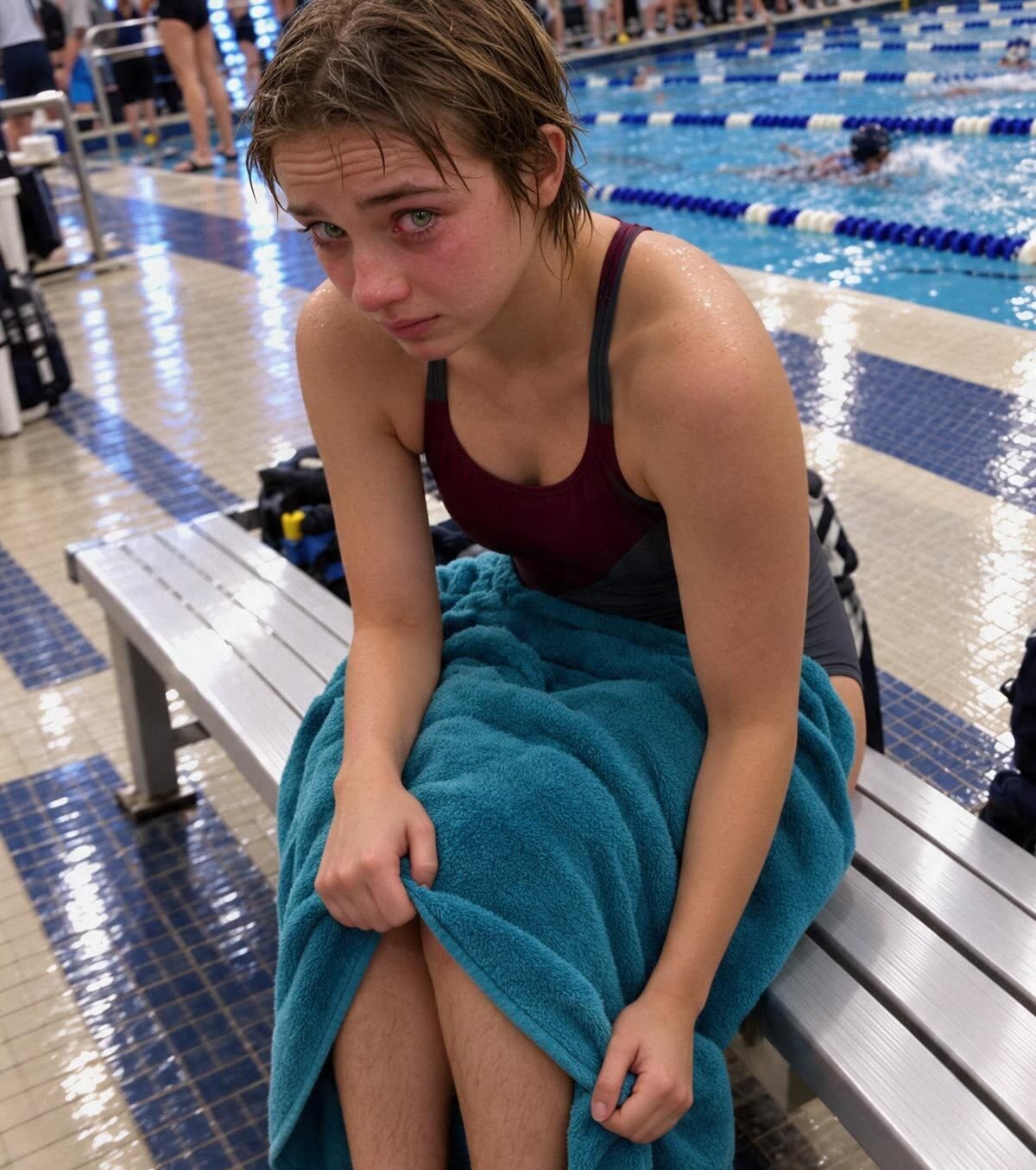
Gia sat on a metal bench near the edge of the pool, a teal-and-white striped towel bunched over her knees. Her hands were wrapped in the fabric so tightly her knuckles had gone pale.
“Those hairy legs?” the coach went on. “That’s embarrassing, sweetheart. Even the boys are going to laugh at you.”
Three girls in matching maroon caps stood a few feet away. One of them giggled. Another covered her mouth, which was somehow worse.
Gia didn’t say a word. She pulled the towel down over her shins and bowed her head until her wet braid slid forward over her shoulder.
I stood frozen for what felt like a full minute and was probably four seconds. My thumb was still hovering over the red record button.
My name is Iris Calloway. I am forty-one years old, I work twelve-hour shifts as a pediatric nurse at Mercy General, and until that Saturday afternoon in March, I had never laid eyes on my daughter’s swim coach.
That was not an accident, exactly, and it was not entirely a choice either. Three years earlier, when Jamie and I divorced, we’d split Gia’s life down the middle like a ledger. I took school nights, dentist appointments, and homework. He took swimming.
It had been his idea. Gia had been nine, quiet and sad in the months after the separation, and he’d signed her up for the Riverside Dolphins because she’d always loved the water. By the end of the first month, she was lit up like a porch lamp every Tuesday and Thursday.
I never wanted to take that away from her. So I stayed out of it.
I’d offered, of course. More than once. I’d said I could drive her, or sit in the stands with a book, or help organize the carpool. Jamie always smiled and said, “We’ve got it handled, Iris. It’s our thing.”
I’d believed him, because I wanted to be the kind of ex-wife who believed him.
But this meet was different. Gia had qualified for the 50-meter freestyle, her first official race, and I had traded shifts with a coworker named Dolores and paid her back with a Saturday and a $40 gift card to the coffee place she loved. I’d slipped into the building at 1:50 p.m., ten minutes before the heat, hoping to surprise my daughter with a hug at the starting block.
Instead I’d walked into this.
Every muscle in my body wanted to move. I could feel my feet pushing against the concrete step, my jaw locking, the old protective heat rising up my neck that every mother knows.
Before I could take a single step down the bleachers, the coach turned and strode away toward the officials’ table, her red polo bright against all that blue tile. A whistle bounced against her chest with every stride.
That was when Gia looked up and saw me.
Her face crumpled and then hardened, all in the space of a breath.
“Mom?” She stood halfway, the towel clutched against her. “Why didn’t you tell me?”
I hurried down the steps. “Tell you what, honey?”
“That my legs are disgusting!” Her voice cracked on the last word. “Coach Emma said girls my age are supposed to shave. She said you should have taught me that already!”
“Gia, there’s nothing disgusting about your legs.”
“Stop it!” She was whispering now, furious and trembling. “Everyone’s going to laugh at me because of you. You’re a terrible mom. Why didn’t you warn me?”
The words hit my sternum like a thrown shoe.
I sat down beside her on the bench. The metal was cold and slick with water. I didn’t touch her at first. I just held out my hand, palm up, and waited.
After a moment, she took it.
“You have nothing to be ashamed of,” I said quietly. “And nobody has the right to talk to you that way.”
“But she’s my coach.” Her eyes were red-rimmed, and one tear slid down and dripped off her chin onto the towel. “She’s in charge of everything. She said I look gross.”
I had my speech ready. I had an entire speech, and it began with the words “Excuse me, ma’am” and ended with the director’s phone number. But Gia’s fingers closed around my wrist.
“Please don’t, Mom. You’ll make it worse. Please.”
I looked at her face, the freckles standing out against her flushed cheeks, the goggles pushed up on her forehead like a headband, and I understood that she was asking for something bigger than silence. She was asking not to be made into a spectacle.
“I won’t cause a scene before your race,” I said. “I promise.”
She exhaled. Some of the tension went out of her shoulders.
Jamie appeared then, jogging in from the parking lot with her spare goggles in his fist. He wore his navy quarter-zip and the same hopeful grin he’d worn at every one of her practices. He didn’t notice me until he was almost beside us.
“Iris? You came!”
“I told you I would.”
“I thought you had a shift.” He looked pleased and a little confused, like a man who’d found a second umbrella in his car.
Gia wiped her face on the towel, stood up, and announced she was fine. She said it three times, to nobody in particular. Then she hurried toward the starting blocks with her braid swinging, and she didn’t look back.
I watched her climb onto lane four. The horn sounded. She swam hard, her arms slicing the water, but she touched the wall more than four seconds behind the times Jamie had been bragging about for weeks.
She didn’t look at the stands when she got out. She went straight for her towel.
I sat through the rest of the meet in the third row like any other stranger, my phone in my lap and the video I’d meant to record still unrecorded. Around me, parents cheered and compared stopwatch times.
Near the end, two of the maroon-capped girls passed below the bleachers, and I heard one of them say to the other, “Coach says Gia’s mom doesn’t even come to anything.”
The other girl shrugged. “Well, she’s never here.”
My hands went cold.
I had been in that building for less than an hour, and somehow I had already become a character in a story I’d never heard.
Part 2: The Friendly Stranger
When the final race ended, Gia went off to change, her gym bag knocking against her hip. Jamie followed her as far as the locker room corridor, murmuring something encouraging.
I stayed where I was and watched Emma.
She stood alone at the far end of the deck, packing a mesh equipment bag with kickboards and stopwatches. She was perhaps thirty-two, with a tight blonde ponytail and a posture so straight it looked rehearsed. She hummed while she worked, and I disliked that more than I’d expected to.
I had promised Gia no scene. I had not promised to stay ignorant.
I took a breath, arranged my face into something pleasant, and walked toward her.
“Excuse me. Are you one of the coaches?”
She glanced up and smiled automatically. “I am. Can I help you?”
“My daughter’s thinking about joining a swim program. I was really impressed with how organized everything was today.”
“Thank you.” She straightened with obvious pride. “We work hard with these girls.”
“Especially at this age, I imagine. They must need a lot of encouragement.”
“Encouragement, yes. But discipline matters just as much.” She zipped the bag halfway. “Honestly, a lot of parents are too soft these days.”
I nodded as though that were wisdom. “Actually, I overheard something earlier. A coach commenting on a young girl’s legs. It struck me as rather personal.”
Her smile thinned, though it didn’t disappear. “Well. Some girls need guidance about their appearance. They’re growing up.”
“Does embarrassing them help?”
“I wouldn’t call it embarrassing.” She shifted the bag to her other shoulder. “Sometimes girls need to hear uncomfortable truths.”
“From their swim coach?”
“Someone has to say it. You’d be surprised how many mothers neglect the basics.”
I studied her face. There was no malice there, and that was the unsettling part. She looked like a woman who believed she was doing a public service.
“Do you see that often?” I asked. “Mothers who neglect things?”
Emma sighed and lowered her voice, as if we were two women sharing a secret over a fence. “There’s one girl on my team whose father does practically everything. Wonderful man. He brings her to every single practice, buys all her gear, sits through every meet. And in two years, I have never once seen her mother.”
I knew exactly who she meant. I could have recited the girl’s measurements.
“Maybe her mother has other responsibilities,” I said, and my voice came out steadier than my pulse.
“Maybe. But children notice who shows up.”
The words landed harder than anything Gia had said. Perhaps because Gia had said hers in pain, and Emma was saying hers with a clear conscience.
“Has the mother told you she isn’t interested?”
Emma blinked at me. “No. I’ve never met her.”
“Then how do you know?”
“Her dad talks about handling everything himself.” She shrugged, almost kindly. “You can draw your own conclusions.”
Across the deck, the locker room door swung open and a stream of girls in sweatshirts spilled out. Somewhere in there was a twelve-year-old who had called me a terrible mother and who, I now suspected, had been fed that idea one small comment at a time.
“What’s the girl’s name?” I asked.
“Gia.”
I let the silence stretch until Emma’s smile started to look uncertain.
“My name is Iris,” I said.
She waited, polite and expectant.
“Gia is my daughter.”
The color left her face in layers, first the cheeks, then the forehead, until she looked like one of her own kickboards. She set the equipment bag down on the wet tile.
“Oh.”
“Yes. And I heard what you said to her before the race.”
“Iris, I think you’ve misunderstood.”
“You told my daughter her legs were embarrassing. You said the boys would laugh at her. Then you told her I should have taught her to shave.”
“I was trying to prepare her.” Her voice rose half a note. “Girls can be cruel to each other.”
“And you decided to demonstrate?”
She glanced toward the pool as though the water might supply an answer. “I didn’t mean to upset her.”
“She was crying when I reached her. She told me I was a terrible mother, because you’d made her believe I’d failed her.”
“I never used those exact words.”
“But you’ve clearly decided something about me.”
Emma drew herself up again, grasping for the posture she’d worn a minute ago. “Jamie has always been the involved parent when it comes to swimming.”
“Because that’s the arrangement we made. Did you ever ask why?”
She said nothing.
“I want Gia to enjoy swimming without worrying about her body,” I said. “And I don’t want you discussing me with her ever again.”
Emma picked up the bag with both hands. They weren’t quite steady. “I think you should talk to Jamie.”
“Why?”
“Because I only repeated what he told me.”
The sentence hung in the humid air between us, chlorine and cold tile and something I did not yet have a name for.
“I’m also speaking with the program director,” I said.
Her composure finally split. “Please don’t turn this into something bigger than it was.”
I looked at her for a long moment.
“You made my daughter’s legs into something bigger than they were.”
Then I turned and walked away, and I did not look back to see whether she was watching.
Part 3: What Gia Never Asked
Jamie was waiting by the front entrance when Gia came out of the locker room, her hair damp and her sweatshirt hood pulled up. He was already halfway into a congratulations speech about finishing her first race.
“Great job, kiddo. Seriously. Do you know how many people never even try?”
“Thanks,” Gia mumbled to the floor.
He looked at me over her head. I shook mine very slightly.
“She had a hard afternoon,” I said. “Let’s talk after dinner.”
“Did something happen?”
“Yes. But she needs some space first.”
Gia tugged my sleeve. “Can I go home with you?”
Jamie’s face did something complicated, a flinch folded into a smile. “Sure, Gia-bean. Of course.”
The drive back to my place on Alder Street took twenty minutes. Gia pressed her forehead against the passenger window and watched the Ohio spring slide by, wet fields and gas stations and a church sign advertising a pancake supper.
At the second red light, she spoke without turning her head. “Are you mad at me?”
“Why would I be?”
“For what I said.”
“No, honey. You were hurt. Hurt people say things.”
She picked at the fringe on her towel. “Coach Emma probably thinks I’m stupid now.”
“Why would she?”
“Because I didn’t know about shaving.”
“You’re not stupid. And shaving isn’t a requirement for being a girl or a swimmer.”
She didn’t answer. The light turned green.
That night, after Gia had showered and gone upstairs with a bowl of mac and cheese and a library book she wasn’t reading, I called Jamie. I stood at the kitchen counter, drumming my fingers beside a stack of unopened mail.
“Did you tell Emma I don’t care about Gia?”
“What? Of course not.”
“She seems convinced you’re raising Gia alone.”
He sighed. “Iris, she’s probably just confused because I’m always there.”
“She said you told her you handle everything.”
“Everything related to swimming. That’s true.”
“And when she started making assumptions about me, did you correct her?”
There was a pause. I could hear a television murmuring in the background of his apartment.
“I don’t remember every conversation I’ve ever had with her.”
“She humiliated Gia today, Jamie. In front of other children. She said I should have taught her to shave.”
“She said what?”
I told him everything, the towel, the giggling, the words. I told him what Gia had said to me on the bench, and I kept my voice flat so it wouldn’t shake.
“Emma said that in front of the other kids?” He sounded genuinely sick. “Gia was crying?”
“Yes.”
“I’ll talk to her.”
“I already did. But something else is bothering me. Why does she think I’m an absent mother?”
The defensiveness came in like a tide. “I can’t control what other people think.”
“You can control what you tell them.”
“I’ve never called you a bad mother.”
“Then help me understand why she thinks you do everything and I do nothing.”
Neither of us spoke. The refrigerator hummed. A clock I’d inherited from my grandmother ticked above the stove.
“Can we discuss this tomorrow?” Jamie said at last. “In person?”
“Fine. Tomorrow.”
I hung up and stood there for a while with my palms flat on the counter.
Sunday morning, I made pancakes, which Gia only eats when she’s sad. She sat at the table with her hair in a messy ponytail and pushed cereal around a bowl she’d insisted she wanted instead.
I poured coffee and tried to sound casual. “Has Coach Emma ever mentioned me before?”
Gia hesitated, spoon halfway to her mouth. “Sometimes.”
“What did she say?”
“Nothing really bad.”
“Tell me anyway.”
She stirred. The cereal had gone soft. “Once, my suit got too tight in the straps, and Coach asked why you hadn’t noticed. I told her Dad buys my swim stuff.”
“What did she say to that?”
“That moms should pay attention to those things too.”
I thought of the swimsuit order Jamie had placed online in January, $89.97, shipped straight to his apartment. I’d offered to split the cost and handle the sizing. He’d said, “Don’t worry about it. I’ve got everything covered.”
“Anything else?”
Gia looked at the table. “She asked why you never come to practice.”
“What did you tell her?”
“That swimming was my thing with Dad.”
“And?”
“She said that was nice, but moms should still make an effort.”
I set my mug down carefully, because my hand wasn’t entirely reliable. “Gia, did you ever want me to come?”
She shrugged, a small, bony movement. “I thought you didn’t like swimming.”
“Why would you think that?”
“Because you’re never there.”
It was such a simple answer. It was a child’s logic, tidy and devastating, and I couldn’t speak for a moment.
“I thought you and Dad wanted that time together,” I said finally.
“We do. But…” She frowned, working it out. “You never said you wanted to come.”
“I never said you couldn’t.”
“Oh.” She looked genuinely surprised, as if I’d told her the sky was green.
Three years. For three years, my daughter and I had each been politely avoiding something the other one wanted.
Then she said, very quietly, “Coach Emma told me that when girls get older, they need a woman who understands them.”
“Did she say I didn’t?”
“Not exactly. But whenever I asked her something, she’d say you should have already explained it.”
“Like what?”
“Growing up stuff. And one time I asked if swimming made leg hair grow faster, and she laughed and said I should ask my mom why I still had so much.”
Heat climbed my throat. I wanted to pick up the phone and call Emma, and I wanted to say things that would have gotten me banned from the Lakeview Aquatic Center for life.
Instead I said, “Why didn’t you ask me, sweetheart?”
Gia lowered her eyes. “I didn’t want you to feel bad.”
There it was. My twelve-year-old had been quietly guarding my feelings while believing, one comment at a time, that I was failing her.
I got up, came around the table, and held her until the pancakes went cold.
At 2:00 that afternoon, the doorbell rang. Through the glass I could see Jamie on the porch, hands shoved in his jacket pockets, looking like a man who hadn’t slept.
When I opened the door he didn’t say hello.
“Iris,” he said, “I need to tell you something I should have admitted three years ago.”
Part 4: A Place at the Pool
We talked in the kitchen while Gia watched television upstairs, the volume turned low enough that I knew she was listening.
I repeated everything she’d told me. Jamie sat across from me at the table with his hands folded, and by the time I finished, he looked miserable.
“I had no idea Emma was saying those things to her.”
“Did you tell her I wasn’t interested in swimming?”
“I might have said you leave that stuff to me.”
“Why?”
“Because you do.”
“Because you asked me to, Jamie.”
He looked away toward the window, where a cardinal was hopping across the fence rail.
I reminded him, gently at first, of every time I’d offered. The week Gia’s team picture was taken. The night I’d suggested watching a regular practice. The time I’d asked to chaperone a hotel trip to a regional meet. Each time, he’d said it was handled. Once he’d told me that Gia loved having something that belonged only to the two of them.
“I believed you,” I said.
“I wasn’t lying.”
“Then why did you keep discouraging me?”
Jamie sat very still. A full minute passed. The clock above the stove counted it out.
“After the divorce,” he said slowly, “Gia spent most of her school nights here. You knew her friends. You knew which teachers were tough. You remembered the orthodontist. I felt like I was always catching up.”
I listened.
“Then swimming started, and suddenly I was the one who knew everything. The coaches knew me. The other parents knew me. Gia needed me for something.” He rubbed his eyes. “I liked having one thing that was ours.”
“Nobody was trying to take it away.”
“I know.”
“Did you ever tell Emma that?”
He shook his head. “I guess I liked hearing her say what a devoted father I was.”
That admission hurt more than all of his earlier defensiveness. It was small and human, and it had cost my daughter a great deal.
“She read your pride as proof I wasn’t doing my job,” I said.
“I didn’t realize.”
“And Gia started believing it.”
His head came up. “What do you mean?”
I told him about Gia assuming I didn’t like swimming. About her feeling too embarrassed to ask me things, and too loyal to say so. Jamie pressed both hands over his face.
“I never wanted that.”
“I believe you. But it happened.”
“Will she talk to me?”
“Yes. But don’t ask her to make you feel better about it. Just listen.”
He nodded, and for the first time I saw him understand that being Gia’s favorite swimming parent had a price neither of us had meant to pay.
On Monday morning, I called the program director. Her name was Bonnie Whitaker, a woman in her late fifties with a silver bob and a reputation for running the Riverside Dolphins like a well-oiled ship. I told her what I had seen at the pool and what Gia had said afterward, in order, with no adjectives.
Bonnie didn’t interrupt once. When I finished, she was quiet for a few seconds.
“Commenting on a child’s body like that is unacceptable,” she said. “And a coach has no business passing judgment on a family she’s never met.”
She scheduled a meeting for Wednesday at 4:30 p.m. and asked both Jamie and me to attend.
Emma arrived in a clean red polo with her ponytail even tighter than before. She sat across from us in Bonnie’s cramped office, beneath a wall of faded team photos, and began by insisting she had only been offering advice.
“Girls notice these things,” she said. “I didn’t want Gia getting teased.”
“She was teased,” I said. “By you.”
Emma turned to Bonnie. “I care about Gia. She’s talented, and I’ve invested a lot of time in her.”
“Then why did you keep criticizing her mother?” Jamie asked.
His voice was low. Emma looked startled, as if the furniture had spoken.
“I never criticized Iris directly.”
“You told Gia her mother should have taught her things,” I said. “Things that have nothing to do with swimming.”
Emma struggled to find an answer. Bonnie took off her glasses and set them on the desk.
“Emma. Explain to me how Gia’s leg hair affects her 50-meter freestyle.”
The silence stretched so long I could hear the vending machine humming in the hall.
“It doesn’t,” Emma finally said.
“Did either parent ask you to advise her about shaving?”
“No.”
“Then you crossed a boundary,” Bonnie said quietly.
Emma’s eyes filled. “I truly didn’t mean to hurt her.”
“She was afraid to stand up without a towel,” I said. “Whatever you intended, that’s what happened.”
Bonnie told us Gia would not be required to train with Emma again. After the program’s review, Emma was removed from the youth group entirely. I didn’t celebrate when I heard. I felt relieved, and a little hollow, and mostly conscious that the thing that still needed repairing wasn’t in that office.
That Saturday, Jamie asked Gia to sit with him on the back porch. I stayed in the kitchen with the window cracked open, folding the same dish towel over and over.
“Mom wasn’t too busy, Gia,” I heard him say. “She asked to come. Many times. I kept telling her we had everything handled.”
“Why?” Gia’s voice was small.
“Because I was being selfish. I thought having something just for us mattered more than it did.”
A long pause.
“I like swimming with you, Dad. But I wanted Mom there sometimes too.”
“I know that now. I’m sorry I didn’t notice what Emma was doing, either.”
Gia didn’t forgive him right away. But a minute later, she scooted closer on the step, and they talked about flip turns for nearly an hour.
That evening she padded into my bedroom in her socks while I was folding laundry.
“Mom?”
“Yeah, sweetheart?”
“Do you think Coach Emma hated me?”
I set down a pair of her pajama pants. “No. I think she believed her opinions mattered more than your feelings. That’s not the same as caring for someone properly.”
Gia sat on the edge of the bed. “I thought she knew everything.”
“Adults can know a lot about one thing and still be wrong about something else.”
She leaned against my shoulder. “I’m sorry I called you a terrible mom.”
I kissed the top of her head. “I know.”
“You’re not.”
“Thank you, honey.”
She was quiet a moment. “Can you come to my next meet?”
“I’d love to.”
Three weeks later, on a gray Saturday in April, Gia stood in front of her bedroom mirror in her maroon-and-charcoal racing suit with her braid pinned up.
“Mom, should I shave my legs?”
I looked up from her equipment bag. “Do you want to?”
She studied her reflection. “Not really.”
“Then you don’t have to.”
“What if someone says something?”
“Then they can learn to mind their own business.”
She laughed, a real laugh, bright and crooked.
At the pool, Jamie met us by the entrance with a coffee for me and a bag of orange slices for Gia. She ran ahead to greet her new coach, a cheerful former college swimmer named Marcus, and waved for us to follow.
She didn’t win her race that afternoon. But she dropped her time by almost three seconds, and when she climbed out of the water, she was grinning so wide her goggles slid down her nose.
I noticed the teal-and-white towel hanging loosely over her shoulders. At her first meet, she’d clutched that same towel around her legs like a shield. Now she’d forgotten it was even there.
“Mom! Dad!” she called, waving both arms. “Did you see my finish?”
We hurried toward her together.
For the first time since she’d started swimming, nobody had to explain why I belonged there.
If someone you trusted unintentionally led others to believe you were a neglectful parent, could you forgive them?
Disclaimer: This story is a work of fiction inspired by real-life themes. Names, characters, places and events are fictionalized, and any resemblance to real persons is purely coincidental. Images are for illustration purposes only.


