

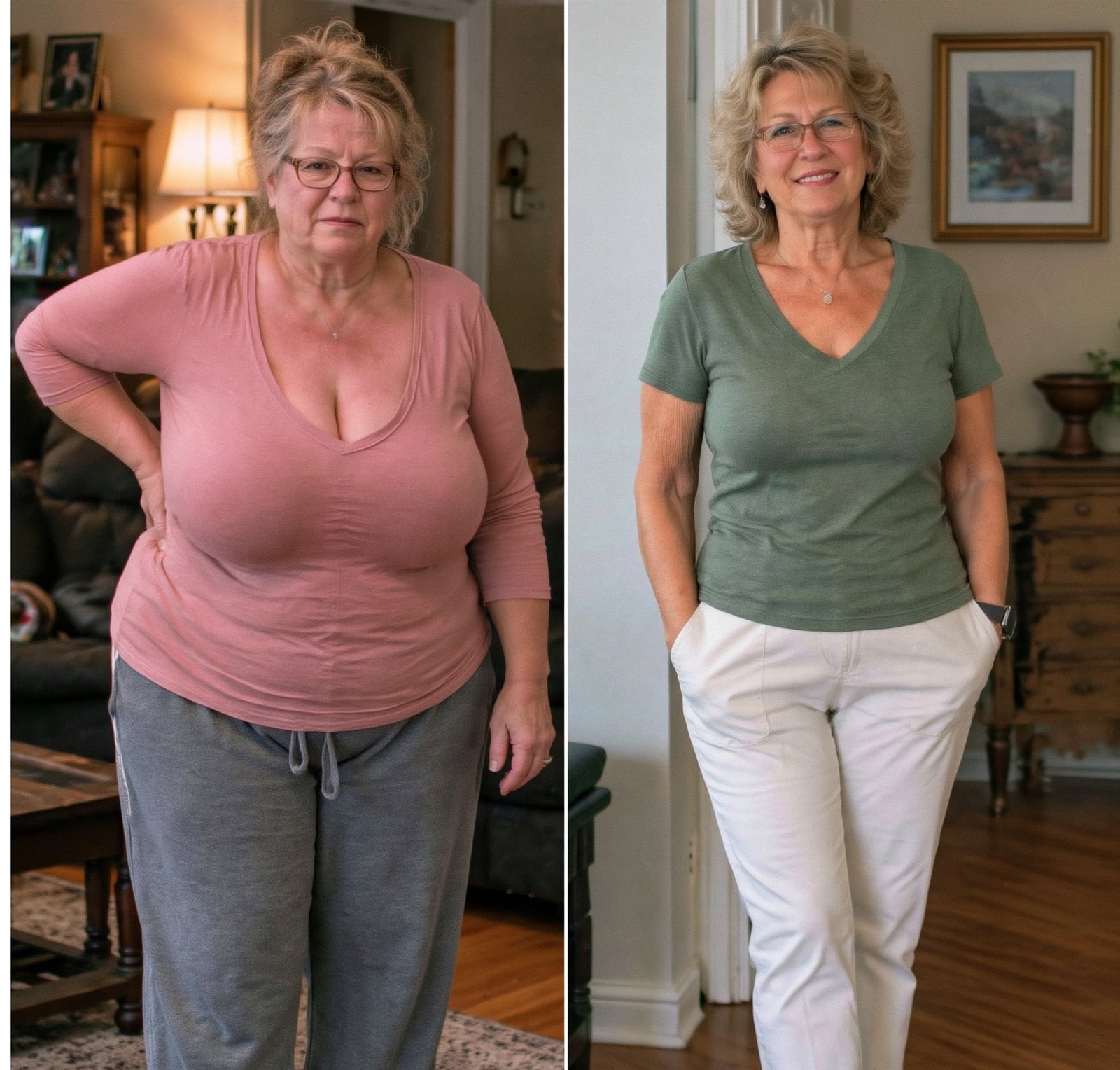
For weeks, my father begged my mother not to go through with it. So when we walked into their bedroom and found bare nails where the mirrors used to hang, I braced myself for a fight. Instead, Dad pulled down an old shoebox from the closet, and Mom went pale before he even opened the lid.
Part One: Seventy Years of Carrying It
For as long as I can remember, my mother has complained about her back.
When I was little, it was just background noise, the way some mothers hum while they cook. She’d press a fist into the base of her spine while she stirred the spaghetti sauce. She’d sigh when she bent to pull a casserole from the oven. On long drives, she’d wedge a rolled-up towel behind her shoulders and shift in her seat every ten minutes, and my brother and I would roll our eyes because we thought she was being dramatic.
She wasn’t being dramatic.
By the time she turned 60, Mom couldn’t stand at the kitchen counter for more than a few minutes without shifting her weight from one foot to the other. Thanksgiving became a production of stools and breaks. She’d chop celery for five minutes, sit down for two, then get up again, waving me off whenever I tried to take over.
“I’m fine, Chiara. It’s just my back.”
It was always just her back.
By 68, buying a bra had turned into a small tragedy. She’d order three online, try them all on, and send all three back. Then she’d go right back to the same old beige one she’d been wearing for years, the one with straps that left deep red grooves in her shoulders by the end of every day. I’d seen those grooves once when she was changing, and I’d never forgotten them. They looked like something had been pressing down on her for decades.
In a way, something had.
So for her 70th birthday, my mother finally did the thing she’d been talking about since I was in middle school.
She scheduled a breast reduction.
She announced it at the dinner table the way other people announce a cruise. “I’ve booked it,” she said, passing the potatoes. “February 12th. Happy birthday to me.”
My father put down his fork.
Dad wasn’t happy about it. Not angry, exactly. Just uneasy in a way he couldn’t seem to put into words. For weeks afterward, every time the subject came up, he said the same thing.
“You’re perfect the way you are, Cindy.”
Mom would roll her eyes so hard I worried she’d sprain something.
“I’m not doing this so you’ll think I’m prettier, Brad.”
“I know that.”
“Then stop saying it.”
He’d go quiet for a day or two, and then he’d say it again, gently, like a man testing ice he wasn’t sure would hold.
What Dad never seemed to understand, or maybe couldn’t let himself understand, was that this had nothing to do with how she looked. My mother wasn’t trying to look younger. She wasn’t chasing some old photograph of herself.
She wanted to kneel in her garden without her shoulders burning.
She wanted to cook a whole dinner without sitting down halfway through.
She wanted to walk around the block with her grandkids and not come home needing a heating pad.
She wanted to spend whatever years she had left without constantly negotiating with pain.
“Seventy years,” she told me one afternoon when I drove her to her pre-op appointment. She was staring out the passenger window at the gray February sky. “Seventy years I’ve carried these things around. I think I’ve earned the right to put them down.”
I squeezed her hand at the red light. “You have, Mom.”
She smiled at me, small and tired. “Your father will come around.”
Part Two: The Bare Wall
The surgery went well.
At least, that’s what I believed when I drove her home two days later.
She was sore, of course. She held a small pillow pressed against her chest the entire ride and winced at every pothole, muttering, “Whoever paves these roads should be arrested.” But she was cracking jokes, which in my family is the most reliable vital sign there is. When my mother stops making jokes, that’s when you call the doctor.
Dad was waiting for us in the driveway before I’d even put the car in park.
He must have been watching through the front window. He hurried around to her side, opened the door, and hovered over her like she was made of spun sugar.
“Careful. Careful, Cindy. Take my arm.”
“I’ve got it, Brad.”
“Did the seat belt hurt? I told Chiara to put a towel under it.”
“She did. It’s fine.”
“Do you need water? I’ve got water inside. And the good crackers. And I bought that ginger ale you like.”
Mom shot me a look over his shoulder that said, Is he going to do this all week? I bit back a laugh.
He carried her overnight bag. He carried her purse. He would have carried her if she’d let him. He walked one step behind her up the stairs with his hands hovering near her back, ready to catch her if she so much as swayed.
I thought it was sweet. I thought maybe this was his way of making peace with the whole thing, of finally accepting the decision she’d made.
Then we walked into their bedroom, and Mom stopped so suddenly that I almost bumped into her.
The large mirror that had hung above the dresser for as long as I’d been alive was gone. All that was left was a pale rectangle on the wallpaper and two bare nails sticking out of the wall.
The full-length mirror that usually leaned against the wall beside the closet was gone, too.
And on the dresser, in the spot where it had sat my entire life, there was nothing but a faint ring in the dust. The little oval vanity mirror Mom had owned since her twenties, the one with the tarnished silver frame and the chip in the corner, had disappeared.
“Brad?”
Dad appeared in the doorway behind us.
Mom let out an uncertain little laugh. “What on earth did you do?”
“You shouldn’t look yet.”
She waved a hand. “The surgeon already warned me about the swelling. I know I’m going to look like a mess for a few weeks. I’m not going to faint.”
Dad shook his head slowly.
“It’s not the swelling.”
Something in his voice made me turn around.
My father is not a frightened man. He’s a retired contractor who once finished framing a roof with a broken wrist because he didn’t want to let the crew down. I’ve seen him handle flooded basements, a car fire, and my teenage years without flinching.
But standing in that doorway, he looked terrified.
Mom’s smile slipped away.
“Brad,” she said quietly. “What aren’t you telling me?”
Part Three: The Shoebox and the Knock
Dad glanced at me, then back at her, as if he were trying to decide how much he could say with me in the room.
“Your surgeon called,” he said finally. “While you were asleep after the operation.”
My stomach tightened.
“Why would the surgeon call you?” I asked.
“Your mother authorized them to talk to me about her care.”
Mom stared at him. “And? What did he say?”
Instead of answering, Dad crossed the room to the closet. He reached up to the top shelf, past the winter sweaters and the old photo albums, and pulled down a battered shoebox. The cardboard had gone soft at the corners. Someone had written something on the lid in faded blue pen.
Mom’s face changed. All the color drained out of it at once.
“Where did you get that?”
“It’s been up there for years, Cindy.”
“I know where it’s been. Why did you take it down?”
Dad lifted the lid and took out an old photograph. He held it against his chest for a moment, as though he couldn’t decide whether to hand it over.
Before Mom could reach for it, the doorbell rang.
Then came pounding. Loud, frantic, open-palmed pounding, the kind that rattles the glass in the door.
Dad froze with the photograph still in his hand.
“I’ll get it,” I said, because nobody else moved.
I went downstairs and opened the front door.
My aunt Linda was standing on the porch.
She was Mom’s younger sister, and she lived almost an hour away, out past the reservoir. But she looked as though she’d walked out of her house without thinking twice. Her hair was twisted up in a lopsided ponytail. She was wearing house slippers. She didn’t have a purse, or a jacket, or anything at all in her hands except her car keys.
“Chiara.” She pushed past me into the hallway. “Where is she? Is she upstairs?”
I caught her arm.
“Aunt Linda, wait. Why are you here?”
She stopped. She looked at me, and her face answered before her mouth did.
“Your dad called me.”
“When?”
She hesitated. “This morning.”
This morning. Before Mom and I had even left the hospital. Before anyone had told the patient a single thing.
Footsteps sounded above us.
Mom was standing at the top of the stairs in her robe, one hand gripping the banister, the other still pressed against the little pillow at her chest.
“Linda?”
Linda looked up at her sister, and her eyes filled.
Mom’s gaze moved from Linda to Dad, who had come out of the bedroom and was now standing a few steps behind her in the hallway. I watched something settle over my mother’s face. It wasn’t fear exactly. It was something harder.
“Everybody,” she said. “Upstairs. Now.”
Dad reached for her elbow. “Cindy, you need to rest.”
“And apparently,” she said, without looking at him, “I also need to find out what everybody else in this family already knows.”
Nobody argued after that.

Part Four: The Photograph
Back in the bedroom, Mom lowered herself carefully onto the edge of the bed. It took her a long moment. I could see what it cost her in the way she held her breath.
Once she was settled, she held out her hand.
“Give me the photograph.”
Dad hesitated.
“Brad.”
He gave it to her.
I sat down beside Mom as she turned it over, and I leaned in to see.
It was an old color print, the kind with rounded corners and that faded orange tint everything from the seventies seems to have. I recognized my grandmother immediately, even though she was decades younger than the woman I remembered. She was standing on a lawn somewhere in summer, squinting into the sun, and she was smiling. On one side of her stood a teenage girl with a serious expression and a feathered haircut. That was my mother. On the other side was a younger girl with braces and a lopsided grin. Aunt Linda.
Then I noticed Grandma’s blouse.
On one side, the fabric curved the way you’d expect. On the other, it lay flat against her chest.
I knew my grandmother had survived breast cancer. It was one of those facts that had always been in the background of our family, like the year my grandparents bought their first house or the name of the town they came from. I knew she’d had a mastectomy. I knew she’d lived a long time afterward.
But I had never seen this photograph.
Mom had.
Her fingers tightened around the edges until the corners bent.
She looked up at Dad.
“Why,” she said quietly, “are you showing me this?”
Dad sat down on her other side. The mattress dipped under his weight.
“Because the surgeon found something.”
Mom went completely still. I don’t think she even blinked.
“In my breast?”
Dad nodded.
“During the reduction, he found a firm mass. In the tissue he was removing from your left side.”
I felt the blood drain out of my face.
Mom didn’t move.
“What did he do about it?” Her voice was very calm. Too calm.
“It was already in the area they were taking out. So it came out with everything else. It’s been sent to pathology.”
“To find out if it’s cancer.”
“Yes.”
The word seemed to change the air in the room. It was like someone had opened a window in the middle of winter. Linda sat down slowly on the cedar chest at the foot of the bed. I realized I was holding my breath.
Mom looked down at the photograph of her mother.
“When will we know?”
“They said it could take several days.”
Linda reached over and put her hand on Mom’s knee.
Mom lifted her eyes and stared at the empty rectangle on the wall above the dresser, at the two lonely nails.
“And the mirrors?”
Dad rubbed both hands over his face. When he spoke, his voice was rough.
“The surgeon said that more tissue ended up coming from that side. Because of what he found. He warned me that one side might look noticeably smaller than the other while you heal. Maybe for a while.”
“So you took down every mirror in the room.”
“I didn’t want you to walk in here, catch yourself in the glass, and panic before I had a chance to explain.”
Mom held up the photograph.
“This is why.”
Dad looked at her for a long moment.
“The second he said the word ‘mass,’” he said, “I thought about your mother.”
Mom’s voice dropped to almost nothing.
“So did I.”
“I knew you would. That’s what scared me.”
“And you thought taking away my mirrors would stop me from thinking about her?”
“No.” Dad swallowed hard. “I thought it might buy you a little time. You’re already bruised and sore and exhausted. I didn’t want you looking at yourself and immediately deciding you were going through exactly what she went through. Not before we even know anything.”
Part Five: Don’t Look, Don’t Ask
Mom stared at him. Then she turned to her sister.
“When did he tell you?”
Linda’s shoulders curled in. “This morning.”
“So you knew before I did.”
“Cindy, he was scared. He didn’t know what to do. He called me crying.”
Mom looked back at Dad. When she spoke, every word came out slow and deliberate, as if she were laying bricks.
“You called my sister. You climbed up and dug out a picture of my mother after her mastectomy. You took every single mirror out of our bedroom. And I was supposed to come home, take my pain pills, and lie down for a nice nap?”
“I was going to tell you.”
“When?”
“Once you were settled. Once you’d rested.”
Mom’s eyes filled with tears.
“That’s exactly what they did when Mom was sick.”
Across the room, Linda lowered her head.
I took Mom’s free hand. “What do you mean?”
Mom ran her thumb slowly across the surface of the photograph, across her mother’s smiling face.
“I was seventeen when she had the mastectomy,” she said. “Nobody explained anything to us. Nothing. Dad told us she was going into the hospital for an operation and that everything was going to be fine. That was all. Then relatives started showing up at the house. Aunts I barely knew. They’d stand in the kitchen and whisper, and every time Linda or I walked in, they’d stop talking and start asking about school.”
She looked at me.
“I found out what they’d actually done to her because I walked into her bedroom one afternoon while she was getting dressed. I didn’t knock. I just opened the door, and there she was.”
My stomach twisted.
“Nobody had told you? Nobody at all?”
“No.” Mom’s voice wavered. “She looked at me like she’d been caught doing something wrong. Like she should be ashamed. And then she pulled her blouse closed and said, ‘Shut the door, Cindy.’ And I did. And we never talked about it. Not once. Not in forty years.”
Linda wiped her eyes with the heel of her hand. “I was twelve,” she said softly. “I didn’t find out until Cindy told me, weeks later, in the dark, after our lights were out.”
Dad leaned forward, his elbows on his knees.
“Cindy, I swear to you, I wasn’t trying to do that to you.”
Mom turned and looked at the bare wall for a long time.
“Then bring me my mirror.”
Dad blinked. “What?”
“Bring me my mirror.”
“No.”
Mom’s head snapped around. “Excuse me?”
“Not today. You’re two days out of surgery.”
“Bring me the little one. The vanity mirror.”
“Cindy, you’re bruised. You’re swollen. You’re bandaged. And you just found out they’re testing something for cancer.”
“Exactly.”
“You don’t need to see this right now.”
Something shifted in Mom’s face, something old and tired and done.
“That,” she said, “is exactly what everybody told me when my mother was sick. Don’t look. Don’t ask. Don’t worry about it. Let somebody else handle it.” She wiped a tear from her cheek with the back of her wrist. “I’m not seventeen anymore, Brad. I’m seventy years old. Bring me my mirror.”
Nobody spoke.
Dad stood there for a long moment. Then he turned and left the room. We heard him go downstairs, heard the door to the garage open and close.
When he came back, he was carrying the small oval vanity mirror.
Its silver-colored frame had gone dark with age, and there was that familiar chip in the upper corner where I’d knocked it off the dresser with a basketball when I was nine. I’d seen it on Mom’s dresser every single day of my childhood. She’d put on her lipstick in it before church. She’d pinned up her hair in it on the night of my wedding.
Dad held it out to her.
Mom took it.
Part Six: Be Scared With Me
Linda and I helped her ease her robe open just enough to see, careful not to disturb the dressings or the surgical bra.
Mom raised the mirror and looked.
For several seconds, she didn’t say anything at all.
Even through the bandages, the difference was noticeable. One side was puffy and swollen, mottled with yellow and purple bruising. The other side looked smaller. Lopsided. Unfinished.
Dad stepped closer. “You’re still beautiful, Cindy.”
Mom raised one hand without looking up.
“Please don’t.”
He stopped where he was.
She kept looking. She tilted the mirror one way, then the other.
“It’s ugly right now,” she whispered.
“It’s surgery,” Linda said firmly. “It’s allowed to look awful. That’s the rule.”
A tiny, surprised laugh slipped out of Mom.
Then the tears started rolling down her cheeks, one after another, falling onto the dressings.
“I look like her,” she said.
Linda shook her head hard. She came around the bed and crouched in front of her sister.
“No. You don’t. You look like Cindy two days after surgery. That’s all you look like.”
Mom lowered the mirror into her lap.
“I’ve spent my whole life wondering,” she said.
I moved closer to her. “Wondering what, Mom?”
“If I’d get it, too.”
That surprised me more than anything else that had happened that day.
My mother had never once talked about being afraid of breast cancer. Not to me. She went to her mammograms every year, right on schedule, and treated them like any other appointment, the same as getting her teeth cleaned or her car inspected. She’d mention them in passing on the phone. Oh, I had my mammogram Tuesday. Then I went to Costco.
I’d always thought that meant she wasn’t worried.
Apparently, fear doesn’t always look like fear. Sometimes it looks like a woman calmly writing an appointment on her calendar every year for forty years and never saying a word about why.
Dad lowered himself down until he was crouching beside Linda, right in front of Mom. His knees cracked. He took her hand.
“When the surgeon said ‘mass,’” he said, “all I could see was your mother. That’s all. Just her face in that picture.”
Mom nodded slowly. “Me too.”
“I thought I was protecting you.”
“You can’t protect me from being scared, Brad.”
“I know.”
“No,” she said, and she turned her hand over so she was holding his instead. “Listen to me. Be scared with me. Don’t be scared for me and then decide what I can and can’t handle. I’ve had enough of that for one lifetime.”
Dad looked down at their joined hands for a long, long time.
Finally, he nodded.
“Okay,” he said. “Okay. With you.”

Part Seven: What the Photograph Really Showed
The next morning, Mom asked Dad to tell her exactly what the surgeon had said on the phone. Word for word, if he could.
He couldn’t.
He remembered the important parts, the mass, the pathology, the asymmetry. But the rest kept coming out as “I think he said” and “I’m pretty sure that’s what he meant” and “he used a word I didn’t know.”
After a few minutes, Mom held up her hand to stop him.
“Give me the number.”
She called the surgical office herself, sitting up in bed with a stack of pillows behind her back. I sat beside her with a notepad and wrote down everything. She asked what exactly the surgeon had noticed during the operation. She asked whether the suspicious area had been entirely inside the tissue they were already removing. She asked what would happen when the pathology results came back, and how long that usually took, and who would call her.
Then she asked the question none of us wanted to hear out loud.
“And what happens if it’s malignant?”
She listened without interrupting. She nodded at things the person on the other end couldn’t see. Once, she said, “Mm-hm, I understand.”
When she finally hung up, she looked tired. But she also looked calmer than she had since we’d walked through the bedroom door.
“What did they say?” I asked.
“That we wait for pathology before we decide anything. If it’s benign, we talk about whether I need any follow-up. If it isn’t, then we talk about what comes next. One step at a time.”
Dad was standing in the doorway with a mug of tea he’d forgotten he was holding.
“That’s it?”
“That’s it.”
Mom closed the notepad and set it on the nightstand.
“I’d rather know what I don’t know,” she said, “than have everybody tiptoeing and whispering around me.”
That afternoon, Aunt Linda found me in the kitchen making chicken soup. She was holding the old photograph.
“I remember this day,” she said, leaning against the counter beside me.
I wiped my hands and looked at it again. Grandma smiling between her two girls, the sun in her eyes.
“Was it right after her surgery?”
“No. Several months after.” Linda smiled faintly at the picture. “You know, Mom almost refused to take this.”
“Because of the mastectomy?” I asked carefully.
“No.” Linda laughed. “Because Cindy kept telling her to move over. Move left, Mom. No, the other left. Stand up straight. Mom finally said, ‘If you tell me where to stand one more time, I’m going inside.’”
I laughed out loud, and the sound surprised me. It felt like the first real laugh anyone in that house had had in two days.
Linda carried the photograph upstairs, and I followed with a bowl of soup on a tray.
Mom was awake, propped up against her pillows, staring at the bare wall.
Linda sat on the edge of the bed and handed her the picture.
“You know what I remember about this day?”
Mom studied it. “What?”
“You. Bossing everybody around.”
Mom frowned. “I did not.”
“You made Dad take three pictures.”
“Because he kept cutting off your head!”
Linda laughed. Then her expression softened, and she tapped the edge of the photograph with one finger.
“Cindy, you always talk about Mom’s operation like everything stopped right there. Like that was the end of her story.”
Mom’s smile faded.
“But look at her,” Linda said. “Really look.”
Mom did.
“That summer, she went swimming with us at the lake. Remember? In that awful flowered swimsuit she sewed the extra panel into. She went back to her tomato garden. She danced at my wedding until two in the morning. And she complained about my cooking for another twenty years.”
Mom let out a laugh that broke halfway through and turned into tears.
“I’d forgotten the swimming,” she whispered.
“I know you did,” Linda said gently. “You only kept the part where you opened the door.”
Mom stared down at her mother’s face for a long time.
For decades, that photograph had stood for everything cancer had taken from our family. The secret. The whispering. The flat side of a blouse. The closed bedroom door.
But watching my mother hold it now, I realized Aunt Linda had shown her something she’d somehow never let herself see.
In that picture, their mother wasn’t dying. She was already living after it.
Part Eight: Back Where It Was
We waited four more days.
They were some of the longest days of my life.
Mom healed a little more each morning. The bruises faded from purple to green to yellow. Dad brought her breakfast on a tray every day, toast cut into triangles the way she liked, and sat with her while she ate it. Aunt Linda stayed for two nights, sleeping in my old room under my high school posters. I handled the groceries, the pharmacy runs, and the medication reminders on my phone.
And nobody pretended we weren’t waiting.
That was Mom’s new rule. When she was frightened, she said so out loud. “I’m scared today,” she’d say over her coffee, the same way she’d say, “Looks like rain.” And when Dad was frightened, which was most of the time, she made him say it too.
“Brad. You’re doing the jaw thing.”
“I’m not doing anything.”
“Say it.”
A long sigh. “I’m scared, Cindy.”
“Good. Me too. Pass the jam.”
On the fourth afternoon, Mom’s phone rang on the nightstand.
She looked at the screen. It was the surgeon’s office.
Everyone in the room stopped moving. Dad froze with the TV remote in his hand. Linda, who’d come back that morning, set down her coffee so carefully it didn’t even clink.
Mom answered.
“Hello?”
We watched her face like it was the only thing in the world.
“Yes. This is she.”
A pause. A long one.
Then her shoulders dropped, all at once, like someone had cut the strings holding them up.
“Benign?”
Dad pressed his hand over his mouth.
Mom closed her eyes.
“Thank you. Thank you so much.”
She listened for another minute, asked what kind of follow-up she’d need and when, wrote something on the notepad with a shaking hand, and then ended the call.
Linda was already crying.
Mom looked up at all of us.
“It’s benign.”
Dad sank down onto the bed beside her as if his legs had simply quit. I threw my arms around both of them, carefully, mindful of her stitches, and Linda leaned over all three of us from behind. For several seconds, none of us said anything useful. There was just a lot of breathing and sniffling and somebody’s elbow in my ear.
Then Mom started laughing and crying at the same time.
Dad pressed his forehead against hers.
“I thought I was going to lose you,” he whispered.
“I know.”
“I’m so sorry, Cindy.”
“I know that, too.”
Mom wiped her face with the sleeve of her robe.
“But listen to me. If that call had gone the other way, we would have dealt with that, too.”
Dad nodded against her forehead.
“Together.”
“Together,” she agreed. “And with every available mirror in the house.”
He laughed, a real laugh, the first one I’d heard from him all week.
That evening, Dad disappeared into the garage. We heard him rummaging around, heard something heavy scrape across the concrete.
He came back carrying the full-length mirror and leaned it against the wall beside the closet, right where it belonged.
Then he went back down and returned with the big dresser mirror. He rehung it on the two bare nails, checking it with a little level from his pocket, adjusting it until it was perfectly straight.
Finally, he went down one last time and came back with the little vanity mirror.
He didn’t put it down. He stood at the foot of the bed and held it out to her with both hands.
“Where do you want this one?”
Mom looked at him for a long moment.
“Back where it was.”
Dad set it gently on the dresser, in the faint ring it had left behind.
And right beside it, Mom placed the photograph of her mother.
She didn’t put it back in the shoebox. The shoebox went into the recycling the following week.
Several weeks later, I stopped by on my way home from work and found Mom standing in front of the dresser mirror.
The swelling had gone down considerably. She was still healing, and she wasn’t perfectly symmetrical, and the surgeon had told her she might never be. But she looked like herself again. She looked like my mom.
She rolled her shoulders back slowly, then forward, then back again.
“How’s the back?” I asked from the doorway.
She caught my eye in the mirror and smiled.
“Better,” she said. “So much better.”
Dad appeared behind me.
And for once, he didn’t say, “You’re perfect the way you are.”
He didn’t tell her she looked beautiful.
He didn’t tell her what she ought to see when she looked at herself.
“How do you feel?” he asked instead.
Mom considered her reflection for a moment.
“Like I’m seventy,” she said.
Dad laughed.
She smiled at him in the glass.
“And like I finally did something good for myself.”
On the dresser beside her, the little vanity mirror caught the late afternoon light. Next to it stood the old photograph.
The picture hadn’t changed at all. Grandma was still standing on that summer lawn after her mastectomy, squinting into the sun, smiling between her two daughters.
But what it meant to all of us had changed completely.
What This Taught Me
My father loves my mother more than anything in the world. That’s exactly why he took the mirrors down. He thought love meant standing between her and the hard thing, deciding what she could bear and when she could bear it.
But my mother had already lived through what happens when people decide for you. She’d spent fifty years carrying the memory of a closed door and a whispered kitchen.
What she needed wasn’t protection. It was a seat at the table of her own life.
Sometimes the most loving thing you can do for someone you’re terrified of losing is hand them the mirror, sit down beside them, and look at the truth together.
[This story is a work of fiction inspired by real events. Names, places, and details have been changed, and any resemblance to real people is coincidental.]


