

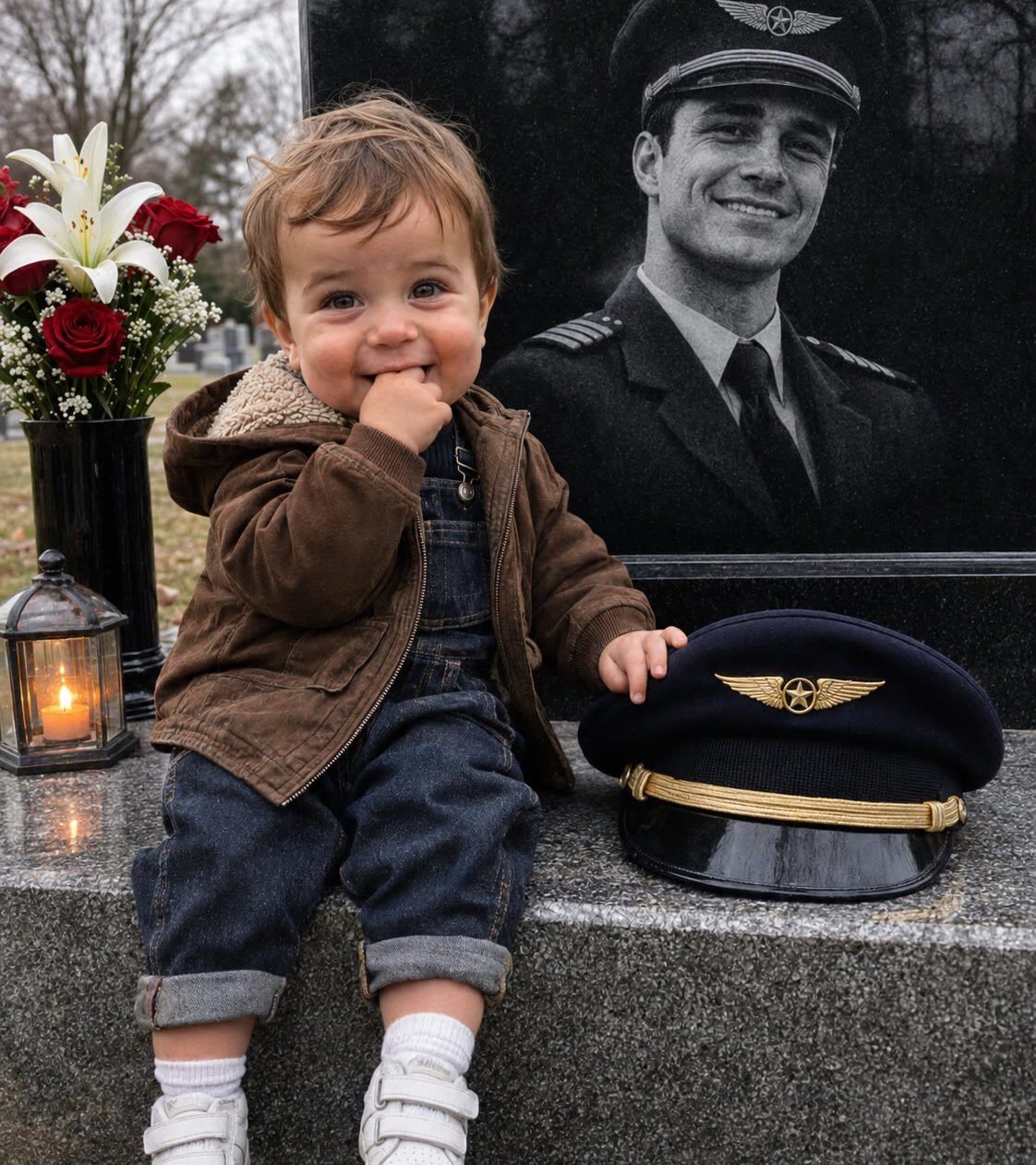
Part 1: The Cap on the Granite
“Dada! Dada!”
Jack’s voice cut through the cold Sunday air like a bell. He was eighteen months old, bundled in a brown hooded jacket, and he was straining so hard against my arms that I nearly lost my grip on the diaper bag.
“I know, baby,” I said. “That’s Daddy’s picture.”
But he shook his head. He kept his chubby finger pointed past the black granite headstone, past the etched portrait of my husband smiling in his captain’s uniform, toward the flat ledge at the base.
I looked.
And my knees almost gave out.
A navy pilot’s cap sat on the stone, its visor gleaming, its gold wings catching the gray light. One side of the braid hung a little lower than the other.
I knew that droop. I had put it there myself.
I set Jack down on the ledge with one hand on his back, because I didn’t trust my legs to carry both of us. Then I picked up the cap. The wool was cold and slightly damp, and it smelled faintly of lemon polish and old leather.
My thumb found the crooked braid on its own.
Twenty-one months. That was how long that cap had been missing. It had vanished the day my husband died, and in all that time I had never stopped wondering where it went.
“Who put you here?” I whispered.
Jack giggled and slapped the ledge. He had no idea that his mother had just gone completely still.
*
I should explain what my life looked like by then.
My name is Emma. I’m twenty-nine. Before Jack, I was a competitive rock climber, the kind who chalked up her hands in a parking lot at dawn and dreamed about opening her own climbing school someday. I had a spreadsheet for it and everything.
Now I did alterations at my kitchen table. Hems, zippers, a wedding dress with forty-two buttons that paid for exactly two weeks of groceries. I worked while Jack napped, and I worked again after he went to bed.
Dan’s savings had run out months earlier. What was left in our joint account was a few thousand dollars, and I treated it like it was made of glass.
The week before, our washing machine had died with a groan and a puff of smoke. The repairman had wiped his hands on a rag and delivered the verdict.
“Four hundred dollars, ma’am.”
“Does that include a new machine?”
He didn’t laugh. I hadn’t really been joking.
My mother, Linda, helped more than she admitted. She watched Jack three mornings a week. She showed up with grocery bags she claimed were “on sale, I couldn’t resist.” And every so often, I found a folded twenty in my kitchen drawer.
“Mom, you have to stop leaving money in there.”
“Maybe your drawer is just very productive.”
I hated it. I hated needing it. I was the girl who used to dangle from a ceiling forty feet off the ground, and now I was afraid of almost everything. Afraid to drive on the highway. Afraid of the phone ringing. Afraid to leave Jack with anyone for longer than a few hours.
Dan would have teased me about that.
He always did. “Most people feel safer with both feet on the ground,” he’d say, watching me chalk up my hands.
“Most people haven’t seen me walk in heels.”
“Fair point. You’re safer hanging from a cliff.”
He wasn’t wrong. Back then, I was.
*
Standing at his grave with that cap in my hands, I could suddenly see the last morning as clearly as if it were playing on a screen.
Dan had been halfway out the door, keys in one hand, thermos in the other, when I spotted the cap on the hall table.
“Dan! Your hat!”
He came back grinning. He ducked his head like a kid, and I noticed the braid had come loose on one side. I tugged it straight, did a quick stitch with the little needle I kept in my pocket, and settled the cap on his hair.
“Perfect,” he said, kissing my forehead. “Now go rest. You’re growing a person.”
Those were the last words he ever said to me.
I was six months pregnant. That afternoon, a younger instructor had been nervous about testing a plane after repairs, and Dan, being Dan, had volunteered. Minutes after takeoff, the engine quit. He steered the plane away from the houses below and didn’t make it back.
When his things were returned a few days later, I went through the box twice. His wallet. His watch. His flight logbook, with a coffee ring on the cover.
No cap.
“Are you sure?” I’d asked his colleague.
“We looked everywhere, Emma. I’m so sorry.”
I had let it go, because I had a baby coming and a funeral to survive. But some part of me had never stopped checking doorways and lost-and-found boxes.
And now it was in my hands, on his grave, on a Sunday when I’d almost stayed home because Jack had a runny nose.
I turned the cap over, and my heart stuttered.
Something was tucked under the inner band. A small square of white paper, folded tight.
My fingers were shaking so badly I had to try twice to pull it free. Jack was babbling beside me. The wind lifted the edge of the page as I opened it.
The handwriting was slanted and hurried.
“Emma, Dan didn’t leave you with nothing. He told me he’d arranged something for Jack’s future, and I believe his parents know more than they’ve said. You deserve answers. I’m sorry I waited so long. — Michael.”
I read it three times.
Michael. Dan’s best friend. The man who had carried Dan’s casket and then, somehow, faded out of my life like a radio signal losing range.
Dan didn’t leave me with nothing?
I looked at the cap, at the note, at my son happily chewing on his own fist. The cemetery had never felt so quiet.
Somebody out there knew something about my husband that I didn’t.
And for the first time in twenty-one months, I wasn’t afraid of what that meant. I was furious.
Part 2: The Family Who Disapproved
I didn’t make it out of the cemetery without calling Patricia.
I know. Terrible idea. But I was standing next to Dan’s headstone with a note in my fist, and my pulse was doing something wild.
She picked up on the fifth ring.
“Emma. What do you want?”
“I found Dan’s cap.”
A pause. “Where?”
“On his grave. There was a note inside.”
“What note?” Her voice sharpened, just slightly, like a blade being turned in the light.
“From Michael. He says Dan set money aside for Jack. He says you might know about it.”
“What money? Are you asking us for money again?”
“Again? I’ve never asked you for—”
“Dan turned his back on this family’s wealth. He said so himself. If he’s left anything, it’s pocket change.”
“Michael thinks you know something.”
“I know nothing about it. Stop calling this house.”
“Patricia, Jack is your grandson.”
“And Dan was my son. He made his decisions.”
The line went dead. I called back, and the call didn’t ring. It just clicked. She had blocked me.
I stood there staring at my phone.
If she knew nothing, why did she sound so afraid?
*
Let me tell you how Patricia and I got here.
I met Dan five years earlier at a climbing gym. I trained there after my shifts at an alterations shop, and he showed up one night in rented shoes, looking like a man who had made a series of questionable choices.
“Do you ever take the easy route?” he asked, nodding at the overhang I’d just finished.
“Only when the hard one’s boring.”
“Then dinner with me should be interesting.”
“Can you climb?”
“Absolutely not.”
“Well. At least you’re honest.”
He was a flight instructor, newly out of military training, with an easy laugh and a way of listening that made you feel like the only person in a crowded room. He also came from money.
His father, Richard, owned a string of car dealerships across three counties. Everyone assumed Dan would inherit them. Dan, however, wanted to fly.
“My father says I either join the business or lose his support,” he told me over pizza, our third date.
“What did you say?”
“I asked if the dealerships came with wings.”
“Dan!”
“He didn’t love it either.”
I understood him better than he knew. People had been telling me for years that climbing was too risky, too impractical, too much of a phase. So I looked at him across the grease-spotted box and said the only thing that mattered.
“You should do what makes you happy.”
“Even if we’re never rich?”
“Can we afford pizza?”
“Probably.”
“Then we’ll survive.”
His mother, though, took one look at me and decided I was a problem.
At our first dinner at their house, the china was so thin I was afraid to breathe on it. Patricia set down her fork and studied my hands.
“So you repair clothing.”
“Yes.”
“And climb rocks.”
“Competitively.”
“How unusual. Dan has always enjoyed his temporary hobbies.”
“Climbing isn’t a hobby for me,” I said.
She smiled the way people smile at an unpaid bill. “I do hope you won’t encourage him to throw away his career for another adventure.”
Dan put his napkin down. “Emma has won more competitions than I’ve won arguments with you, Mother.”
Nobody laughed.
*
After the wedding, his parents faded out of our lives. No more Sunday dinners. No more calls on holidays. We rented a small house with a sagging porch, bought furniture from yard sales, and saved every dollar we could.
Dan wanted a backyard. That was his dream, a patch of grass with a swing set where our kids could scrape their knees.
When I got pregnant, he started picking up extra shifts. Dawn lessons, weekend charters, night-flying hours. I’d find him asleep at the kitchen table with his logbook under his cheek.
“You’re working too much,” I told him one night.
“I’m building our future.”
“We already have one.”
“I just want to make it easier for you.”
I assumed he meant our savings. I assumed a lot of things.
*
After the funeral, I waited a few months, and then I swallowed my pride and asked Patricia whether she and Richard could help with some of the costs before the baby came.
She stood in her immaculate living room, her pearl earrings catching the light, and she didn’t even invite me to sit.
“Dan made his choice,” she said. “Now you have to live with it.”
She never visited her grandson. Not once. Not when he was born, not when he took his first steps, not when he said his first word, which, in case anyone is wondering, was “Dada.”
*
That night, I put Jack to bed and sat in the kitchen with the note spread flat in front of me, as though staring at it long enough would make it explain itself.
Then I texted Michael.
“I found Dan’s cap. We need to talk.”
His answer came in under a minute. “Tomorrow. 11 a.m. The café by the airfield. I’m sorry, Emma.”
I stared at the second sentence for a long time.
*
My mother took Jack the next morning. She zipped his jacket and kissed his head and gave me a look I knew well.
“You’re sure about this?”
“No.”
“Good. Sure people make mistakes.”
The café sat at the edge of the airfield, close enough that the windows hummed when a small plane took off. I got as far as the front door and stopped. My hand was on the handle, and my body was telling me to turn around.
Twenty-one months of avoiding hard things. What if he told me something I couldn’t unhear?
I opened the door.
Michael was in a booth by the window, a cup of coffee gone cold in front of him. He looked older. Thinner. When he saw me, he stood up so fast he nearly knocked the table.
“Emma.”
“Where did you get his cap?” I asked. I didn’t even sit down.
“Dan left it in his locker that morning. He wasn’t wearing it on the flight.”
“What?”
“He’d forgotten it. Or maybe he ran out of time. I found it when we cleared out his things.” He rubbed his jaw. “I wanted to put it on his coffin.”
“Why didn’t you?”
“Patricia wouldn’t allow it. She said she couldn’t stand anything that reminded her of planes.”
“Then why didn’t you bring it to me?”
He winced. “She told me you were severely depressed. That contacting you would make it worse.”
“And you believed her.”
“I did.” His voice cracked. “I’m sorry. I’ve been sorry for a long time.”
“Twenty-one months, Michael.”
“I know.”
I finally sat down. My legs insisted.
“Why now?”
“Someone mentioned you were struggling. I was stunned. Dan told me he’d put money away for Jack. A lot of it, I think. I assumed you were taken care of.”
“How much?”
“I don’t know. He never showed me papers.”
“Then why not just call me? Why leave a cap on a grave like a ghost story?”
He looked down at his coffee. “Shame, mostly. I’d seen you at the cemetery a few Sundays. I figured you’d find it eventually. I just couldn’t make my feet walk over.”
“You thought I already had the money.”
“I thought he’d arranged everything. I swear.”
Silence settled between us, and the window hummed as another plane passed overhead.
“I can’t tell you where it is,” Michael said quietly. “But I know what Dan wanted. He wanted Jack protected.”
I stood. My chair scraped the floor.
“Then I’ll find out who’s been keeping it from us.”
I thought the hardest part would be finding the money. I had no idea that the harder part was the family waiting behind it.

Part 3: Find Your Next Hold
That evening, I told my mother everything.
She sat at my kitchen table with her hands wrapped around a mug of tea, listening without interrupting, which is a rare skill for a mother.
When I finished, she was quiet for a moment.
“Maybe you should leave it alone,” she said. “Patricia has shown you who she is.”
“Patricia has hidden enough from me.”
“You’re frightened.”
“Of course I’m frightened, Mom. I’m frightened of the highway. I’m frightened of the phone. I’m frightened that Jack will outgrow his shoes and I won’t be able to replace them.”
She reached across and squeezed my hand. Her fingers were warm and papery.
“Remember what Dan always told you before a hard climb?”
I swallowed the lump in my throat. “You don’t have to see the whole route. Just find your next hold.”
“That’s the one.”
“Will you watch Jack tomorrow?”
“Sweetheart, I’d watch him till the sun burned out. Just be careful.”
“I will.”
*
The next afternoon, I parked across the street from Patricia and Richard’s house, a pale stone colonial with perfectly trimmed hedges, and I didn’t move for five full minutes.
Twice, my hand drifted to the gearshift.
The memory arrived uninvited. Dan on the wall below me at the gym, calling up, grinning. “Don’t think about the top, Em. Just the next hold.”
I got out of the car.
The doorbell echoed through the house. Footsteps. A deadbolt turning. Patricia opened the door in a camel cardigan with her silver hair perfectly smoothed, and her mouth thinned into a line.
“I believe I made myself clear.”
“You did. Now it’s my turn.”
“Leave.”
“Tell me what happened to the money Dan saved for Jack.”
“There is no money!”
“Then why are you so desperate to end this conversation?”
“Because I’m tired of your greed!”
“All I’m asking for is the truth.”
She stepped onto the porch and lowered her voice, which somehow made it worse. “Dan had a secure future. The dealerships, a salary, a family name. Then he met you, and suddenly climbing and airplanes mattered more than his own mother.”
“Dan made his own decisions, Patricia.”
“And you cheered every single one of them!”
My hands were trembling, but I kept them at my sides. I wasn’t going to let her see.
“I was six months pregnant when he died. You never once asked if your grandson was healthy.”
“That wasn’t our responsibility.”
“You disliked your son’s choices so much that you decided his child should pay for them.”
Her eyes filled, and for one second I almost felt sorry for her.
“How dare you,” she whispered. “How cruel can you be?”
“Not cruel enough to abandon my own grandson.”
“Get out of my house!”
“What on earth is going on out here?”
The voice came from the hallway behind her. Richard stood there in a navy quarter-zip sweater, one hand on the doorframe. He looked as though he’d aged ten years since the funeral.
“She’s demanding money again,” Patricia said, her voice trembling.
“I’m asking about the money Dan saved for Jack,” I said. “Michael told me about it.”
Richard went completely still.
It was the stillness of a man who had been caught, and I recognized it, because I’d seen the same look on a kid who got caught cheating at chalk.
“Michael knows about the money?”
“He knows Dan saved something. That’s all he knows.”
Patricia turned to her husband. “Richard? What is she talking about?”
He didn’t look at her. He looked at me, and his shoulders dropped.
“I know exactly what money she means.”
Part 4: What Dan Built
Patricia stared at him as though he’d spoken another language.
“Richard. What are you saying?”
“Come inside,” he said to me. “Please. Both of you. We need to sit down.”
We went into the formal sitting room, the one with the cream sofa nobody was allowed to enjoy. Patricia perched on the edge of an armchair with her hands clenched in her lap. Richard stood by the fireplace as if he needed something solid at his back.
“When we found out you were expecting,” he began, looking at me, “I called Dan. Privately.”
Patricia’s head snapped toward him. “You met with him behind my back?”
“Yes.”
“Richard!”
“I wanted my grandson to have a chance, Patricia. I didn’t know how else to do it.”
He turned to me again, and for the first time I noticed how tired his eyes were.
“Dan and I set up an education trust. He put in all the savings he could spare. I added to it.”
“How much?” My mouth felt dry.
“One hundred fifty thousand dollars.”
I heard the number, but it didn’t land. It bounced off me like a pebble off a window.
“One hundred and fifty thousand,” I repeated.
“Yes.”
“For Jack.”
“Jack is the beneficiary. I’m the trustee.”
Patricia rose halfway out of her chair. “You gave that boy money after he threw this family away?”
“He was our son.”
“He rejected us!”
“And he was still our son.”
The words hung in the room, and neither of them seemed to know where to put them.
I thought about the twenty-one months behind me. Counting coins for the laundromat. Stretching one chicken across four dinners. Watching my mother tuck diapers into my cupboard and pretend they’d always been there.
“Why didn’t you tell me?” I said. My voice came out smaller than I wanted.
“I meant to keep it safe until Jack turned eighteen. For college.”
“You knew we were struggling?”
“I knew things weren’t easy.”
“Then why didn’t you help us?”
Richard’s gaze slid toward the window. “After Dan walked away from the business, I started doubting his judgment. And I’ll be honest, Emma. I wasn’t sure I could trust you with the money either.”
“So you punished Jack because you disapproved of his parents.”
“I told myself I was protecting his future.”
“By ignoring his present?”
He had nothing to say to that.
He rubbed his forehead with his palm. “There’s something else you should know.”
My stomach tightened. “What else?”
“Dan insisted on a condition. A particular one.”
“What condition?”
“He wanted some of the money available before Jack turned eighteen. Medical care. Childcare. Essential living expenses.”
“Why?”
Richard’s voice thickened. “He said, ‘Emma shouldn’t have to choose between feeding our son and giving him a future.’”
I covered my mouth.
Even then. Even with a plane waiting on a runway somewhere, Dan had been thinking about the two of us at our little kitchen table.
“You could have helped us this entire time,” I said when I could speak.
“Yes.”
“And instead you let us struggle while you kept his wishes in a drawer.”
Patricia folded her arms. “Richard was being prudent. You have never shown any financial responsibility.”
I turned to face her, slowly.
“Neither of you trusted me enough to tell me the truth.”
Richard lowered his head. “I told myself I was protecting the money. But I never really accepted the life Dan chose, and I let that judgment spill onto you and Jack. That was wrong.”
“Dan trusted me to raise his son. You should have respected that.”
“You’re right. I’m sorry.”
I didn’t tell him it was okay. It wasn’t.
“Then I want the trust documents,” I said. “And the distributions Dan requested.”
“Of course.”
“I’ll have an attorney review every page. If you refuse to follow them, I’ll take legal action.”
Patricia scoffed. “You’re threatening us now?”
“I’m protecting my son.”
Richard nodded once. “I’ll call the attorney tomorrow morning.”
“Good.”
Patricia opened her mouth again, and I held up one hand.
“No. You’ve had twenty-one months to tell me what you think of me. I’m finished listening.”
She closed her mouth.
I turned to Richard, and I kept my voice steady, even though everything inside me was shaking.
“Don’t make me fight you for the future Dan left our son.”
Then I walked out, and nobody followed.
*
Three days later, a courier delivered a thick envelope to my door. My attorney, a brisk woman named Ms. Alvarez, read the trust papers at her desk with a pen between her teeth.
“Your father-in-law could have approved payments for Jack from the start,” she said. “The language is clear.”
So he’d had the key all along.
A week after that, Richard signed the first distribution request. I stood in the bank lobby, holding a receipt, and tried not to cry in front of the teller.
I fixed the washing machine. I bought Jack new shoes, the kind with Velcro straps that he loved to rip open in the stroller. I told my mother she could finally stop emptying her purse into my kitchen drawer.
“Are you sure?” she asked.
“I’m sure, Mom.”
“Because that drawer still has magical powers.”
I laughed, a real laugh. “Then maybe it can pay for a vacation for you.”
Richard wrote me a letter of apology, two pages in blue ink, and asked if he could meet his grandson. I said yes, on one condition: that he respect every decision I made as Jack’s mother. He agreed. He sat on my sagging porch the first time, awkward and unsure, while Jack handed him a soggy cracker.
Patricia never apologized. Not once. So I kept my distance, and I didn’t feel guilty about it.
Most of the money I left alone, exactly the way Dan had wanted. For Jack’s future. For now, we had room to breathe.
*
The next Saturday, my mother took Jack to the park, and I drove to the climbing gym for the first time in nearly two years.
The smell hit me at the door. Chalk, rubber, old sweat. The wall rose in front of me in a patchwork of colored holds, and my heart thumped as if I were meeting someone I’d wronged.
I put on a borrowed harness. My hands shook so badly I fumbled the first knot.
“You don’t have to see the whole route,” I whispered. “Just find your next hold.”
I reached up. My fingers closed around the first hold, cool and rough and familiar.
I climbed.
It wasn’t graceful. My forearms burned by the halfway point. But I kept going, one hold, then the next, until my fingertips touched the top bell and the sound rang across the gym.
I hung there, breathing hard, and tears slid down my face.
I had spent so long afraid of falling that I’d forgotten I knew how to climb.
The next Sunday, I brought Jack to the cemetery in his little brown jacket. The cap sat on the ledge beside him, with its crooked gold braid, right where we’d left it. I couldn’t bring myself to move it.
“Dada,” Jack said softly, patting the granite.
“I know, baby,” I whispered. “We’re okay now. We’re finding our way up.”
Would you have forgiven Richard, or kept your distance like Emma did?
Disclaimer: This story is a work of fiction inspired by real-life themes. Names, characters, places and events are fictionalized, and any resemblance to real persons is purely coincidental. Images are for illustration purposes only.


