

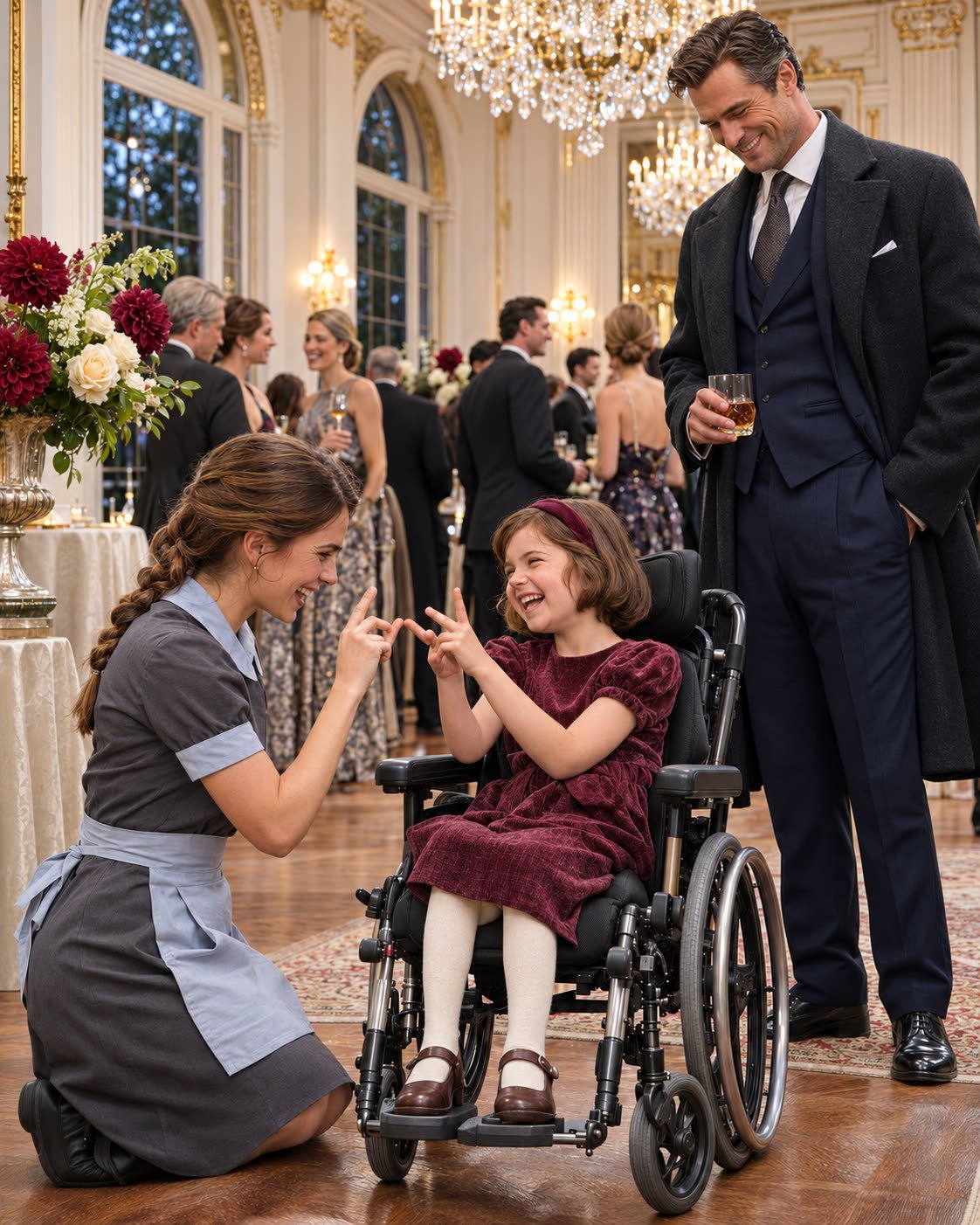
Part 1: The Dance Beside the Windows
For eight months, Adrian Castellane had mistaken his daughter’s silence for something doctors alone could fix. Then a housekeeper knelt beside Elena’s wheelchair and offered her a dance that required no standing, no painful effort, and no permission to be happy. Her laughter crossed the ballroom. What followed would uncover why another woman’s warnings had been buried—and what protecting a child would finally demand of her father.
“Daddy, look! I can dance sitting down!”
Maren Ashby froze with one hand raised between herself and the little girl. Across the ballroom, conversations thinned. Adrian Castellane turned from a circle of donors, his untouched drink suspended near his chest, while his five-year-old daughter made her fingers sweep through the air.
Then Elena laughed.
It was not the polite little sound she sometimes produced when adults tried too hard. It was an untidy, delighted laugh, followed by a snort that made her laugh again. Adrian set his glass down so abruptly that amber liquid splashed over the rim.
Ten minutes earlier, Maren had been carrying champagne along the ballroom wall. She had worked at the Boston estate since June, four months of learning which corridors guests used and which questions employees were not expected to ask. Tonight’s reception benefited a children’s rehabilitation foundation.
Elena sat near the windows in her wheelchair, wearing a plum-colored dress and watching the dancers. Her stuffed rabbit rested sideways on her lap. Nobody had asked whether she wanted a better view, a quieter room, or company.
Maren put her tray on a service table.
“Would you like to make up a dance?”
Elena glanced at her supported feet.
“I can’t do that kind.”
“Neither can my fingers. They keep insisting on their own.”
Maren crouched, leaving space between them, and raised her smallest finger.
“This is a princess who dislikes long speeches.”
Elena studied the finger.
“So do I.”
“And this”—Maren lifted her thumb—“is a prince who thinks every speech should be about him.”
The thumb bowed so deeply it bumped her palm. Elena’s mouth twitched. When Maren made it bow again and collide with an imaginary chandelier, the laugh escaped.
Now Adrian was approaching, and Maren’s first instinct was to stand and apologize. His reputation made that instinct sensible. His shipping and construction companies were legitimate businesses, but newspapers had long connected the Castellane family to organized crime. At the estate, nobody mistook his quiet voice for gentleness.
Elena held up both hands.
“She says hands can dance too.”
Adrian looked at Maren, then at his daughter.
“Apparently yours are better at it than mine.”
“You have to learn.”
“I see.”
He lowered himself onto a nearby chair. Maren demonstrated the bow again, and Adrian attempted it with such grave concentration that Elena corrected him immediately.
“No, Daddy. He’s a silly prince.”
Something moved across his face before he made his thumb stumble. This time, when Elena laughed, he did too.
Near the ballroom entrance, Celeste Laurent stood beside a display describing the foundation’s work. Adrian’s companion had organized the evening and much of Elena’s private care since the February crash. Her smile remained in place as she watched, but she stopped greeting arriving guests.
The music ended. Maren let her hands fall.
“Again?” Elena asked.
“After some water, perhaps,” Adrian said.
For the first time since Maren had met him, he asked his daughter instead of answering for her.
“Would you like that?”
Elena nodded, then caught Maren’s sleeve.
“Will you come back?”
“If your father and Mrs. Pike say it’s all right.”
“It’s all right,” Adrian said.
The permission unsettled Maren almost as much as a reprimand would have.
At midnight, after the guests left, Mrs. Pike found her counting clean glasses.
“Mr. Castellane would like a word.”
Maren glanced toward the kitchen clock. Her mother would be waiting for the call that meant she was safely on her way home. Joan had dialysis early the next morning, and Maren had promised to help pack her treatment bag.
Mrs. Pike noticed.
“Call your mother first. He can wait five minutes.”
That small kindness steadied her.
Adrian stood in his study without his jacket. On the desk lay a photograph of Elena on a beach, taken before the collision that had injured her spinal cord and left her unable to walk.
“She hasn’t laughed like that since February,” he said.
Maren folded her hands.
“I’m glad she enjoyed herself.”
“Why did you approach her?”
“She was watching everybody else have a good time.”
“She has people employed to keep her company.”
“Tonight they appeared to be somewhere else.”
He glanced toward the closed door. Maren wondered whether she had just talked herself out of a job she could not afford to lose.
Instead, he said, “I’d like you to spend time with her regularly.”
“I’m not a therapist.”
“I’m not asking you to be one.”
He described a paid companion position, with separate childcare training and duties that would not include medical treatment. Maren listened carefully. Better wages would mean fewer overdue bills and fewer nights calculating whether she could miss a shift to accompany her mother to an appointment.
“I would need the responsibilities in writing,” she said.
“You’ll have them.”
“And Elena should get a choice.”
Adrian studied her.
“Yes. She should.”
As she reached for her bag, the silver bracelet on her wrist slid into the light. Its broad clasp was engraved with a tiny bird.
Adrian stared at it.
“Where did you get that?”
Maren covered it instinctively.
“It belonged to my sister.”
“What was her name?”
“Theresa Ashby. Everyone called her Tess.”
He went very still.
For six months, since Tess’s death in April, Maren had learned to recognize the pause that followed her sister’s name. Usually it meant someone was preparing condolences. This silence felt different.
“Your sister treated Elena,” Adrian said.
Maren looked at the beach photograph again.
Tess had worked at St. Catherine’s Pediatric Rehabilitation Center. She had spoken about frightened children and difficult administrators, but never identified a patient. Even at home, she had respected those boundaries.
“Nobody told us that.”
Adrian moved to the desk and opened a drawer.
“I was told she left the clinic after a disagreement about my daughter’s care.”
Maren’s fingers tightened around the bracelet.
“She told me records were being changed.”
He looked up.
“What records?”
“She wouldn’t say. She said she was trying to report it properly.”
Adrian took an old appointment summary from the drawer. A neat paragraph explained that Theresa Ashby had withdrawn from Elena’s case and should no longer be contacted.
Maren read the date twice.
It was April seventeenth.
“That can’t be right,” she said.
“Why?”
She laid the paper down carefully, because her hands had begun to shake.
“My sister died on April tenth.”
Part 2: What the Child Had Learned Not to Say
Adrian called Victor Hale, his security director, but Maren stopped him before he could give instructions.
“Don’t ask your people to investigate my family.”
The words surprised her with their force. Adrian lowered the phone.
“Then tell me what you want.”
“A copy of that page. Time to speak to my mother. And no one questioning Elena because of something I said tonight.”
He agreed to all three.
At home, Joan read the summary under the kitchen light. Her treatment bag was packed beside the door, a paperback tucked into its outer pocket.
“Could it be a delayed letter?” she asked.
“Possibly.”
“Then find out before you decide what it means.”
Maren sat opposite her. She had spent six months imagining explanations for Tess’s death, a hit-and-run outside the rehabilitation center whose driver had never been identified. Grief made patterns out of everything. Joan knew that as well as she did.
“I remember what she said about the records.”
“So do I.”
Her mother smoothed the page.
“But your sister deserves facts, not just our worst fears.”
The next morning, Maren returned to a written job offer. She read it in an empty breakfast room, asked for a trial period, and requested a clear right to report safety concerns outside the household. Adrian’s attorney revised the confidentiality language accordingly.
Then Adrian asked Elena whether she wanted Maren to visit more often.
“Does she have to make me practice?” Elena asked.
“No,” he said.
“Then yes.”
During their first week, Maren learned that Elena liked dragons, disliked having strangers touch her wheelchair without asking, and could invent elaborate excuses to avoid answering whether something hurt.
She also learned that Celeste’s arrival could end a conversation faster than a closed door.
One afternoon, Celeste entered while Elena was teaching Maren the finger dance. She leaned toward the child’s right leg, which rested in an orthosis prescribed to support its position.
“Let’s straighten this. You mustn’t get careless.”
Elena drew back.
“Please don’t.”
Maren moved her hand toward the call button instead of touching the device.
“We can ask the nurse to check it.”
Celeste straightened.
“There’s no need to make everything an event.”
After she left, Elena stopped dancing.
“I wasn’t being difficult,” she whispered.
“I didn’t think you were.”
“Sometimes I forget the rules.”
“Which rules?”
Elena pulled her rabbit close.
“Not making Daddy sad.”
Maren waited before answering.
“You don’t have to keep grown-ups happy by hiding what you need.”
Elena looked unconvinced.
Two days later, Dr. Samuel Reed arrived for a scheduled rehabilitation review. Maren had permission to remain as Elena’s companion, while the household nurse assisted with the clinical tasks.
When the orthosis was removed for examination, Maren noticed a red pressure mark that remained visible. Elena flinched when Reed approached it.
“Should someone look at that area?” Maren asked.
“I am looking at it.”
He continued the assessment. Elena became rigid, watching his face rather than following his instructions.
“Does that hurt?” Maren asked her.
Reed answered first.
“Some discomfort is expected.”
Maren kept her attention on Elena.
“You can tell us.”
The child’s chin trembled.
“Please don’t tell Celeste I failed.”
The nurse paused. Maren asked that the session stop, and the nurse supported the request. Reed ended it with a clipped warning about undermining treatment.
That evening, Adrian received both his complaint and Maren’s written account. She had recorded what she saw, what Elena said, and who had been present. She had not tried to diagnose anything.
“I can’t tell you whether his plan is wrong,” she said. “I can tell you she was afraid to answer him.”
Adrian looked toward the doorway.
“I thought consistency was helping her.”
“Then let someone independent check.”
Dr. Priya Shah came three days later. She reviewed the available records, asked permission before examining Elena, and accepted “not yet” as an answer.
When Adrian asked whether his daughter would walk again, she did not offer reassurance she could not support.
“Her injury is significant. I need the original imaging and a fuller assessment before discussing prognosis. Whatever we learn, her comfort and participation matter now.”
She found that the orthosis needed prompt reassessment and that several treatment goals were poorly matched to Elena’s current abilities. Those findings justified changes in care, not conclusions about criminal intent.
The records raised different concerns.
“This page lists Tess as attending a session after her death,” Maren said.
Dr. Shah compared the dates.
“We need the underlying record and its audit history. It could be an import error. It could be something else.”
Adrian authorized a complete records request and transferred Elena’s care to an independent team.
That night, Maren opened Tess’s keepsake box again. She had searched it before, looking for explanations among birthday cards and photographs. This time she knew the child’s face.
In a photograph from March, Tess knelt beside Elena in the estate’s music room. Painted blue birds crossed the wall behind them. Maren slid the photograph from its paper sleeve and noticed writing hidden along the folded edge.
For M. The clasp opens. Keep the original safe.
Maren sat down.
Tess had given her the bracelet two days before she died, saying only that she wanted Maren to have it. At the time, Maren had been preoccupied with Joan’s changing treatment schedule. She had teased her sister for making a gift sound like an assignment.
Now she called an independent attorney recommended by Joan’s patient-support organization.
The attorney arranged for the bracelet to be examined and its contents preserved. Inside its unusually broad clasp was a microSD card wrapped in a sliver of protective film.
Maren did not take it to Adrian first.
She took it to someone who did not work for him.
A forensic examiner made a verified copy while preserving the original. Two days later, with the attorney present, Maren and Adrian watched an eleven-second video.
Tess stood beside Elena at supported parallel bars, helping her complete a brief weight shift before immediately assisting her back to sitting. It was not evidence that she would recover the ability to walk. It was evidence of a session missing from the progress summary.
Other files included photographed records and emails Tess had received as part of her work.
One message referred to an upcoming fundraising campaign.
Please avoid revised public language suggesting meaningful improvement until the campaign closes.
Beneath it was a reply from an address Adrian recognized.
Approved. I’ll speak to Samuel.
The sender was Celeste Laurent.
Part 3: The Price of Asking
For a long moment, Adrian said nothing.
Then he reached for his phone.
“Don’t call her,” Maren said.
He looked at her, anger still shaping his face.
“My daughter—”
“Is upstairs. If you start a fight now, she’ll hear it. And you’ll warn anyone who might destroy records.”
The attorney nodded.
“We preserve first. We make the appropriate reports. Nobody conducts a private interrogation.”
Adrian put the phone down.
By evening, Elena was at a scheduled assessment with Dr. Shah, accompanied by Maren and the nurse she trusted. Adrian’s attorney had issued preservation notices. Maren’s attorney had contacted investigators about Tess’s material and the questionable use of her name.
The household was told only that access arrangements were changing while Elena’s care was reviewed. Celeste would not have unsupervised contact with her.
Elena noticed anyway.
“Is somebody in trouble?” she asked on the drive back.
“Grown-ups are checking some important things,” Maren said.
“Do I have to help?”
“Your job is to be a child. If someone needs to ask you questions, they’ll explain why, and you can ask for a break.”
Elena considered that.
“Can my job include pancakes?”
“I’ll inquire.”
At the estate, the housekeeper produced pancakes for dinner without asking why. Elena appointed herself supervisor of strawberry placement.
Maren was grateful for the ordinary argument that followed about whether a dragon pancake required wings.
The next week brought no dramatic confession. It brought requests, interviews, delays, and the discovery that a document could be alarming without being sufficient.
Dr. Shah explained that the brief video did not establish Elena’s long-term potential. A clinician reviewing Tess’s photographs could identify discrepancies but needed original records before assigning responsibility. The email about fundraising showed an unacceptable conflict of interest, but investigators still needed to establish what happened after it was sent.
Maren sometimes hated their caution.
Then she remembered Joan’s hands smoothing the appointment summary.
Facts, not just our worst fears.
An independent accountant examined the foundation’s available records. Several equipment purchases were genuine. Several consulting invoices had no supporting work product. Payments had passed through a company managed by Celeste’s business manager, Martin Voss.
The mixture made the deception harder to see. Real grants and useful equipment had helped lend credibility to payments that deserved scrutiny.
Adrian read the preliminary findings alone, then asked Maren to meet him.
“They used Elena’s name in appeals I approved.”
“Did you read them?”
“Not closely enough.”
He pushed one across the desk. It described Elena’s private fears and presented her future as settled, hopelessly limited without the foundation’s intervention.
“I thought if the money helped someone, it justified the attention,” he said.
Maren did not offer him an easier explanation.
“Did you ask her?”
“No.”
He collected the remaining campaign materials.
“There won’t be another appeal using her medical history.”
Meanwhile, Tess’s photographs established that the estate’s music room had once been used for some home therapy sessions. Adrian remembered Tess carrying a blue exercise notebook.
The room had been redecorated after she was dismissed. Maren asked whether the old piano bench remained.
It did, in storage.
They did not search it privately. With legal advice, its contents were photographed and examined in a documented process. Beneath old sheet music lay a slim notebook with a blue cover.
Tess’s entries described fatigue, discomfort, improvements, setbacks, and questions she had been unable to resolve. She had not written like a person constructing a dramatic accusation. She had distinguished observations from concerns and recorded when she had asked supervisors for clarification.
One entry made Maren stop reading.
E asked whether telling the truth about pain would make her father stop visiting. Reassured her. Need family conversation.
Adrian stood at the other end of the table.
Maren turned the notebook so he could read it.
He sat down.
That night, he went to Elena’s room without a present or a plan. Maren was finishing a chapter about a dragon who disliked treasure.
“Can I ask you something?” Adrian said.
Elena nodded.
“Have you ever thought you needed to hide pain from me?”
Her eyes moved toward Maren.
“You’re not in trouble,” he added.
“You get the face.”
“What face?”
Elena pressed her mouth into a hard line and stared at the floor.
Adrian recognized himself.
“I’m sorry,” he said. “I’ve been frightened, and I made it look as though you were disappointing me.”
“Am I?”
“No. Never because of what your body can or can’t do.”
“What if I don’t walk?”
He took a breath before answering.
“Then I will still be your father, and we will still make a life with things you enjoy.”
Elena leaned against him.
Maren closed the book and quietly left them together.
Her phone vibrated as she reached the stairs.
The message came from an unfamiliar number. Beneath a photograph of Joan leaving the dialysis center were eight words.
Your sister should have minded her own business.
Maren gripped the banister.
For a few seconds, every careful distinction vanished. She wanted to get her mother, lock the door, and stop asking questions.
Instead, she called Joan.
“Are you home?”
“Yes. What’s happened?”
“I need you to stay inside while I call the police.”
Adrian found her making the report. His expression changed when she showed him the photograph.
“I can put people outside her building.”
“With her permission,” Maren said. “And nothing else without telling us.”
He nodded.
Joan chose to stay temporarily with her sister. Her dialysis arrangements continued, and the police documented the threat. Maren spent that night at her aunt’s house, listening to the refrigerator cycle on and off.
The next afternoon, a detective asked to meet her.
Victor had recognized a company name among the foundation’s invoices. Years earlier, he had given police a witness statement about a van leaving the clinic road on the night Tess died. The new connection had prompted investigators to revisit it.
“Was it the van that hit her?” Maren asked.
“We don’t know yet. The original file includes a partial plate and a traffic-camera image. We’re comparing them with lease records.”
“Who leased it?”
The detective placed a copy of the relevant business registration on the table.
Maren recognized Martin Voss’s name.
The person handling Celeste’s questionable payments had also controlled the vehicle investigators were trying to identify.
Part 4: What the Records Could Prove
Celeste returned from a trip that Thursday and asked why her access code no longer worked.
Adrian met her in a downstairs sitting room. His attorney was present. Elena was out with Maren, choosing library books after an appointment.
“You could have spoken to me before humiliating me in front of the staff,” Celeste said.
“Your belongings can be collected by arrangement. You won’t be alone with Elena.”
She stared at him.
“After everything I’ve done?”
“We’re not discussing this where she might hear us.”
“Is that the maid’s rule?”
“It’s mine.”
Celeste’s lawyer later denied that she had directed improper medical care or authorized fraudulent payments. She maintained that campaign language had been handled by staff and that financial irregularities were the responsibility of her business manager.
Those claims were recorded and investigated. Adrian did not get to settle them by being angrier or richer.
December arrived with interviews and requests for records. St. Catherine’s placed Reed on leave pending review. Investigators obtained the system audit history behind the disputed treatment notes.
Several entries attributed to Tess had been added after her access was disabled. The timing matched changes to appointment summaries and billing descriptions. The notebook and preserved files helped investigators distinguish what she had actually recorded from what had later appeared under her name.
Maren received the findings through her attorney.
She read them at Joan’s kitchen table after helping unpack groceries.
“They used her name,” she said.
Joan lowered herself into a chair.
For months, they had been told Tess was difficult, emotional, unwilling to accept professional judgment. Now the documents showed that some of the very records used to discredit her had been altered.
Joan touched her daughter’s hand.
“She knew what she’d seen.”
“I wish I’d asked more.”
“So do I. That doesn’t mean we caused this.”
Maren cried then, not neatly or briefly. Her mother stayed beside her until she could breathe without trying to apologize.
The collision investigation moved separately. The archived image, lease records, dispatch messages, and a repair invoice led police to Daniel Rusk, a former delivery driver employed through a contractor.
With counsel present, he eventually acknowledged driving the van.
He had been sent to the clinic to collect boxes of records. He said an employee confronted him about taking material away, and he left in a panic. On the access road, driving too fast, he struck Tess and fled.
Investigators did not simply accept his account. They compared it with physical evidence, the original witness statements, and communications recovered through lawful searches.
A message from Voss had instructed him to collect the records before Ashby could take them outside. Another exchange referred to damage and keeping the vehicle off the road.
Maren asked the detective the question she had carried since seeing the threat.
“Did they send him to hurt her?”
“We haven’t established that. We have evidence about removing records and concealing what happened. Intent matters, and we have to prove it.”
The answer hurt.
It also gave Tess something more durable than a story assembled from fear.
In January, investigators told Adrian that their review of Elena’s original February crash had found no evidence of deliberate sabotage. Road conditions and the other driver’s documented failure to yield remained consistent with the original findings.
The wrongdoing they could substantiate concerned what happened afterward: financial exploitation, altered records, compromised care, and efforts to suppress scrutiny.
Adrian sat with that distinction for a long time.
An accident had injured his daughter. People he trusted had then made choices that deepened the harm. Those were different truths, and neither canceled the other.
At home, Elena’s care changed more quietly.
Her new team adjusted equipment, treated pressure areas, developed tolerable activity goals, and included psychological support. Progress was measured in useful ways: more comfortable sitting, easier transfers with help, better sleep, and confidence saying stop.
One afternoon, she declined an exercise and asked to try something different.
Maren waited for an adult to call it refusal.
Instead, the therapist offered two alternatives.
Elena chose one.
Later, she announced to Adrian, “I stopped before I cried.”
He kissed the top of her head.
“I’m glad you told them what you needed.”
Not every day went well. Sometimes she was angry. Sometimes she asked why other children could run. Nobody answered by insisting that she would too if she worked hard enough.
Maren learned to stay beside questions she could not fix.
By spring, financial charges had been filed against Celeste and Voss. The allegations included fraudulent diversion of restricted donations and participation in falsifying supporting records. The threat to Joan was also traced through evidence recovered during the investigation to an arrangement made by Voss.
Reed faced a separate professional review and allegations concerning his approval of inaccurate documentation. His ultimate responsibility would be determined through those proceedings, not by household opinion.
The arrests did not produce relief as cleanly as Maren had expected.
There were still hearings. Joan still needed dialysis. Tess’s number remained in Maren’s phone because deleting it felt impossible.
Adrian offered to pay for independent representation for the Ashbys. Their lawyer reviewed the arrangement to make certain his money gave him no authority over their decisions.
Joan accepted under those terms.
“We’ll need help,” she told him. “But we won’t become part of your household.”
“Understood.”
Maren’s trial employment period had long since ended. With the investigations underway, she could have sought work somewhere less burdened by headlines and security checks.
Adrian acknowledged that when they met to review her contract.
“I won’t ask you to stay because of Tess.”
“Good.”
“Or because Elena is attached to you.”
“Better.”
He almost smiled.
“What would make staying right for you?”
She asked for regular hours, protected leave to accompany Joan to appointments, outside training, and a salary that reflected the job rather than gratitude or guilt. She would remain Elena’s companion, not the family’s permanent rescuer.
He agreed to have the terms reviewed independently.
Before Maren could answer finally, Elena appeared in the doorway with a paper invitation.
She had drawn three enormous hands beneath a crooked chandelier.
“It’s for my birthday,” she said. “I’m making the dance this time.”
Maren accepted the invitation.
Elena looked from her to Adrian, suddenly serious.
“But before you say yes, there’s one rule you both have to promise.”
Part 5: The Rule for Every Dance
“Nobody gets to say the dance would be better if I stood up.”
Elena delivered the rule without looking at either adult. She watched the corner of her invitation instead.
Maren crouched so they could see each other.
“That sounds like a good rule.”
Adrian sat on the bench beside the doorway.
“I promise.”
Elena studied him.
“Even if somebody else says it?”
“Especially then.”
She nodded and handed him his invitation.
Her sixth birthday in May was not a fundraising event. There were no photographers, no medical updates, and no speeches about bravery. Elena invited two children she knew from an accessible recreation group, Mrs. Pike, Maren, and Joan.
Adrian was assigned refreshments.
“Apparently,” he told Maren, reading his list, “I’m not trusted with decorations.”
“You suggested white orchids for a dragon party.”
“I’ve been informed.”
Elena chose cardboard flames, purple paper wings, and a cake with a dragon sleeping on its own treasure. When one guest wanted to race, the adults helped them invent a game that everyone could play without turning Elena into the reason the rules had changed.
She laughed often that afternoon. She also became tired and asked to leave before the presents were finished.
Adrian took her upstairs without telling her to wait for anyone’s sake.
Maren stayed after her shift only long enough to help Joan find her coat. Then she went home with her mother, as planned.
Boundaries, she discovered, were easier to trust when someone respected an ordinary one.
In early summer, Rusk entered a guilty plea to charges arising from the fatal collision and leaving the scene. The agreement followed months of investigation and negotiations with prosecutors. Maren and Joan attended the hearing together.
When invited to speak, Maren unfolded a page and then set it down.
“My sister was a physical therapist,” she said. “She was also the person who remembered which neighbor needed groceries and which child disliked being called brave.”
Her voice shook. She kept going.
“She deserved to come home. I want the court to understand that the person you left on that road had a life larger than the worst thing that happened to her.”
There was no applause. Maren was grateful.
Outside, she and Joan sat on a bench before walking to the car. Neither said that it was over. The hearing had answered some questions and established responsibility. It had not returned Tess.
Later that summer, Celeste and Voss resolved the principal financial case through guilty pleas after extensive documentary evidence had been disclosed. Their admitted conduct included diverting charitable funds and participating in false supporting documentation. Voss also admitted his role in arranging the threatening message and concealing evidence connected to the van.
Restitution orders and the recovery of assets did not mean all the money returned immediately. An independent administrator continued tracing funds and handling claims.
The medical review reached its own conclusions. Reed lost his position at St. Catherine’s and faced disciplinary restrictions. The clinic adopted external oversight for documentation and patient complaints as part of a broader corrective process.
Maren read the public findings once. Then she put them in a folder rather than leaving them on the kitchen table.
There had to be somewhere in her life that was not an evidence room.
Adrian also learned that exposing Celeste’s conduct did not erase questions about his own businesses. He retained outside counsel to review practices he had long allowed others to handle and cooperated with inquiries his attorneys advised him to address.
Maren did not mistake those first steps for transformation.
She trusted the things she could observe: he attended Elena’s appointments when invited, listened when contradicted, paid employees properly, and stopped using anger as the end of a conversation.
Trust returned unevenly, in pieces small enough to test.
Joan’s health remained demanding. Some weeks she felt well enough to argue with Adrian about his soup choices; other weeks treatment left her exhausted. Maren’s improved wages bought stability, not a cure.
They moved to an apartment closer to Joan’s dialysis center. Joan chose it herself and rejected the first three places Maren suggested.
“I have kidney disease,” she said. “I have not lost the ability to dislike a kitchen.”
Maren laughed so hard that she had to sit down.
In September, the Ashbys approved a patient-advocacy program bearing Tess’s name. It was small by design, overseen by an independent board and funded through several donors rather than one household.
Families could receive help understanding records, requesting second opinions, and raising concerns without offering photographs or personal stories in return.
Maren helped review the policies. She insisted on a plain-language complaint process.
“If people need an advocate to complain about the advocates, we’ve missed something.”
Joan seconded that without looking up from her copy.
Adrian contributed funds but accepted no controlling seat.
On a quiet afternoon before the program opened, Maren brought Elena to the memorial garden at St. Catherine’s. The clinic had returned Tess’s photograph to its staff display with an acknowledgment that her concerns had been substantiated.
Elena placed a blue paper bird beside the stone.
“I remember her song,” she said.
Maren waited.
Elena hummed three wandering notes, then stopped.
“That’s all.”
“That’s enough.”
“Was she scared?”
Maren looked at the paper bird.
“I think so.”
“But she still asked?”
“Yes.”
Elena touched Maren’s bracelet, its clasp repaired after the evidence had been preserved.
“You did too.”
Maren covered the small hand with her own.
The following October, a year after the first finger dance, the ballroom opened for a modest reception supporting independently administered rehabilitation services. Financial reports were available before invitations went out. Elena’s name and image appeared nowhere in the appeal.
She could attend, stay upstairs, or change her mind.
She chose a private dance before the guests arrived.
The wheelchair she now used fit her better. Her dress was midnight purple, selected because, she explained, dragons were more interesting than princesses that year. Her stuffed rabbit wore a paper crown anyway.
Maren arrived in a green dress rather than her work uniform. Joan had helped her choose it and then ordered her to stop checking whether it could survive a washing machine.
Adrian waited beside the windows where his daughter had once sat alone.
“The choreographer has been asking for you,” he said.
“I hope she isn’t difficult.”
“Extremely particular.”
Elena raised one finger.
“First, the princess bows.”
Maren answered with her smallest finger.
“Then the dragon arrives,” Elena continued.
Adrian lifted his thumb.
“I thought I was the prince.”
“You’ve been promoted.”
He considered that with appropriate gravity.
“Does the dragon have lines?”
“Only if he remembers not to make a speech.”
Maren laughed. Adrian made his thumb bow too far and tumble into his palm. Elena’s laughter followed, bright and unguarded beneath the chandeliers.
They did not celebrate it as proof of recovery. They let it be laughter.
When the music ended, Elena brought her palms together.
“That’s the hug.”
Adrian leaned close, and she pulled him in with one arm. Her other hand reached for Maren.
Maren joined them.
Nothing in the embrace repaired the past. Tess was still absent. Elena still had an uncertain medical future. There would be difficult appointments, unfinished grief, and days when patience failed them.
But the child between them no longer had to earn a place in their happiness.
Later, as the first guests arrived, Elena returned to her drawing table by choice. Maren stood beside Adrian for a moment, watching her explain a complicated dragon to Mrs. Pike.
“I kept waiting for someone to tell me how to bring my daughter back,” he said.
Maren looked at him.
“She was here.”
He nodded slowly.
Across the room, Elena lifted both hands.
“Daddy! Maren! I’ve invented the next dance.”
Adrian glanced toward the arriving guests, then set aside the welcome remarks in his hand.
They crossed the ballroom together.
This time, when Elena made room for them, neither adult asked what the steps would be. They held out their hands and waited to learn what she would choose next.
Disclaimer: This story is a work of fiction inspired by real-life themes. Names, characters, places and events are fictionalized, and any resemblance to real persons is purely coincidental. Images are for illustration purposes only.


