

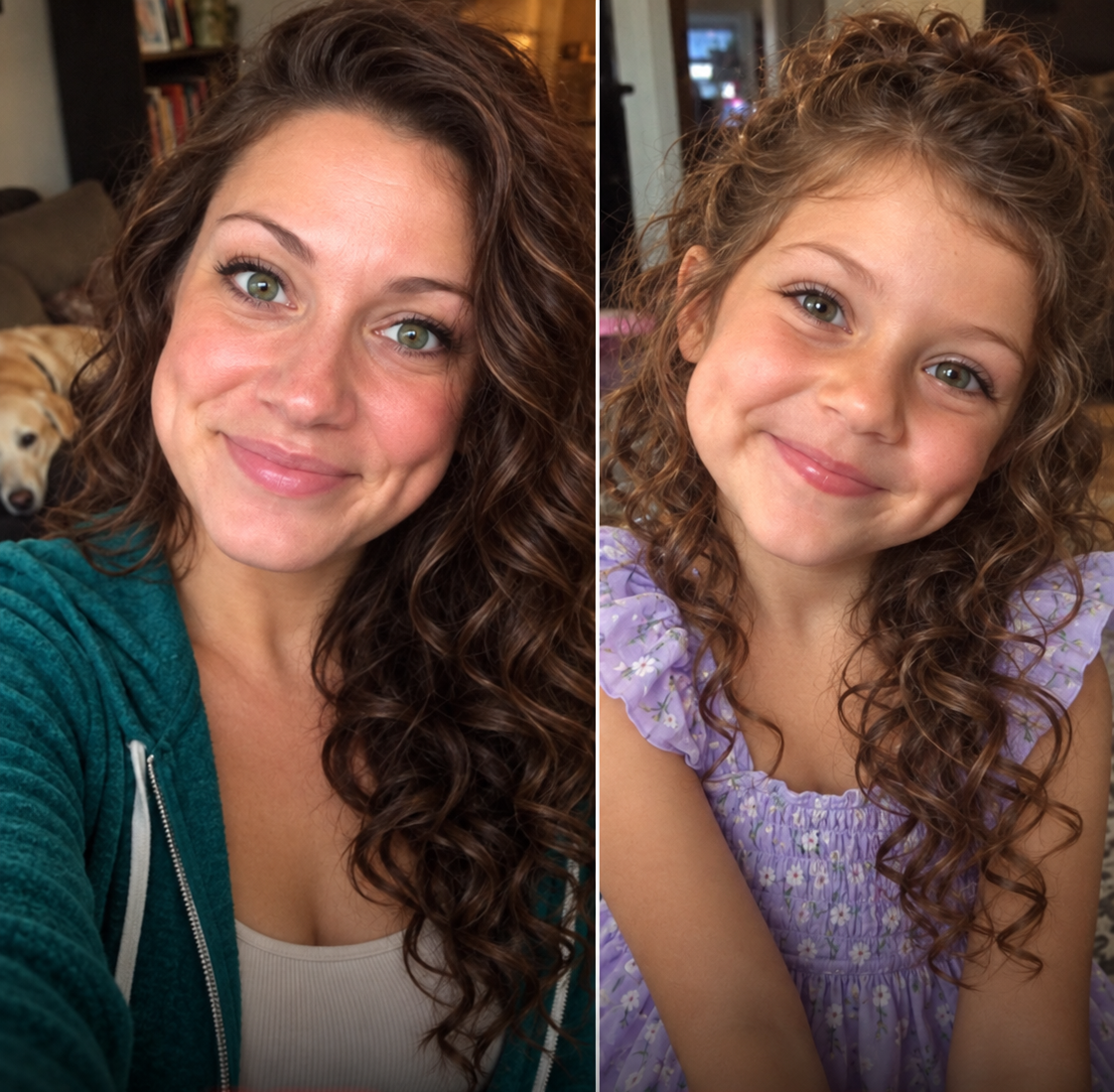
Part 1 — The Envelope That Turned My World Upside Down
For five years, I had kept my daughter’s tiny hospital bracelet in a box beside my bed.
It was the only thing I had left from the little girl I had barely been allowed to hold before being told she was gone.
I never imagined that a simple envelope, delivered by my own sister, would force me to question everything I had believed about that terrible day.
It happened just two weeks after my sister, Nora, brought home her adopted daughter.
When I opened my front door that afternoon, Nora was standing on the porch, clutching a crumpled envelope against her chest.
Her eyes were red, her cheeks were wet, and she looked as though she had spent hours crying.
“Claire,” she whispered, “can we talk? There’s something I need to tell you.”
My heart immediately sank.
“What’s wrong? Is something happening with Ellie?”
She shook her head.
“She’s safe. She’s at home with Tom.”
“Then what is it?”
Nora stepped inside, but instead of sitting down, she stood in the middle of my kitchen, staring at the envelope in her hands.
I had never seen her so frightened.
“Nora, you’re scaring me.”
“I know.” Her voice trembled. “I’m sorry. I just don’t know how to explain this.”
She finally pulled out a chair.
“Do you remember what the adoption agency told us about Ellie’s early life?”
I nodded.
“They said she was found when she was a baby. No one knew who her biological parents were.”
Nora looked down.
“That’s what we believed.”
Something about her answer made my stomach tighten.
“What do you mean?”
She took a shaky breath.
“Some of Ellie’s original records were incomplete. Tom and I wanted to understand her medical history, so we asked the agency to look into it.”
“And?”
“They discovered information that doesn’t match the story we were given.”
She placed the envelope on the table between us.
I stared at it without touching it.
Only two weeks earlier, Nora and I had spent an entire afternoon arranging pink curtains in Ellie’s bedroom and deciding where to put her stuffed animals.
My sister had been happier than I had seen her in years.
Now she looked as though that happiness was slipping through her fingers.
“Claire,” she said softly, “I need you to read these papers. And before you do, please know that I never meant to hurt you.”
I frowned.
“Why would you hurt me?”
Her eyes filled again.
“Because what we found might have something to do with Lucy.”
For a moment, the name didn’t seem real.
Lucy.
My daughter.
The baby I had buried in my heart five years earlier.
I felt the room grow strangely quiet.
“What does my daughter have to do with Ellie?”
Nora couldn’t answer.
Instead, she pushed the envelope closer.
And with trembling hands, I opened it.
Part 2 — The Daughter I Never Got to Raise
To understand why Nora’s discovery nearly destroyed me, I need to explain what happened five years earlier.
I had been expecting my first child.
Like most mothers, I spent months imagining the little things that would make up our life together.
I wondered whether she would inherit my dark curls, whether she would be stubborn like me, and whether she would love the bedtime stories I had already bought.
I had chosen her name long before she was born.
Lucy.
I used to say it aloud when I was alone, just to hear how it sounded.
But Lucy arrived too early.
The delivery was frightening, and almost immediately, the medical team realized she needed urgent care.
I remember seeing her for only a few seconds.
She was so tiny that I could hardly believe she was real.
One little hand moved beside her face.
I tried to reach for her.
“Can I hold my baby?” I asked.
A nurse gently explained that they needed to stabilize her first.
I understood.
Of course I understood.
All I wanted was for my daughter to survive.
So I watched as they took her away, telling myself that soon someone would bring her back and I would finally get to hold her.
That moment never came.
The following morning, a doctor entered my hospital room.
I still remember his expression.
He sat beside me and told me that Lucy hadn’t survived.
At first, I didn’t understand what he was saying.
I had spent months preparing to become a mother. I had folded tiny clothes, bought blankets, and imagined carrying my daughter through the front door.
How could all of that suddenly be over?
But the doctor repeated the news gently.
And eventually, I understood.
I went home without my baby.
The nursery remained untouched for months. Friends and relatives tried to comfort me, but there were no words that could make the empty crib less painful.
I kept Lucy’s hospital bracelet.
Sometimes, late at night, I would take it from its little box and trace the letters of her name.
It was proof that she had existed.
Proof that for one brief moment, I had been her mother in more than just my dreams.
I never found the courage to try for another child.
The possibility of experiencing that kind of loss again frightened me more than I could explain.
During those years, Nora was facing a different kind of heartbreak.
For eight long years, she and her husband, Tom, had tried to have a baby.
There were doctor’s appointments, treatments, disappointing test results, and countless months that ended in tears.
Eventually, Nora began avoiding children’s birthday parties because being surrounded by happy families reminded her of everything she wanted.
One evening, I suggested that she consider adoption.
She looked at me uncertainly.
“What if I can’t love a child who isn’t biologically mine?”
I took her hand.
“Nora, love doesn’t come from sharing the same blood. It comes from caring for someone, choosing them, and being there when they need you.”
She thought about that conversation for a long time.
Eventually, she and Tom began the adoption process.
And when they finally brought Ellie home, I thought life had given my sister the happiness she deserved.
Ellie was five years old.
She had beautiful dark curls, enormous brown eyes, and a tiny dimple in her left cheek.
The first time I saw her, my heart gave an unexpected twist.
I had the same dimple when I was little.
Nora laughed as she watched Ellie explore the living room.
“Look at her, Claire! She could practically be part of our family already!”
I smiled.
But later, after I climbed into my car, I began crying.
Ellie looked painfully similar to the little girl I had spent five years imagining.
I had often pictured Lucy growing older, wearing colorful dresses and asking me to fix her hair before school.
Now there was a real child standing before me who looked almost exactly like the daughter in those dreams.
At first, being around Ellie was difficult.
But children rarely understand the complicated emotions adults carry.
Ellie simply decided she liked me.
She began calling me Auntie Claire.
Whenever I visited, she would run to find her favorite hair ribbons and insist that I make two pigtails.
“Not one braid,” she would instruct seriously. “Two.”
“Yes, ma’am.”
“And don’t pull my hair!”
“I’ll do my best.”
She would sit on a kitchen chair, swinging her little feet while I carefully parted her curls.
One afternoon, she unexpectedly asked, “Auntie Claire, do you have any children?”
I hesitated before answering.
“I had a little girl once, sweetheart. But she passed away when she was a baby.”
Ellie became quiet.
Then she looked up at me with genuine sadness.
“That’s really sad.”
“It is,” I whispered.
For a moment, I thought I might start crying.
But Ellie simply handed me a pink ribbon.
“This one goes on the left.”
I couldn’t help smiling.
She had a wonderful way of reminding me that even when life was painful, there were still small things that needed doing.
I never imagined how important those moments would become.
Part 3 — The Test Result I Couldn’t Believe
Sitting across from Nora in my kitchen, I unfolded the first document.
It was a formal notice from the adoption agency explaining that Ellie’s original placement records contained significant inaccuracies.
I frowned.
“What kind of inaccuracies?”
Nora pointed toward another page.
“This is what the records review uncovered.”
I began reading.
Halfway down the page, I saw a hospital name.
My breath caught.
It was the same hospital where I had delivered Lucy.
I looked up sharply.
“Nora, why is this hospital mentioned in Ellie’s records?”
“Please keep reading.”
The document described a newborn girl who had entered emergency protective care five years earlier.
According to the paperwork, the child’s identity had not been established.
But the records contained conflicting information about how she had entered the care system.
The dates were from the same week Lucy was born.
I pushed the papers away.
“No.”
Nora reached toward me.
“Claire—”
“No. There must be another explanation. Thousands of babies are born in hospitals. This doesn’t prove anything.”
“I know,” she whispered. “That’s exactly what I told myself.”
She opened the envelope again and removed several more pages.
“When I noticed the hospital and the dates, I asked the caseworker whether there was any way to check for a possible family connection.”
My stomach tightened.
“What did they do?”
“Do you remember the cheek swab you agreed to give last week?”
I nodded slowly.
Nora had explained that the records review suggested Ellie might have some biological connection to our family.
Nobody had known how close that connection might be.
I had agreed to the test because Ellie deserved accurate medical information.
I certainly hadn’t imagined that it could have anything to do with Lucy.
“They arranged a preliminary genetic comparison,” Nora continued. “Tom and I worked with the caseworker to get everything done properly.”
She slid the report toward me.
I read the names printed at the top.
Mine.
Ellie’s.
Then I reached the conclusion.
The preliminary findings indicated a biological parent-child relationship.
For several seconds, I couldn’t move.
I read the sentence again.
Then a third time.
Finally, I whispered, “This can’t be right.”
Nora began crying.
“Claire, I think Ellie might be Lucy.”
I stood so suddenly that my chair scraped against the floor.
“No. My daughter died.”
“I know that’s what they told you.”
“I have a death certificate, Nora!”
She covered her mouth.
I walked toward the sink and gripped the counter with both hands.
Outside, life continued as though nothing extraordinary had happened.
A delivery truck stopped across the street.
Someone called out to a neighbor.
A car passed slowly beneath my kitchen window.
The ordinary sounds felt almost unbearable.
How could the world remain so normal when mine had just been turned upside down?
I turned toward my sister.
“Does Ellie know about any of this?”
“No.”
“Does Tom know?”
“Yes. And he thinks we should wait until everything is properly confirmed before telling her.”
I returned to the table.
“How reliable is the result?”
“It’s preliminary. They want an independent test and a complete review of the records.”
I lowered myself into the chair.
“Then we still don’t know.”
Nora nodded through her tears.
“We don’t know everything yet.”
I looked down at the hospital name again.
“Who told the agency Ellie was unidentified?”
“That’s part of what they’re investigating.”
“And how could the hospital tell me my daughter was dead if she wasn’t?”
Nora shook her head helplessly.
“I wish I knew.”
I wanted to believe the report.
More than anything, I wanted to believe it.
But after five years of mourning, allowing myself to hope felt terrifying.
What if there had been a mistake in the test?
What if I started seeing Ellie as Lucy, only to be told that she wasn’t my daughter after all?
I didn’t think my heart could survive losing her twice.
Then Nora asked something I wasn’t expecting.
“Claire, do you hate me?”
I stared at her.
“What?”
“If Ellie really is Lucy… if I’ve somehow brought your daughter into my home…”
“Nora, you didn’t know.”
“But I’m her mother now.”
I looked into my sister’s frightened eyes.
“You brought home a little girl who needed a family. You gave her love. You haven’t done anything wrong.”
Nora began sobbing.
I wanted to reassure her that everything would be fine.
But I couldn’t.
Because whatever the truth turned out to be, our lives would never be quite the same again.
Before she left, Nora stopped in the doorway.
“Claire, whatever happens, please remember that I love Ellie.”
“I know you do.”
After she was gone, I went upstairs and opened the little box beside my bed.
Inside lay Lucy’s hospital bracelet.
The plastic had grown slightly yellow over the years, but her name was still clearly visible.
I carried it downstairs and placed it beside the genetic report.
One document told me my daughter had died.
The other suggested she had been alive all along.
And for the first time in five years, I didn’t know which version of my own life was true.
Part 4 — The Longest Days of My Life
The days that followed were filled with phone calls, meetings, documents, and questions nobody seemed able to answer.
Nora, Tom, and I spoke with the adoption professionals responsible for reviewing Ellie’s records.
We also consulted an attorney.
He explained that even if a biological connection was confirmed, there were still legal questions concerning Ellie’s adoption that would need to be addressed carefully.
Nothing would be decided by a single genetic report.
Most importantly, Ellie would remain in the home where she felt safe while the adults worked toward understanding what had happened.
That mattered to all of us.
Whatever the truth revealed, none of us wanted Ellie to believe she had to choose between the people who loved her.
We requested the hospital records surrounding Lucy’s reported death and arranged for an independent genetic test.
Then came the waiting.
I had never known that a telephone could become such a frightening object.
Every time mine rang, I felt my stomach twist.
I continued going to work, shopping for groceries, and answering messages.
On the outside, I probably looked no different.
But inside, everything had changed.
I found myself remembering moments I had spent with Ellie and wondering whether my heart had somehow recognized her before my mind could.
Her smile.
Her dark curls.
That little dimple.
The way she leaned against me while I brushed her hair.
One afternoon, Nora sent me a photograph.
Ellie was sitting on the living room floor, proudly showing off a tower she had made from colorful building blocks.
Her hair was divided into two crooked pigtails.
Underneath the photograph, Nora had written:
ELLIE DID HER HAIR ALL BY HERSELF TODAY.
I enlarged the picture until her smiling face filled my screen.
Then I began crying.
For five years, I had imagined what Lucy might look like at that age.
Now I was staring at a little girl who might actually be her.
I wanted to get into my car and drive straight to Nora’s house.
I wanted to hold Ellie, ask a hundred questions, and never let her go.
But I knew I couldn’t act on feelings that she didn’t yet understand.
Instead, I called Nora.
“How is she doing?”
“She’s wonderful. She keeps asking when you’re coming to visit.”
I closed my eyes.
“Tell her I’ll come soon.”
“You know you don’t have to stay away, Claire.”
“I know.”
But I also knew that if I saw Ellie before the results came, I might not be able to hide everything I was feeling.
I needed answers.
And I was afraid of what those answers would mean.
A week later, they finally arrived.
The independent genetic test confirmed that Ellie was my biological daughter.
There was no longer any doubt about the relationship.
Ellie was Lucy.
My little girl had survived.
For five years, I had mourned a child who had been alive somewhere in the world.
I had missed her birthdays, her first steps, her first words, and all the ordinary moments that make up a childhood.
And somehow, without either of us knowing, she had found her way back into my life.
I picked up my phone and called Nora.
She answered almost immediately.
“Claire?”
I struggled to speak.
“It’s confirmed.”
There was silence.
Then I heard Nora take a shaky breath.
“Oh, Claire.”
Neither of us seemed to know what to say.
Finally, she whispered, “Come over.”
Part 5 — Holding the Daughter I Thought I’d Lost
Tom opened the door when I arrived.
He looked as though he hadn’t slept well in days.
“She’s in the kitchen,” he said quietly. “She’s drawing.”
I hesitated at the entrance.
“Have you told her?”
He shook his head.
“Not yet. We’re waiting for guidance on how to explain everything in a way she can understand.”
I nodded.
That was the right decision.
Even though every part of me wanted to run into the kitchen and tell Ellie who I was, I knew that her feelings mattered more than my desperate need to reclaim what I had lost.
Then I heard a familiar little voice.
“Auntie Claire!”
Ellie appeared in the hallway.
The moment she saw me, her face lit up.
She ran toward me with her arms wide open.
I knelt just in time for her to throw herself against me.
And suddenly, I was holding my daughter.
Not a memory.
Not a photograph.
Not a tiny bracelet in a box.
My living, breathing daughter.
Her curls brushed against my cheek.
Her little arms wrapped around my neck.
For one brief moment, the five years between us seemed to disappear.
I wanted to tell her everything.
I wanted to say, I’m your mother. I’ve loved you since before you were born. I never stopped loving you.
But I held those words inside.
Because to Ellie, I was still Auntie Claire.
And she deserved to learn the truth gently, when the people caring for her knew how to help her understand it.
She pulled away and examined my hair.
“Can you make mine look like yours?”
I smiled through my tears.
“Of course, sweetheart.”
She hurried away and returned carrying her hairbrush and two pink ribbons.
I sat behind her at the kitchen table.
As I began separating her curls, my fingers trembled.
“Ouch!” Ellie complained.
I immediately loosened my grip.
“I’m sorry, darling.”
“You’re pulling too hard.”
“I’ll be more careful.”
She nodded seriously.
“Okay.”
Nora stood near the counter, watching us.
I knew she was trying not to cry.
I finished the first pigtail, then carefully tied the second.
Ellie jumped off the chair and hurried toward the hallway mirror.
She turned her head from side to side.
“Perfect!”
Then she ran to find Tom.
I listened to her excited footsteps disappear down the hallway.
Nora sat across from me.
For a long moment, neither of us spoke.
There were so many things we could have said.
So many feelings neither of us knew how to put into words.
Finally, Nora looked at me.
“Claire, are you going to take her away from us?”
I looked toward the hallway.
I could still hear Ellie talking happily to Tom.
“I don’t know what the legal process will mean,” I answered carefully. “But I do know that I’m not going to do anything that frightens her.”
Nora wiped her cheeks.
“I’m so scared you’re going to think I stole your daughter.”
“You didn’t, Nora.”
“But she’s yours.”
I looked down at the hairbrush on the table.
“She’s my biological daughter,” I whispered. “And you’ve become her mother too.”
Nora’s tears fell harder.
“I finally have a little girl, Claire. I can’t imagine losing her.”
“I know.”
“And you’ve already lost so much.”
I swallowed.
“That’s what makes this so hard.”
She reached toward my hand.
I stared at the two pink ribbons Ellie had left on the table.
For five years, I’d dreamed of having a daughter who would ask me to fix her hair.
Now I had that moment.
But I had also lost something I could never recover.
Her first birthday.
Her first Christmas.
The times she was sick and needed comforting.
The mornings when she woke up and called for someone.
Another family had been there for those moments.
And while I was grateful Ellie had been loved, I couldn’t pretend it didn’t hurt.
“I’m afraid,” I finally admitted, “that every time I look at her, I’ll think about everything I missed.”
Nora lowered her eyes.
“You did miss those things. And I wish I could give them back to you.”
Her honesty hurt.
But it was also the first time I felt that we were truly beginning to understand what lay ahead.
Neither of us could change the past.
We could only decide how much love we were willing to bring into Ellie’s future.
Part 6 — The Truth Hidden in the Hospital Records
Two days later, our attorney called with an important update.
The records review had uncovered something that investigators believed might help explain how Ellie had disappeared from my life.
Five years earlier, two newborns had been involved in a neonatal transfer.
Their hospital identification numbers appeared to have been accidentally transposed.
One baby had been recorded as deceased.
Another had entered emergency protective care with incomplete identifying information.
And the earliest child-welfare record connected to Ellie carried the identification number originally assigned to Lucy.
I listened carefully, trying to understand.
“So there was a mix-up?”
“There appears to have been a serious identification error,” the attorney explained. “But that doesn’t answer every question.”
I felt my chest tighten.
“What questions?”
“We still need to understand who confirmed Lucy’s reported death, how that confirmation was made, and why the conflicting records were never properly investigated.”
I gripped the phone.
For five years, I had believed my daughter was gone because a doctor had told me so.
I had carried that grief through every birthday, holiday, and ordinary day.
Now I was discovering that the paperwork behind the most painful moment of my life might not have been accurate.
“Does this explain everything?” I asked.
“Not yet. But investigators now have a specific trail of records to examine.”
The hospital had opened a formal investigation.
I requested every document relating to Lucy’s reported death.
I wanted to know who had verified her identity, what information had been used to prepare the death certificate, and how a living baby had ended up in protective care without her real identity being connected to her.
For once, I wasn’t willing to accept an incomplete answer simply because someone in authority offered it.
I had already spent five years trusting an explanation that turned out to be wrong.
I needed the full truth.
But the investigation wasn’t the only difficult part of our situation.
There was Ellie.
She was five years old, happy in her new home, and completely unaware of the complicated history surrounding her birth.
Tom helped arrange a meeting with a counselor who had experience working with adopted children and families facing unexpected biological discoveries.
Together, we agreed that Ellie should remain with Nora and Tom while the legal questions were being reviewed.
We would introduce the truth carefully, with professional support.
We would not let our fear, guilt, or anger become something Ellie had to carry.
And above all, we would make sure she understood that none of this was her responsibility.
That evening, Nora called me again.
“Claire?”
“Yes?”
“Are you angry with me?”
I thought about the question.
I was angry.
More angry than I had ever been.
I was angry about the five years I had lost.
Angry about the missing records.
Angry about the birthday celebrations I had never witnessed and the bedtime stories I had never read.
Sometimes, I felt angry at the entire world.
But when I thought about Nora, I remembered the woman who had spent eight years desperately hoping to become a mother.
I remembered how lovingly she had decorated Ellie’s room.
How excited she had been when Ellie finally came home.
And I remembered that she had come straight to me when she discovered the truth.
“Sometimes I’m angry at everyone,” I admitted. “But I’m not angry because you love her.”
Nora became quiet.
“Will you still come over?”
“Of course I will.”
“Promise?”
I looked toward the little box beside my bed.
Then I answered.
“I promise.”
Part 7 — Two Pink Ribbons and a New Beginning
Several weeks passed.
The investigation was still ongoing, and there were legal questions we hadn’t yet resolved.
I still didn’t have a complete explanation for how Lucy had been reported dead or why her identity had been lost in the system.
Some days, I was overwhelmed by grief for everything I had missed.
Other days, I felt an almost unbearable happiness simply knowing that she was alive.
Eventually, I began to understand that those emotions didn’t have to cancel each other out.
I could mourn the five years we had lost while also being grateful for the years that still lay ahead.
I could love Ellie as my daughter without asking her to stop loving the parents who had welcomed her into their home.
And Nora could love her as a mother without denying the bond that existed between Ellie and me.
None of this was simple.
We were still learning.
But one thing had become clear.
Ellie was not a prize to be claimed or a problem to be solved.
She was a little girl who deserved a safe, happy childhood surrounded by people who cared about her.
One Saturday morning, I arrived at Nora’s house before a family outing.
Ellie appeared in the kitchen carrying two familiar pink ribbons.
“Auntie Claire! Can you do my hair?”
I smiled.
“Let me guess. Two pigtails?”
She looked at me as though I’d asked the silliest question in the world.
“Obviously.”
Nora laughed and handed me the brush.
“She washed her hair this morning. Just warning you, it might be tangled.”
Ellie rolled her eyes.
“Mommy, it’s not that bad!”
“It was when I brushed it.”
“That’s because you did it wrong.”
I burst out laughing.
“Well, I’d better be careful, then.”
Ellie climbed onto the kitchen chair.
I stood behind her and gently separated her curls.
The first ribbon went in easily.
The second was a little more difficult.
“Too tight,” Ellie complained.
“Sorry, sweetheart.”
I loosened it.
“Better?”
She reached up to inspect both pigtails.
“One is higher than the other.”
Nora leaned over my shoulder.
“She’s right, Claire.”
I gave my sister a playful look.
“Whose side are you on?”
“Ellie’s, obviously.”
We both laughed.
Nora reached over and helped me adjust the ribbon.
When we finished, Ellie hurried to the mirror.
She examined herself carefully.
Then she smiled.
“Perfect!”
From the hallway, Tom called out, “Are we actually leaving today, or should I change our plans to next Tuesday?”
“Next Tuesday!” Ellie shouted mischievously.
We heard him laugh.
A moment later, Ellie grabbed her little jacket and rushed toward the door.
“Can we get ice cream afterward?”
“We’ll see,” Nora called.
Ellie was already negotiating with Tom before we had even gathered our things.
I stood for a moment in the kitchen, watching the ordinary scene unfold.
My sister picked up Ellie’s sweater.
Tom waited near the front door.
And my daughter—my beautiful, living daughter—was laughing in the hallway.
There were still so many unanswered questions.
There were years I would never get back and memories I would never be able to create.
But there were also mornings like this.
Mornings when Ellie asked for two pigtails, complained about her hair being pulled, and worried about whether we would stop for ice cream.
For five years, I had believed that motherhood had ended for me in a hospital room.
Now I understood that my story with Lucy hadn’t ended there.
It had continued somewhere beyond my knowledge, growing into a little girl named Ellie who loved pink ribbons, building blocks, and making everyone around her laugh.
I couldn’t change what had happened.
I couldn’t erase the mistakes that had separated us.
And I couldn’t expect Ellie to understand all of it at once.
But I could be there now.
I could listen to her stories.
I could celebrate her birthdays.
I could learn who she was becoming instead of only mourning the childhood I had missed.
And I could help build a future where she never felt that loving one person meant betraying another.
“Claire?”
Nora was standing by the doorway, holding Ellie’s sweater.
“Are you coming?”
I placed the hairbrush on the table and picked up my purse.
“Right behind you.”
She waited for me.
Then we walked outside together.
Ellie was already calling to us from the car, impatient to begin the day.
For the first time in five years, I wasn’t walking toward another memory of the daughter I’d lost.
I was walking toward a new memory with the daughter I had found.
And for that moment, it was enough.
THE END.


