

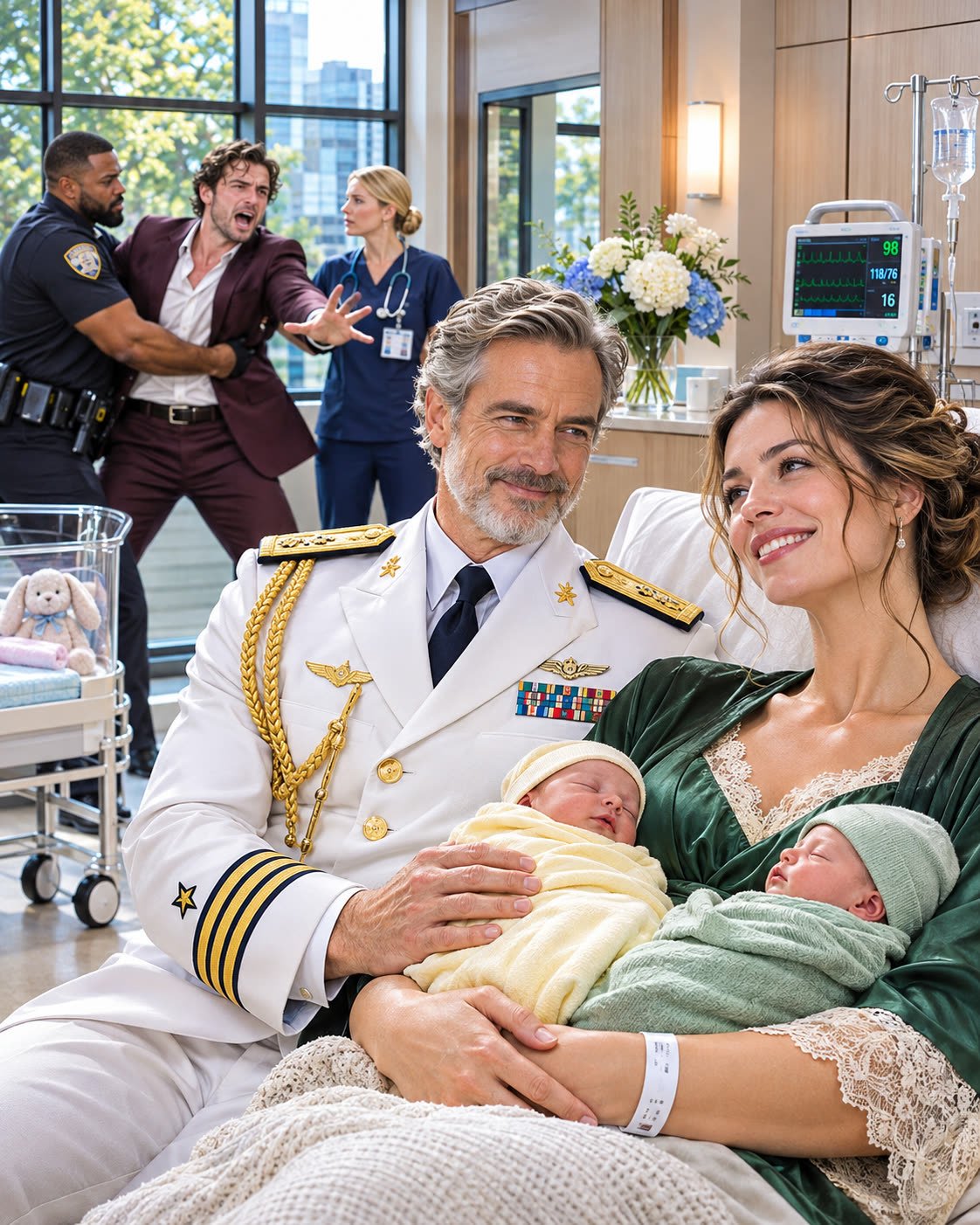
Part 1: The Empty Chair
The first time I saw my husband holding his son, I was lying in a hospital bed trying to keep our twins alive. A nurse was adjusting the monitor against my stomach when Julian appeared on my phone screen, smiling beneath a spray of gold balloons.
He was supposed to be in London. Instead, he was twenty minutes from me, standing beside his assistant at a birthday party.
“Help Daddy blow out the candle,” the woman in the video said.
My next contraction began before I could turn off the sound. I gripped the bedrail while my husband leaned over a little boy whose face was suddenly, unmistakably familiar.
Nurse Denise Alvarez glanced from the monitor to my face. “Clara, look at me. Is the pain different?”
“No,” I said. “Everything else is.”
I had been at Harbor Light Medical Center in Boston since before dawn. At thirty-four weeks and two days, my water had broken early, and the doctors had admitted me for monitoring because one baby was small and the fluid around him was low.
Julian had left the previous morning carrying the brown leather overnight bag I had bought him for our second anniversary. His mother, Vivian, had assured me that important negotiations could not be rearranged around every possible complication.
Now Vivian’s public birthday video showed her fastening a tiny gold bracelet around the little boy’s wrist. Behind her, a banner read, “Owen Is One.”
Denise pulled the visitor’s chair close enough to sit beside me. I held out the phone, and together we watched Julian kiss Tessa Lane on the temple while his entire family applauded.
“That’s my husband,” I said.
Denise did not offer the easy explanation people reach for when they want pain to become a misunderstanding. She watched another few seconds, then handed the phone back carefully.
“Who would you like me to call?” she asked.
I almost said his mother. Habit could survive a betrayal for several humiliating seconds.
Instead, I called Julian. The phone rang until voicemail answered, and his cheerful recorded voice told me he would return my call as soon as he could.
I left a message saying the doctors were concerned, that labor was progressing, that he needed to come to the hospital. I did not mention the party because some frightened part of me still wanted to hear what he would choose without knowing he had been caught.
Then I sent a message.
Clara: I’m in labor. The babies may need to be delivered today. Please come now.
The message changed to read. No answer followed.
For three years, I had arranged my life around the belief that Julian was trying. When he missed dinner, he was working; when he canceled appointments, he was exhausted; when he grew impatient with my questions, I told myself the strain of becoming a father frightened him.
I had made allowances so consistently that they had become the structure of our marriage. Now, with every contraction, I could feel that structure giving way.
Denise asked whether I had another support person. I told her my closest friend was visiting her sister in Colorado, which was true, and that most of my family lived out of state, which was also true without being the whole truth.
My mother had died when I was nineteen. My father had never been a dependable part of my life, so my mother’s father had raised me through the years when grief made ordinary decisions feel impossible.
Arthur Whitmore had taught me to drive, attended my college graduation, and once crossed the country because I sounded unhappy on the telephone. He had also made loving him difficult when I decided to marry Julian.
“He measures every room before he enters it,” Grandpa had said. “I’m afraid he’s measuring you, too.”
I had accused him of confusing caution with control. When he offered to have an attorney review the apartment purchase Julian wanted us to make, I heard contempt for the man I loved instead of concern for me.
After the wedding, our conversations became short and careful. Eventually, even those stopped.
Julian knew my grandfather was a retired Navy officer named Arthur. He did not know that my mother had been a Whitmore, or that the engineering company whose ships and harbor systems he admired belonged to the same family.
I had never invented poverty. I had told him my grandmother had left me savings, that I could contribute toward a home, and that I wanted to build a life on our own incomes.
But I had withheld the scale of what waited behind that ordinary explanation. I wanted to be loved without a balance sheet attached, and pride had helped me mistake secrecy for independence.
Another contraction tightened around me. Denise checked the monitor, and something in her posture changed.
“I’m going to bring Dr. Patel back in,” she said.
Within minutes, the room filled with people who spoke calmly while moving fast. Dr. Patel explained that both babies were having repeated drops in heart rate and were not recovering as well as they should.
“We recommend a cesarean delivery now,” she said. “I know this isn’t what you hoped for, but waiting carries more risk.”
I asked whether the babies would be all right. She answered honestly: they had a strong neonatal team ready, but she could not promise what they would need after delivery.
Nobody asked for my husband’s permission. Dr. Patel explained the procedure and its risks to me, answered the questions I could form, and placed the consent form where I could reach it.
My hand shook when I signed. Not because I doubted the decision, but because the empty chair beside the bed had become impossible not to see.
Denise gathered my belongings while another nurse prepared me for surgery. When she lifted my phone, I asked her to bring it close.
I scrolled past Julian’s name and Vivian’s, past the people who had taught me to apologize before asking for help. Near the bottom of my favorites was the number I had kept even through the angriest years.
Grandpa answered on the second ring.
“Clara?”
He said my name as though no time had passed, and that nearly undid me.
“I’m at Harbor Light,” I said. “The twins are coming early. They’re taking me into surgery.”
He asked which hospital entrance, which doctor, whether someone was with me. Practical questions, steady enough to hold on to.
“Julian isn’t here,” I said. “He’s with another woman. They have a little boy.”
For a moment, I heard only his breathing. Then his voice came back lower and gentler.
“You do not have to explain anything else right now.”
I began crying in earnest then, the kind of crying I had postponed through every polite conversation about my marriage.
“I should have called sooner.”
“Then we’ll be grateful you called today,” he said. “Put your nurse on for a moment, sweetheart. I’m coming.”
Denise took the phone while the team unlocked my bed. She gave him the ward number and explained that he should check in through the main entrance, not arrive expecting access simply because he knew my name.
I heard him say, “Of course.” Those two words mattered more than any promise of influence could have.
As they wheeled me toward the operating room, another notification lit the screen in Denise’s hand. Julian had finally answered.
Julian: Stop panicking. Mom says you always get dramatic when I’m away. I’ll call after the meeting.
I looked at the message once. Then I asked Denise to save it, because for the first time in my marriage, I understood that remembering the truth would not be enough.
Part 2: The Name I Left
My son was born at 2:14 p.m., and my daughter followed two minutes later. I heard a brief cry from each before the neonatal team moved them to warming beds beyond my shoulder.
I had expected joy to arrive like an opening door. Instead, it came in fragments: a nurse saying my son was breathing, a glimpse of my daughter’s dark hair, the anesthesiologist telling me I was doing well when I could not stop trembling.
My son weighed four pounds, five ounces. My daughter weighed four pounds, one ounce, and both needed help maintaining their temperature and blood sugar.
Dr. Patel told me they would go to the neonatal intensive care unit for close observation. My son also needed breathing support, something she said was not unusual at their gestational age.
“Can I see them?” I asked.
They brought my daughter close first, then paused beside me with my son in his transport incubator. I touched the edge of his blanket with one finger before they took him upstairs.
I named them Benjamin and Lucy in recovery. Julian and I had once made a list together, but those were the names I had returned to privately whenever I pictured calling my children home.
Denise wrote them down and repeated them without making me defend the decision. Then she helped me call the NICU so I could hear another update.
Grandpa arrived a little after four, having driven from Newport with his longtime aide, Peter Lawson. He had been attending a veterans’ scholarship ceremony when I called, which explained the dark dress uniform beneath his unbuttoned overcoat.
At seventy-two, he moved more carefully than I remembered. He stopped at the doorway instead of striding in, and I realized he was waiting for me to decide whether I wanted an embrace.
I held out my hand.
He crossed the room and bent over it, pressing his forehead against my knuckles. For a few seconds, neither of us said anything useful.
“You’ve had quite a day,” he said at last.
It was such a small sentence for what had happened that I laughed, then cried, then asked him not to make me laugh because the incision hurt.
He sat down immediately. “No jokes. Strict orders.”
Denise explained my medication schedule and reminded him that I needed rest more than visitors. He listened with the concentration I remembered from childhood, when he would read every instruction before assembling something and still let me believe I was helping.
After she left, I showed him the video. He watched it once, his hands motionless on his knees.
“Did you know?” I asked.
“About the woman and child? No.”
“About Julian?”
He took time before answering. “I had concerns. Concerns are not the same as knowledge.”
That distinction loosened something inside me. I had been bracing for vindication, for the terrible comfort of hearing that my worst day proved someone else right.
Instead, he asked whether I had eaten.
Later, while I managed a few spoonfuls of soup, he told me something I had not expected to hear.
“I owe you an apology, Clara. When you chose a life I wouldn’t have chosen, I behaved as though love gave me the right to veto it.”
I stared at him.
“I should have kept calling,” he said. “Not to persuade you. To be your grandfather.”
I told him I should have answered more honestly. I had sent birthday cards and brief holiday messages, but I had hidden the difficult parts because I could not bear to have my marriage become evidence in our old argument.
“We can both do better,” he said. “That’s different from deciding you deserved any of this.”
By early evening, I was able to visit the NICU in a wheelchair. Grandpa pushed me slowly, stopping whenever I needed him to, while Peter waited downstairs with our bags.
Benjamin lay beneath a small hat, a breathing mask covering part of his face. Lucy was in the next space, wrapped closely under the glow of her monitor.
Their nurse showed me how to rest a still hand against Benjamin instead of stroking his sensitive skin. Grandpa stood behind me until I asked him to come closer.
“That’s your great-grandfather,” I whispered. “He’s very good in a crisis and occasionally impossible at dinner.”
Grandpa cleared his throat and inspected a box of tissues with great interest.
When we returned to my room, Denise asked whether I wanted to revise my visitor list. I said Julian could receive information about the babies through the appropriate staff, but I did not want him entering my room without my permission.
She documented the request without surprise. Marriage, she explained, did not erase my right to decide who visited while I was a patient.
My phone had accumulated eleven calls. Julian’s messages had moved from irritation to concern, although none mentioned the birthday party.
Julian: Why is your grandfather answering questions about my children?
Julian: Mom says the hospital won’t confirm your room. Tell them I’m your husband.
Julian: We need to discuss this privately before you make it worse.
I had not told him Grandpa was there. Denise explained that Julian had called the ward and been told only that I had a support person and was not accepting calls at that moment.
The assumption in his messages was so familiar that I nearly answered defensively. Instead, I took screenshots and placed the phone facedown.
Grandpa asked whether I wanted a family-law attorney. I said yes, then added that I wanted someone who represented me, not his company.
“Quite right,” he said.
He gave me three names. I chose Miriam Shaw because she could speak briefly that evening and because, when she called, her first question was whether I was well enough to have a conversation.
She told me not to sign anything, move joint funds impulsively, or make promises about custody while recovering. She also told me that an affair, however cruel, did not automatically settle questions about parenting or property.
“Our job is to make sound decisions,” she said. “Not fast decisions that feel satisfying for an hour.”
I mentioned our apartment, the $80,000 I had contributed from my grandmother’s estate, and the watch Julian said was away for repair. Miriam asked me to save the relevant records without confronting him about them yet.
When I repeated the watch question to Grandpa, his expression changed. It was a Patek Philippe he had lent me after my mother died, one she had loved winding when she was little.
“The insurance office received an inquiry about that watch last month,” he said. “I thought you were arranging an appraisal.”
I remembered Julian telling me not to contact the repair shop because he had negotiated a special price. At the time, I had thanked him.
Before I could ask anything else, Grandpa’s phone rang. He glanced at the screen, hesitated, and stepped only as far as the open doorway.
I heard him say, “No. Do not change the process because he’s my granddaughter’s husband.”
When he returned, he sat beside me rather than remaining at the foot of the bed.
“There’s something else you need to know,” he said. “Whitmore Marine has been conducting due diligence on a company called Northbridge Logistics.”
Julian worked for Northbridge. He had spent months promising that a new investor would finally recognize his value.
“The review started six weeks ago,” Grandpa said. “Yesterday, their finance director flagged payments involving a vendor Julian manages.”
I looked down at the untouched water cup in my hands. My grandfather had come because I needed family, but the life Julian had kept from me was already beginning to unravel somewhere neither of us had thought to look.
Part 3: Visitors Behind Glass
The next morning, Miriam spoke to me before breakfast. She had already made clear that Grandpa’s corporate counsel would handle the business investigation separately; she represented me alone.
“Your divorce is not a bargaining chip for a criminal complaint,” she said. “If there is misconduct, it gets handled on its own facts. Nobody offers silence in exchange for signatures.”
I told her I understood, although part of me wanted a single document powerful enough to end every frightening thing at once. She seemed to hear that wish without my saying it.
“You don’t have to solve your whole future before lunch,” she added.
My first task was smaller. With Denise’s help, I drank water, stood beside the bed, and walked to the doorway with one hand pressed against a folded pillow over my incision.
The effort left me shaking. It also reminded me that my body was recovering from something real, regardless of how many messages Julian sent about my overreaction.
At 10:20 a.m., he arrived with Vivian. Tessa was not with them, and I was relieved that none of the children would be present for whatever came next.
Denise asked whether I wanted to see him. I agreed to a short visit, provided she remained nearby and Grandpa stayed in the room.
Julian entered carrying supermarket flowers with the price sticker still attached. I might once have found that detail endearing; now I noticed only that he looked at Grandpa before he looked at me.
“There you are,” he said. “Nobody would tell me anything.”
“You were told how to contact the NICU,” I said. “I asked for privacy in my room.”
Vivian came in behind him. “A husband shouldn’t need an appointment to see his wife.”
Grandpa rose, but I spoke before he could.
“A recovering patient can decide who visits her.”
Julian set the flowers on a cabinet and tried a softer expression. “How are the babies?”
I gave him the update the neonatal team had given me: Lucy was feeding with help, Benjamin still needed breathing support, and both remained under close observation. He asked whether they could come home by the weekend.
“The doctors will decide when they’re ready,” I said.
He nodded as though I had introduced an inconvenient scheduling problem. Then he glanced at Grandpa’s uniform, still hanging on the wardrobe door from the night before.
“Your grandfather looks familiar.”
“Arthur Whitmore,” Grandpa said, extending his hand.
Julian’s fingers stopped halfway through the handshake. He looked from Grandpa to me, then back again.
“Whitmore Marine?”
“Yes.”
The room became very quiet. Vivian’s gaze moved over the flowers, the visitor’s chair, and the overnight bag beside Grandpa’s feet, rearranging the significance of everything she saw.
“Clara never mentioned—” Julian began.
“Clara can introduce her family in her own time,” Grandpa said.
I had imagined that revealing my family’s wealth might feel like winning. Instead, I felt tired enough to see how small that victory would have been.
“I saw the birthday video,” I said.
Julian looked toward the door. Vivian pressed her lips together.
“You saw a few seconds without context.”
“Then give me the context. Is Owen your son?”
He pulled the visitor’s chair closer but did not sit. “It happened during a difficult period for us.”
We had been married for less than two years when Owen was conceived. The difficult period he meant was the month I worked late preparing a grant proposal and asked him to share the cooking.
“Is he your son?” I asked again.
“Yes.”
The answer hurt differently from the video. A screen could still leave room for some desperate, unreasonable uncertainty; his voice left none.
Vivian stepped forward. “That child is innocent, Clara.”
“I know,” I said. “He is not the person I’m questioning.”
Julian began explaining that Tessa had been overwhelmed, that he had intended to tell me, that the right moment had never arrived. Every sentence placed the decision somewhere beyond him.
I asked why he had pretended to be in London while I was carrying twins under close medical supervision. He said he thought I had more time.
“You read my message yesterday.”
“I thought you were frightened, not actually—”
He stopped when he heard himself.
Grandpa sat down again. He did not need to interrupt; Julian had finally said something neither money nor anger could improve upon.
“I am frightened,” I said. “My children are upstairs in incubators. Being frightened did not make me wrong.”
Julian reached for my hand. I moved it beneath the blanket before he could touch me.
That was when he noticed Miriam’s business card on the bedside table. His expression changed from apology to calculation so quickly that I wondered how many times I had ignored that same transition.
“You called a lawyer before speaking to me?”
“Yes.”
“Then you should know that the apartment is marital property. And whatever your family has, I’m not walking away with nothing.”
Grandpa’s jaw tightened, but he remained silent. I was grateful; I needed Julian to hear my answer in my voice.
“You should have your own lawyer explain your rights. Mine is explaining mine.”
Vivian called me ungrateful. Julian said I was allowing my grandfather to turn a private mistake into a public execution.
Denise appeared in the doorway. “This visit needs to end.”
Julian ignored her and took a step closer to the bed. “We are not finished.”
“I am,” I said.
He raised his voice, not enough to shout but enough that another nurse looked in from the corridor. Denise repeated the instruction, and a hospital security officer came to the open doorway.
Julian finally moved, then stopped outside the glass panel beside my door. Through it, I saw him turn back toward the room while Vivian pulled at his sleeve.
He tried to come in again. The officer placed himself between Julian and the doorway, guiding him away when he would not step back.
Inside, Grandpa stayed beside me while I shook too hard to lift my water. There was nothing triumphant about watching the man I had married being escorted down a hospital corridor.
That afternoon, Miriam obtained copies of the repair receipt Julian had emailed me months earlier. The business named on it had closed two years before.
An hour later, Tessa sent a message to the number printed on our shared holiday card. I had forgotten Julian had taken a stack to his office.
Tessa: I know you don’t owe me anything. But he told me you knew about us. He also told me your grandfather was funding our apartment.
I read the message twice. Then another arrived, this one with a photograph attached.
It was a bank transfer confirmation for $50,000, and beneath the account details Julian had written, “Clara approved the family assistance.”

Part 4: The Cost Of Proof
I did not answer Tessa immediately. I forwarded the messages to Miriam, then put the phone in a drawer while a lactation consultant helped me learn how to use the hospital pump.
It was an awkward, practical lesson, and I welcomed it. For twenty minutes, my attention belonged to something I could do for my children instead of something Julian had done to me.
Miriam called afterward. She asked whether I recognized the transfer or had ever authorized a payment to Tessa.
“No,” I said. “I’ve never even seen her bank details.”
“Then we preserve the original messages and let the investigators establish where the money came from. A screenshot is a lead, not a complete explanation.”
She arranged a call with Tessa for the following afternoon, with me listening only if I felt well enough. I agreed, but first I asked a question that had been bothering me since the photograph arrived.
“Could he have signed something in my name?”
“Possibly,” Miriam said. “We won’t assume it. We will check.”
I went home four days after delivery without my babies. There was no version of that drive in which wealth made the empty car seats less painful.
Grandpa offered the Newport house, but I chose a short-term furnished apartment near Harbor Light. He paid the deposit as a gift after Miriam made sure I understood and documented it.
I wanted help without another fog of unspoken arrangements. Grandpa accepted that more easily than I expected.
Every morning, someone drove me to the NICU. I changed tiny diapers through incubator openings, learned the rhythm of feeding tubes and weight checks, and discovered that progress could be measured in a few milliliters.
Benjamin came off breathing support after several days. Lucy’s main obstacle was staying awake long enough to finish her feeds.
Neither recovery followed a dramatic straight line. There were good mornings and discouraging afternoons, and the nurses taught me not to treat either as a prediction of the rest of our lives.
On the sixth day after delivery, I joined the call with Tessa from Miriam’s office. She had her own attorney present, something Miriam had encouraged rather than resisted.
Tessa did not ask me to like her. She began by saying she had known Julian was married.
“He told me you lived separately,” she said. “He said the marriage was an arrangement your family wanted maintained until a trust issue was settled.”
I thought of the birthday dinners I had cooked and the nights I had waited for his key in the lock. His invention had turned my ordinary devotion into a legal fiction.
“You saw that I was pregnant,” I said.
She lowered her eyes. “He said you used a donor. I wanted to believe him because the alternative meant admitting what I was doing.”
It was not an excuse I accepted. It was, however, the first account I had heard from anyone involved that contained an honest description of a choice.
Tessa provided full message exports, the lease on her apartment, and statements showing the payments she had received. Her attorney handled the transfer so there would be a record of what had come from where.
The $50,000 had arrived from a consulting company I did not recognize. Julian had described it to her as family money and asked her to keep part of it available for a future house deposit.
Northbridge’s independent review found a different story. The consulting company had invoiced Northbridge for services its staff could not verify, and its listed contact was a college friend of Julian’s.
The finance director had flagged the payment before Grandpa ever heard my hospital call. That fact became important when Julian later claimed the entire investigation was revenge arranged by my family.
Whitmore Marine paused the proposed acquisition while outside accountants reviewed the concerns. Grandpa recused himself from decisions involving Julian and put that instruction in writing.
“I’m your grandfather in this,” he told me. “That is enough work.”
Miriam’s review of our personal accounts uncovered no forged signature on a loan, which was a relief. It did uncover withdrawals from our joint savings that Julian had described as tax payments.
There were also restaurant bills, hotel charges, and transfers that lined up with the days he had told me he was traveling for work. Each entry made some old argument briefly, bitterly clear.
I did not need every receipt to decide whether the marriage was over. I needed them because fairness in a legal process depended on more than knowing I had been wronged.
The watch was traced through its serial number to a licensed dealer in Providence. The dealer had purchase records identifying Julian, along with a copy of the identification he had presented.
He had received $46,000, not the small repair refund he had once mentioned when I asked about an unfamiliar deposit. Because the watch belonged to Grandpa, the ownership documents mattered more than my memories of wearing it.
Grandpa reported the unauthorized sale through his attorney. He did not promise to withdraw it if Julian cooperated with the divorce.
The dealer placed the watch in secure storage while the ownership question was resolved. It would take months to bring it home.
Julian hired an attorney and stopped calling me directly for a while. Through counsel, he proposed that I remain in the marriage publicly while we lived apart, at least until Northbridge’s review ended.
I asked Miriam whether she thought he understood what he was asking.
“He understands what he wants,” she said. “That is not the same thing.”
I rejected the proposal. We filed for divorce and requested temporary orders governing money, access to the apartment, and arrangements for the babies.
The first hearing did not resemble the courtroom victories people imagine. It was short, restrained, and full of unfinished questions.
The judge did not award me a fortune or declare Julian unfit because he had cheated. She ordered financial disclosures, prohibited unusual transfers of marital assets, and established a process for the parenting issues after the babies left the hospital.
Miriam and Julian’s attorney negotiated my temporary exclusive use of the apartment, although I chose not to move back yet. Julian received scheduled access to collect his personal belongings without seeing me.
Vivian sent a message asking how I could make her son feel unwelcome in his own home. I did not answer; I sent it to Miriam and returned to practicing Lucy’s bottle feed.
Two weeks after birth, Lucy was discharged. Benjamin followed three days later, once he could feed consistently and maintain his temperature without extra help.
Grandpa was waiting in the apartment when we arrived with both babies. He had assembled the bassinets and then asked the visiting nurse to check every fastening.
That evening, I sat between them while they slept, afraid to believe that everyone who belonged there was finally under one roof.
Then Miriam called.
Julian’s attorney had sent a draft parenting demand seeking alternating weeks once the babies were older. Attached was an offer to reduce that demand if I agreed to a substantial financial settlement.
“We will address this properly,” Miriam said before I could speak. “Children are not negotiating currency.”
I looked at Benjamin’s small hand resting against his blanket. Ending the marriage had been a decision; protecting the shape of the life that followed would be a longer fight.
Part 5: The Door We Chose
For several days, anger made every possible response seem obvious. I wanted Julian kept away, Vivian silenced, and every person who had watched that birthday video forced to explain why they had smiled.
Then Benjamin developed a feeding problem that required an extra pediatric appointment, and Lucy stayed awake through most of the following night. My children brought me back to the scale on which our real life would be lived.
I needed a workable plan more than I needed an audience for my anger.
Miriam responded to the settlement proposal through Julian’s attorney. Financial negotiations would remain separate from parenting arrangements, and any plan for the twins would need to reflect their medical needs, age, and each parent’s actual caregiving.
I agreed to professionally supervised introductory visits while the court considered a longer-term arrangement. The first time I signed the consent, I cried afterward in Miriam’s office.
“Agreeing to something safe is not saying what he did was acceptable,” she told me.
That sentence became one I returned to often.
Julian attended the first visit with a large bag of toys the babies could not use. The supervisor showed him where to put them, then taught him how to support Lucy’s head and recognize when Benjamin needed a pause during feeding.
I received a written summary afterward. It did not call him a monster or a misunderstood father; it described what he did, what he needed help with, and whether he followed instructions.
Those ordinary records were more useful than any speech I could have made.
He missed the third scheduled visit, saying he had confused the time. He attended the next four, then asked to move another because of an interview.
I learned not to explain those choices to myself. The supervisor documented them, and the court could weigh a pattern instead of my fear.
The financial investigation took longer. Northbridge suspended Julian, then terminated his employment after the independent review substantiated false expense claims and undisclosed vendor payments.
The proposed acquisition eventually went forward on revised terms, with a different team responsible for compliance. Grandpa neither announced the purchase as a family victory nor discussed Julian in company meetings.
Months after the hospital, prosecutors filed charges related to the vendor arrangement and fraudulent reimbursements. The total supported by the records was substantially more than the first $50,000 transfer, though less than the wild figures that began circulating among former colleagues.
I refused interviews and asked relatives not to share photographs of the twins. There were consequences enough without turning my children into proof that I had won.
Tessa moved closer to her mother in western Massachusetts. Through her attorney, she cooperated with the financial inquiry and established her own support arrangements for Owen.
She sent me one final message before changing her number.
Tessa: I’m sorry for the part I chose, not just the things he lied about. You don’t need to answer.
I did not answer. I hoped, sincerely, that Owen would grow up in a steadier home than the one the adults around him had begun with.
Vivian tried longer to reach me. Her messages moved between apology and accusation, sometimes within the same paragraph.
Eventually, I sent one response approved by Miriam: communication about the children could go through the agreed channel, unannounced visits were not welcome, and insulting messages would receive no reply.
She called that cruelty. For the first time, her description of me did not become an assignment I had to complete.
Our property negotiations required appraisals, mortgage statements, and more patience than any dramatic confrontation had demanded. The apartment did not become mine overnight because I had supplied the down payment.
My contribution from my grandmother’s estate was documented and addressed in the settlement. Other equity and debts were divided under the agreement our attorneys negotiated after full disclosure.
I chose to sell the apartment. After the mortgage, costs, and agreed credits were settled, each of us received the amount specified in the final documents.
I did not destroy the furniture. I kept the kitchen table because I liked it, donated what I did not want, and arranged for Julian’s belongings to be collected without requiring him to stand there while strangers judged him.
I was beginning to understand that refusing humiliation was different from needing to distribute it.
The trust became less dramatic on paper than it had sounded in Julian’s threats. It was an existing family trust with independent trustees, not a vault Grandpa could open or close according to his mood.
I had declined discretionary distributions during the marriage and lived on my salary, later our savings and Julian’s income during medical leave. Its principal was not a marital account Julian could claim simply by demanding a share.
Miriam made no sweeping promises. She reviewed the documents, obtained specialist advice, and negotiated from what the law and the records actually supported.
Nine months after the twins’ birth, the divorce became final. Julian had his own counsel throughout, and nobody brought papers to his bedside or threatened him into signing.
The parenting order gave me primary physical custody and set a structured schedule of supervised contact, with a review process tied to reliability, parenting education, and the children’s needs. It did not erase him, and it did not require me to pretend trust could be restored by a signature.
The criminal case concluded separately when Julian entered a negotiated guilty plea to financial offenses. The judge imposed restitution, probation, and a custodial sentence partly suspended under the applicable terms of the plea.
I learned the outcome from the written notice Miriam forwarded. I read it at the kitchen table, closed the file, and went into the next room because Lucy had begun laughing at Benjamin’s determined attempt to remove one sock.
That was not indifference. It was the first evidence that his consequences no longer had to occupy the center of my day.
Grandpa and I rebuilt more quietly. He came for dinner on Wednesdays and learned that advice offered after being asked was received much better than advice delivered as a weather warning.
I learned to tell him when I was struggling before struggling became a crisis. Once, when he began arranging three solutions to a problem I had only wanted to describe, I held up my hand.
“Grandpa. Listening first.”
He leaned back in his chair. “A difficult new protocol. I’ll adapt.”
He did.
When the watch was finally returned, he brought it in its old case. I expected him to insist I keep it somewhere safer this time.
Instead, he asked whether I still wanted it.
I fastened it around my wrist. For years, I had confused accepting help with surrendering control; he was learning that giving help did not entitle him to take control, either.
One year after the twins were born, we held their birthday lunch in Grandpa’s garden in Newport. It was a small gathering: a few friends, two cousins, Denise, and the people who had shown up consistently after the emergency had ended.
Benjamin was sturdy now, though we still kept his follow-up appointments. Lucy had discovered that dropping a spoon produced a fascinating variety of adult reactions.
Their birthday cake leaned slightly because I had insisted on decorating it myself. Nobody corrected the frosting.
This was the epilogue I could not have imagined from the hospital bed: not a grand announcement of what I had inherited, but a table with enough high chairs, an ordinary pediatric appointment on the calendar, and a future that no longer depended on being believed by someone committed to misunderstanding me.
Julian had attended his scheduled visit the previous day. The children’s routines remained protected, communication stayed in writing, and I no longer searched his messages for the person I had once hoped would emerge.
Forgiveness was not something I had promised. Peace, I was discovering, did not require that particular word.
After lunch, Grandpa took Benjamin while I carried Lucy toward the old porch swing. Denise raised her phone and asked whether I wanted a photograph.
For an instant, I remembered the birthday video: gold balloons, a smiling family, and a woman in a hospital bed just outside the frame of their happiness.
I almost said no.
Then Lucy rested her cheek against my shoulder, and Benjamin reached toward me from Grandpa’s arms. Neither child knew what this date had once contained, and I was grateful they would not have to carry it.
“Yes,” I said. “Take it.”
Denise waited until Grandpa sat beside me. His sleeve brushed mine, the watch caught the light, and both children looked anywhere but at the camera.
The photograph was imperfect. My hair had escaped its clip, Benjamin had frosting on one cuff, and Lucy was trying to steal the ribbon from her brother’s gift.
I loved it immediately.
That evening, after the guests left, I placed a copy in the family album. There was room beside it for another photograph, and another after that.
I had once believed that an empty chair meant I had been left with nothing. Now I knew I was allowed to choose who sat beside me—and to leave space for the life still coming.
What does rebuilding trust look like when protecting your peace matters more than proving someone else wrong?
Disclaimer: This story is a work of fiction inspired by real-life themes. Names, characters, places and events are fictionalized, and any resemblance to real persons is purely coincidental. It does not represent any person or organization and does not encourage inappropriate behavior. Images are for illustration purposes only.


