

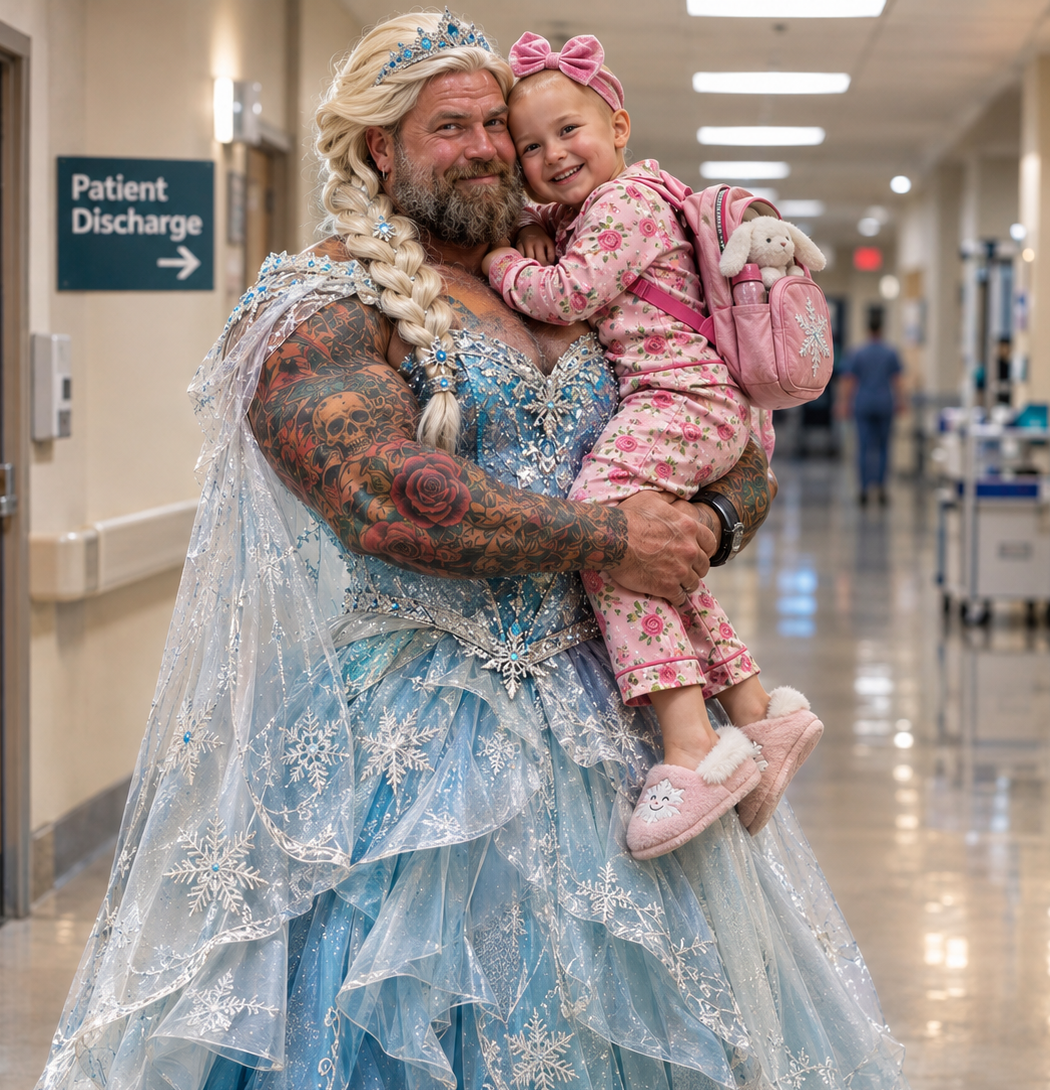
On the morning my seven-year-old rang the bell at the end of her cancer treatment, a 6’4″ biker in a sparkly blue gown walked into the hospital lobby. My daughter screamed “Uncle Hank!” and ran straight into his arms. I had never seen this man in my life. Then he handed me a photo album—and a secret my ex-husband had kept until the very end.
The Ice Queen in the Lobby
The bell hung on the wall outside the pediatric oncology unit at Mercy Children’s in Columbus, Ohio. Brass, about the size of a coffee mug, with a little plaque underneath that said Ring this bell three times loud.
Maisie rang it eleven times.
Nobody stopped her. The nurses clapped. Dana, the charge nurse who had held my hand through more bad nights than I can count, wiped her eyes with the back of her wrist and pretended she had something in her contact lens.
Seven years old. Nine months of treatment. Thirty-one nights in Room 412. And now my daughter was standing in a purple puffer coat with a knit hat over her fuzzy head, grinning like she’d just won the lottery.
I had the discharge papers in one hand and her overnight bag in the other. I was already thinking about traffic on I-71, about whether we had milk at home, about how I was going to sleep without the beep of an IV pump.
Then the elevator doors opened.
The man who stepped out was huge. Six-foot-four, maybe more. Broad as a refrigerator. His arms were covered in tattoos from wrist to shoulder—eagles, roses, a compass, a name in script I couldn’t read. He had a gray beard that reached halfway down his chest.
And he was wearing a floor-length, sparkly, ice-blue princess gown.
There was a cape. There was a sequined bodice stretched across his chest like it was holding on for dear life. There was a platinum blond braid—clearly a wig—draped over one massive shoulder. Under the hem of the dress, I could see black leather motorcycle boots.
I took a step in front of Maisie without thinking.
She ducked right around me.
“UNCLE HANK!”
She ran down the hallway so fast her hat flew off. The giant in the gown dropped to one knee, opened his arms, and caught her like he’d done it a hundred times before.
“There she is,” he said, his voice low and gravelly. “There’s my warrior.”
I stood frozen with the bag strap cutting into my palm.
I had never seen this man before in my life.
And my daughter was hugging him like family.
The Year Everything Went Quiet
To understand why that moment knocked the air out of me, you have to understand the two years before it.
My name is Claire. I’m a photographer—or I used to be. Weddings, newborns, senior portraits, the occasional real estate listing when money was tight. I married Ben Whitaker when I was twenty-six. He was an HVAC technician with a laugh you could hear from the driveway and a habit of fixing things nobody asked him to fix. Squeaky hinges. Loose cabinet knobs. My grandmother’s broken music box.
We had Maisie two years later. Ben built her crib himself and cried when he finished it.
For a long time, we were happy in the ordinary way most people are happy. Pancakes on Saturdays. Arguments about the thermostat. Ben falling asleep on the couch during every movie we ever started.
Then, about three years ago, something changed.
He started coming home late. Not suspiciously late—just late enough. He stopped laughing at dinner. He lost weight, and when I asked about it, he said he was “cutting carbs.” He started sleeping in the guest room because, he said, he was snoring and didn’t want to keep me up.
I asked him what was wrong at least fifty times.
“Nothing, Claire. I’m just tired.”
“Is it me? Is it us?”
“It’s not you.”
Which, of course, is exactly what people say when it is you.
I thought he’d met someone. I checked his phone once while he was in the shower. Nothing. No texts, no strange numbers. Just a lot of calls to a number labeled “Hank” and a few to a medical billing office I assumed was about his back.
Eight months later, he sat at the kitchen table and told me he wanted a divorce.
He didn’t fight me on anything. Not the house. Not custody. He signed every paper my lawyer sent over without changing a word. He asked for every other weekend with Maisie, and then, within a couple of months, he started canceling those too.
“Something came up with work.”
“I’m not feeling great this weekend.”
“Tell her I love her.”
I was furious. I told myself he’d simply checked out. That some men just do that. They get bored of the life they built and walk away from it like it’s a lease they didn’t renew.
Five months after the divorce was finalized, Maisie started getting bruises she couldn’t explain. Then fevers. Then she fell asleep at the kitchen table in the middle of eating a grilled cheese.
Acute lymphoblastic leukemia.
I called Ben from the hospital parking garage. It went to voicemail. I called again. Voicemail. I texted him: Maisie has cancer. Please call me.
He texted back four hours later.
I’m so sorry. I can’t right now. I’m so sorry, Claire.
That was it.
I read that message probably two hundred times over the next nine months. Every time, it made me angrier. What kind of father can’t “right now” when his little girl has cancer?
So I stopped calling. I stopped expecting. I quit taking photography jobs because I couldn’t leave the hospital, and I learned to live on vending machine crackers and the generosity of a GoFundMe my sister started.
I did it alone. Or at least, that’s what I thought.
The Album
The man in the gown stood up slowly, still holding Maisie on his hip like she weighed nothing.
Up close, I could see the makeup. Blue eyeshadow, applied with surprising care. Glitter on his cheekbones. A little smudge of pink lipstick at the corner of his mouth.
“Ma’am,” he said, and nodded at me. “I’m Hank Calloway. I’m guessing you’ve got some questions.”
“Some,” I said. My voice came out thin. “Who are you? And how does my daughter know you?”
Maisie looked at me like I’d asked the dumbest question in the world.
“Mom. Uncle Hank comes on Sundays.”
I looked at Dana. Dana looked at the floor.
“Sundays,” I repeated.
Sundays were the one day I went home. My sister would sit with Maisie from ten until four so I could shower, do laundry, pay bills, and sleep for a few hours in my own bed. For nine months, Sunday was the only day I wasn’t in that hospital.
Hank shifted Maisie to his other arm and reached into the canvas tote hanging off his shoulder—a tote that said Ice Ice Baby in glitter letters. He pulled out a thick photo album with a navy cover.
“Maisie,” he said, “you want to give it to her?”
She wriggled down, took the album with both hands, and held it out to me like it was made of glass.
“I made it for you,” she said. “It’s a surprise. It’s for when I’m all done.”
I opened it right there in the hallway.
The first photo was Maisie in her hospital bed, bald, giggling, while a man in a pirate costume pretended to sword fight with her IV pole. It was Hank.
The next page: Maisie and Hank in matching superhero capes.
Then: Hank dressed as a fairy godmother, wand and all, reading her a book.
Hank as a mermaid with a fishtail made of green tarp.
Hank as a dinosaur, Maisie riding his back down the hallway while Dana laughed in the background.
Page after page after page. Thirty-six Sundays. Thirty-six costumes. My daughter, smiling in a place where I had mostly watched her cry.
“I don’t understand,” I whispered.
Hank cleared his throat. “I run a club. The Iron Hearts. We’re a riding club—mostly guys my age with too many tattoos and bad knees. We visit kids in treatment. Costumes, presents, whatever cheers ’em up. Kids get a little less scared of a big guy on a motorcycle when he’s wearing a tiara.”
“And the hospital just lets you in?”
“We’re registered volunteers,” Dana said quietly. “Background checks, the whole thing. They’ve been coming here for two years, Claire. The kids love them.”
I flipped another page. On the inside of the back cover, there was a small photo tucked into the corner. A man on a motorcycle, his back to the camera, wearing a leather vest with the same Iron Hearts patch.
Something about the shape of his shoulders made my stomach drop.
“Who started the club?” I asked.
Hank was quiet for a long moment.
“My best friend,” he said. “He passed this summer.”
I looked at the tattoo on his forearm. The name in script I couldn’t read before. Now, this close, I could.
Benny.
What Ben Didn’t Say
We sat in the family lounge at the end of the hall. Dana took Maisie to say goodbye to the other nurses, and Hank lowered himself into a plastic chair that groaned under his weight. The gown pooled around his boots.
He took off the blond wig and set it on his knee. Underneath, he was mostly bald.
“Ben didn’t want you to know,” he said. “I need you to understand that first. I argued with him about it for two years. He was stubborn as a mule.”
“Know what?”
“He got diagnosed before the divorce. Pancreatic cancer. Stage three when they found it.”
I didn’t say anything. I couldn’t.
“He knew what it meant. Doctors gave him maybe eighteen months, two years if the treatment worked. He watched his own dad die of the same thing when he was fourteen. Said it took four years and took the whole family down with it. The money, the marriage, everything. His mom never recovered.”
The weight loss. The guest room. The calls to Hank. The medical billing office.
“He didn’t want that for you,” Hank said. “He figured if you were angry at him, you’d move on easier. He figured it was better for you to hate him for leaving than to watch him go slow.”
“That wasn’t his choice to make,” I said, and my voice cracked down the middle.
“No, ma’am,” Hank said gently. “It wasn’t. I told him that every week.”
I pressed my hands against my face.
“When Maisie got sick,” Hank went on, “it about killed him faster than the cancer did. He was in the middle of chemo himself. Couldn’t drive. Couldn’t be around a kid with no immune system—he was carrying infections half the time. He couldn’t even get out of bed some days.”
I can’t right now. I’m so sorry, Claire.
I had read that text two hundred times. I had never once read it right.
“So he called me,” Hank said. “He’d been riding with me for twenty years. When he got sick, he came up with the idea for the hospital visits. Said if he couldn’t be there for kids, he could at least send people who could. That’s how Iron Hearts started visiting. Then Maisie got diagnosed, and he asked me to make sure she was never alone on Sundays—the day he knew you went home.”
“How did he know that?”
Hank almost smiled. “Your sister. He called her once a month to ask how you both were. Made her promise not to tell you.”
I thought of Jenna, always oddly careful around the subject of Ben. Always changing it.
“He asked me to stay away from you,” Hank said. “Said if you met me, you’d figure it out in about five minutes. He was right. You did.”
“When did he die?”
“July twelfth. Four months ago. Hospice in Westerville.” Hank looked down at his huge hands. “He wanted to see her so bad, Claire. Near the end, he asked me to bring the album so he could look at the pictures. Every Sunday night, I’d show him the new ones. He kept the one of her in the dinosaur ride on his nightstand.”
He reached into the tote one more time and pulled out an envelope. It was soft at the corners, like it had been carried around for a while.
For Maisie. When she’s older. In Ben’s blocky handwriting.
“He wrote it in June,” Hank said. “He said you’d know when the time was right. I figured it should come to you, not me.”
I held that envelope in my lap for a long time. I didn’t open it. It wasn’t mine.
Through the lounge window, I could see Maisie down the hall, showing off her bell certificate to a janitor who looked genuinely impressed.
She didn’t know her father was gone.
I had told her he was “busy” for nine months. And now I had to decide whether I was going to keep doing exactly what Ben had done—protect her from the truth because the truth hurt.
The Picture on the Last Page
I didn’t tell her that day. I wanted her first night home to be about her own bed and her own stuffed animals and the macaroni and cheese she’d been requesting since August.
But I told her that weekend.
We sat on the living room floor with the album open between us. I told her that Daddy had been sick too, with a different kind of sickness. That he had loved her so much it scared him. That he couldn’t visit, so he sent Uncle Hank instead. That every costume, every Sunday, every dinosaur ride had been a little piece of her dad finding a way to be there.
And then I told her he had died.
She didn’t cry right away. She turned the pages slowly, looking at each picture like she was seeing it for the first time.
“So Daddy saw these?” she asked.
“Every single one,” I said. “Uncle Hank showed him every Sunday night.”
She was quiet for a while. Then she said, “Did he like the mermaid one? Because Uncle Hank’s tail fell off.”
I laughed so hard I started crying, and then she started crying, and we sat there on the carpet for a long time.
We didn’t open the letter. Not yet. It’s in a fireproof box in my closet, next to her birth certificate. She knows it’s there. When she’s ready—maybe at twelve, maybe at eighteen—she’ll read it. That’s her choice now. Not mine, and not his.
In January, I went to my first Iron Hearts meeting.
It was held in the back room of a diner in Grove City. Fourteen bikers, mostly in their fifties and sixties, eating pie and arguing about whether a tutu could survive a rainstorm. They had a spreadsheet for costumes. They had a spreadsheet for birthdays. They had a fund—$4,280 at the time—for gas cards for families driving in from rural counties.
“We could use somebody who knows how to work a camera,” Hank said. “Families never get good pictures in there. Just blurry phone shots.”
So I dusted off my Canon.
Now I go with them on Sundays. I take portraits of kids in their hospital beds—real portraits, good light, the kind parents can frame. I print them for free and put them in albums. Twenty-three families so far. One mom told me it was the only picture she had of her son where he looked like himself instead of like his illness.
I started taking paid work again too, slowly. A wedding in April. A few family sessions. It turns out you don’t forget how to see.
Hank comes over for dinner once a month. He insists on bringing dessert, and it’s always a store-bought pie with the price tag still on it. Maisie calls him Uncle Hank, and I’ve stopped hearing anything strange in that.
He told me once, over the last slice of a $7.99 pecan pie, that Ben made him promise one more thing near the end.
“What?” I asked.
“Make sure they’re okay,” Hank said. “That’s all. Just make sure my girls are okay.”
“Are we?”
He looked at Maisie, who was teaching the dog to shake hands in the next room.
“Yeah,” he said. “I think you are.”
In June, the Iron Hearts held their summer ride at a park near Alum Creek. Eighty-something motorcycles. Bounce houses. Hot dogs. Kids in remission, kids still in treatment, parents who looked like they hadn’t slept in a year, finally sitting in lawn chairs in the sun.
Hank wore the ice-blue gown again. By popular demand.
Near the end of the day, Maisie grabbed my hand and dragged me over to him.
“We need a picture,” she said. “For the album. All three of us.”
One of the other riders took my camera. Hank knelt in the grass in his sequins. Maisie stood between us, her hair grown back in soft brown curls, wearing an Iron Hearts T-shirt that hung down to her knees.
That night, she slid the print into the very last page of the album.
Right next to the photo of a man on a motorcycle, his back to the camera, riding toward something he never got to see.
Except, in a way, I think he did.
Would you have forgiven Ben for keeping his secret—or do you think he took away a choice that wasn’t his to make?
Note: This story is a work of fiction inspired by real events. Names, characters, and details have been altered. Any resemblance is coincidental. The author and publisher disclaim accuracy, liability, and responsibility for interpretations or reliance. All images are for illustration purposes only.


