

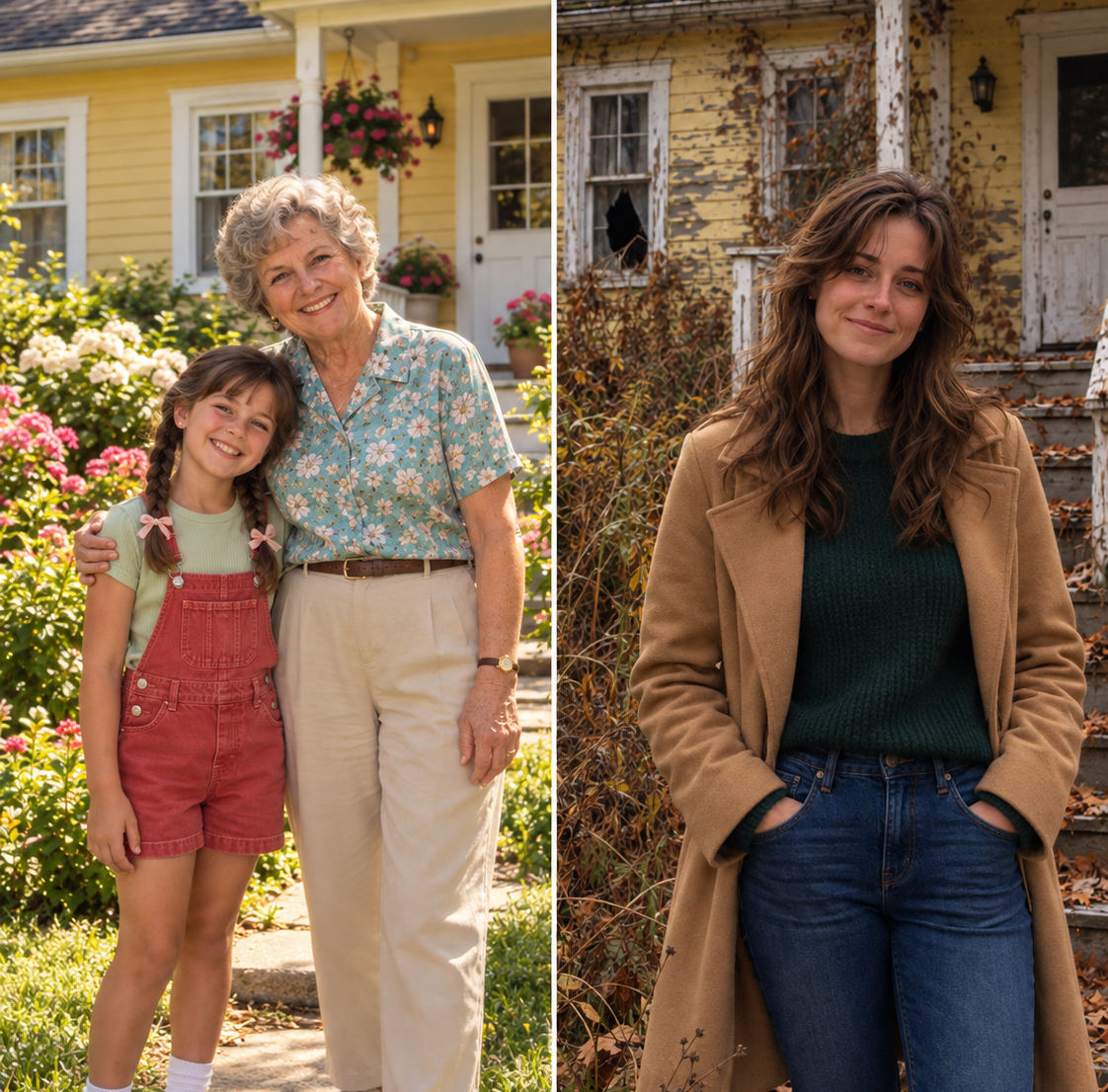
Part One: The Worst Decision I’d Ever Made
“Tell her,” my husband said. “Go on. Tell her what it’s worth.”
I was standing in the doorway of my grandmother’s storage room. The plywood that had covered the back wall for as long as I could remember was lying in splintered pieces on the floor. A man I’d never seen before stood beside the hole, holding a folder against his chest and smiling at me like we were old friends.
“What on earth is going on here?” I said.
To explain how I ended up in that doorway, I have to go back three days. To breakfast.
I’d waited until Owen left for the bus. I poured Declan a second cup of coffee, sat down across from him, and said it the way I’d practiced in the car.
“I bought Grandma Rose’s house.”
He didn’t even put his mug down. He just laughed, one short, flat sound.
“Well. Congratulations, Layla. You’ve officially found the dumbest possible way to waste money.”
“You haven’t even asked what I paid.”
“I don’t need to. I’ve driven past that place. Peeling paint, two broken windows, weeds up to the mailbox.”
“I know what it looks like.”
“Then you know it’s a dump.”
That was Declan. He could pour thousands into his ’67 Mustang without blinking, but the moment I spent money on something that was mine, he turned into a financial advisor.
Last Christmas, I replaced our coffee maker, and he spent a full evening telling me how overpriced it was. Two days later, a new set of socket wrenches showed up on the porch.
“Didn’t you just buy tools?” I’d asked.
“Not these.”
“You have three toolboxes.”
“And you already had a coffee maker.”
“Mine was broken.”
“It still made coffee.”
Apparently, things only needed replacing when they belonged to him. The cereal Owen liked was an extravagance. The premium brake pads for the Mustang were “an investment in safety.” I’d spent eleven years quietly stepping around those double standards, the way you learn to step around a loose floorboard.
What I hadn’t expected was for him to step on my grandmother’s house.
“The roof is ancient,” he went on. “The kitchen hasn’t been touched since the seventies. Do you have any idea what repairs are going to cost?”
“Yes. I’ve talked to two contractors. I have a plan, and I’m doing it slowly.”
“With what money?”
“Mine. I’m not asking you for a cent.”
He stood up and grabbed his keys off the hook.
“That’s the worst decision you’ve ever made. Don’t come crying to me when you figure that out.”
I didn’t answer. I should have. Letting it go that morning only taught him he could keep going.
“Declan, can you at least let me tell you why I bought it?”
“You already did. You miss your grandma.”
“That’s not all of it.”
“Then what? You’re planning to move us into that place?”
“No. I want somewhere we can go on weekends. Somewhere Owen can actually play outside instead of staring at a screen.”
“And I want you to sell that shack before it falls on somebody.”
The door closed behind him before I could say another word.
I sat alone at the table with two cups of coffee going cold and thought, Eleven years of marriage, and that’s what I get.
Part Two: Grandma Rose’s House
Every summer of my childhood happened in that house.
Grandma Rose taught me to make apple pie at her kitchen counter, standing on a step stool so I could reach the dough. She let me crimp the edges badly and never fixed them. We spent whole evenings on her porch swing, counting fireflies, and when it rained, we curled up under one blanket on the couch and read until the storm passed. She read with her whole body, gasping at the cliffhangers, doing every voice.
When she died, she left the house to her son, my Uncle Frank. He listed it a month after the funeral.
I was nineteen and broke, working nights at a diner. I couldn’t have bought a shed. I drove past the SOLD sign once and had to pull over because I couldn’t see the road.
Other families lived there for years after that. Then, last spring, I was scrolling listings on my lunch break and her front porch appeared on my screen. The swing was gone. The paint was gray and blistered. But it was hers.
What Uncle Frank didn’t know, and what I’d never told Declan in full, was that Grandma Rose had quietly left me some money of my own. Not much. I’d invested it instead of spending it, the way she would have wanted, and over the years I’d watched it grow without ever touching it.
It had grown just enough.
I didn’t think of it as a waste. I thought of it as bringing her home.
For the next two days, Declan wouldn’t let it go.
I mentioned rebuilding the porch.
“Do you know what lumber costs right now?”
“I’ve got an estimate.”
“Of course you do. And when the estimate doubles?”
“Then I wait until I can afford it.”
I mentioned the kitchen, and he actually laughed.
“Maybe fix the roof before you start dreaming about curtains.”
“The roof is first on my list.”
“Then why are we talking about the kitchen?”
“Because I’m allowed to think about more than one room at a time, Declan.”
At dinner that night, Owen looked up from his plate. He’s ten, and he lives and breathes comic books. His bedroom walls are covered in them.
“Mom, can I have a room at Grandma Rose’s house?”
“Of course you can, honey.”
His whole face lit up. “Could we put shelves on the walls? Like at the comic shop, where they face out?”
“We’ll see what fits.”
“If your mom doesn’t blow every penny fixing up that dump,” Declan said, not looking up from his phone.
“Declan. Not in front of him.”
Owen set his fork down slowly.
“It’s not a dump, Dad. Mom says Grandma Rose loved that house.”
“Loving something doesn’t make it worth the money, buddy.”
Owen thought about that for a second. Then he asked, very seriously, “Would you sell your Mustang if somebody said it wasn’t worth fixing?”
Declan finally looked up.
“That’s different.”
“Why?”
“Because I know what I’m doing with that car.”
I put my own fork down.
“And I know what I’m doing with the house.”
Declan didn’t answer. But Owen pushed his plate away, and he didn’t touch his dinner again. That hurt more than anything Declan had said to me.
On the third morning, I’d had enough.
“This weekend, I’m starting to clean out the house,” I told him. “With your help or without it.”
“Fine. Just don’t expect me to get involved.”
“I don’t.”
And I didn’t. That’s what made the phone call that afternoon so strange.
Part Three: “Just Get Here”
I was at my desk at work when my phone buzzed. Declan.
He never called me during the day.
“Layla.” His voice sounded wrong. Thin. “I’m at your grandma’s house.”
“What? Why?”
For one ridiculous second, my heart lifted. Maybe he’d come around. Maybe he’d gone over there to surprise me, to measure for the porch, to see the place through my eyes.
“I found something,” he said. “I don’t even know what to say.”
My stomach dropped. I ran through everything at once: black mold, a cracked foundation, water pouring through the ceiling. Every disaster he’d promised me.
“What did you find?”
“Just get here. Now.”
He hung up.
I told my manager it was a family emergency and drove faster than I should have. When I turned onto Grandma’s street, Declan was standing at the front door, pale and silent.
Declan is never silent.
“What’s going on?” I called, getting out of the car.
“Come inside.”
He led me through the living room, past the spot where her couch used to sit, to the little storage room off the side. That’s where I found the plywood on the floor, the hole in the wall, and the smiling stranger.
And on the floorboards between us sat a small metal chest.
Part Four: The Appraiser
“Who is this?” I asked.
“Robert.” The man stepped forward and held out his hand. “I’m a real estate appraiser. Your husband asked me to take a look at the property.”
I didn’t shake it. I turned to Declan.
“You brought an appraiser into my house?”
“I wanted to know what it’s actually worth.”
“Why? I already bought it.”
“Exactly.” He spread his hands like it was obvious. “I wanted to know how much of your money we could get back.”
The floor seemed to tilt a little.
“You were going to sell it. Behind my back.”
“I never said sell. I wanted numbers. Real numbers. So you’d finally see reason.”
“He did ask what it would list for as-is,” Robert offered helpfully.
Declan shot him a look that could have stripped paint.
“Thank you, Robert,” I said. “Now would someone please explain the wall?”
Robert cleared his throat. “There was plywood covering an old built-in closet. Behind it were shelves. Mostly junk. Old jars, rusted tools. Your husband pulled the plywood off so I could check the framing for rot.”
He hesitated, then added, “I understood he had your authorization.”
“He didn’t.”
Robert’s smile finally faded. He looked genuinely mortified.
“I’m very sorry, Mrs. … Layla. I wasn’t aware there was a disagreement.” He nodded toward the floor. “That was on the bottom shelf, pushed all the way to the back.”
The chest was about the size of a shoebox. The metal was scratched and spotted with rust, with no label and no writing anywhere on it. Someone had wanted it to look like nothing.
“It’s locked,” Declan said. “We tried everything. I bent a screwdriver on it.”
“So that’s why you called me.”
“Obviously. I figured you might know where the key was.”
“Why would I know that? I haven’t been in that closet since I was a teenager. I didn’t even remember it had shelves.”
“Maybe your grandmother said something about it.”
“She didn’t.”
He shrugged, like it barely mattered. “If we’d been able to open it, we would have.”
I stared at him.
“You would have opened it without me.”
“It’s in your house, Layla! Somebody went to a lot of trouble to hide it. It could be cash. Jewelry. Anything.”
“Other families lived here for years. I don’t even know who put it there.”
“Legally,” Robert said carefully, “found property doesn’t always automatically belong to the current homeowner.”
“Who cares?” Declan said. “Robert’s got a pry bar in his truck.”
“No.”
“Layla…”
“Robert, thank you for coming out. I’d like you to leave now.”
“I’m happy to wait while the two of you…”
“I’m not selling. I don’t want an appraisal. Please take your folder and go.”
He tucked the folder under his arm. “Should I send the report to your husband?”
“No. And I’d appreciate it if you didn’t discuss anything you saw here with anyone.”
Robert glanced at Declan, who was practically vibrating with impatience. Then he looked back at me and nodded.
“Of course. I’m sorry for the trouble.”
The front door clicked shut behind him.
Part Five: What He Never Asked
“Great,” Declan said. “You just humiliated me in front of that guy.”
“You did that yourself when you brought him here.”
I walked to the front door, locked it, and came back.
“Now talk.”
“I’m trying to protect this family’s finances!”
“By going behind my back?”
“You dumped your entire inheritance into a house that’s falling apart!”
“My inheritance, Declan.”
“We’ve been married eleven years! Since when do we have separate money?”
“Since you spent three days telling me how stupid I was for spending mine.”
“I’m being realistic.”
“Realistic?” A laugh came out of me that I didn’t recognize. “You bought a boat.”
“That’s different.”
“You’ve taken it out twice.”
“I like having it.”
“And the Mustang?”
“I’m restoring it.”
“For six years. Every weekend. Every spare dollar. And not once, in six years, did I ever call it a dump.”
“That’s a hobby!”
“And this is a house.”
“Your hobby is a hole you throw money into!”
“Yours has an engine. It’s the same thing.”
He opened his mouth. Then closed it.
I took a breath and lowered my voice, because I didn’t want to win a shouting match. I wanted him to actually hear me.
“Did I ever bring someone over to tell you what you could get for the Mustang?”
“No.”
“Did I ever try to sell your boat while you were at work?”
“Of course not.”
“Then why is it acceptable when it’s something I care about?”
“Because your house costs a hell of a lot more than my boat!”
“Okay. Then let’s talk numbers. How much do you think I have left for repairs?”
He hesitated. “I don’t know.”
“Because you never asked. What did the contractors quote me for the roof?”
“How would I know that?”
“I tried to tell you on Monday. You walked out of the kitchen.”
“Layla, I can’t remember every conversation we’ve ever had.”
“You don’t remember the ones you refuse to listen to.”
That landed. I watched it land. He looked away, toward the hole in the wall, and then pointed at the chest like it was a lifeline.
“Well, maybe your grandmother left you something that’ll actually pay for those repairs.”
“I never expected to find anything here. I bought this house because I love it. That was the whole reason.”
“And that’s exactly the problem! You make decisions with your heart instead of your head!”
“If you’re so worried about Owen’s future,” I said, “then why did you tell him his mother’s dream was a dump? You saw his face at dinner.”
Something flickered across his expression.
“I didn’t mean to hurt him.”
“But you did. And you humiliated me in front of our son.”
He started pacing the little room, three steps one way, three steps back.
“You know what? I’m done apologizing for being the only practical person in this marriage.”
“You haven’t apologized once.”
His face went red, all the way up to his hairline.
“If I hadn’t brought Robert here, you wouldn’t even know this thing existed!”
“That doesn’t give you the right to make decisions behind my back!”
“You wouldn’t have found a damn thing without me!”
And he kicked the chest.
Part Six: The Key
It scraped across the floorboards and hit the baseboard with a hollow clang. Something small dropped from underneath it and clinked against the wood.
A tiny brass key. It had been stuck to the bottom of the chest with a strip of tape so old it had gone yellow and brittle.
I stared at it, and suddenly I was eight years old again, watching Grandma Rose kneel by her front steps to tape the spare house key to the underside of a flowerpot.
“Nobody ever looks underneath, sweetheart,” she’d told me with a wink. “People only look where they expect to find things.”
My throat closed. I bent down and picked up the key.
“Well,” I said, when I trusted my voice again. “At least you finally did something useful.”
Declan didn’t even react. He was staring at the chest. “Open it.”
The key stuck the first time. I wiggled it, eased it back, and tried again.
Click.
I lifted the lid. Declan leaned in so close over my shoulder I could feel his breath.
Inside lay a stack of flat packages, each one wrapped carefully in thick, protective paper and laid flat, one on top of the other, like something precious being put to bed.
“What is it? Jewelry? Bonds?”
I unwrapped the first one.
It was a comic book. An old one. Superman on the cover.
Declan let out a breath. “You have got to be kidding me.”
I unwrapped another. And another. Every single one had been wrapped with the same patient care, the corners folded just so.
“They’re comic books,” I said.
“Yeah, I can see that, Layla.”
He dropped into a dusty old chair in the corner like someone had cut his strings.
“I actually thought we’d found something.”
“Owen is going to love these.”
“Of course he will. Your grandmother hid a box of junk in the wall. Fantastic.”
But I wasn’t listening anymore.
I was remembering a rainy afternoon, the two of us under the blanket on her couch, and Grandma telling me about my grandfather, who died before I was born.
“Walter loved Superman,” she’d said. “He used to read them to me out loud when we were courting. Did all the voices, too, terribly. I kept every one.”
I had been six. I’d forgotten that until this exact second.
I looked down at the first cover more closely. Superman, lifting a car over his head while men scattered in terror. Across the top, in bold letters: Action Comics. Below that: No. 1. The date in the corner said 1938.
I didn’t know exactly what that meant. But I’d sat beside Owen on the couch through enough of his collector videos, the ones where grown men in white gloves talked in hushed voices about the rarest comics in the world, that something in my chest went very still.
“Declan. Wait. I think this might be something special.”
He laughed. “Oh, come on. You think this junk is worth money?”
“Somebody wrapped these and locked them away for a reason.”
“People collect weird stuff. Throw it on eBay and see what happens.”
“I’m calling Owen.”
“Great. A ten-year-old appraiser. That’s who we’re trusting now.”
Part Seven: The Ten-Year-Old Appraiser
I video-called our son. He was at his friend Marcus’s house, and I could hear a video game blaring in the background.
“Hey, sweetheart. Can you look at something for me?”
I turned the camera toward the cover.
“Mom, bring it closer.”
I did. There was a pause. The background noise disappeared, like he’d walked into another room.
“Mom. Is that Action Comics Number One? From 1938?”
“It says so. Why?”
“Mom.” His voice cracked straight up an octave. “That’s Superman’s first appearance! That’s like, the comic. Real ones have sold for millions!”
Behind me, Declan stopped laughing.
“Millions?” he repeated.
“Don’t bend it!” Owen shouted. “Don’t touch the corners! Mom, you have to get an expert! Like, a real one!”
Declan was already on his feet, hand out.
“Let me see that.”
I pulled it away from him and held it against my chest.
“Two minutes ago, you called it junk.”
“I didn’t know!”
“Neither did I,” I said. “That never seemed to matter to you before.”
I wrapped it back up in its paper, slowly, the way someone had wrapped it decades ago, and set it gently in the chest. When I looked up, Declan was already scrolling through auction results on his phone, his lips moving as he read the numbers.
After three days of telling me I’d made the worst decision of my life, my husband was finally satisfied with me.
I was a long way from satisfied with him.
Part Eight: Millions
The next morning, he shoved his phone across the breakfast table before I’d even sat down.
“Look. One sold for millions. We need to find a buyer.”
“We need to find out if ours is real.”
So that’s what I did. I found a rare-comics specialist two hours away and drove the chest there myself, belted into the passenger seat like a child. I arranged proper archival storage. And I sat down with a lawyer, because Robert had been right about one thing: other families had lived in that house, and I needed to know the comic was legally mine before I let myself believe any of it.
Declan hated every minute of the waiting.
“What if someone offers us cash in the meantime?”
“Then they can wait too.”
The lawyer dug through old property records and the previous owners’ disclosures. Nobody had ever reported anything hidden in the house. The plywood over that closet predated every sale after my grandmother’s. And when I showed him the key and told him about the flowerpot, he smiled for the first time in our meeting.
Three weeks later, the experts called. It was a genuine, remarkably well-preserved copy of Action Comics No. 1. Potentially worth several million dollars.
I sat in my car in the parking lot of the grocery store for a long time after I hung up. Then I called Owen.
“You were right about Superman, sweetheart.”
“Mom. How much is it worth?”
“Millions.”
He screamed so loud I had to hold the phone away from my ear. Then he went quiet.
“Was it Grandpa Walter’s?”
“I think so, baby. I think Grandma Rose kept it safe for him.”
“That’s so cool,” he whispered. “That’s the coolest thing that’s ever happened.”
Declan, meanwhile, started browsing car dealerships that same night. Then boats. A bigger boat.
“We haven’t sold anything yet,” I reminded him.
“But we will.”
His excitement grated on me in a way I couldn’t quite explain at first. Then I understood it. All of his joy was attached to the money. Not to my grandmother. Not to Walter reading comics out loud on a porch in the 1940s. Not to Owen. And not to me, or to the three days he’d spent making me feel like a fool.
He’d moved on from all of that the moment a number appeared on his screen.
I hadn’t.
“I’ll probably auction the rarest one,” I told him. “The rest are staying with Owen.”
“Even if they’re valuable?”
“They’re valuable to him.”
Declan shook his head and went back to his phone.
Part Nine: The Apology
That evening, after Owen went to bed, Declan sat down across from me at the kitchen table. The same spot where all of this had started.
“I owe you an apology,” he said. “I called your grandmother’s house a dump. I called her comics junk. I went behind your back. I was wrong.”
It was the apology I’d wanted three weeks ago. Hearing it now felt strange, like getting a birthday card in the mail a month late.
“Would you be apologizing,” I asked quietly, “if that comic had been worthless?”
He hesitated.
It was only a second. But I’d been married to him for eleven years, and I knew what that second meant.
“Layla, why does that even matter? We’re going to be rich.”
“Because you only respect my decision now that it’s worth millions.”
“That’s not fair.”
“Neither was bringing an appraiser into my house without telling me.”
He looked down at his hands on the table. For once, he didn’t argue.
“I’m sorry,” he said again, and this time his voice was smaller. “I really am.”
And he looked it. He looked ashamed in a way I hadn’t seen in years.
“I hear you,” I said. “I do. But I need some time.”
Part Ten: The Porch
The next Saturday, Owen and I drove out to Grandma Rose’s house alone.
We sat on the front steps, because the porch boards weren’t safe yet, and he sketched out his comic room on a yellow legal pad. Shelves facing out, like the comic shop. A beanbag chair in the corner. A frame on the wall for one of Grandpa Walter’s comics. Not the valuable one, he informed me, very solemnly. One he could actually take down and read.
“Mom,” he said, not looking up from his drawing. “Are we keeping the house?”
“Of course we are.”
“Even with all that money?”
“I didn’t buy this house to get rich, sweetheart.”
He thought about that for a while, chewing the end of his pencil.
“Grandma Rose kept the comics for Grandpa Walter,” he finally said. “And now you’re keeping the house for Grandma Rose.”
I had to look away toward the street for a minute.
“Yeah, baby,” I said. “Something like that.”
He grinned and went back to drawing shelves.
Once all the paperwork clears, I’ll sell the rarest comic through an auction house. Then I’ll fix the roof first, just like I always said I would. After that, the kitchen. And then the porch, with a new swing hung exactly where hers used to be.
Declan has apologized several more times since that night. He’s driven out to the house twice on his own to help clear the yard. Maybe he means it. I want to believe he does.
But late at night, I still catch myself wondering whether he’d have said a single one of those words if that chest had turned out to be empty.
I haven’t decided yet whether I can forgive him. The money doesn’t erase how he treated me, or the look on our son’s face at that dinner table.
What I do know is this: that house was worth saving long before anyone found a single comic book inside its walls.
My grandmother knew that. So did I.
What This Story Taught Me
Respect that only shows up once something proves profitable isn’t really respect. It’s an appraisal.
The people who love us should be able to honor what matters to us before it has a price tag, not after. And an apology that arrives alongside a windfall will always carry a question mark, no matter how sincerely it’s meant.
Some of the most valuable things we inherit aren’t money at all. They’re the stories, the habits, the little secrets taped to the bottom of a box, waiting for someone who knows where to look.
[This story is a work of fiction created for entertainment purposes. Names, places, and details are invented, and any resemblance to real persons, events, or places is coincidental.]


