

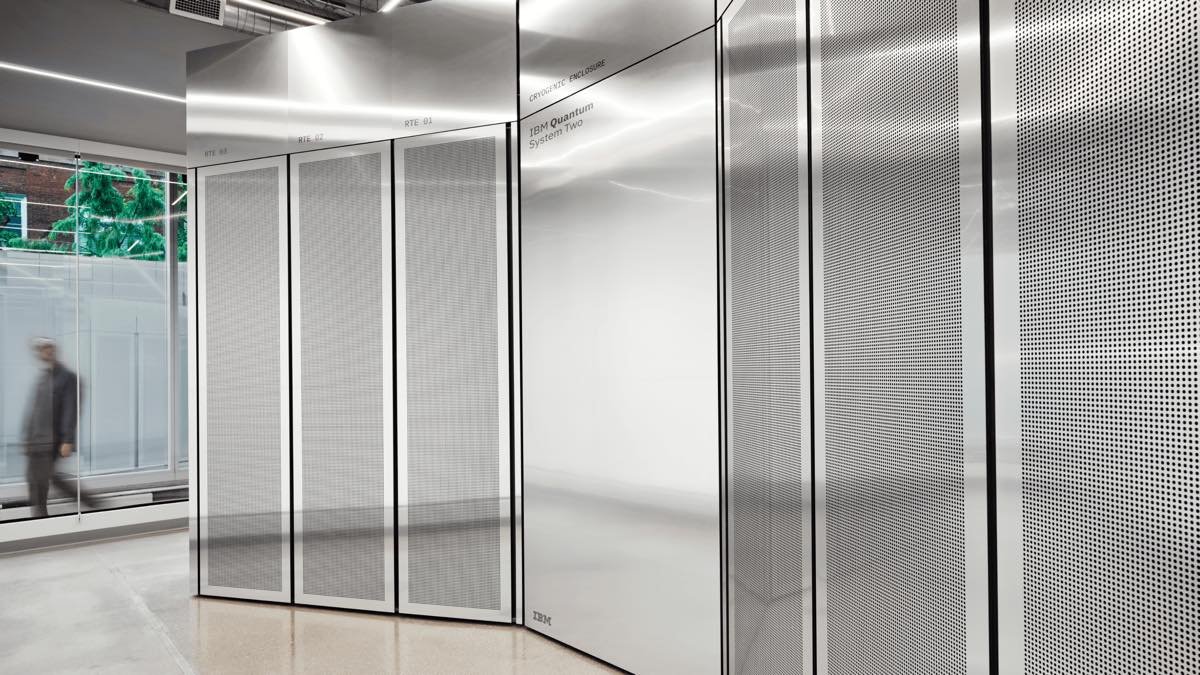
IBM has commissioned its first quantum computer in Illinois. Installed in the Hyde Park laboratories of the University of Chicago, Quantum System Two is now operational and uses the Nighthawk chip, touted by the group as its most powerful quantum processor to date.

The IBM Quantum System Two installed at the Hyde Park Labs at the University of Chicago. Credit: IBM.
A real machine, already installed in Chicago
The announcement is not about a concept or a roadmap. The system exists, was introduced on-site, and can be used by the Illinois research ecosystem. It will first operate at Hyde Park Labs, before moving to the Illinois Quantum and Microelectronics Park when that campus is completed.
This distinction is important in an industry where announcements often mix lab prototypes, isolated processors, and remotely accessible services. Quantum System Two is a complete architecture: it brings together the cryostat, the control electronics and the components necessary for the operation of the processor. Nighthawk is the computing heart, but the deployment affects the entire machine and its integration into a research center.
The system will serve as the core team at the National Center for Quantum Algorithms, created in 2024. IBM is working there with universities, public laboratories and companies to develop quantum algorithms. Among the avenues cited are molecular simulation for pharmaceutical research, optimization of electrical networks and high energy physics.
What Nighthawk changes
Nighthawk is not presented as a general-purpose computer capable of replacing supercomputers. It is a chip designed to run more complex quantum circuits with better connectivity between its qubits. IBM thus seeks to increase the number of useful operations before noise and errors render the result useless.
The interest of the Chicago site will be to compare quantum methods with classical approaches on defined problems, with verifiable protocols. The proximity of university teams and laboratories like Fermilab should make these comparisons easier.

The Nighthawk quantum processor, unveiled by IBM in 2025. Credit: IBM.
This deployment constitutes a substantial evolution compared to the simple presentation of new chips. We had already mentioned IBM’s ambitions around its next-generation quantum processors. New for Chicago is its move to an operational facility, along with a local research program and a future move to a specialized campus.
still limits
Such a quantum computer is still subject to strong limitations. Qubits must be kept at very low temperatures, operations are sensitive to noise, and errors accumulate quickly. Comprehensive error correction, which would allow many logical qubits to operate reliably during long calculations, remains a development goal rather than a mundane feature of the installed machine.
IBM does not provide in this press release the number of qubits in the Chicago configuration, their average error rate, or a public access schedule for each partner. The group also does not publish an independent proof showing that System Two consistently outperforms the best classical calculations. Therefore, the exact status is that of an operations research system, not that of a universal quantum computer ready to address any industrial problem.
A future transfer to the Illinois Quantum and Microelectronics Park is expected to make the machine the anchor of the National Center for Quantum Algorithms. Until then, it will be used at Hyde Park Labs, where teams can begin developing and testing circuits on hardware physically installed in the state. It is this local and immediate availability, rather than the promise of distant applications, that gives scope for deployment.


