

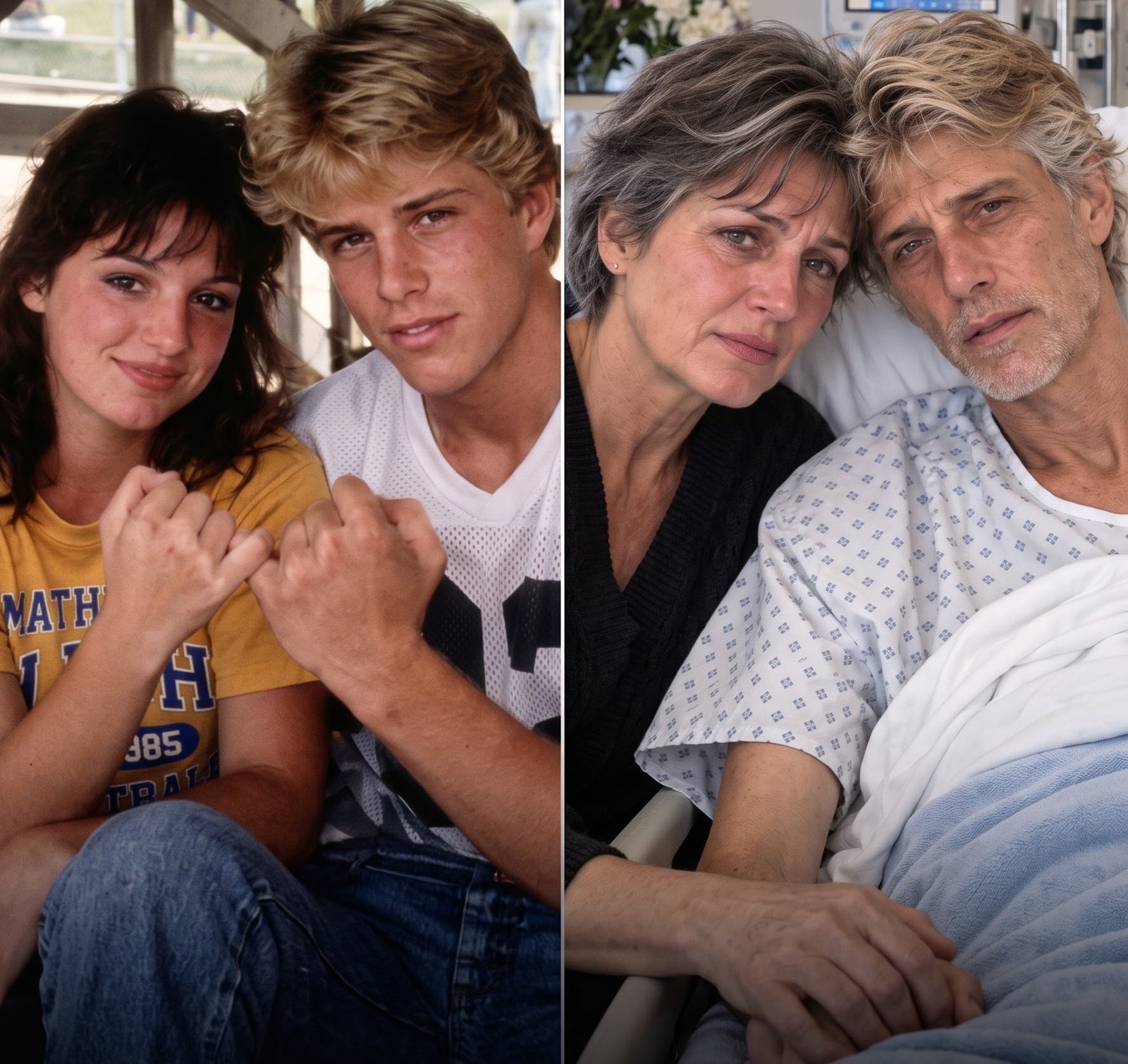
For most of my life, I told myself that some people are meant to stay in your past, no matter how badly you once wanted them in your future. Then a voice I hadn’t heard in forty years said my name, and everything I’d told myself fell apart.
Part One: The Door at the End of the Hall
His room was the last one on the corridor.
I stood outside it with my palm flat against the door, unable to push. The hallway smelled of antiseptic and burnt coffee, and somewhere behind me a monitor beeped in a slow, patient rhythm. I kept thinking the same thing over and over, as if repeating it might make it make sense.
Forty years.
Forty years since I’d last read his handwriting. Forty years since he’d asked me, gently and firmly, to never reach out to him again. And I hadn’t. Not once.
“He keeps asking if you’ve come yet,” said the man beside me.
I turned. Peter was tall and a little stooped with exhaustion, and when he looked at me, my breath caught. He had his father’s eyes, that same warm, searching brown that used to look at me across a kitchen table while I pretended not to notice.
“Is he awake?” I asked.
“He’s been fighting to stay awake. For you.”
For one cowardly second, I nearly turned around and walked back to my car.
I was sixty years old. I had spent the better part of my life teaching myself how to live without Jeffrey. I had built a whole quiet existence around the hole he left. And less than an hour ago, the phone in my childhood kitchen had rung, and now all of it was about to be undone.
I pushed the door open.
He was lying in the bed by the window, smaller than I remembered, as though the years had been slowly taking pieces of him away. His hair had gone completely white. His cheeks were hollow, his hands thin against the blanket.
But it was him. Underneath everything time had done, it was still him.
His eyes found mine, and something in them lit up.
“Ruthie.”
No one had called me that in four decades. My throat closed so tightly I couldn’t answer.
Then my gaze drifted to the chair beside his bed, and I saw what was sitting on it.
I gasped. For a moment, I forgot how to breathe.
Part Two: Just Jeffrey and Ruth
We met when we were seventeen, and from the very beginning, we were friends. Only friends. Not sweethearts, not an item, not a couple in waiting. Just Jeffrey and Ruth, said in one breath, the way people say salt and pepper.
He dated other girls. I went out with other boys. On prom night, my date’s car died at the end of my street, and it was Jeffrey who showed up in his father’s old sedan, still in his own rented tux, to drive me to the dance. He walked me to the door of the gym, bowed like an idiot, and went off to find his own date.
Everyone thought we were fooling ourselves.
“You two are going to figure it out one day,” my mother, Erica, liked to say. She’d stand at the stove while we fought over algebra at the kitchen table, and she’d smile to herself like she knew the ending of a book we hadn’t finished reading yet.
Jeffrey would grin at her. “Figure out what, Mrs. Hale?”
“Oh, you know exactly what.”
And then he’d glance at me, and I’d roll my eyes hard enough to hurt.
“We’re friends, Mom.”
That was the truth. Or at least, it was the only truth either of us was brave enough to say out loud.
Because the thought of losing him frightened me far more than the idea of loving him ever thrilled me. He was the one steady thing in my world. If we tried and failed, I would lose everything. I think he felt the same. So we kept it simple. We kept it safe.
We kept it that way until one summer night when we were nineteen.
Part Three: The Promise Under the Bleachers
We’d both suffered through terrible dates that evening. Mine had spent two full hours talking about his car, his plans, and his opinions, without asking me a single question. Jeffrey’s had stormed off halfway through dinner after an argument about a movie neither of them had liked.
Afterward, without planning it, we both ended up at our old high school football field. The gate was unlocked, as it always was in summer, so we ducked under the bleachers and sat in the cool, damp grass, the way we used to when we skipped pep rallies.
Jeffrey leaned back against one of the metal beams and stared up through the gaps in the seats at the stars.
“We’re terrible at this,” he said.
“At dating?”
“At choosing people.”
I laughed, but he didn’t. He was quiet for a long moment, and when he finally spoke again, his voice was softer.
“What if we never get it right, Ruthie?”
“Then we’ll survive.”
“What if we’re both alone forever?”
I turned to look at him. He was already looking at me. Then he held out his pinky finger, just like he had when we were seventeen and swearing to keep each other’s secrets.
“If we’re both single at sixty,” he said, “we stop being idiots and we find each other.”
I stared at his hand. I waited for the grin, the joke, the easy way out.
It never came.
“Jeffrey.”
“I mean it.”
“Why sixty?”
A small smile. “Because if we haven’t worked it out by then, we clearly need supervision.”
I hooked my pinky around his.
“Deal.”
“Deal.”
And then neither of us let go. For one long, suspended second, we just sat there, fingers linked, the whole summer night holding its breath around us.
I remember thinking, Say something. Say it now.
I didn’t.
Two months later, he left for a college three states away.

Part Four: Ink and Distance
At first, we wrote to each other constantly.
Long, rambling letters. Birthday cards with inside jokes scribbled in the margins. He wrote about his roommate, who seemed to believe laundry was a myth. I wrote about my job shelving books at the library between classes. He complained about the cafeteria’s mystery meat. I complained about patrons who returned novels with coffee rings on the covers.
That first year, I knew more about Jeffrey’s life than the people who lived down the hall from him. I’d wait for the mail every afternoon, and when I saw his crooked handwriting on an envelope, my whole day would brighten.
Then, slowly, the letters thinned out.
Every week became every other week. Every other week became once a month. And each gap felt a little wider than the last.
I told myself college was changing him. What I didn’t want to admit was that life was changing me, too. I’d started training to become a teacher. I had new friends, new routines, the occasional date. But whenever anything that mattered happened, good or bad, Jeffrey was still the first person I wanted to tell.
Then, in the fall of his second year, he wrote about a girl named Margaret.
She was studying nursing. She was funny, he said. She argued with him and won. He thought I’d really like her.
I read that letter sitting on my bedroom floor, and something I should have understood years earlier finally landed on me with its full weight.
I was in love with Jeffrey.
I had probably been in love with him since the day he drove me to prom.
I cried until the page went soft in my hands. Not because he’d found someone, but because I had waited so long to understand my own heart that it no longer mattered.
That night, I tried to write back and tell him everything. I filled page after page. I told him I loved him. I told him I thought I always had.
Then I read it over, and I tore it into tiny pieces.
If he was happy, I would not be the one to ruin it. So I folded my feelings away and went on being his friend.
Part Five: The Last Letter
In the summer of 1986, the final letter came.
I knew before I even opened it. Jeffrey’s letters always began with a joke, some silly line to make me smile before anything else.
This one began with my name. Nothing more.
Ruth,
Margaret and I are getting married. The ceremony is in August.
I sat at our kitchen table, the same table where we’d done our homework, and read that line again and again until it stopped looking like words. Then I forced myself to keep going.
He said it would be a small wedding. Margaret’s family was helping them get settled. And then, at the bottom of the page, there was one more thing.
He asked me not to contact him anymore.
Margaret knew how close we had been, he wrote, and he wanted to give his marriage an honest start. Our friendship meant too much to him to let it turn into something that might hurt someone else.
And then:
I hope you have a wonderful life, Ruthie.
I’m sorry.
Jeffrey.
I cried for weeks. I cried in the shower, in the car, in the stacks at the library where no one could see me.
But I did what he asked. I didn’t write. I didn’t call. I didn’t drive the three states to find him.
Over the years, scraps of his life reached me secondhand, through people who still knew his family. He and Margaret had a son. He’d built a good career. Then, eventually, even the scraps stopped coming.
I never married. I dated. I had relationships, and some of them were kind and good. One came very close to becoming something permanent. But whenever anyone asked why I’d never settled down, I gave the same easy answer.
“I just never met the right man.”
It wasn’t true. I had met him. I’d met him when I was seventeen.
Part Six: The Call on My Birthday
Last Tuesday, I turned sixty.
I live in my childhood home now. When my parents passed, I couldn’t bring myself to sell it. I’d spent so many years moving from one rented apartment to the next that coming back to these walls felt like finally setting down a heavy bag.
I ate dinner alone that night. I cut myself a slice of birthday cake and sat with it at the old kitchen table, listening to the clock tick above the sink.
At 9:17 p.m., the landline rang.
Hardly anyone called that number anymore. It was mostly a relic I kept out of sentiment. I nearly let it ring out, but something made me stand up and lift the receiver.
“Hello?”
“Is this Ruth?” A man’s voice. Careful. Unsure.
“Yes.”
“My name is Peter. I’m Jeffrey’s son.”
My knees gave out, and I sat down hard in the chair. For a moment, I couldn’t make a single sound.
“Jeffrey’s son?”
“Yes, ma’am.”
“What’s happened?”
A long pause on the line.
“My father wants to talk to you. He… he doesn’t have much time left.”
My fingers tightened around the phone until they ached.
Before I could say anything, I heard rustling, murmuring, the phone being passed. And then a voice came through, thin and rough and so achingly familiar that it cracked something open inside me.
“Ruthie.”
Tears flooded my eyes before I could stop them.
“Jeffrey?”
He made a small, breathless sound that might have been a laugh. “Happy birthday.”
I pressed my hand to my mouth. “You remembered.”
“I remembered every single one.”
Forty years collapsed in that one sentence. Just like that, I was nineteen again, sitting in the grass with his pinky wrapped around mine.
Then his voice broke.
“Ruthie, there’s something you need to know before I’m gone.”
I closed my eyes. “What is it?”
“I was in love with you. That night we made the promise. I was already in love with you.”
I couldn’t move. I couldn’t even breathe.
“Jeffrey…”
“And I’d already bought the ring.”
My eyes flew open. “What ring?”
“The one I was going to give you before I left for school.”
The kitchen seemed to tilt around me. I stood up without meaning to, the phone cord pulling taut.
“Then why did you marry someone else?”
I heard him start to cry, a quiet, broken sound.
“That’s what I’ve spent forty years wishing I could explain to you.”
His voice dropped lower, weaker.
“I need you to come here. Please come to the hospital. There’s something you have to see. Once you do, you’ll understand why I walked away.”
“Jeffrey, I…”
“Please, Ruth. Hurry.”
I was already reaching for my coat.
“Tell me where you are.”

Part Seven: The Wooden Box
Forty minutes later, I was standing in his room.
He smiled at me, and even through all the years and all the illness, it was the same crooked smile.
“Hey, Ruthie.”
I was crying before I could help it. “Hey, idiot.”
And then I looked at the chair.
On it sat a wooden box, and I knew it instantly. The dark walnut, the brass latch, the little nick on one corner where I’d dropped it as a child.
It had been my father’s. Thomas Hale kept his most important papers in it. After he died, I turned the house upside down looking for that box and never found it. I’d assumed it was lost for good.
“Why do you have my father’s box?” I whispered.
“Open it.”
My hands shook as I lifted the lid.
Inside were letters. Dozens of them, bundled and yellowed, all in my father’s handwriting. Beneath them was a small velvet ring box. I opened it.
A simple diamond ring sat inside, modest and beautiful, exactly the kind of ring a nineteen-year-old boy with a part-time job could afford if he saved for a very long time.
“You bought this?” I asked.
He nodded.
“Then why didn’t you give it to me?”
He lifted a trembling hand and pointed to a single envelope tucked along the side of the box. It had his name on the front.
The handwriting was my father’s.
I unfolded the letter carefully.
Jeffrey,
Ruth is going to be accepted into the teaching program here. She has a real future ahead of her. If you ask her to follow you, she will. I know my daughter. Please don’t make her choose between you and the life she can build for herself. If you truly care for her, give her room to become her own person.
Thomas.
Tears slid down my face and onto the paper. I looked up at him.
“My father sent you this?”
“Right before I left. He knew about the ring because I showed it to him. I went to ask for his blessing.”
I sank into the chair beside the bed, the box heavy in my lap.
“What did he say?” I already knew. I asked anyway.
“That we were too young. That you’d give up anything I asked because you were loyal to a fault. That if I loved you, I’d let you go.”
I stared down at the bundle of letters.
“So you just… started a new life.”
“I held on as long as I could. But after a while, I convinced myself that letting you go was the kindest thing I could do for you.”
“You never once asked me what I wanted.”
“I know.”
His voice was barely a whisper. I felt the anger rise in me, hot and old, but underneath it was something heavier. A tiredness that went all the way down to my bones.
Jeffrey turned his face toward the window.
“When your letters started slowing down, I thought your father had been right. I thought you were moving on without me.”
“My letters slowed down because yours did.”
He nodded slowly. “I know that now. The truth is, I knew it before the wedding.”
I stared at him. “What do you mean?”
“Your father came to see me.”
“He what?”
“He drove all that way to tell me he’d been wrong.”
Part Eight: What Silence Costs
My father fell ill not long after that. The sickness was long and slow, and he died the following year. I never knew any of this.
Jeffrey told me that in those last months, my father had been eaten up with regret. He’d given Jeffrey the wooden box as a kind of apology. Inside were the letters he’d written to my mother before they married, back when my grandfather had forbidden the match and told them they were making the mistake of their lives.
My father had once loved someone that a parent thought was wrong for him. He’d refused to listen, and he’d married her anyway. If he had listened, I would never have existed.
And then, years later, he’d turned around and done the very same thing to me.
“Why didn’t you come back?” I asked. “After he told you?”
“Because by then, I’d already promised my life to Margaret.” He met my eyes. “And I loved her too, Ruth. I need you to know that.”
I waited for it to hurt. Strangely, it didn’t. Not the way I expected.
“What you had with her was real?”
“Yes.”
“Then I’m glad.”
He looked at me with surprise.
“I mean it,” I said. “I would never want her whole life to become a mistake just because two scared teenagers couldn’t say what they felt.”
He reached for my hand across the blanket.
“I wrote that last letter because I knew if we kept talking, I’d come running back to you. I wouldn’t have been able to stop myself.”
“And you thought cutting me off completely was better?”
“No.” A sad, tired smile. “I thought it was the responsible thing to do. I was wrong.”
I laced my fingers through his.
“Did Margaret ever know?”
“Eventually.”
“What did she say?”
His smile softened. “She said we were two of the most ridiculous people she’d ever heard of.”
I laughed, a real laugh that surprised us both. Jeffrey laughed too, until it turned into a cough, and in the doorway, Peter smiled.
“She sounds like a smart woman,” I said.
“She was.”
Margaret had passed away several years before, he told me. After she was gone, he’d picked up the phone to call me more times than he could count. He never finished dialing.
“I didn’t know if I still had the right,” he said.
“You could have tried.”
“I know.”
I shook my head slowly.
“So we lost forty years because everyone kept deciding what was best for someone else.”
“Pretty much.”
“That’s unbelievably stupid, Jeffrey.”
“Also true.”
We sat in silence for a while after that. His thumb moved slowly across my knuckles, and the monitor beeped softly, counting out the time we had.
Then something occurred to me, and I looked up at him.
“Jeffrey.”
“Hmm?”
“I’m sixty.”
His eyes widened, just slightly. Then that smile spread across his face, the same one he’d worn under the bleachers.
“So you are.”
“We had a deal.”
Very slowly, his hand shaking, he lifted his pinky.
“If we’re both single at sixty…”
I hooked mine around it, the way I had forty-one summers ago.
“…we stop being idiots and find each other.”
Tears ran down the lines of his face.
“Still single?” he asked.
“Yes.”
“Me too.”
My eyes drifted back to the ring, glinting in its velvet box.
Part Nine: The Promise Kept
I stayed with him through the night and all of the next day.
We talked more in those hours than I would have believed possible, as if we were trying to fit forty years into one long conversation. He told me about Peter, and about his granddaughter, Anna, who apparently had his stubbornness and Margaret’s laugh. I told him about my students, the classrooms I’d taught in, the children who’d grown up and still sent me cards at Christmas.
We talked about my mother. About Margaret. And yes, about my father.
I was angry with him. I think a part of me always will be. But I also understood something now that I couldn’t have understood at nineteen.
My father had been afraid for me, the same way my grandfather had once been afraid for my mother. He made the wrong choice because he believed he was protecting my future. Jeffrey had done the same thing. And so had I, every time I tore up a letter or swallowed the words I wanted to say.
All of us stayed silent because we believed silence was the kinder choice.
It never was.
Jeffrey was discharged two days later. Peter arranged for him to stay with family and have care brought to him there. No one can say exactly how much time he has left.
I’ve decided not to count.
Yesterday, Peter drove his father to my house. We sat together on the front porch, the same porch where we used to sprawl with our textbooks on summer afternoons, arguing about everything and nothing.
He held my hand the whole time. Then he set the wooden box down on the bench beside me.
“I never actually asked you,” he said, with a crooked smile. “So tell me. Would nineteen-year-old Ruth have said yes?”
I thought about it. About the girl under the bleachers who was too afraid to speak. Then I looked at the man sitting beside me.
“Yes.”
He smiled. “And sixty-year-old Ruth?”
I squeezed his hand. “She’s smarter.”
Jeffrey laughed. “So that’s a no?”
“It means she knows we don’t need another forty years to prove something we’ve always known.”
He opened the little velvet box, took out the ring, and slid it onto my finger.
It fit perfectly.
I looked at him, and he leaned his head gently against mine, and for a long time neither of us said anything at all. For once, the silence between us wasn’t full of things we were too afraid to say. It was simply full.
For most of my life, I believed our story had ended in 1986.
It hadn’t. We had only stopped writing it.
Now he calls me every morning, and I call him every night. Peter stops by often. Anna has started calling me Aunt Ruth, even though I’ve told her more than once that she doesn’t have to. I secretly hope she never stops.
Jeffrey and I will never get back the years we lost. I’ve made my peace with that. But I refuse to waste the time we have left mourning the time we can’t change.
For so long, I believed that meeting the right person at the wrong time meant you’d missed your chance forever.
Now I know better. Timing isn’t always the whole story. Sometimes life hands you a second door, even at sixty, even on a quiet birthday with a slice of cake and an old phone that almost no one calls anymore.
You just have to be brave enough, this time, to open it.
Note: This story is a work of fiction inspired by real events. Names, characters, and details have been altered. Any resemblance is coincidental. The author and publisher disclaim accuracy, liability, and responsibility for interpretations or reliance. All images are for illustration purposes only.


