

Part 1: Twenty Dollars in the Dust
“Buy them some formula,” Tiffany said, leaning across me to hold a twenty-dollar bill out of the truck window. “They look like they need it.”
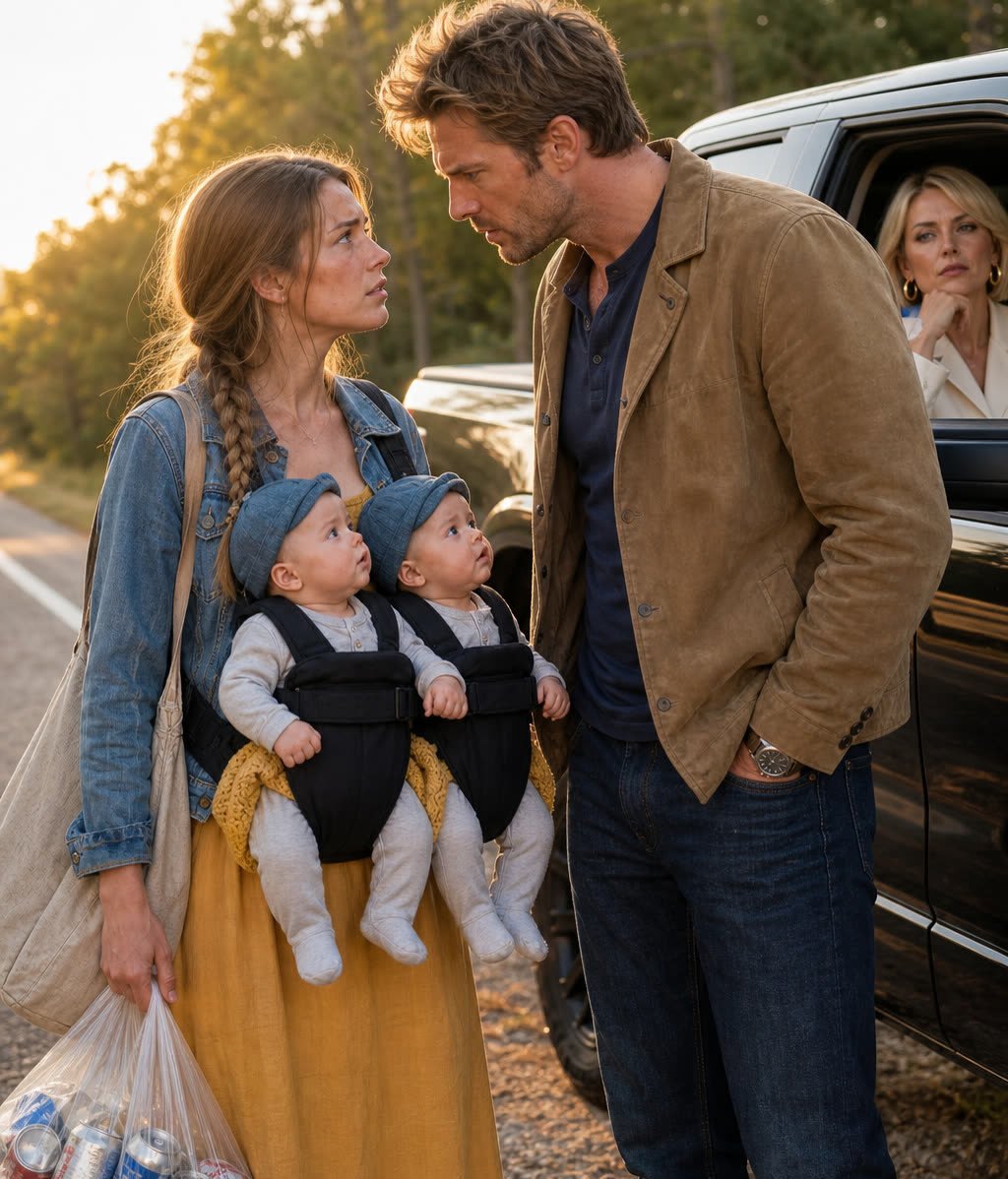
She let go. The bill flipped once in the hot air and landed in the gravel at the feet of a woman walking the shoulder of Highway 70, two babies strapped to her chest and a clear garbage bag of crushed aluminum cans dragging from one fist.
I laughed. God help me, I laughed, because it was 4:40 on a Thursday afternoon in late September, I was behind the wheel of a ninety-thousand-dollar pickup, and the woman out there in cracked sandals was my ex-wife.
Megan didn’t look at the money. She stopped walking, reached up, and tugged a small blue cap straight on the head of the baby on her left. Then she turned and looked at me.
It wasn’t hatred. I could have handled hatred. It was pity, calm and worn-out and absolutely certain, and it hit harder than anything she could have screamed.
“You really still don’t know, do you, Garrett?” she said.
“Know what?”
“Ask in your own house.”
She shifted the bag of cans to her other hand and kept walking. Tiffany let out a short, bright laugh and told me to drive, that we were going to be late for the cake tasting. I put the truck in gear.
But my eyes stayed on the rearview mirror. The babies’ heads bobbed over Megan’s collarbone, and from under the little caps stuck out curls the exact color of corn silk.
I knew that color. My mother kept a photograph of me at two years old in the hallway of her house in Belle Meade, and I had hated that photograph my whole life because the hair in it was so ridiculously pale.
My name is Garrett Sullivan. I own Sullivan Freight out of Nashville, forty-one trucks and a warehouse on the east side. For about ten years I also ran a side business I called “collections,” the kind of thing nobody puts in a brochure and nobody asks about at a dinner party.
I was used to doors opening when I said so. I was used to people lowering their eyes. And a woman with sunburned shoulders and a bag of cans had just made me feel like the last person in Tennessee to learn something about my own life.
Thirteen months earlier, Megan had been asleep beside me every night. We had been married four years. She was an auditor, the kind of person who read the fine print on a parking ticket, and I used to tease her that she could find a missing nickel in a bank vault.
Then one Tuesday an envelope arrived at my office. Inside were photographs of Megan walking into a hotel in Gatlinburg beside a man I didn’t recognize. A week later came screenshots of bank transfers and messages in which she wrote that she would leave as soon as she had gathered enough money.
The last piece arrived on a Friday night. My grandmother Josephine’s sapphire necklace, a piece that had sat in her safe since before I was born, turned up zipped inside the lining of Megan’s suitcase.
“Check the dates, Garrett,” Megan begged. Her hands were shaking so hard she couldn’t hold the necklace. “Ask for the original records. Somebody put that there.”
I told her I was done listening to lies. Before midnight, I had two men from our security staff walk her to the front door.
She stopped on the threshold and laid her palm flat against her stomach, as if she were about to tell me something. I turned my back before she could.
My attorney handled the divorce. Tiffany Ward, a friend of the family since we were teenagers, stayed beside me through all of it, bringing coffee to my office and answering my phone when I couldn’t stand to. It was Tiffany who recommended the investigator, Russell Cole, and Tiffany who kept saying Megan had fooled all of us.
A few months later, Tiffany and I were a couple. I called it a second chance. Looking back, I think I called it that so I wouldn’t have to call it a rebound.
Now, in the truck, the sun slid behind a billboard for a personal injury lawyer and I couldn’t stop thinking about how Megan had held one hand over her stomach that night. I couldn’t stop thinking about the curls, either.
“Don’t be dramatic,” Tiffany said when she caught me glancing at the mirror again. “Babies look alike. Every baby looks like every other baby.”
She said it quickly. Too quickly, and without once turning her head to look back at the road behind us.
I pulled into a gas station outside Dickson and killed the engine. I counted on my fingers like a man doing homework: thirteen months since the night I threw Megan out. Those babies looked about eight months old.
Somebody had to do the arithmetic, and I was the only one in the truck who wanted to.
That was when I remembered the thing I had glimpsed just before she walked away. A yellow knitted blanket had been tucked around the babies, its corner folded over her forearm. In one corner, stitched in white thread, were two small letters.
J.S. My grandmother had monogrammed everything she ever knit. Josephine Sullivan had been in the ground for four months.
Part 2: The File Russell Never Showed Me
I told Tiffany I had a problem at the warehouse, which was a lie, and I dropped her at her condo downtown, which was the first thing I’d done all day that felt like honesty.
She kissed my cheek and held on one second too long. “Whatever you’re thinking,” she said, “stop. You’ll only hurt yourself.”
I called Russell Cole from the parking garage.
“I want Megan’s file,” I said. “All of it. Including whatever you didn’t show me.”
“That case closed a year ago, Garrett.”
“For me it just opened.”
We met at dusk in his office on Charlotte Avenue, a second-floor suite above a dry cleaner that smelled like hot steam and old carpet. Russell was a heavy man in his fifties who wore the same gray cardigan every time I’d seen him, and he looked at me like a man watching a storm roll in over an open field.
“I don’t want printouts,” I said. “I want originals. Every page, every file, every invoice.”
He hesitated. Then he unlocked a gray filing cabinet and began setting folders on the desk, one after another, like a man laying down cards he’d hoped never to play.
The first was the hotel invoice, the one that supposedly proved Megan had checked into a room in Gatlinburg. I had read it a dozen times in my lawyer’s office. This time I read the small print at the bottom, and the folio number belonged to a different date than the one printed at the top.
I took out my own phone and called the hotel’s main line. A tired night clerk listened to me, then said the request would have to go through their formal review channels and that someone would contact me in writing. I thanked her and set the phone on the desk very gently.
The second folder held the photographs. Russell had stapled a technical report to the back, and I read the highlighted lines under the desk lamp.
The background and the figure of Megan carried different resolution signatures. The edges of her coat didn’t match the light on the hotel steps. The analyst had written, in plain language, that the image was likely a composite.
“You told me this was authentic,” I said.
“I did.”
“Why did you leave this part out?”
Russell took a long time to answer. A truck downshifted on the street below, and the glass in the window hummed.
“I was asked for a conclusive report,” he said.
“By whom?”
“By Tiffany. And Walter.”
The name landed on the desk between us. Walter Briggs, sixty-two years old, had managed my family’s security and properties for twenty-six years. He had the keys to every room I had ever slept in. He had been in the house the night the necklace turned up, standing by the stairs with his hands folded and his face arranged into concern.
I picked up Russell’s invoice ledger. Two payments stood out in blue ink, both from a consulting firm with a bland name and a post office box. The first had landed three days before the photographs arrived at my office. The second had arrived the week before the necklace was found.
I checked the firm’s registration number against the paper trail on Tiffany’s name, and my mouth went dry. For the first time I understood that I had never been the victim of an infidelity. I had been the accomplice to an injustice, and I had signed the paperwork myself.
“What else?” I said.
Russell didn’t answer. He reached into the bottom drawer, took out a thick manila envelope, and slid it across the desk like it was warm. The label said Personal Follow-Up.
Inside was a note, typed, passed along by one of his employees, about a premature birth at a Nashville hospital. Three newborns. Two boys, named Mason and Bryce, small but stable.
And a girl. The note said the girl had been born with a serious heart condition and needed surgery. A second page described an urgent transfer to a children’s hospital in Memphis. On a third page, the address had been blacked out with a marker so thick it had torn the paper.
I read it twice. Then I read it a third time with the words swimming.
“You investigated a birth,” I said slowly. “You wrote a report about my children and never told me.”
Russell’s face had gone the color of old putty.
“Walter wanted to know whether Megan had survived the pregnancy without coming to you for help,” he said. “That’s all I was told. I swear that’s all.”
“And the girl?”
His eyes dropped to the desk.
“Her name is Hazel,” he said. “And somebody gave very clear instructions that you were never to know where she was.”
“Who?”
“I don’t have the original order.” He swallowed. “But two people signed the checks on this case, Garrett. And one of them is picking out your wedding invitations right now.”
Part 3: A Bench, a Photograph, and a Signature
I didn’t hit Russell. I want that on the record, because a few years earlier I might have done worse than hit him, and I knew exactly who I could have called to help.
Instead I made copies of everything he agreed to hand over, told him he would be answering to a lawyer by Monday, and drove home with the radio off.
Tiffany was at the dining room table in my house, a fan of cream-colored cards spread across the wood, a pen tapping against her lip. She looked up with a smile that had been polished like a coin.
“Fonts,” she said. “I can’t decide between the script and the serif.”
“How well do you know Walter?”
Her pen stopped for barely a second.
“As well as you do. Why?”
“Because you both paid Russell.”
The smile didn’t fall. It simply disappeared, the way a light goes out when you pull a plug.
“Garrett, you’re jumping to dangerous conclusions.”
“That’s exactly what Megan told me,” I said. “And I didn’t listen.”
I picked up my keys and left before she could build another explanation out of thin air. I slept that night on the couch in my office, listening to the freight trucks idle in the lot below and thinking about one thing I had finally learned about myself.
When I got angry, I stopped listening. This time I had to listen to every answer, even the ones that would shame me, and especially those.
The next morning I tried to find Megan. I called two shelters, a church pantry, and a hospital social worker my lawyer knew. Nobody would give me an address, not even when I said my name, not even when I told them I was the father.
At first it made me furious. Then I understood that those people were protecting a woman from a man who, by reputation and by bank balance, had every resource to scare her. I put the phone down. I didn’t push.
Late that afternoon, a woman named Tammy Reyes returned a message I’d left at a community center on the south side. She had a soft, flat voice, the voice of someone who had said no to powerful men before.
“I know Megan,” she said. “Before I tell you anything, tell me why she should talk to you.”
“Because I found out the evidence against her was fake,” I said. “And because I’m not going to show up unless she says yes.”
There was a long silence on the line.
“I’ll ask her,” Tammy said. “Don’t call me again. I’ll call you.”
She called two days later. A time, a place: a quiet park off Woodmont, Saturday at ten, near the playground with the faded blue slide.
I arrived early and sat on a bench for forty minutes with my hands between my knees. I had rehearsed apologies. I had written questions on the back of a receipt. I had prepared explanations that made me sound like a reasonable man.
Megan came across the grass pushing a borrowed stroller with a squeaky wheel. The two boys sat shoulder to shoulder inside it. The smaller one was concentrating on pulling a sock off his brother’s foot, and the other was scowling about it.
Every sentence I had prepared left my head at once.
“Mason’s the one with the sock,” she said. She didn’t sit down. “Bryce is the one getting mad.”
“Are they mine?”
Her hand tightened on the stroller handle.
“I was never with another man, Garrett. If you need legal certainty, take whatever test the court recognizes. I’m not going to beg you to believe me again.”
“I’m not asking for a test,” I said. “I’m asking because I want to hear you say it.”
She studied me for a long moment, and then, slowly, she sat at the far end of the bench.
She told me she had been ten weeks pregnant the night I sent her out. She had meant to tell me that very evening, over the dinner she had cooked and I never ate. She didn’t know yet there were three.
A few weeks later, at a prenatal appointment, a technician went quiet and called the doctor in. After that, Megan worked from a borrowed laptop until a complication put her on bed rest, and the babies came early, small and loud.
“I called you when Hazel went into surgery,” she said. “Twice. Your office told me you didn’t want news from me.”
I remembered who managed my schedule and decided which calls reached my desk. I remembered Tiffany saying, with a sympathetic wince, that Megan would probably try everything.
“I never heard either of those calls,” I said.
“I know that now. Back then I thought you had simply chosen not to pick up.”
Hazel, she told me, had been born with a congenital heart defect. Surgery in Memphis had gone well, but she still needed specialized monitoring. For now she lived with Gladys, a retired nurse who volunteered with a family support program near the hospital. Megan was her mother and made every medical decision. She drove between the two cities constantly so the twins wouldn’t feel it.
“I can pay for the treatment,” I said. “The house. All of it.”
“The treatment is already covered.”
“By whom?”
“By your grandmother.”
Before we married, Megan had worked as an auditor. Josephine had asked her to review the books of a family foundation that paid for scholarships and children’s medical care. Megan found repeated invoices for consulting work that nobody could explain.
When she asked for the contracts, Walter stopped answering her emails. Three weeks later, the photographs of the Gatlinburg hotel appeared. I had known about that review. It had never occurred to me to connect the two events.
I sat on that bench like a man who had been hit and hadn’t fallen over yet. My grandmother had died four months earlier. In her last weeks, she had asked me three times to come to her house so we could talk about Megan. I had put her off every time, because Tiffany said it was better not to stir up the past.
“She came looking for me when I was pregnant,” Megan said. “She didn’t believe the necklace story. She helped me get care, and she set up a trust for Hazel.”
“Why didn’t she tell me?”
“She tried. You never went.”
The shame was a physical thing. It pressed on my chest in a way no deal or debt ever had.
Megan slipped a photograph from the pocket of her denim jacket. A little girl with pale curls and a thin scar along the top of her chest sat in front of a stone fireplace, a wooden spoon clutched in one fist, grinning at someone outside the frame.
“That’s Hazel,” Megan said quietly. “She’s alive. And she’s getting stronger every month.”
I reached for it. She kept it between her fingers.
“You don’t show up with bodyguards,” she said. “You don’t decide where she lives. First, you prove you can respect a boundary.”
Tammy had warned me not to answer for people. For the first time all morning, I did not. I let Megan’s words stand in the air and I nodded, and I did not offer a single justification.
She held the photograph a second longer, as if deciding something. Then she set it in my palm and let me look until I had to look away.
Before she left, she handed me a folded copy of a letter my grandmother had written and given to her estate attorney. It explained that Megan had detected irregular payments in the family foundation and that Walter had controlled all information about them.
At the very end, in Josephine’s slanted blue ink, was a precise instruction: find out who funded the investigation that destroyed my grandson’s marriage.
Beneath it was a wire transfer reference. And beneath that, a signature I had known since I was old enough to read.
Diane Sullivan. My mother.
Part 4: What My Mother Paid For
My mother walked into Josephine’s old house in Franklin on a gray Sunday, not knowing Megan would be there. She had her purse over one arm and her pearls on, the armor she wore to every difficult conversation of my life.
Then she saw the copy of the wire transfer on the dining table, and she set the purse on a chair and sat down as if her knees had folded.
“I authorized that money,” she said. Her voice came out smaller than I had ever heard it. “But Walter swore it was to stop a scandal.”
“What scandal?” I asked.
Diane looked at Megan, then at the floor.
“Lorraine’s.”
I had never heard that name in my life.
My mother explained it slowly, her hands twisting a tissue into a thread. Before my father married her, he had fathered a daughter. My grandmother had quietly supported that daughter through a private fund for decades, and my mother had known, in the way people know things they never say aloud.
Walter administered that fund. He had told Diane that Megan was about to expose the family’s private documents to outsiders, that a scandal was coming, and that the only way to protect the family was to make Megan look unreliable.
“She was auditing the foundation’s invoices,” I said. “Not our marriage. Not our secrets.”
“I know that now.”
“When we accused her of stealing, you sat at the table and said nothing.”
Diane lowered her head. She admitted that she had paid for what she believed was a discreet investigation, and that when she saw how it ended, she chose to pretend she didn’t understand what had happened.
She had not ordered anything fabricated. But she had funded the man who fabricated it, and she had let her son throw a pregnant woman out of his house.
Megan listened without interrupting once. A clock ticked in the hall.
“I lost my home,” she said at last. “I lost my job. I lost my peace of mind for a year.” Her voice never rose. “You lost the chance to stop it.”
My mother cried, quietly and without any performance. Megan didn’t reach across the table to hold her hand. I understood, watching, that saying sorry did not entitle anyone to comfort.
The next day I hired an attorney named Priscilla Dunn, a sharp, unhurried woman with no ties to my companies or my family. I asked her to run an independent audit of the foundation and of every document in Megan’s divorce file.
Megan agreed to hand over the papers she had kept, but she set a condition, and she set it before I could open my mouth.
“My cooperation is not reconciliation,” she said. “If you read it that way, I walk.”
“I understand.”
“Say it back to me.”
“Your cooperation is not reconciliation.”
The audit took three weeks. During the period in question, the foundation had logged one-point-one million dollars in programs and services, and most of it was exactly what it claimed to be: scholarships, hospital bills, school supplies for kids whose names I’d never known.
But two hundred forty thousand dollars had gone to consulting firms with no demonstrable work, and every one of those firms traced back to Walter.
He had taken advantage of the fact that he also managed Josephine’s private fund, deliberately blurring the two so that anyone who asked a question would have to untangle both before getting an answer. Megan had asked the question. That was her whole crime.
The hotel replied in writing: the invoice from my divorce file did not match any stay by Megan, and the folio number belonged to a guest from another state. A forensic analysis confirmed the photograph was a composite.
The bank transfers Megan had supposedly received did not match the statements we obtained through authorized channels. Three pieces of evidence I had treated as unquestionable were nothing but carefully arranged garbage.
I called Tiffany and asked her to meet me at a quiet café on Eighth Avenue. I brought no folder to wave at her and no threats to deliver. I simply laid Priscilla’s summary and the invoices from her consulting firm on the table, side by side.
She read the first page. She didn’t read the second.
“Did you know Megan was pregnant?” I asked.
“Yes.”
The word was so quiet I almost missed it. A barista dropped a spoon somewhere behind us.
“Did you keep her calls from reaching me?”
Tiffany turned her head toward the window, where rain had started to trace lines down the glass.
“I asked that they not be put through,” she said. “Walter told me she would try to win you back with a made-up pregnancy.”
“And you believed him.”
“I wanted to.”
“And you still wanted to marry me.”
“Yes.”
She admitted that she had paid for the photographs and the fake messages. She claimed she knew nothing about the necklace and nothing about a third child. I couldn’t prove how much she knew about Hazel, but I could prove she had deliberately kept me from hearing Megan’s side.
“Why did you obey Walter so completely?” I asked. “You’re a grown woman. You don’t take orders from my family’s head of security.”
Tiffany opened her mouth, closed it, and looked at her hands. The rain thickened against the window.
“Because,” she said finally, “he’s my father.”
Part 5: The Road Back
I would like to say I stayed calm. I didn’t. I sat with my jaw locked until the espresso machine hissed and the sound brought me back.
Tiffany explained it without being asked. Her mother had married another man years earlier, a good one who raised her and gave her his name. Walter kept working for the Sullivans and kept his bond with her out of sight, a thread nobody noticed.
To my family she had always been the daughter of a family friend. Walter knew how she felt about me, and he used it to keep control of the documents.
“It wasn’t only him,” Tiffany said, and her voice cracked on the last word. “I chose to make you distrust her. Nobody forced that choice.”
I took the engagement ring out of my jacket pocket, where it had been riding for two days like a stone, and set it on the table in front of her.
“There won’t be a wedding.”
“I figured.”
“And I’m not going to send anyone after you,” I said. “Whatever comes next, the authorities will handle it. That’s how it should have been from the start.”
For the first time since I had known her, Tiffany looked afraid of something other than losing me.
Walter received a formal letter through his attorney requesting clarification and preservation of documents. He arrived at Priscilla’s office in a charcoal windbreaker, a lawyer on his left, his pale eyes moving across the room like someone counting exits.
I had not had him brought in. I had not called a single man from my old life. I sat at the end of the table and let Priscilla do the talking.
He denied the diverted funds first. Then he claimed the contracts were legitimate expenses. Priscilla laid out the shell companies, one after another, and the names on the registrations began to repeat.
There was no dramatic confession. There were silences, contradictions, and finally a promise to hand over the remaining accounting files.
Before we finished, I asked him about the necklace.
“You had access to Josephine’s safe,” I said. “Russell says you gave it to him to photograph.”
Walter didn’t answer.
“That necklace turned up in the suitcase of a pregnant woman,” I said. “What exactly did you expect me to do?”
“Believe your family,” he said, finally.
“And Hazel? Why hide her?”
“If you found her, you would talk to Megan.” His mouth flattened. “And then you would review the accounts.”
I looked at him without blinking.
“She was my family,” I said.
The sentence didn’t change the past. But it was the first time I had been able to say it out loud, and it sounded strange and true in that quiet room.
We filed the evidence and the complaints with the district attorney’s office. The fates of Walter, Russell, and Tiffany were left to investigators, forensic analysts, and judges. Nobody was touched by any order of mine.
Walter stopped managing the family’s assets, his signing authority was frozen, and proceedings began to recover the money. My mother agreed to testify about the payment she had authorized.
I also sat down with my attorney and told her about my own decisions, including the side business I had called collections. I couldn’t demand honesty from everyone else while keeping a second life of my own. I shut it down, and I accepted whatever answering for it would cost me.
Still, fixing documents turned out to be the easy part. Learning to care for my children was harder.
The first time Megan let me hold Mason, I held him like a crate of glass, and he screamed until his face went dark pink. Bryce watched from the stroller with a look so skeptical I almost laughed.
Megan taught me to mix a bottle, to change a diaper without turning it into a wrestling match, to tell the difference between a cry that meant hunger and a cry that meant tired. She never thanked me for any of it. They were obligations I should have taken on from the beginning, and we both knew it.
We completed a paternity test through a legally recognized process, and then I formally acknowledged all three children. With guidance from family court, we set child support, a gradual visitation schedule, and agreements on medical expenses.
I offered to buy Megan a house. She said no without hesitating.
“I’d rather have a place in my own name,” she said, “and an agreement I can enforce without asking you for favors.”
I didn’t argue. I deposited what we had agreed on and showed up at the scheduled time. When she said a visit was over, it was over.
Two months later, Megan drove with me to Memphis. Gladys met us at the door with the caution of a woman who had spent entire nights beside a little girl’s heart monitor. She was small and silver-haired and she didn’t smile until she was sure of me.
Hazel sat on a blanket in the living room, surrounded by stuffed animals, her pale curls sticking out in all directions. A thin scar ran along her chest, half hidden by the collar of her pajamas.
“Don’t pick her up yet,” Gladys said. “Let her get used to you.”
I knelt on the carpet.
“Hi, Hazel,” I said. “I’m Garrett.”
She stared at me for several long seconds. Then she held out a yellow toy duck.
I took it. I didn’t have a single word that would fit in that moment. When she got tired, she reached for Gladys, and I let her go.
Hazel kept her cardiology appointments. The trust Josephine had created before she died guaranteed her treatment and the use of the family house for recovery stretches. My grandmother had written precise instructions so that Hazel would never depend on my moods or my money.
One afternoon I finally read the full letter she had left with her attorney. The last line read: “Listen to Megan before you try to win back what you never should have thrown out.”
The months went by. The twins learned to walk, then to run, then to hide from bath time. Hazel spent longer and longer stretches in Nashville. My mother met Lorraine, my father’s daughter, but neither woman pretended that decades of silence could dissolve over one lunch.
Tiffany left town and continued to answer for her actions. Restitution moved slowly, the way real things do. My legitimate company came under outside oversight, and I let it.
Megan went back to work as an auditor. She no longer carried bags of cans along any highway. One evening, when I finally found the nerve to ask about that day, she smiled faintly.
“I picked up Tiffany’s twenty after you drove off,” she said. “I bought formula. Not because she told me to. Because my kids were hungry.”
I had nothing to say that was worth saying out loud.
When the twins turned two, we celebrated in the garden of Josephine’s old house with Gladys, Tammy, and a few friends. Megan had agreed that she and I could get to know each other again, with no promise of marriage. That night, after the boys were asleep, we sat on the stone steps beneath the old magnolia.
“Do you still think about the highway?” she asked.
“Every day.”
“I don’t anymore.”
I turned to look at her, surprised.
“I don’t want that moment to decide the rest of our lives,” she said. “But I don’t want you to forget it, either.”
She took my hand. It wasn’t a forgiveness that erased anything. It was a decision both of us could revisit, one day at a time.
Some months later, we turned part of the old house into temporary lodging for families of children receiving cardiac care, with books that anyone could audit in public. Gladys helped design the program. Tammy worked with the families who stayed. Megan insisted that no donation could buy gratitude or obedience, and she was right.
One late afternoon I drove back to Highway 70 with her. Mason, Bryce, and Hazel slept in their car seats in the back, warm and safe, while we stood beside the car in the same hot gold light.
I looked at the patch of gravel where Tiffany’s twenty had landed.
“I thought you were the one who had lost everything,” I confessed.
Megan watched our children through the back window.
“I was scared, Garrett,” she said. “Terribly. But I knew exactly who loved me.”
Then I understood why she had looked at me that day with pity. She had been walking with no money, but never without love. I had houses, men who obeyed me, and a woman ready to marry me, and I hadn’t known the truth about any of them, including myself.
We didn’t come back to that road to pretend the pain was over. We came back because, for the first time, I could choose not to drive away.
If you had been in Garrett’s place, what would you have done first once you learned the truth about the evidence?
Disclaimer: This story is a work of fiction inspired by real-life themes. Names, characters, places and events are fictionalized, and any resemblance to real persons is purely coincidental. Images are for illustration purposes only.


