

Nvidia announced on November 12 the immediate resignation of Jensen Huang, co-founder and director of the group for thirty-three years. Chief Financial Officer Colette Kress becomes interim CEO, while the board of directors launches an internal and external search and names Harvey Jones as its first president. Therefore, the issue is not limited to the name of the successor. Nvidia must demonstrate that a company formed by a very present founder can preserve its technical speed, its relationships with large customers and its geopolitical influence without remaining dependent on a single person. Their roadmap gives time to the new tandem; The concentration of its risks makes this transition much less comfortable than it seems.

An organized transition to avoid immediate emptiness
HE Document 8-K filed with the SEC is deliberately brief: the board accepted Jen-Hsun Huang’s resignation on November 11, effective immediately, and entrusted the interim position to Kress, 59. At the same time, she retains her position as financial director. Nvidia has not announced the length of the search or a preferred candidate. We reported on the departure of Jensen Huang; The analysis begins where the statement ends, with the actual distribution of power.
Choosing Kress reduces near-term operational risk. He arrived in 2013 after responsibilities at Microsoft, Cisco and Texas Instruments and understands capacity contracts, customer investments, Wall Street expectations and the supplier network. Nvidia claims that commitments to clients and the roadmap are not interrupted. This promise is credible over a few quarters: a chip architecture, a cooling system, or a wafer order doesn’t change because a manager leaves his or her office.
The appointment of Harvey Jones as the first president of the council is more structuring. In its 2026 annual report, Nvidia further explained that it preferred an independent lead director over a president. The new role creates a clear separation between the interim executive and board oversight, following the opening of an independent investigation related to reports directed at Huang. The council said on Nov. 8 that it had no reason to believe that secrets or national security had been compromised. This reservation remains important: an open investigation and a resignation do not constitute a conclusion on the accusations.
The roadmap may survive; The decision-making system is more fragile.
Nvidia is no longer just a GPU designer. Its advantage combines chips, CUDA software, complete systems, high-speed networks and a developer ecosystem. Part of this construction is institutionalized. Vera Rubin Architecture has already begun production deliveries in the fiscal third quarter of 2027, according to the latest quarterly report available. Blackwell still represents the majority of shipped systems, with subsequent generations being prepared several years in advance. Readers already discovered the Vera Rubin platform at CES.
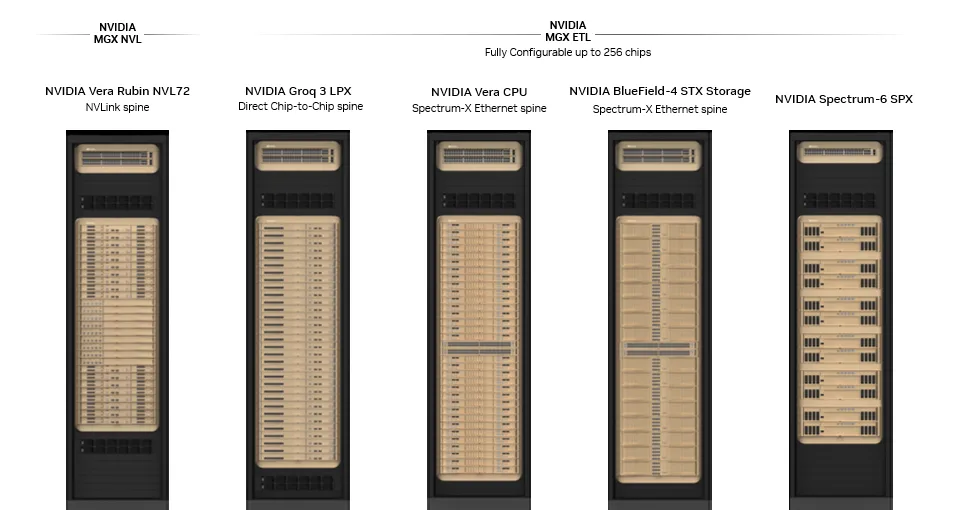
The different compute, storage and networking bays of the Vera Rubin platform, in a technical illustration published by Nvidia in March 2026.
On the other hand, Huang was not satisfied with validating a roadmap. He arbitrated capacity bets, negotiated directly with cloud group executives and defended a public position on restrictions on exports to China. It also turned a product launch into an industry focus for customers: Buying an Nvidia chip often means adopting its network, libraries and upgrade program. The next CEO’s ability to secure multimillion-dollar commitments matters almost as much as his or her understanding of architecture.
This dimension has become more sensitive as Nvidia finances or supports companies that then buy its systems. These relationships can accelerate the ecosystem, but they integrate the manufacturer into their customers’ capital plans. Reuters describes Kress as an internal counterweight after having questioned certain commitments considered too ambitious. This cautious role is useful during a crisis; It still does not answer the question of who will decide the next bets when the available data is incomplete.
Colette Kress can stabilize Nvidia without being the final choice
A CFO is often seen as a guardian of the margins. At Nvidia, the function is broader. The group had increased its manufacturing and capacity commitments from $119 billion to $279 billion between April and July 2026 in order to secure components for the coming years. This figure is not an expense already consumed, but measures the extent of decisions made before the final demand is certain. Therefore, the person who controls the financing and demand scenarios participates directly in the product strategy.

Colette Kress
Kress also has a political advantage: he can reassure without immediately trying to embody the founder. The temporary maintenance of these two functions avoids a new vacancy, but concentrates financial and general management at a time when investors expect greater control. If the interim continues, the board will likely need to strengthen the team around it or appoint a new chief financial officer. A structure planned for a few weeks is not necessarily healthy for several quarters.
Your profile finally contains a dilemma. Limiting circular investments, tightening financing criteria and talking less directly about export controls could reduce the risk. However, excessive caution could give customers time to develop their own accelerators or increase purchases from AMD and specialized suppliers. Google just announced new variants of its TPUs and several large cloud groups are already designing in-house chips. The successor must maintain financial discipline without treating technical audacity as a simple cost line.
The choice between an internal engineer and an external figure is not neutral
The council says it is looking at both options. An internal manager would more easily preserve CUDA’s culture, teams, and continuity. Ian Buck, who participated in the creation of CUDA and leads accelerated computing activities, is mentioned among the possible profiles by several sources, without his candidacy having been officially announced. This type of choice would indicate that Nvidia views the technical domain and software ecosystem as the heart of the position. On the other hand, it might require a stronger tandem for government and financial relations.
External hiring would provide a clearer governance mandate, particularly after the independent investigation opened by the board. But the pool is narrow. Few executives are familiar with semiconductors, big cloud contracts, the TSMC chain, developer software and US export restrictions. Attracting a competitor’s boss would also create deadlines, contractual clauses and a learning period that the annual pace of architectures does not facilitate.
Therefore, the best choice may be less spectacular than a “new Jensen Huang.” Nvidia needs distributed leadership: a CEO capable of allocating capital and negotiating with governments, technical leaders with real authority, and a board independent enough to challenge decisions. Trying to reproduce the founder would once again concentrate the risk that the transition has just revealed.
The real tests will come before the permanent appointment
The first meeting is near: Nvidia is due to release its results for the fiscal third quarter of 2027 on November 17. The numbers will be inherited almost entirely from the Huang period, but the conference will hear who responds based on demand, capacity commitments, China and Rubin’s schedule. Clients’ reaction to these answers will be more informative than a few negotiation sessions. Two direct clients already represented 22% and 14% of the turnover for fiscal year 2026, according to the latest annual report : Losing the trust of a small number of buyers would have a disproportionate effect.
The second test concerns the teams. Frameworks that carry CUDA, networking, systems, and sales have tremendous value in the market. The departure of some key officials would not derail the roadmap, but a series of departures would show that the organization was more dependent than advertised on Huang’s personal authority. By contrast, a stable team would lend weight to the board’s claim that Nvidia already has collective leadership.
Finally, relations with Washington and large suppliers will have to be observed. Huang personified the defense of access to the Chinese market while negotiating limits on advanced accelerators. Kress or his successor will have to maintain a line understandable to the US government, investors and Asian customers, without promising what export licenses might prohibit. Nvidia has technology, software and controls that do not disappear with its founder. The transition will be successful when you demonstrate that these assets can produce coherent decisions without your presence, not simply when the board has found a new name.


