

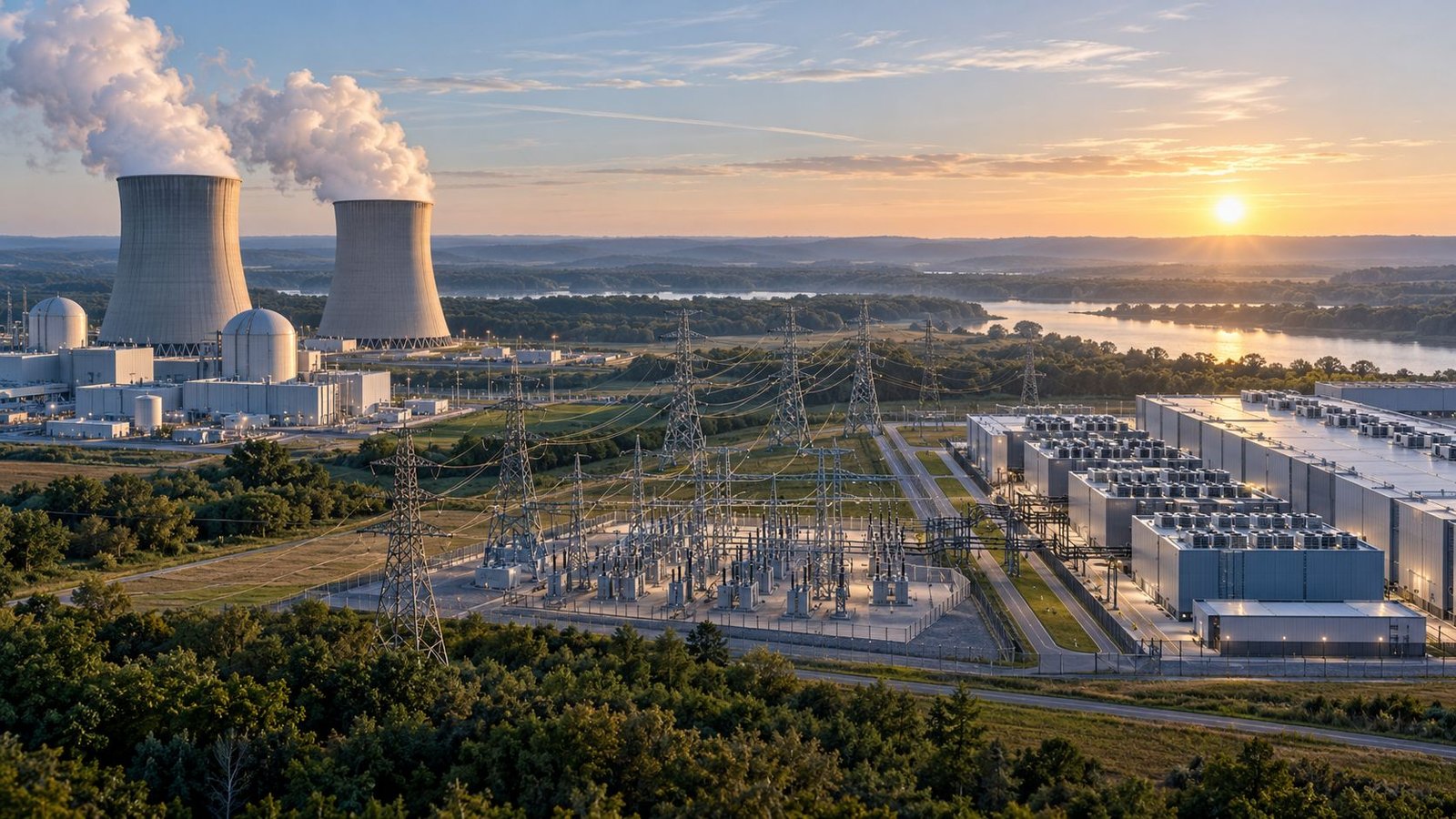
Google and Constellation Energy announced this week an agreement for 3.59 gigawatts on the PJM networkthe largest electricity market in the United States. The figure is impressive, but it covers two different commitments: 890 megawatts of new capacity obtained through the upgrade of eleven existing nuclear reactors, and 2,700 megawatts supplied over fifteen years by the current Constellation fleet, without a precise source having been identified. This distinction is essential. The deal does not mean that Google will power its data centers with 3.59 GW of new nuclear energy. Rather, it shows that the rise of artificial intelligence is forcing digital giants to become players in electricity financing. The question is no longer just whether the energy will be “clean,” but who will pay for the additional capacity, at what pace it will come, and what risks will remain on the grid.

3.59 GW, of which only 890 MW are truly new
HE joint press release from Google and Constellation details a twenty-year electricity purchase contract. Constellation will invest more than $4.3 billion in new equipment and efficiency improvements at eleven nuclear units located in Illinois, Pennsylvania and New Jersey. These operations, called “surges,” should allow existing reactors to produce more without building a full power plant. The first megawatts are expected in 2028.
The 890 MW therefore constitute the additional, carbon-free part of the system. The company compares this volume with that of a new reactor. However, this is not a single power plant dedicated to Google: the additional electricity will be injected into the PJM network, which supplies 67 million people. Google buys production and guarantees long-term income; it does not physically receive electrons reserved for a particular data center.
The second part is different. Constellation will contribute an additional 2,700 MW over fifteen years from its operating assets. As Reuters clarified, this energy It is not linked to a specific technology. Constellation operates primarily on nuclear power, but also has gas plants and other facilities since its merger with Calpine. Above all, the contract provides financial visibility to existing capabilities. Adding the two parts is commercially accurate; presenting them as 3.59 GW of “new nuclear energy” would not be.
We presented the figures for the deal when it was announced. Its analytical interest lies in this architecture: one part finances new production, the other insures the assets already available. It responds to two different emergencies: that of increasing supply and that of preventing controllable power plants from abandoning an already overloaded grid.
PJM wants data centers to “contribute” their power
The geography of the contract explains its scale. PJM covers thirteen states and the District of Columbia, including Virginia, which has become one of the world’s leading data centers. According the proposal published by the network administrator As of August, 30 of the 32 GW of demand growth expected between 2024 and 2030 come from data centers. This localized growth is coming faster than new power plants and high-voltage lines.
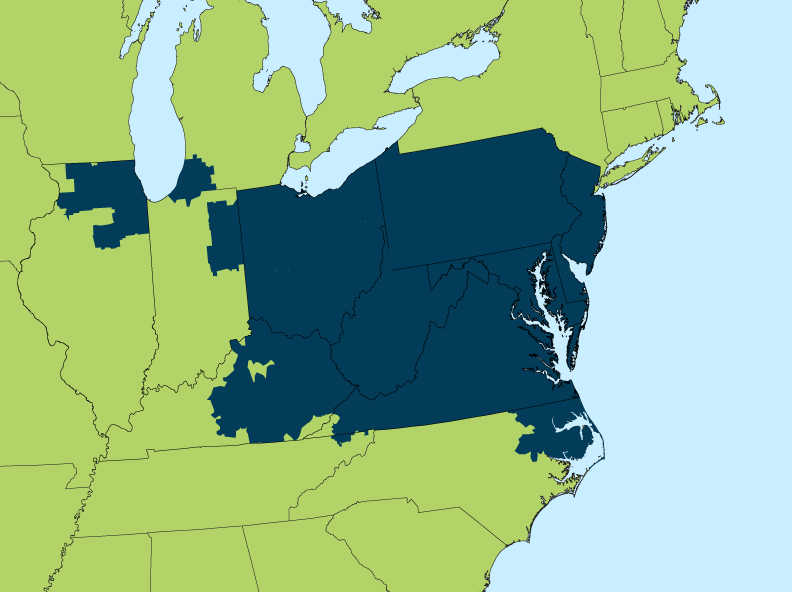
The territory served by PJM Interconnection, which coordinates the transmission of electricity in all or part of thirteen American states and the District of Columbia.
Therefore, PJM proposes a “Bring Your Own Power” logic: new very large loads must build, buy or bring capacity corresponding to their maximum consumption. Those that don’t could be discounted to traditional consumers during a shortage. The mechanism also seeks to prevent households from financing, through their bills, the infrastructure that a few technology companies make necessary.
The Google deal seems like a direct answer. Instead of relying solely on generic market purchases, the company guarantees identifiable investments in the nuclear park. Reactor upgrades have a timing advantage: They are generally faster than a new plant and use already connected sites. They also provide continuous power, useful for servers that must operate day and night.
This model does not eliminate public arbitrations. Authorizations, security, network works and cost distribution remain subject to regulators and states. Above all, a private contract only protects other consumers if the financed capacity is truly additional, is delivered to the right location and is available at peak times. The 890 MW clearly meets the first criterion; The 2,700 MW of existing capacity offers stability, but does not by itself create an equivalent surplus.
IT efficiency no longer offsets AI growth
Google highlights that its data centers are very efficient. Its PUE indicator, which compares a site’s total electricity with that consumed by IT equipment, was 1.09 in 2025. The company also claims having multiplied by more than three the computing power obtained per unit of energy in five years, in particular thanks to its TPU chips. This progress is real: less electricity is lost in cooling and more calculations are made per watt.

However, they are no longer sufficient when the computing volume increases even faster. The International Energy Agency estimates that global data center consumption could double to around 945 TWh in 2030. In its central scenario, it would increase by around 15% annually between 2024 and 2030, while accelerated server consumption, mainly linked to AI, would increase by 30% annually. We had already mentioned the US trajectory, where geographic concentration makes the constraint stronger than global participation suggests.
the clean Google Environmental Report 2026 recognizes this tension between hypergrowth and responsibility. The company states that it has contracted 12 GW of clean energy until 2025, but specifies that the volume actually produced may vary depending on modifications, cancellations and execution of the project. This reservation applies to all large energy commitments: a contract is not yet a functioning power plant.
Nuclear power is of interest to AI operators because it combines low carbon intensity in operation and continuous production. However, it is not a substitute for efficiency, demand flexibility, storage or renewables. A data center that can shift some calculations to peak times can reduce the need for peak capacity. Google and Constellation also mention a future framework that combines production, batteries and erase. The deal will also have to be judged by these tools, not just the number of megawatts acquired.
Existing nuclear power is gaining value, but its limits remain
Financing the increase in power of reactors already in operation avoids several difficulties of new projects: there is a site, equipment, a connection to the network and some authorizations. For Constellation, the twenty-year contract reduces financial risk and justifies work that might have been less profitable in the wholesale market alone. For Google, it fixes part of its costs and associates its growth with measurable carbon-free capacity.
This approach cannot be reproduced infinitely. The number of reactors that can be upgraded remains limited, as does the profit available on each unit. Work must pass security checks and may be delayed. Nuclear electricity is stable, but not invulnerable: a simultaneous shutdown of several units, a drought or a network limitation can reduce the production delivered. Therefore, it is necessary to maintain reserves and diversify sources.
The race of technological groups towards nuclear energy can also modify the economics of the system. Meta has signed several partnerships, Microsoft supports the reactivation of a reactor in Pennsylvania and Google has already closed other nuclear deals. These contracts expand or increase low-carbon capacities, which benefits the grid. But they also give the richest companies privileged access to rare and predictable production. The promise of collective benefit will depend on price transparency, additionality and infrastructure sharing.
The good indicator will be the cost actually avoided for other users.
The Google-Constellation deal marks an advance compared to the growth of data centers that would simply absorb available electricity. A company whose needs are measured in gigawatts can no longer behave like an ordinary customer. You must participate in financing new capacity, guarantee income long enough to start work and agree to be flexible when the network is under strain.
However, it would be premature to make it a complete solution for the AI footprint. Only a quarter of the announced volume corresponds to new identified nuclear power plants. The remaining 2.7 GW guarantee the existing ones and the agreement does not indicate either Google’s total future consumption in PJM or the price paid. Without these elements, it is impossible to know how much of the growth is actually covered and whether indirect costs have been fully internalized.
Three signals will make it possible to decide: the effective delivery of the first improvements in 2028, the validation of the PJM framework by the federal regulator and the publication of more detailed data on emissions and local consumption from Google. If the new capacities arrive on time and if households cannot support the reinforcements that data centers require, this agreement could serve as a model. Otherwise, the 3.59 GW figure would have mostly illustrated the magnitude of the energy problem created by AI.


