

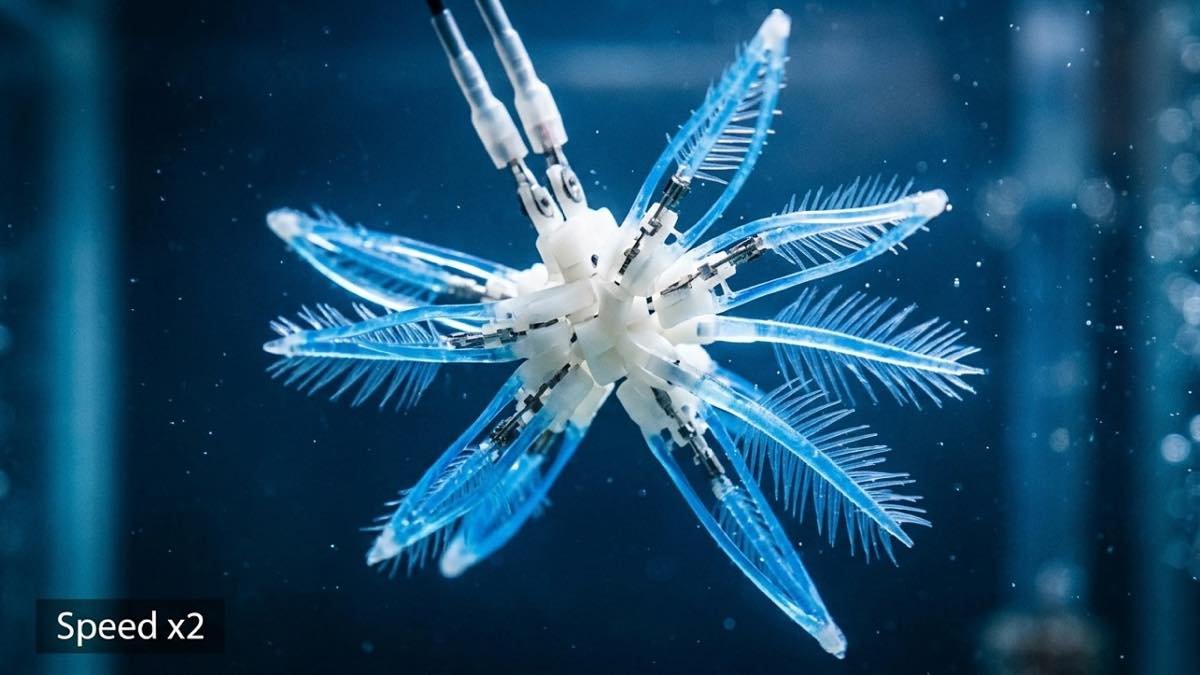
A flexible robot inspired by comatulas, these marine animals with feathery arms, moves up, down, forward, backward and can rotate on itself with just a few clicks. two pneumatic actuators. The prototype designed at North Carolina State University takes advantage of the shape of its four wings to simplify a maneuver that normally requires many more motors and controls.

Four elastic wings do the work of six actuators
The robot looks like a central disk surrounded by four flexible arms. Each arm is monostable: it can deform under the effect of pressure and then suddenly returns to its original position when this pressure disappears. Therefore, the two actuators do not control each wing separately. They trigger collective movements whose mechanics produce various behaviors.
This approach is part of what researchers call mechanical intelligence. Some of the control is built into the structure itself, rather than constantly being calculated by a computer. The team explains that a typical machine would need at least six actuators to achieve the same set of movements in three dimensions.
The peer-reviewed study, published October 7 in Scientific advancesdescribes three modes. When both actuators pulse rapidly, the four wings flap and the robot rises. A slower pace allows you to stay at a given depth, while stopping pulses causes you to go down. The authors call this behavior jellyfish mode.
Three movements combined to explore a volume.
Fishing mode only uses one actuator. A wing then functions as a tail fin and pushes the robot forward or backward. In the third mode, the two controls alternate rapidly: the disc rotates around its axis, allowing propulsion to be directed.
The video released with NC State’s release shows mode changes in a pool, as well as several underwater manipulation demonstrations.
The prototype reaches a maximum speed of 1.64 body length per second and can rotate up to 90 degrees per second. The researchers studied the vortices produced around the wings with particle velocity measurements and numerical simulations. These analyzes show that each sequence generates a different water circulation, responsible for thrust or rotation torque.
The team also attached a camera to the robot to test exploring submerged space. In another experiment, a device lifts an object; several instances can cooperate to move a load. These tests are still simple, but they illustrate the benefit of a platform that combines mobility and a low number of active components.
A promising prototype, still connected to its power source
Reducing the number of actuators can reduce weight, complexity, and the number of failure points. It could be useful for inspection robots capable of gliding through cluttered environments, for scientific observation or for small underwater manipulation tasks. The flexibility of the wings is also interesting when the plane must operate near organisms or fragile structures.
However, it is not a marine drone prepared to dive autonomously. Both inlets are pneumatic and the presented prototype operates under laboratory conditions. The researchers explicitly cite the creation of a fully wireless version as the next step. It will be necessary to integrate a power source, valves, control, communications and possibly sensors without losing the simplicity that makes the concept interesting.
The durability of the wings, their behavior in irregular currents, their resistance to pressure and the overall effectiveness of an autonomous system have not yet been demonstrated at sea. The patent application mentioned by NC State concerns the mechanical principle, but no commercialization schedule is announced.
This strategy expands work with robots that exploit the physics of their bodies rather than multiplying calculations. KultureGeek notably presented a soft robot capable of walking and swimming without a processor or artificial intelligence. Here the control is still external, but the geometry of the four wings converts just two commands into a full range of three-dimensional movements.


