

Part 1: The Note on the Pillow
“Now you look as ridiculous as you really are.”
The line was written in black ink on a Grand Bellmont notecard, propped against the pillow beside my face, in handwriting I’d have known anywhere. Carter wrote his capital letters like he was signing contracts. I read it twice at 6:41 on the morning of my wedding before I understood why my head felt so cold.
I reached up to push my hair out of my eyes. There was nothing to push.
My fingers kept searching anyway, the way your tongue keeps finding the gap where a tooth used to be. The back of my neck was bare, and so was the skin above my ears. On the carpet beside the bed lay a few long brown strands, the only part of the job nobody had bothered to clean up.
I stood up slowly. My legs felt heavy, as if I’d slept through two nights instead of one, and the room tilted once before it settled.
The bathroom of Suite 1408 had the kind of mirror wedding photographers love, framed in brushed gold and lit from both sides. It was very good at showing me exactly what had been done.
The cut was uneven, close in some places and ragged in others, with tender pink patches where the clippers had been pushed too hard. Hair I’d been growing since college, for this exact day, was gone. I braced for the scream.
It didn’t come. What came instead started low in my chest, a short disbelieving sound, and then it kept going until I had to put a hand on the marble counter. I laughed until my eyes watered, because something in me that had been quiet for two years had finally sat up.
“Oh, sweetheart,” I said to the empty bathroom, touching the sore spot behind my left ear. “You picked the perfect day.”
I held the notecard beside my face so I could see both of us in the mirror at once: the woman with no hair, and the sentence that was supposed to break her. He’d underlined the word ridiculous. Of course he had.
Here was what Carter Whitmore knew about the day. At noon, in the main ballroom downstairs, he and I would marry in front of two hundred guests, a string quartet, and about four thousand dollars’ worth of white garden roses his mother had chosen without asking me.
Here was what he didn’t know. At two o’clock, as soon as our marriage license was signed, I planned to move fifteen million dollars from my late grandfather’s trust into a joint investment account in both our names.
It was my wedding gift to him, a fresh start for both of us. I’d been picturing his face for weeks.
Carter knew I’d inherited money when Grandpa Tom died three years ago. He didn’t know how much. I’d let him believe I was “comfortable,” which was the word I used whenever anyone asked, and he’d taken that word and built jokes on top of it.
“Marrying you is basically charity,” he liked to say at dinners, one arm draped over the back of my chair. “Good thing I’ve got a big heart.”
People laughed. I laughed too, which I’m not proud of.
His mother, Diane, didn’t bother with jokes. At their Fourth of July party in Lake Forest, I was refilling a pitcher of iced tea maybe six feet behind her when she told two women from her club, “She’s a sweet girl. But Carter could have done so much better.”
She hadn’t lowered her voice, and she’d seen me standing there. I smiled, set the pitcher down, and filed the moment away the way Grandpa taught me.
Grandpa Tom built Hale Properties Group out of one parking garage on Wabash Avenue and forty years of never paying retail. Every other Saturday when I was a kid, he took me to Sal’s Barbershop on Halsted Street. He got his head buzzed down to gray stubble, and I got a cherry lollipop and a spin in the big red chair.
“Let people think you’ve got less than you do, Rachie,” he told me once, rubbing his freshly shorn scalp in Sal’s mirror. “Then listen. Folks say the truest things in front of people they think don’t matter.”
I’d followed that advice for two years. Somewhere along the way it had stopped being wisdom and become a test I was afraid to grade.
My phone buzzed on the nightstand. Carter.
Hope you learned something. Don’t embarrass me today. Wear a wig.
Before I could set the phone down it buzzed again. This time it was his sister, Vanessa.
OMG did he actually do it?? Mom said you had it coming after you wouldn’t let Carter handle the inheritance. Just apologize and enjoy your day, seriously.
My laugh was gone.
Mom said. His family knew. Maybe not all of them, but enough to talk about it, enough to decide I deserved it, and enough to text a bride at seven in the morning and tell her to say sorry.
I made myself go back through the night before. The rehearsal dinner had been on the Bellmont’s rooftop terrace, and Carter had kept topping off my champagne without asking, though I’d only finished two glasses. He said, “You look wiped, babe,” walked me down to the suite by 9:30, and pulled the comforter up over my shoulders. I remembered nothing after that, and I always remember.
Two glasses of champagne had never put me under like that. Not once in my life.
I sat on the edge of the tub and took screenshots of both texts. I photographed the note front and back, the hair on the carpet, and the empty champagne flute on the nightstand that I didn’t remember carrying upstairs. Then I made one phone call.
“Rachel.” Margaret Sloan picked up on the second ring, calm as ever. “It’s seven in the morning on your wedding day. Tell me this is about flowers.”
Margaret had been Grandpa’s attorney for twenty-six years and was now executor of his trust. She’d once called my engagement “a legal event with cake.”
“I need you at the Bellmont by ten.”
A pause. “What happened?”
I looked at the notecard on the counter. “Bring the transfer documents.”
“The fifteen million?”
“Yes.”
“And the prenuptial amendment Carter’s attorney sent over yesterday afternoon?”
“Bring that too.”
Her voice changed, sharpened. “Rachel, that amendment gives him broad management authority over marital property. I told you I didn’t like it.”
“I know.”
“You haven’t signed it.”
“I know.”
The silence lasted long enough that I could hear her breathing. “What are you planning?”
I walked to the window and pulled back the heavy curtains. Below, in the hotel’s circular drive, a florist’s van was unloading buckets of white roses while caterers hurried through a side door with covered trays. In the middle of it all stood Diane in a cream blazer, pointing and directing, like a woman running her own wedding.
“I’m giving Carter exactly what he earned,” I said.
Margaret was quiet for a moment. Then she said, “Should I bring the blue-tab file as well? The one from March?”
Down in the drive, Diane waved a florist toward the ballroom entrance and laughed at something on her phone.
“Bring everything,” I said.
Part 2: The Woman Who Held the Flashlight
By 10:30 the bridal suite sounded like a hospital waiting room. Everyone spoke in low voices, and nobody quite looked at the top of my head.
My cousin Emily, my maid of honor, had arrived at nine with a garment bag and a box of almond croissants. She’d made it exactly two steps past the door before she set both down on the carpet. My college roommates, Priya and Jess, came in behind her and stopped so fast they bumped into each other.
Emily cried first, and she’d been crying on and off ever since.
“What kind of monster does this on the morning of his own wedding?” she asked for maybe the fourth time, pressing a tissue under her eyes so she wouldn’t ruin the makeup she’d just had done.
“The kind who’s sure I’ll marry him anyway,” I said.
At 9:45 Margaret had called ahead and sent up a nurse from the hotel’s on-call medical service. Denise was brisk, with reading glasses on a beaded chain, and she drew two vials of blood at the dressing table while Priya held my hand. “Twenty-four hours is a lot better than seventy-two,” she said, labeling them and handing me a chain-of-custody form. “Whatever it was, we want it before your body finishes clearing it.”
Nobody said the word out loud. Nobody had to.
On the bed lay the wig. Vanessa had sent it by courier at 8:15: honey-brown human hair, shoulder length, with the $1,240 tag still looped through the lace and a card that said Problem solved! xo V.
Emily picked it up and held it out to me the way you’d offer a coat to someone standing in the rain. “Rach. Nobody would ever know.”
“I would.”
“But the pictures—”
“That’s the whole point of it,” I said. “He wants me to walk down that aisle covering up what he did, so two hundred people can smile at me and never ask. I’m not going to help him hide it.”
Emily lowered the wig. After a moment she put it back in its box and closed the lid.
The stylist, Dana, had been booked to do an elaborate low chignon with baby’s breath pinned through it. She stood behind my chair for a long moment without speaking, then opened her kit and took out a pair of clippers. “Okay,” she said quietly. “Let’s make it look like you chose it.”
The clippers hummed against my scalp and I closed my eyes. For a second I was eight years old at Sal’s on Halsted, watching Grandpa’s gray hair fall onto the checkered floor while he winked at me in the mirror.
When Dana finished, the patchy mess had become a close, even buzz cut, soft as suede under my palm. “Honestly?” she said, tilting her head. “You’ve got the bones for this. Most people don’t.”
I put on my grandmother Ruth’s diamond drop earrings, the ones Grandpa gave her on their fortieth anniversary. Emily helped me into the ivory silk gown I’d chosen six months earlier, bare-shouldered and simple, and fastened the twenty-two covered buttons down my back one at a time.
The woman in the mirror looked like a stranger, and the hair had nothing to do with it. For the first time in a long while, she didn’t look afraid of anyone.

At 10:40 Margaret came in carrying a black leather case. She was sixty-four, with a precise silver bob, a navy suit, and the kind of composure that made bank presidents straighten their ties. She took one look at my head, said, “Well,” and closed the door behind her.
“Priya, Jess, would you give us a few minutes? Emily, you can stay.”
Once the room was clear, she unlatched the case and laid printouts across the coffee table like a hand of cards. “There’s more,” she said. “You’re not going to like it.”
The first was an email Carter had sent three weeks earlier to a financial adviser named Brent Kowalski. What’s the fastest way to get access to my wife’s inherited assets once we’re married? Asking for planning purposes.
The second was Kowalski’s reply, which included a rough estimate of my trust: five million dollars.
I stared at the number. Then I laughed again, which seemed to be the theme of my morning. “He thinks it’s five?”
“Apparently.”
Grandpa Tom’s fortune came from commercial real estate: parking garages, medical office buildings, and two strip malls in Naperville he called his ugly ducklings. After taxes and his charitable gifts, my share of the trust came to a little over forty-two million dollars.
The fifteen million had never been everything I had. It was simply what I’d chosen to give.
Margaret slid another page toward me. “This is the amendment from Carter’s attorney. Read clause four.”
Clause four gave Carter sole management authority over any joint investment account opened during the marriage, effective the moment it was signed.
“He was going to move it,” Margaret said.
“Where?”
She opened a second folder. “Whitmore Development.”
My stomach dropped. Diane talked about the family company the way other mothers talked about a gifted child, and her word for it, at every dinner and every party, was unstoppable.
“It’s nearly insolvent,” Margaret said. “Payroll has gone out late twice since January, and four subcontractors have filed liens. They’re out of runway, Rachel.”
I sat down on the arm of the sofa, careful of the silk, while everything rearranged itself in my head.
Carter didn’t need a wife. He needed my inheritance, and marriage was the fastest door into it.
The haircut wasn’t a drunken prank or a cruel joke that went too far. It was planned. If he humiliated me badly enough on the most public day of my life, I’d be too shaken and too grateful to refuse whatever he slid across the table afterward.
My phone rang. Carter.
Margaret raised an eyebrow. I answered without putting him on speaker and tapped the record button with my thumb.
“Where are you?” There was no hello and no worry in it, only irritation.
“Getting ready.”
“You’re wearing the wig, right?”
“No.”
A silence, and then, low and warning: “Rachel.”
“Carter.”
“Don’t do this today. I’m serious.”
The confidence in his voice almost impressed me. “You shaved my head while I was asleep.”
“Because you were being impossible about the money. I asked you nicely for six months.”
Across the coffee table Margaret went very still. Emily’s hand rose slowly over her mouth.
“My mom was right about you,” Carter went on. “You needed to understand that in a marriage, the husband leads. That’s not me being mean. That’s just how it works.”
“And if I don’t agree with how it works?”
“You’ll learn.”
I kept my voice light, almost curious. “Did your mother know what you were going to do?”
He actually laughed. “Know? She held the flashlight.”
Nobody in the suite moved. I could hear the ice settling in the champagne bucket on the sideboard.
“See you downstairs,” I said, and hung up.
I saved the recording, emailed one copy to Margaret, and sent another to myself. When I looked up, Margaret was holding the blue-tabbed folder in both hands.
“There’s one more thing you need to know before you walk into that ballroom,” she said. “Whitmore Development missed its cure deadline at midnight. As of 12:01 this morning, the trust can take their headquarters, their equipment, and every parcel they’ve pledged.”
Part 3: The Gift Nobody Knew About
Emily looked from Margaret to me. “Take their headquarters? Rach, what is she talking about?”
I didn’t answer right away. I walked to the window, where valets in maroon jackets were already parking the first guests’ cars in the circular drive below.
“Sit down, Em,” I said. “I’ll tell you. I should have told somebody a long time ago.”
I met Carter two years ago at a benefit for the Lincoln Park Zoo, eight months after Grandpa died. I was still in that stage of grief where you go to things because staying home feels worse. He spilled a glass of Riesling on my shoe, apologized so elaborately that I laughed for the first time in weeks, and asked for my number before I’d finished drying it off.
He was good at remembering things. He remembered that I took oat milk, that my childhood dog was named Biscuit, and the date Grandpa died. On that date the first year, he sent white tulips to my office with a card that said Thinking of you both.
“He made grief feel lighter,” I told Emily. “I mistook that for love. Maybe it was, for a while.”
The first time I had dinner at the Whitmores’ house in Lake Forest, Diane asked what my father did. I told her he’d died when I was twelve and that my grandparents had raised me. She said, “Oh. So no family money, then,” and passed the salad.
“I could have corrected her,” I said. “I didn’t. I told myself I was being careful, the way Grandpa taught me.”
I looked down at my hands, at the engagement ring Carter had chosen. “The truth is uglier than that. I wanted to know whether anyone would love me with the price tag turned around, and I was too scared of the answer to stop asking.”
“That’s not a crime,” Emily said softly.
“No. But it made it easier for him to think I was small.”
The warning signs were there, and I’d stepped around every one of them. Carter corrected me at dinners in front of his friends. He took my phone to “help” with my calendar and somehow ended up reading my email. In the spring he started calling the inheritance “your little trust,” asking how it was invested, and asking whether he could look at the statements.
In May he asked me for signing authority. He framed it as a favor, so I wouldn’t have to deal with the boring parts. When I said no, he didn’t speak to me for two days and then acted as if nothing had happened.
“Vanessa’s text,” Emily said slowly. “After you wouldn’t let Carter handle the inheritance. That’s what she meant.”
“That’s what she meant.”
Margaret set the blue-tab folder on the coffee table and turned it so Emily could read the label: WHITMORE DEVELOPMENT, SENIOR NOTE, MIDLAND COMMERCE BANK.
“In March,” Margaret said, “I learned that Midland was quietly selling Whitmore’s main loan. Eleven point six million, already in default. The likely buyer was a fund called Cardinal Ridge Capital, and Cardinal Ridge doesn’t restructure. It forecloses fast and sells the pieces.”
“There are a hundred and forty people working at that company,” I said. “Site supervisors, estimators, a receptionist named Gloria who’s been there twenty-nine years and keeps a candy dish shaped like a hard hat. I couldn’t let some fund in Delaware swallow Carter’s family business three months before our wedding.”
So Hale Properties bought the note for $8.4 million. I signed the papers at my kitchen table on a Tuesday night with Margaret beside me, and I never told Carter.
“Why not?” Emily asked.
“Pride, mostly. His. I knew he’d feel humiliated that his fiancée had bailed out his father.” I laughed without any humor. “I was protecting his feelings.”
My plan had been simple and, I thought, beautiful. After our first dance, I’d hand Carter an envelope containing a full release of the loan, paid and forgiven. Fifteen million for our future, and a clean slate for his family.
“I thought it would be the most romantic thing I ever did,” I said.
Emily was quiet for a long time. “And he shaved your head over five million he thought you had.”
“Over five million he thought he was owed.”
Margaret took off her reading glasses. “The trust’s servicer sent the formal default notice in April, standard letter, sixty-day cure period, later extended once. Richard Whitmore signed the acknowledgment himself.”
She tapped clause four of the amendment. “They knew the deadline was midnight last night. That’s why this was written to take effect on signing. They needed your money by Monday, and they needed you too rattled to read what you were signing.”
It explained everything about the last three weeks: Carter’s sudden impatience, Diane’s tight smile, and the way Richard kept checking his phone at the rehearsal dinner.
Emily leaned forward and took both my hands. “Listen to me. You don’t have to go down there. The service elevator goes straight to the loading dock, my car’s on level two, and you could be at my place in twenty minutes with sweatpants and a pint of ice cream.”
It was a real offer, and for one long breath I wanted it more than anything.
“If I leave,” I said slowly, “Diane tells the story. The bride had some kind of breakdown, shaved her own head, and ran out on her wedding. By Monday I’m the unstable one and Carter’s the poor jilted groom.”
I stood up and smoothed the silk over my hips. “If I go down there, I tell it.”
Margaret studied me over the folder. “Whatever you decide, I’ll back you. But it has to be your decision, not mine and not anger’s.”
“It’s mine.”
At 11:52 I called the hotel’s banquet captain, a calm man named Theo who had been running weddings at the Bellmont for eighteen years. I asked him to have two of the hotel’s security officers stand near the AV booth during the ceremony. Then I asked him to load an audio file from my phone into the ballroom sound system and wait for my nod.
He didn’t ask why. “Yes, Ms. Hale,” he said. “It’ll be ready.”
Emily held out my bouquet, a dense cluster of the white roses Diane had picked. I looked at it for a second, then shook my head. “I’ll need my hands free.”
At noon the ballroom doors swung open.
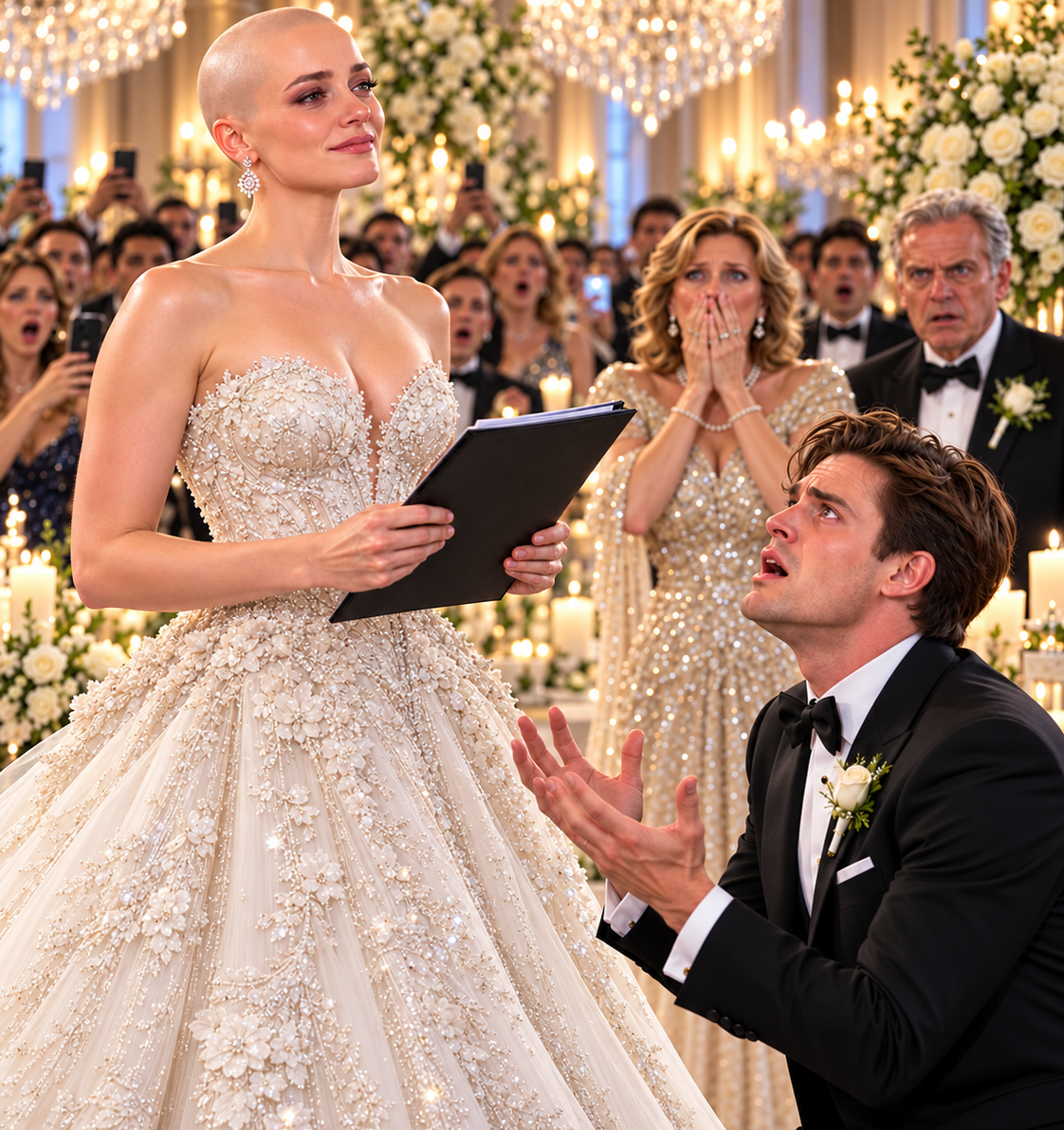
The string quartet had started Pachelbel, and the cellist faltered for half a bar when he saw me. Two hundred heads turned. The whispers rolled across the room in waves: Is that— Oh my God. Her hair. A woman in the third row lowered her phone, then raised it again.
Grandpa should have been walking me down that aisle. I walked it alone, with my chin up and my grandmother’s earrings brushing my bare neck.
Carter stood at the front in a midnight-navy tuxedo, a white rose pinned to his lapel. For half a second I saw panic cross his face. Then it smoothed into a smile, as if this had been his idea all along.
In the front row sat Diane in cream silk and pearls, wearing a small satisfied smirk. Vanessa sat beside her, staring at her lap. Richard checked his watch.
When I reached the altar, Carter leaned close enough that only I could hear him. “You actually came.”
“I wouldn’t miss this for anything.”
His smile widened, certain he’d won. Then his eyes slid past my shoulder to the second row on my side of the aisle.
Margaret Sloan sat there beside Leonard Fisk, my grandfather’s accountant of thirty years, with a black folder resting on her knees.
The smile drained off Carter’s face.

Part 4: What Was in the Black Folder
The officiant, Reverend Paula Brennan, opened her leather book and smiled at the room. “Dearly beloved, we are gathered here today—”
“Before we go any further,” I said, “I’d like to give Carter his wedding gift.”
Carter’s shoulders came down an inch. He let out a breath through his nose.
In the front row Diane clapped, three bright little claps in the hush. “I knew she’d come around,” she said, loudly enough for the fourth row to hear.
Margaret rose, walked to the altar, and placed the black folder in my hands. Carter watched it the whole way, the way a dog watches a plate being carried to the table.
I turned to face the guests. “Carter believes this folder contains fifteen million dollars.”
The room went silent. The cellist lowered his bow. At the back, a waiter froze with a tray of champagne flutes halfway to the bar.
“Rachel,” Carter said under his breath. “What are you doing?”
“This afternoon I was going to transfer that money into an account for both of us,” I said. “That was the plan.”
Diane’s hand flew to her pearls with a delighted little gasp.
“There isn’t going to be a transfer.”
Carter’s fingers closed around my arm just above the elbow. “Stop. Right now.”
I pulled free. “I’m finishing the lesson you started.”
I opened the folder and took out the notecard. I held it up so the front rows could see the black capitals and the underline, and I read it aloud, slowly, into the officiant’s microphone.
“This was on my pillow at 6:41 this morning,” I said. “Last night, after the rehearsal dinner, I fell into a sleep I couldn’t wake up from. While I was out, Carter shaved my head.”
The room broke open. Carter’s college roommate, Mike, half rose from his seat in the third row and then didn’t seem to know what to do with himself. Somewhere on my side an aunt said, “Rachel, honey,” in a cracked voice, and a program slid off someone’s lap onto the marble floor.
Diane shot to her feet. “That is a lie!”
I turned to her. “Would you like everyone to hear Carter explain who held the flashlight?”
The color left her face from the neckline up, pink to white, as if someone had pulled a plug. She sat back down without seeming to decide to.
I looked toward the AV booth and nodded once at Theo.
Carter’s voice came through the ballroom speakers, warm and casual and enormous. My mom was right about you. You needed to understand that in a marriage, the husband leads.
A pause, a laugh, and then the line that ended everything: Know? She held the flashlight.
Someone near the back said, “Jesus,” very quietly, and nobody shushed him.
Vanessa stood up so fast her chair scraped. “Carter, what the hell? You told me she’d laugh about it by lunch.”
Carter didn’t answer her. He lunged toward the AV booth, and the two security officers Theo had placed there stepped smoothly into his path, one on each side.
He spun back toward me. “You recorded me?”
“Yes.”
“You vindictive—” He bit the rest off when he saw how many phones were pointed at him.
I waited until the room settled into something like quiet. “Now,” I said, “let’s talk about why Carter wanted this wedding so badly.”
Margaret walked to the second row on the groom’s side and handed copies of the emails to Richard Whitmore. She handed more to the two people beside him: Alan Pruitt, Whitmore’s chief financial officer, and Linda Cho, its head of operations. I watched their faces change as they read.
I laid it out plainly for the room. There was the late payroll, the four liens, the defaulted Midland loan, and Carter’s email asking how fast he could get into his wife’s inheritance. Then there was clause four, which would have handed him control of every dollar I moved into our joint account the moment I signed.
Richard looked up from the pages at his son. “You told me the financing was secured.”
“It was going to be!”
“With her money?”
Carter opened his mouth. Nothing came out.
Diane rose again, her voice shaking with a different kind of anger now. “Rachel, that is enough. You are humiliating this family in front of everyone we know.”
“You stood over a sleeping woman with a flashlight so your son could frighten her into signing over millions,” I said. “I think the family managed that part without me.”
I took the last envelope out of the folder, the one with the blue tab. “And now, Diane, here’s your surprise.”
I told them about March, about Midland and Cardinal Ridge, and about the $8.4 million I’d spent at my kitchen table to keep a stranger from gutting their company. I told them I’d meant to hand Carter a release tonight, the whole loan forgiven, as a gift.
Margaret stepped up beside me. “The notice of default was delivered in April and acknowledged in writing by Mr. Whitmore. The cure period expired at midnight.”
Richard closed his eyes. He’d signed that acknowledgment himself.
“No,” Carter said.
“Yes,” said Margaret.
“As of this morning,” I said, “my grandfather’s trust holds the loan on your headquarters on Randolph Street, your equipment yard in Elk Grove Village, and three development parcels in Schaumburg.”
Carter came closer, his voice dropping. “You wouldn’t.”
“You thought shaving my head would make me obedient.”
Then he did something I’d never seen him do. He went down on one knee, not the way he had on the pier at Montrose Harbor with a ring box, but with both hands open and empty in front of him.
“Rachel, please.” His voice cracked. “I can fix this.”
In two years I had never once heard him beg. I looked down at him, at the hair gel and the boutonniere and the face I’d once thought was kind.
“No,” I said. “You can face it.”
I handed Margaret a single signed page, and she read it aloud. The trust would hold off on foreclosure for ninety days on four conditions: the board would remove Carter from every management role that day, appoint an independent restructuring officer, keep payroll whole for all one hundred forty employees, and pay legitimate subcontractors before any family member saw a dime. If the board refused, the trust would foreclose on Monday morning.
Richard held out his hand for the page. I walked it to him myself.
“It’s your company, Mr. Whitmore,” I said. “It’s your signature. I’m not going to answer for you.”
He read it twice. Linda Cho leaned over and murmured something, and he nodded. Then he lifted his eyes to his son, still kneeling at the altar.
“You’re fired.”
“Dad—”
“Get out of my sight.”
Diane began to cry, loud and wet, her pearls trembling. “Thirty years,” she kept saying. “Thirty years we built that company.” Not one word of it was about me.
Carter got slowly to his feet. He looked at me as if I were the one who had broken something. “We were supposed to get married.”
I looked around the ballroom at the roses, the candles, the champagne tower glittering under the chandeliers, and two hundred silent faces.
“No, Carter. You were supposed to acquire me.”
I slid the ring off my finger and set it on the altar beside the unity candle nobody would light. “Deal canceled.”
Then I picked up the notecard, turned, and walked back down the aisle alone. At the ballroom doors two Chicago police officers stood waiting, the ones Margaret had quietly called at 11:30, and one of them took off her cap.
“Ms. Hale? We understand you’d like to make a report.”
“Yes,” I said, and held out the card. “I’d like to start with this.”
Part 5: Growing It Back
The detective assigned to my case was a soft-spoken woman named Ana Ruiz, who listened for two hours that afternoon in a borrowed Bellmont conference room without interrupting me once. When I finished, she slid the notecard into a clear evidence sleeve and wrote the time on it. “This,” she said, “was very stupid of him.”
The blood Denise had drawn came back eleven days later. It showed a prescription sedative I had never been prescribed, the same one Carter had been filling for two years for what he called his travel insomnia.
The hotel’s security footage was worse. At 1:07 a.m. it showed Carter and Diane stepping out of the elevator on the fourteenth floor and letting themselves into Suite 1408 with his key card. At 1:49 they came back out, Carter carrying a Bellmont laundry bag and Diane slipping her phone back into her purse.
It took months. There were depositions and lawyers and one long afternoon when I had to describe waking up to a room full of strangers. Diane was interviewed twice, and her name was in the police report, in the footage, and in the minutes of the country club board she quietly resigned from in September.
In January, Carter pleaded guilty to reduced charges. He was sentenced to two years of probation, mandatory treatment, and two hundred hours of community service, and as part of a separate settlement he paid me $185,000 in damages.
At the hearing, he stood at the lectern in a gray suit that no longer quite fit and read an apology from a sheet of paper. He said he was sorry for what he’d done to me. He also said the word pressure three times.
When he finished, he turned and looked at me in the gallery, waiting.
I didn’t nod or look away. I didn’t tell him it was okay, because it wasn’t, and he hadn’t earned the right to hear that it was.
Vanessa wrote me a letter in October, three pages by hand on lined paper. She said she’d typed that text before she let herself think, that she’d spent her whole life taking her mother’s side because it was easier, and that she’d started therapy. She said she didn’t expect anything back.
I wrote her one line on a plain white card. Thank you for telling me the truth; I’m not ready to tell you it’s okay. I meant both halves of it.
Whitmore Development survived. The restructuring officer, a blunt former bankruptcy lawyer from Milwaukee, cut Richard’s salary in half, sold one of the Schaumburg parcels, and met payroll every two weeks without fail.
All one hundred forty employees kept their jobs. Gloria still sits at the front desk on Randolph Street with her hard-hat candy dish.
In November Richard sent me a short letter on company letterhead. You could have taken everything, he wrote. You didn’t, and I won’t pretend I’d have done the same. Margaret converted the forbearance into a seven-year repayment plan, at a fair rate, with no forgiveness and no wedding envelope.
The fifteen million stayed in Grandpa’s trust, right where it had always been. I didn’t miss the version of me who had been so eager to give it away.
Seven months after the wedding, my hair had grown into a short chestnut pixie cut. I’d planned to grow it all the way back. Then one Saturday in January I walked into Sal’s on Halsted Street for the first time in nearly twenty years.
Sal had retired to Arizona, but his son Marco ran the place now, with the same checkered floor and the same red chair, a little more cracked. Marco squinted at me for a second and then broke into a grin. “Tommy Hale’s granddaughter. He used to show everybody your school pictures.”
He trimmed the back neat and left the top soft. Then he spun the chair around so I faced the mirror, the way Sal used to for Grandpa.
“You keeping it like this?” he asked.
I looked at the woman in the mirror. She had my grandmother’s earrings, my grandfather’s stubbornness, and a face that didn’t flinch anymore.
“Yeah,” I said. “I think I am.”
That evening Detective Ruiz called to say the case was formally closed and evidence could be released. The next week a manila envelope arrived at my apartment. Inside, still in its clear sleeve, was a cream Grand Bellmont notecard.
I took it out of the sleeve and carried it into the bathroom. My apartment mirror isn’t framed in brushed gold and isn’t lit from both sides, but it does its job.
I propped the card against the glass and looked at the two of us together again: the woman with short chestnut hair, and the sentence in blocky capitals with the word ridiculous underlined.
Now you look as ridiculous as you really are.
I laughed the way I had that morning, low and surprised, until my eyes watered. Carter had been right about one thing.
He had picked the perfect day. It just hadn’t been perfect for him.
Then I took the card down, tore it in half, and dropped it into the wastebasket. I left the mirror exactly where it was.
Would you have walked into that ballroom without the wig, or taken the service elevator down to the loading dock before anyone saw you?
—
Disclaimer: This story is a work of fiction inspired by real-life themes. Names, characters, places and events are fictionalized, and any resemblance to real persons is purely coincidental. Images are for illustration purposes only.


