

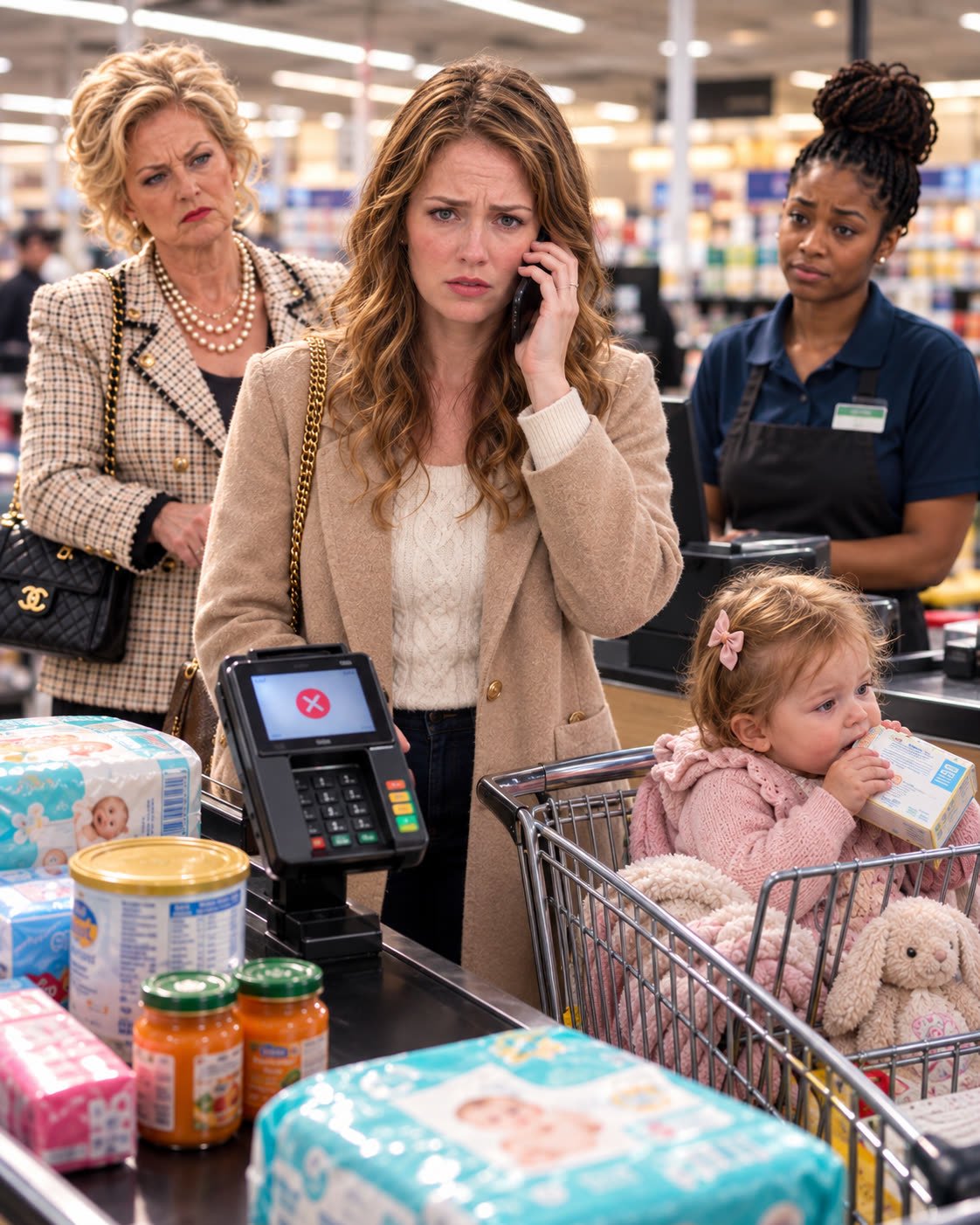
Part 1: The Red Box on Lane Four
Two boxes of size-three diapers, one tub of formula, $114.62 on the screen, and a card that kept saying DECLINED. My husband told me to walk away from the register and solve it on my own. His mother called me a leech over the speaker. I folded the receipt into my wallet. Five days later, in a glass boardroom, his lawyer read one page about a twelve-million-dollar note, clicked his pen shut, and walked out.
“I’m so sorry, ma’am. It declined again.”
The cashier said it quietly, the way you’d tell a stranger their headlights were on. Her name tag read KAYLA in green block letters. She tilted the card reader toward me as if I might spot something she had missed.
The screen said $114.62. Under it, inside a red box, it said DECLINED.
I looked down at the belt. There was a tub of hypoallergenic formula at $41.99, the only kind Hazel’s stomach could handle, plus four glass jars of sweet potato puree and two boxes of size-three diapers.
Hazel was eight months old and sitting in the front of the cart, gumming the corner of a board book about ducks. She had no idea that her mother’s face had just gone hot from the collar all the way to the hairline.
It was 4:40 on a Thursday afternoon in late October, lane four of the Meijer on 28th Street in Grand Rapids. Three people stood behind me. The woman directly behind me, a silver-haired lady with a basket full of cat food, let out a sigh loud enough to count as a sentence.
“Let me just call my husband,” I told Kayla. “It’s probably the bank.”
I believed that when I said it.
Brandon picked up on the second ring. His voice was so relaxed that for one stupid second I almost apologized for bothering him at work.
“I locked the shared cards this morning, Paige,” he said, before I had finished saying his name. “Your spending has gotten out of hand, and this ends today.”
The store noise went flat around me: the scanners beeping, the bakery speaker announcing fresh cider donuts, a toddler wailing two lanes over.
“Brandon,” I whispered, turning my shoulder to the line. “I’m buying formula and diapers. For your daughter.”
He laughed, a short breath through his nose.
“Then walk away from the register and solve it on your own,” he said. “Maybe leaving empty-handed will finally teach you what a dollar is worth.”
I heard a rustle and a muffled “Give me that.” Then a different voice filled my ear, so loud I knew he had switched to speaker.
“You are an expensive, lazy leech wrapped around my boy’s throat,” my mother-in-law, Brenda Faulkner, said. “You do nothing all day. Let’s see how brave you are once he cuts off the free ride.”
The line went dead. I hadn’t said a single word in Hazel’s defense.
Behind me, the cat-food woman tapped her foot against the tile. Kayla’s eyes went from my phone to my face and back to the belt. Then she did something I have never forgotten: she didn’t look away.
“Could you suspend this for twenty minutes?” I asked. “I need to make one call outside.”
“Take your time,” Kayla said. She pressed a key, and the register spat out a short slip that read TRANSACTION SUSPENDED, with DECLINED printed above the total. She tore it off and held it out. “So you keep your place.”
I folded that slip twice and tucked it behind Hazel’s newborn photo in my wallet. I don’t know why. My hands needed something to do.
Out in the parking lot, the wind came across the asphalt hard enough to lift the corner of Hazel’s fleece blanket. I tucked it under her legs, leaned against my dented silver Equinox, and stared at the contact list on my phone.
Here is the part I’m not proud of. For four years of marriage, I let Brandon handle the money, because it was easier than asking questions.
Before Hazel, I’d been a billing coordinator at a pediatric practice on Michigan Street. Brandon said daycare would cost nearly what I earned, which was almost true. He said his company was “in a growth phase,” which I never once asked him to explain.
Faulkner Commercial Builders had been his father’s company. After Gerald Faulkner died four years ago, Brandon became president. He started wearing a gold watch and began talking about cash flow at dinner the way other men talk about the weather.
We had the mortgage on the four-bedroom in Ada, the payment on his Tahoe, and Hazel’s co-pays, which seemed to arrive every other week. I clipped coupons. I bought store-brand wipes and told myself that was what a good partner did.
My father would have called it something else.
Samuel Callahan sold farm equipment in Ionia County for thirty-one years. He drove the same Ford pickup through most of my childhood and wore flannel shirts my mother patched at the elbows. He kept a folded twenty-dollar bill in every coat he owned. When he sold the dealerships the year I turned twenty-five, the local paper ran a small article. Nobody in town ever learned the number, and he liked it that way.
He died nineteen months ago, in March, in his recliner with the Tigers game on mute.
Brandon came to the funeral in a black suit and spent most of the reception asking my cousin what the farmhouse might sell for. A few weeks later, he found a thick cream envelope from something called Sterling Crest on our counter. “Estate paperwork,” I told him, and he lost interest.
There was one more thing about my father. At our last Thanksgiving together, he asked Brandon over pie whether he could take a look at Faulkner’s most recent annual statement. Brandon laughed and said, “Sam, you sold tractors.” Dad just smiled and passed the whipped cream.
Two weeks before he died, Dad handed me a business card with a phone number written on the back in his blocky capitals. “The day somebody makes you ask permission to feed your family,” he said, “you call Russell. Not before. Promise me.”
I had promised. I’d assumed that day would never come.
I dialed.
“Sterling Crest Wealth Management, Russell speaking.”
Russell Hayes had managed my father’s money for twenty-two years. His voice was the same as it had been at the funeral, measured and unhurried, like a man folding a road map.
“Russell, it’s Paige.” My fingers were shaking, so I pressed the phone harder against my ear. “It’s time. Unlock everything.”
The silence went on so long that I checked the screen to make sure the call hadn’t dropped.
“Your father built this trust so no one could ever keep you under their thumb,” he said at last. “But before I do this, you need to understand something about your husband’s company. Your father asked me not to tell you unless you made this exact call.”
Hazel kicked her socked feet against the cart. Somewhere behind me, a car alarm chirped and stopped.
“The trust holds a note against Faulkner Commercial Builders,” Russell said. “Twelve million dollars of mezzanine debt. Your father bought it three years ago through a confidential holding entity. If the trust goes active in your name, a covenant review on that note triggers automatically. Paige, the company is already in technical default. It could be insolvent by morning.”
I looked through the sliding glass doors toward lane four, where my daughter’s formula was still sitting on the belt.
“Don’t hold anything back,” I said.
“Then the portal will be ready tonight,” he answered. “And Paige? Speak with a lawyer before you touch that note. Your father would tell you the same.”
I went back inside and paid with the emergency cash Dad had always made me keep in the glove box: $140 in a bank envelope he had labeled, in those same capitals, FOR NOTHING GOOD. I thanked Kayla twice. She told me to drive safe.
Brandon came home at 7:15 smelling of cold air and office coffee. He walked into the kitchen like a man who had won something.
He flicked the tip of my nose with one finger, the way you’d tease a child, and set a printed sheet on the island. The heading said HOUSEHOLD FINANCIAL POLICY in bold.
“I’m running the budget from now on,” he said, glancing at his gold watch. “You get five hundred a month for everything. Groceries, gas, Hazel. If she gets sick, you bring me the clinic invoice and I’ll approve it.”
Five hundred dollars. The formula alone came to nearly two hundred.
I read the paper. Then I looked up at him and gave him a small, pleasant smile, the one I used to use on insurance companies.
“Thank you for being so clear, Brandon,” I said.
He whistled on his way down to the basement den. The door clicked shut, the TV came on, and an announcer shouted about a fumble.
I opened my laptop at the kitchen table and logged into the Sterling Crest portal with the credentials Russell had texted me.
THE SAMUEL J. CALLAHAN FAMILY DYNASTY TRUST. Status: ACTIVE. Beneficiary: Paige E. Callahan Faulkner.
Halfway down the dashboard, a red box blinked: FAULKNER COMMERCIAL BUILDERS, MEZZANINE NOTE, $12,000,000, ACCELERATION ELIGIBLE. Beneath it sat a single button that said AUTHORIZE.
Downstairs, my husband laughed at something on TV, sure he had finally put me in my place.
My cursor floated over the button. That was when I noticed the gray line beneath it, a monitored external asset my father had apparently been watching for me: PAIGE CALLAHAN, INHERITED MUNICIPAL BOND PORTFOLIO (FROM ESTATE OF MARGARET CALLAHAN). Balance: $0.00.
My mother’s seventy thousand dollars was gone.
Part 2: A Signature in Someone Else’s Hand
“The balance is zero,” Lauren Vance said, sliding a ledger across her walnut desk. “Seventy thousand dollars in municipal bonds, transferred out on September twelfth.”
I never pressed AUTHORIZE that Thursday night. I sat at the kitchen table until midnight with the cursor hovering over it. Then I closed the laptop, and on Friday morning I called the attorney Russell had recommended.
Now it was Monday, 10:00 a.m., eleventh floor of a brick building on Monroe Center. Hazel was asleep in her car seat by my chair. Russell sat in a leather armchair near the window with his hands folded, saying nothing yet.
My mother died when I was twenty-two. She left me those bonds with a note in her loopy handwriting that said, For something that matters. I had never touched a cent. In my head, they were Hazel’s first year of college.
I barely glanced at the numbers. My eyes went straight to the document stapled behind them: IRREVOCABLE SPOUSAL ASSET WAIVER AND TRANSFER GRANT. Every dollar had been moved into an account belonging to Brandon Faulkner.
At the bottom was a blue notary stamp. MEGAN COLE, NOTARY PUBLIC, KENT COUNTY. Megan was Brandon’s executive assistant. She had brought a fruit tray to Hazel’s baby shower.
Next to the stamp was my name, signed in a loopy, confident hand. My mother taught me to make my capital P with a straight back and a small closed loop. This P was wide open, like a sail.
“The notarization is dated Tuesday, September twelfth, at two o’clock in the afternoon,” Lauren said, peering over her tortoiseshell glasses. “Can you tell me where you were?”
I didn’t have to think. I opened my phone and set it on her desk.
“Hazel had an ear infection,” I said. “Her fever was 103.2. We were in an exam room at Cascade Pediatric Clinic from 1:15 until three. I have the visit summary, my location history, and the Walgreens drive-through receipt for her amoxicillin at 3:22. It was $4.17 with insurance.”
Lauren scrolled through each screen. Then she tapped her gold fountain pen twice against the desk.
“This stopped being a standard divorce the moment that stamp went on the page,” she said. “Forgery, identity theft, grand larceny. And a notary who either lied or was told to.”
Something else came back to me then, cold and slow. On September twelfth, a little after one, Brandon had texted me: How’s the baby? Where are you guys?
I had thought it was sweet. I had sent him a photo of Hazel on the crinkly paper of the exam table.
“He’s going to file for divorce,” I said. “Isn’t he?”
“My associate pulled the pending dockets at the Kent County courthouse this morning.” Lauren turned a printout toward me. “There’s a draft petition ready to serve. Full legal and physical custody of Hazel, no spousal support, exclusive possession of the house.”
“On what grounds?”
“That you’re emotionally unstable and incapable of managing money.” She paused. “He intends to use your frozen accounts and your lack of income as proof that you can’t keep a roof over your daughter.”
A laugh came out of me, ugly and short. Hazel stirred in her car seat and settled again.
The whole thing came together in my head like a jigsaw puzzle with the picture showing at last. He drained my accounts, forged my name, and left me at a register with a hungry baby. Then he handed me a five-hundred-dollar allowance on paper so a judge could see it. He was building a file, and I was the evidence.
“He thinks the farmhouse and a little savings were all I had,” I said.
Russell finally spoke from the window.
“Brandon believes he declared war on an unarmed woman,” he said, and the corner of his mouth lifted. “He has no idea you own the ground his company is standing on.”
“Should I authorize the note?” I asked them both. “Tonight?”
Lauren shook her head. “Not yet. When you do it, you do it in daylight, in front of witnesses, with every page in order. For now, take the allowance. Smile. Let the forensic accountants work.”
It was the right advice. It also meant going home to live on Brandon’s rules a little longer. I nodded anyway.
“A few days,” I said. “Not a week.”
When I pulled into our driveway in Ada at 2:30 that afternoon, Brenda’s white Lexus was parked crooked across half of it. Beside it sat a faded blue F-150 with FAULKNER COMMERCIAL BUILDERS peeling off the door.
Brenda was at my kitchen island, drinking coffee out of my grandmother Ruth’s porcelain mug, the one with the hand-painted roses that I never put in the dishwasher. Brandon’s older brother, Wayne, leaned against the counter beside her, still in his work boots, looking like he wanted to be anywhere else.
“We need to talk about your attitude toward my son, young lady,” Brenda said before the front door had even clicked behind me. “Brandon works seventy hours a week to keep that company afloat in this market, and you sit here doing nothing.”
I set Hazel’s car seat on the floor, gently, so it wouldn’t wake her.
“I took care of Hazel all day,” I said. “While dealing with cards that don’t work.”
“You brought nothing into this marriage.” Brenda waved a hand, and her burgundy nails flashed under the pendant lights. “If you fight Brandon on this budget, I’ll make sure the judge puts you on the street without a penny.”
She set Grandma Ruth’s mug down hard. A little coffee sloshed over the roses.
Wayne cleared his throat and touched her shoulder.
“Mom, that’s enough,” he said quietly, looking down at the tile. “This is between Brandon and Paige.”
“Be quiet, Wayne.” She shrugged his hand off and grabbed her leather handbag. “Your brother is the only reason this family still means something in West Michigan. Remember your place, Paige. Nobody will take your side over ours.”
The Lexus backed out over the edge of my lawn. I picked up the mug, rinsed it under warm water, and dried each rose with a dish towel while my hands found their way back to steady.
Wayne hadn’t left. He stood in the foyer, glancing out the window until his mother’s taillights turned the corner. Then he unzipped his canvas jacket and pulled out a thick manila folder, creased down the middle.
“Don’t ever let Brandon or my mother know I gave you this,” he whispered. His fingers were shaking. “Dad wrote it four years ago, a few weeks before he died. He gave it to me, not Brandon.”
I opened it an inch. There were pages of handwritten notes on yellow legal paper, columns of invoice numbers, and two names I didn’t recognize circled in red: Lakeshore Pinnacle LLC and Grandview Site Services. Next to each, Gerald Faulkner had written DOUBLE BILLED.
“Dad knew Brandon was skimming,” Wayne said. “Fake vendors. Shell companies. He wrote that anyone who helped cover it up would end up in federal prison.” He swallowed. “Brandon’s sinking the whole company, Paige. Forty framing crews. I won’t go down for him.”
“Why now?” I asked. “Why give it to me now?”
He looked at the porcelain mug drying on the rack.
“Because she said that to you in your own kitchen,” he said, “and I’ve been standing next to her saying nothing for forty years.”
He was gone before I could thank him. I carried Hazel upstairs, fed her, rocked her in the glider until her fists uncurled, and slid the folder under the mattress of the guest bed.
I didn’t sleep much. Brandon came to bed around eleven, checked his phone, and turned his back to me.
At exactly 2:15 a.m., my phone lit up on the nightstand with a silent banner from the Sterling Crest app: SECURITY ALERT. Unauthorized login attempt, Callahan Family Dynasty Trust. Origin IP registered to Faulkner Commercial Builders, Executive Office.
I rolled over. Brandon’s side of the bed was empty, and the sheets were cold.
Down the hall, a thin blue glow was leaking from under the basement door.
Part 3: The Promise I Kept Too Long
I didn’t go downstairs.
I lay in the dark with the phone face-down against my chest and listened to the furnace click on and off. I counted Hazel’s breaths through the baby monitor, a soft whisper of static every two seconds.
At 2:51, the basement door opened. Brandon’s footsteps came up the stairs, careful and light, and he slid back into bed smelling of the cold basement and something sour, like nerves. Within ten minutes he was snoring.
I texted Russell one line: He tried to get in. Then I stared at the ceiling until the window turned gray.
People ask me why I didn’t just use the money earlier. Why I let Brandon count my groceries, and why I let his mother talk to me like that for four years when I could have walked out with a checkbook.
The honest answer isn’t flattering.
I wanted to be ordinary. I grew up as the girl whose dad owned every dealership from Ionia to Greenville, and boys always seemed to learn that fact before they learned my middle name. When I met Brandon at a friend’s wedding in Saugatuck, he thought my father sold a few tractors. He liked me anyway, or I thought he did.
I didn’t tell him about the trust because I didn’t fully understand it myself. Dad kept it sealed. “It’s a lifeboat, not a yacht,” he used to say. “You don’t sail around in a lifeboat for fun.”
And I made Dad a promise. Not before.
So I clipped coupons. I let Brandon keep the passwords. I told myself his temper was stress and his mother was old-fashioned. I told myself that the silence at our dinner table was what marriage looked like after a baby.
Then a red box on lane four told me the truth, and Kayla handed it to me on a slip of paper.
At 6:40 that morning, Russell called. Brandon was in the shower.
“Our security team traced it,” he said. “Someone used remote-desktop software from a residential connection to control a terminal inside Faulkner’s executive office, then went after your trust from there. They tried your father’s birthday, your mother’s maiden name, and Hazel’s birth date.”
“He was in our basement,” I said.
“Then he made it look like the office, and he left a trail straight back to himself.” Russell’s voice stayed level, but something underneath it had hardened. “Paige, he also asked his lawyer to request an emergency meeting with us this morning. Nine o’clock. He’s calling it an aggressive marital asset audit.”
I almost laughed. He wanted to audit me.
“Lauren says it’s time,” Russell went on. “Two investigators from the state financial fraud unit will be there. Megan Cole came in last night with her own attorney. Wayne dropped off his father’s ledger at six-thirty. Everything is in order.”
I stood in my kitchen in my socks and looked at the HOUSEHOLD FINANCIAL POLICY sheet still lying on the island, held down by the salt shaker.
“Then let’s do it in daylight,” I said.
I opened the laptop and logged in. The red box was still blinking.
I thought about Dad passing the whipped cream. I thought about the How’s the baby? text, and the open sail of a P that wasn’t mine.
I pressed AUTHORIZE.
A confirmation screen asked if I was sure. I clicked yes, then typed the six-digit code Russell’s office sent to my phone. The box turned from red to gray, and a line of small text appeared: ACCELERATION REQUEST SUBMITTED TO INVESTMENT BOARD. 8:27 A.M.
Brandon came down the stairs at 8:30 in a charcoal three-piece suit, knotting a silver silk tie. He kissed the air near my cheek.
“Big meeting,” he said. “Douglas is going to clean up your little mess. Don’t wait up.”
“I won’t,” I said.
He didn’t ask where I was going with the diaper bag and my good navy blazer. He had never once asked.
By nine o’clock, I was sitting in the top-floor glass boardroom of Sterling Crest on Monroe Avenue, with the Grand River gray and wide below the windows. Hazel was downstairs in the building’s monitored nursery with a woman named Patrice, who had already gotten her laughing.
On my side of the long table sat Lauren, Russell, and two investigators from the state, a man and a woman with laptops and identical lanyards. I sat between Lauren and Russell with a manila folder in front of me and my wallet in my blazer pocket.
At 9:04, the elevator opened.
Brandon walked in first, adjusting his cuffs. Brenda followed in a camel cashmere turtleneck and pearls. Behind them came Douglas Bennett, the Faulkner family’s corporate attorney for twenty years, a heavyset man with a gold pen already in his hand.
Brandon’s eyes found me and narrowed. Then he took in the investigators, and something flickered across his face and was gone.
“Let’s bring some common sense to this misunderstanding,” Douglas said, laying his pen on a yellow legal pad. “My client made a reasonable decision to restrict household credit to curb overspending. Mrs. Faulkner has, unfortunately, blown that out of proportion.”
Brandon leaned forward over the table and shook his head slowly, the way a disappointed teacher does.
“Paige, this is childish,” he said. “You got embarrassed at a grocery store because of your own reckless spending. Dragging investigators into our private family business is unhinged.”
Brenda nodded, smoothing her sweater.
“Offer the girl forty thousand in cash,” she said to Douglas, not to me. “Let Brandon have primary custody so the baby has a proper home. She can move back to the countryside where she belongs.”
I didn’t say anything. I reached into my blazer pocket, took out my wallet, and slid the folded DECLINED slip out from behind Hazel’s newborn photo. I set it on the glass table in front of me and smoothed it flat with two fingers.
Brandon glanced at it, then away.
Then I looked at Russell.
He opened a black leather portfolio, took out a stapled document with a red cover sheet, and slid it across the glass to Douglas.
“This is not a divorce mediation, Mr. Bennett,” Russell said. His voice was so quiet that everyone leaned in. “At 8:27 this morning, the beneficiary authorized acceleration, and thirty minutes ago, our investment board formally accelerated the twelve-million-dollar mezzanine facility held against Faulkner Commercial Builders. The grounds are covenant default.”
Brandon’s grin stayed on his face a half-second too long, like a light that hadn’t gotten the message that the power was out.
“What are you talking about?” he said. “That note belongs to an institutional fund. Offshore. We have sixty days before anyone can even review a covenant.”
“The Callahan Family Dynasty Trust is the sole holder of that note,” Russell said. “Samuel Callahan purchased your company’s secondary debt three years ago through a confidential holding entity. The fund you dealt with was his.”
Brandon looked at the red cover sheet. Then at the signature block. Then at me.
“Your entire company has been running on capital owned by the woman you tried to put on a five-hundred-dollar allowance,” Lauren said, and her voice could have cut glass. “Paige is not your dependent spouse, Brandon. She is your company’s primary secured creditor.”
Nobody moved. Somewhere down the hall, a phone rang four times and stopped.
Lauren reached into her own folder and laid a second document on the table, right next to my DECLINED slip: a certified copy of the waiver with the open-sail P and the blue notary stamp.
“And now,” she said, “we need to talk about Megan Cole.”

Part 4: What My Father Bought
“Last night at 6:10,” Lauren said, “your executive assistant signed a sworn affidavit with the state attorney general’s office. She states that you instructed her to notarize this waiver on September twelfth. She states that Paige was never present, and that you told her if she refused, she’d be the one explaining the missing invoices to an auditor.”
“That’s a lie.” Brandon’s palms came down flat on the table, and the sound cracked across the glass. “Megan is loyal to me.”
“Megan signed a full cooperation agreement,” Lauren said, unbothered. “She brought her notary journal. Your entry for September twelfth is in your handwriting, not hers.”
The male investigator typed something without looking up.
“Your brother also delivered your late father’s private ledger this morning,” Lauren went on. “Lakeshore Pinnacle LLC. Grandview Site Services. Both are shell vendors registered to a P.O. box you rent in Kentwood. Our forensic team traced over four hundred thousand dollars moved out of company accounts and your joint family accounts in the last eleven months.”
Brenda turned her head slowly toward her son. Her pearl earrings caught the light.
Lauren touched her tablet, and the wall monitor behind her filled with a gray grid of timestamps and numbers.
“And at 2:15 this morning,” she said, “someone used remote-desktop software from your home internet connection to take control of your terminal at company headquarters. From there, they tried to break into Paige’s trust using her father’s birthday, her mother’s maiden name, and your daughter’s birth date.”
She let that last part sit for a moment.
“Your daughter’s birth date, Mr. Faulkner.”
Douglas Bennett stared at the screen for a long time. Then he picked up the red-covered document, read the first page again, all the way to the bottom, and set it down.
He clicked his gold pen shut, put it in his breast pocket, and snapped his briefcase closed with two sharp sounds.
“Douglas,” Brandon said. “What are you doing?”
“I’m withdrawing as your counsel, effective immediately.” Douglas stood and buttoned his jacket. When Brandon grabbed his sleeve, he pulled his arm back, firmly and without hurrying. “You’ve just discussed felony bank fraud in front of two state regulators. Stop talking, Brandon. Hire a criminal defense attorney.”
He nodded once to Russell, once to Lauren, and walked to the elevator. Nobody watched him go except Brenda.
When the doors closed, she turned to Brandon. Her hands were trembling so hard that her rings clicked against each other.
“Tell me this isn’t true,” she said. Her voice cracked right down the middle. “Tell me you didn’t gamble away your father’s company and drag our name into a criminal investigation.”
“Supply costs doubled, Mom!” Brandon’s face had gone from pink to a blotchy red. “Lumber, steel, everything. I was going to pay it all back the second the hospital bid cleared.”
“By stealing from Paige?”
“Paige had millions sitting in trust doing nothing while my company suffocated!” He swung toward me, and his eyes were wet and furious. “We’re married. Whatever her father left belongs to me by right.”
“It doesn’t,” Lauren said flatly. “It never did. A dynasty trust funded before your marriage is separate property under Michigan law. And forging her name doesn’t change who owns it.”
I leaned forward. I had imagined this moment for five days, in the shower, in the car, in the glider at two in the morning, and in every version I yelled. In real life, my voice came out low.
“You didn’t build anything, Brandon,” I said. “You took over your father’s company and ran it on mine. You forged my name to empty my mother’s bonds. You stood next to your mother while she called me a leech, and you left your daughter at a register without formula to teach me a lesson.”
I touched the corner of the DECLINED slip.
“That’s what you were building. A file.”
He sank back into the leather chair and pressed both hands over his face. When he spoke again, it came out through his fingers.
“Please don’t call the note,” he whispered. “Paige. If that debt is accelerated, the company goes into receivership. I lose everything I’ve ever worked for.”
“You should have thought about that,” I said, “when you decided Hazel could go without formula.”
I turned away from him and looked at Lauren and the two investigators.
“File the receivership petition with the county court today,” I said. “Freeze every operating account connected to Faulkner Commercial Builders. And remove Brandon and Brenda from the board of directors, effective immediately.”
The female investigator nodded and picked up her phone.
Russell slid one more item across the table, toward me this time. It was a small cream envelope, unsealed, with my name in my father’s blocky capitals.
“He left instructions,” Russell said quietly. “This was to go to you on the day the note was accelerated. Not before.”
My hands weren’t steady, so I opened it slowly. There was a single index card inside.
PAIGE. I BOUGHT THEIR DEBT BECAUSE A MAN WHO WON’T SHOW HIS BOOKS IS HIDING SOMETHING, AND I WANTED YOU STANDING ON SOLID GROUND IF IT CAVED IN. I HOPE YOU NEVER READ THIS. IF YOU ARE, I’M PROUD OF YOU FOR CALLING. YOU DON’T HAVE TO BE CRUEL. JUST DON’T BE SMALL. LOVE, DAD.
I read it twice. Then I folded it around the DECLINED slip, so the two papers were nested together, and put them back behind Hazel’s photo.
Across the table, Brenda was on her feet. Her leather purse slid off the chair and hit the carpet, spilling a lipstick and a set of car keys. She didn’t pick them up. She came around the end of the table toward me with both hands out, palms up.
“Paige,” she said. “Please. Have some mercy. The Faulkner name is all we have left in this town. This will ruin us.”
I stood up. I gathered my folder, and I looked at the woman who had drunk from my grandmother’s roses and told me to remember my place.
“The Faulkner name never kept that company alive, Brenda,” I said. “My father’s quiet money did. Your son threw that away.”
She stopped two feet from me. Her mouth opened, then closed. Then, in a voice I had never heard from her, small and scraped thin, she said the one thing I hadn’t prepared for.
“I’m sorry. For what I said to you on that phone.”
Part 5: Approved
I didn’t tell her it was okay.
I looked at her, really looked at her: the stiff platinum waves, the lipstick on the carpet, and the hands still held out as if I might put something in them.
“I believe you’re sorry today,” I said. “Ask me again in a year.”
Then I went downstairs and picked up my daughter.
The next six weeks were paperwork. A court-appointed receiver named Thomas Okafor moved into Faulkner’s offices on Monday morning with two forensic accountants and a rolling cart of banker’s boxes.
They traced every transfer. The money hadn’t gone into lumber or steel. It had gone to country-club dues in Cascade, to a black Porsche Cayenne leased under Lakeshore Pinnacle LLC, and to two long weekends in Scottsdale that Brandon had told me were bid meetings.
Brandon had no ground left to fight on. Facing the forgery, the shell vendors, and the 2:15 a.m. login logs, his new criminal defense lawyer advised him to settle the divorce fast and quietly. He gave up every claim to the house in Ada. He signed a waiver of spousal support. He agreed to supervised visits with Hazel every other Saturday at a licensed family center on Plainfield Avenue.
The criminal case would take longer. Lauren said that was how it went. “The courts move slow,” she told me, “but they keep very good records.”
The company was the hard part. Thomas Okafor told me plainly that if the board stayed empty, he’d have to liquidate, and forty framing crews would lose their jobs before Christmas.
So I drove to Wayne’s house in Lowell on a Sunday afternoon with Hazel on my hip and a pan of my mother’s lemon bars. I sat at his kitchen table, and I didn’t tell him what to do.
“The court will approve you as interim president if you want it,” I said. “Full supervision. Every contract reviewed. It’ll be miserable for a year. You can say no.”
Wayne turned his coffee cup in a slow circle on the table. His wife, Denise, stood at the sink with her back to us, not washing anything.
“Dad would’ve wanted me to say yes,” he said finally.
“I didn’t ask what your dad would want.”
He looked up at me. Then he laughed, short and surprised, and the lines around his eyes eased.
“Yes,” he said. “I want it.”
He rebuilt the business on honest contracts and a lot of late nights. He kept all forty crews. In December, he lost the hospital bid that Brandon had been counting on and won a smaller school renovation in Kentwood on his own numbers. He called me from the job site just to tell me.
Brandon took a job as a junior blueprint estimator for an independent drywall contractor in Holland, forty minutes west. He rented a one-bedroom apartment near the highway with a window unit and carpet the color of wet sand. The state garnished thirty-five percent of every paycheck for child support, and the court directed it into a protected education account in Hazel’s name.
My mother’s seventy thousand dollars came back through restitution in January, minus nothing. I put it in the same account. For something that matters.
Brenda sold the house in East Grand Rapids. She sold the Lexus and most of the jewelry to cover personal guarantees she had signed for Brandon’s credit lines without reading them. She moved into a two-bedroom garden condo off Leonard Street.
She sent Hazel a card for Christmas with a twenty-dollar bill inside and nothing written but Love, Grandma B. I put the card in Hazel’s memory box. I didn’t write back yet.
I filed the paperwork to restore my maiden name in November. Russell and I spent three long afternoons restructuring the trust so Hazel would be protected for her whole life without ever being able to coast on it. “A lifeboat,” Russell said, tapping the final page. “Your father would sign this.”
Grandma Ruth’s porcelain mug went back into the cabinet over the sink, on the top shelf, roses facing out.
Three months after that afternoon on lane four, I drove my dented silver Equinox through Grand Rapids under a hard, bright January sky. Snow was banked up along the curbs on 28th Street, gray at the edges. In the back seat, Hazel, eleven months old and stuffed into a red puffer snowsuit, was shouting “Ba! Ba!” at every tree we passed.
I pulled into the Meijer lot and parked in the same row where I had stood in the wind and dialed Russell. The light pole had a new dent in it. Otherwise, everything was the same.
I lifted Hazel into a cart and pushed her through the sliding doors into the warm air and fluorescent hum.
Lane four was open. And behind the register, with her braids pulled up into a high bun and the green name tag on her navy polo, was Kayla.
I set my things on the belt: one box of size-four diapers, a carton of strawberries, bananas, two boxes of oat cereal, and a gallon of whole milk, because her pediatrician had said she could start in two weeks. Hazel had found a soft brown plush puppy in the seasonal aisle and refused to let go of it. I set the puppy on the belt too, with Hazel still holding one ear.
Kayla scanned it carefully around Hazel’s fist, and Hazel shrieked with delight.
“Fifty-two dollars and fourteen cents,” Kayla said.
Then she looked at my face, really looked, and I watched her remember. I saw it reach her eyes: the woman in the olive jacket, the phone on speaker, the cat-food lady tapping her foot.
She didn’t say anything about it. She just smiled a little wider.
I opened my wallet. Behind Hazel’s newborn photo, the DECLINED slip was still folded around my father’s index card. I left them where they were and pulled out a navy debit card with silver letters across the bottom: PAIGE E. CALLAHAN.
I slid it into the chip reader and waited the long one second it took for the machine to reach across the city to the top floor of a building on Monroe Avenue.
The terminal chimed. Across the little screen, in a green box, a single word appeared: APPROVED.
Kayla tore off the receipt and handed it to me. Then she leaned over the counter and waggled her fingers at Hazel, who waggled the puppy back.
“You two have a really good day,” she said.
“You too,” I said. “Thank you. For last time, too.”
She shrugged, a little embarrassed. “I just pressed a button.”
“You gave me my place back,” I said.
Out in the lot, the cold hit my cheeks, and Hazel squealed and pressed the puppy against her face. I buckled her in and kissed both of her round cheeks. Then I leaned against the car door for a minute with the receipt in my hand.
For a long time, I thought the worst part of that October afternoon was the humiliation, the red box and the line of strangers watching. I was wrong. The declined card was the first honest thing anyone in my marriage had told me in four years.
Brandon never wanted a partner. He wanted someone who had to ask. He emptied my accounts, forged my name, and turned our daughter’s formula into a bargaining chip, so sure I had nothing behind me that he never bothered to look.
My father didn’t build that trust to destroy anybody. He built it so his daughter could love someone with her whole heart and still be able to leave. I didn’t unlock it to hurt Brandon. I unlocked it the moment he decided that Hazel’s food was leverage.
I don’t think about Brandon or Brenda much anymore. When I do, it’s mostly about how small they wanted me to be, and how much room there turned out to be once I stopped agreeing.
Dad taught me to keep records, read the fine print, and never mistake someone’s permission for real security. Brandon just gave me the expensive lesson that proved him right.
I opened my wallet one more time and folded the APPROVED receipt in with the other two papers, the red one and the green one and my father’s capitals, all nested together behind my daughter’s first photo.
Then I got in the car and pulled out of the snowy lot toward home.
He’d told me to walk away from the register and solve it on my own.
So I did.
What would you have done in Paige’s place: called Russell from that parking lot, or tried one more time to work it out with Brandon?
Disclaimer: This fictional story is for entertainment only. It does not represent any person or organization and does not encourage inappropriate behavior. Created with AI assistance.


