

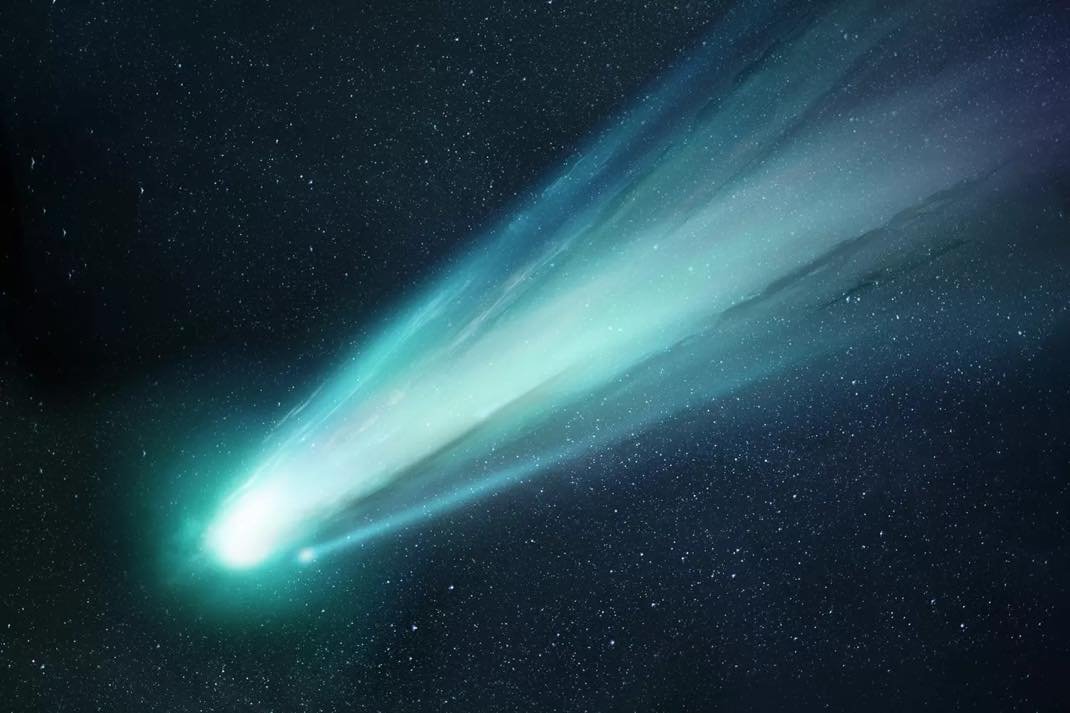
What if comets ultimately played only a marginal role in the emergence of life on Earth? a study published in scientific reports It strongly calls into question the idea according to which these frozen bodies would have provided our planet with the essential molecules for prebiotic chemistry. The problem would not come from its “cargo”, rich in organic compounds, but from the extremely violent conditions of its arrival.
Researchers at the University of Cambridge have modeled the behavior of hydrogen cyanide (HCN), a molecule containing carbon and nitrogen that is periodically detected in comets. Simulations show that the speed and angle of impacts generally cause its destruction before it can reach the surface in sufficient concentration.
An almost impossible combination of circumstances
For Richard Anslow, lead author of the study, the scenario would require “one chance event in a million.” The comet should arrive at the right speed, at a favorable angle, and then deposit enough molecules before they rapidly dilute or transform.

The models even indicate that most simulations do not produce any impacts capable of providing an appropriate HCN concentration for prebiotic chemistry. This conclusion does not completely rule out an extraterrestrial contribution. Asteroids rich in the building blocks of life, many more of which have collided with Earth, remain serious candidates.
Mars would have offered better conditions
Surprisingly, Mars may have been more welcoming to these cosmic deliveries. Its low gravity and less dense atmosphere favor less destructive impacts. The discovery by Curiosity of molecules linked to the chemistry of life maintains interest in the prebiotic past of the red planet.
“It’s a pretty romantic idea, but our results suggest it’s highly unlikely.”summarizes Richard Anslow about comets that sow life. As the organic molecules detected on Enceladus remind us, finding the ingredients for life in space is not enough for life to emerge.


