

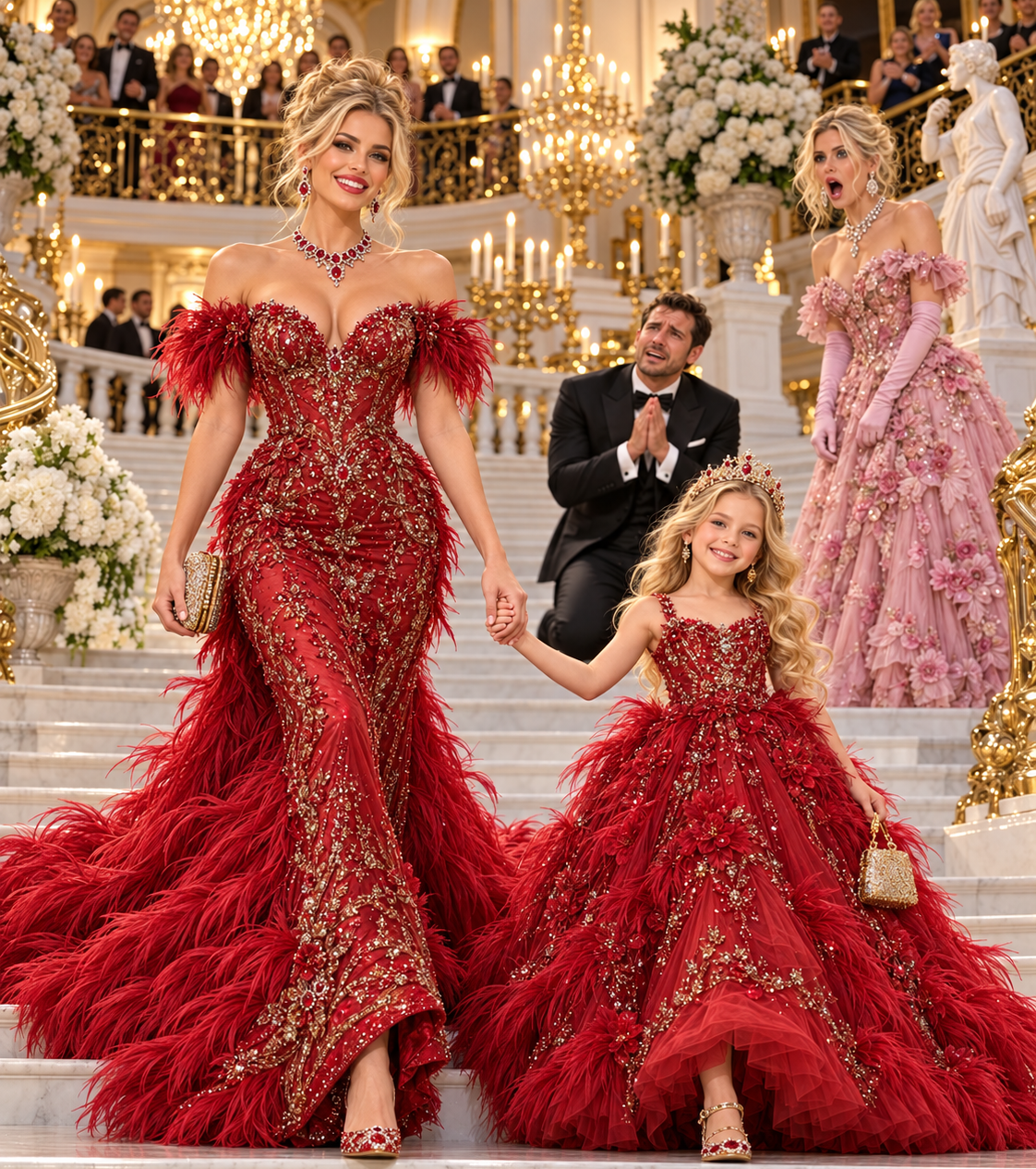
Part 1: The Sink
“Stay home and wash the dishes, Imogen.”
Everett said it while checking his reflection in the dark kitchen window, not even looking at me.
“Tonight I need to look like a successful man. Not a man who married someone who’ll never fit in.”
There were twenty-two plates in the sink. I know because I’d counted them while his mother finished her second slice of lemon tart. Constance had come over at four “to help,” which meant sitting at my island with a glass of my wine, telling me the roast was dry.
His sister, Bianca, was on her phone by the pantry, filming herself in a sequined jacket.
And standing beside my husband, close enough that I could smell her perfume over the dish soap, was Sabrina Locke. His communications director. She reached up and straightened his bow tie like she’d been doing it for years.
Maybe she had.
“You’re taking her,” I said. “To the Sterling gala. As your date.”
“As my director of communications.” Everett finally turned around. “It’s a business event, Imogen. You wouldn’t know what to say to those people.”
“I’ve talked to those people my whole life.”
He laughed. Not a mean laugh, exactly. Worse than that. A tired one, like I was a child who’d said something cute.
“You lived above a print shop when I met you. You drove a Corolla with a coat hanger for an antenna. You bought your interview blazer at Goodwill.” He picked up his car keys. “Everything you have, you have because of me. Let’s not pretend otherwise.”
“Do you actually believe that?”
“It’s not a belief, babe. It’s a bank statement.”
Constance smiled into her wine. Bianca didn’t look up from her phone.
Sabrina slid her hand into the crook of his arm, and the four of them walked out the front door to the black car idling in the driveway. Nobody said goodbye. The door clicked shut, and the house went so quiet I could hear the dishwasher’s little green light humming.
I stood there with my yellow rubber gloves on and the water still running.
For eight years, I had told myself that keeping quiet was the same thing as keeping my dignity. That if I didn’t fight, I was being the bigger person.
Standing at that sink, I finally understood that I hadn’t been the bigger person.
I’d just been the smaller one.
I turned off the faucet. I peeled off the gloves, one finger at a time, and laid them over the edge of the sink.
Then I walked down to the wine cellar.
Part 2: The Room Under the Cellar
Everett never went into the cellar. He said it was damp and he didn’t care about wine as long as someone else picked it.
That was the only reason it worked.
At the back of the third rack, there was a 1961 Château Latour that nobody was ever going to drink. I tilted it forward, the way my grandmother had shown me when I was twelve. Behind the rack, a panel clicked and swung inward.
The house had belonged to Eleanor Sterling for thirty years before it belonged to us. Everett thought he’d bought it at a “family discount” from an estate trust. He never asked whose estate.
The little room behind the panel had been her private office. A desk. Three monitors. A filing cabinet with a combination lock. A framed photo of a woman in a cardigan standing behind a folding table full of fabric bolts, squinting into the sun.
On the wall above the desk was a brass plaque, small and plain:
STERLING INVESTMENT GROUP — EST. 1974
The same Sterling Investment Group that Everett had spent six weeks trying to impress. The same fund whose forty-million-dollar credit line was the only thing standing between Hale Enterprises and bankruptcy.
I picked up the desk phone and pressed one button.
“Ms. Sterling.” Nolan Fraser, my general counsel, answered on the first ring. I could hear the gala behind him, a string quartet and two hundred conversations. “Is everything all right?”
“Is Everett there yet?”
“Just walked in. With Ms. Locke.” A pause. “I’m sorry, Imogen.”
“Don’t be. It saves me from having to explain.”
For nine months, Nolan’s forensic team had been going through Hale Enterprises line by line. It started as normal due diligence for the loan. It didn’t stay normal for long.
They found invoices for consulting work that never happened. Wire transfers that bounced through two banks and landed in an account owned by Lockridge Consulting LLC. Lockridge was Sabrina’s mother’s maiden name. Sabrina was the sole member.
Eleven million, four hundred thousand dollars over three years.
And then, three weeks ago, they found the recording.
Everett had held a late meeting with Sabrina in the Hale conference room and forgotten the room’s video system was set to record and transcribe every meeting automatically. The file sat on the company server with everything else Hale had handed over for our review.
I’d listened to it once. That was all I could manage.
“Imogen’s an idiot,” my husband said on that recording. “She never asks questions. She trusts me with her eyes closed.”
Sabrina asked what would happen if I demanded an audit during a divorce.
“Then we use the psych reports,” he said. “Dr. Pratt owes me. A judge sees ‘unstable’ and ‘paranoid’ in writing, she loses any say over anything. With the right lawyers, we walk out with all of it.”
All of it. He meant the house. He meant me.
“Nolan,” I said. “Where’s his table?”
“Row four, near the bar.”
I pulled up the seating chart on the center screen and looked at the stage, the podium, the empty round table directly in front of it.
“Move him,” I said. “Front row. Dead center.”
Nolan was quiet for a second. “You’re coming.”
“I’m coming.”
Part 3: Who I Was Before
People hear “heiress” and picture yachts. My grandmother would have hated that.
Eleanor Sterling started out selling fabric remnants at a weekend market in Paterson, New Jersey. She bought the building where I later lived, a two-story brick place with a print shop downstairs, because the landlord was going to evict the printer and she liked him. She charged him $300 a month for twenty-two years.
By the time I was born, she’d turned fabric money into real estate, and real estate into one of the largest private investment funds in the country. She still wore cardigans with holes in the elbows. She still clipped coupons, mostly to annoy her accountants.
“Money makes people show you their worst manners,” she told me once. “Let them meet you first. The money can come later.”
My parents died when I was nineteen. Eleanor died when I was twenty-nine and left me the controlling stake in everything.
I watched what that did to people almost overnight. A college friend asked me to “invest” in her boyfriend’s bar. A cousin I hadn’t seen in a decade sent me a Christmas card with his Venmo handle inside.
So I kept the apartment above the print shop. I kept the Corolla. I let a board of very good people run the fund day to day, and I made the decisions that mattered from a laptop at my kitchen table.
And then I met Everett at a coffee cart outside a zoning meeting in Stamford.
He was twenty-nine, broke, and wearing a borrowed suit jacket with the sleeves an inch too short. He had a plan to turn an old textile mill into apartments, and he talked about it like it was the most exciting thing in the world. He bought my coffee with quarters.
“I like that you don’t care about any of that stuff,” he told me on our third date, nodding at a man getting out of a Porsche. “Status, money. You’re real.”
I didn’t tell him who I was. I told myself I’d tell him when I was sure.
Then I kept not being sure.
When his first bank pulled out of the mill project, a Sterling-backed trust quietly stepped in. When two lenders froze his credit lines in 2020, the fund bought his debt through a subsidiary and gave him terms no one else would have.
Everett called it his comeback. He gave a talk about it at a business breakfast. I sat in the third row and clapped.
His family never knew either. Not who paid Constance’s $380,000 in casino markers in 2019, before they could go to collections and hit the local paper. Not who invested in Bianca’s clothing label after nine other investors passed. Not who covered the part of Leonard’s heart surgery that his insurance denied.
I didn’t do it to be thanked. I did it because they were Everett’s family, and I thought that made them mine.
Upstairs, I opened the closet at the end of the hall. Everett thought it held winter coats. It held my grandmother’s things, and a navy silk gown I’d had made two years ago for a board dinner I never went to.
I put on her necklace last. Forty-one small diamonds on a plain platinum chain. She’d bought it for herself at sixty, the year her fund passed its first billion. “Nobody was going to buy it for me,” she’d said, “and I was tired of waiting.”
The woman in the mirror didn’t look more powerful. She looked like someone who had stopped hiding.
At 10:17, a car pulled into the driveway.
I didn’t look back at the kitchen.
Part 4: The Service Hallway
Nolan met me at the loading dock of the Harbourview Grand. He didn’t say anything about the dress. He just held out a folder.
“The SEC and the state attorney general’s office both have the full report,” he said. “Delivered at six. Hale’s board chair has it too. Two investigators from the AG’s office are in the ballroom. They asked me to tell you they’re only there to observe.”
“And Everett?”
“Front row. He thinks Sterling moved him up because they’re about to say yes.”
We walked through the service hallway toward the side stage door. It ran right past the hotel kitchen. Through the swinging doors, I could see a row of steel sinks and a young man in a hairnet scraping plates into a bin, steam fogging his glasses.
I stopped for a second.
“You okay?” Nolan asked.
“Fine.” I watched the kid stack another tray. “I just washed twenty-two plates tonight. Well. Twenty-one. I left the last one.”
Nolan almost smiled.
At the end of the hallway, there was a gap in the curtain where I could see the room. Chandeliers. Champagne towers. The kind of laughter people do when they’re being watched.
And there was Everett, leaning back in his chair at the center table, one arm along the back of Sabrina’s seat.
He was telling a story. I could hear him from where I stood.
“Nobody’s ever met the owner. Some recluse who inherited the fund and hides behind lawyers.” He raised his glass. “People like that are easy. You make them feel smart, they write the check.”
Sabrina laughed. Constance laughed louder.
Bianca leaned in. “And what are you going to tell Imogen when you close?”
“Nothing.” He shrugged. “She’ll find out when she sees the new car.”
Something in my chest went very still. Not angry. Just finished.
At 10:52, the quartet stopped playing.
Walter Haines, who had chaired our board for eleven years and had known me since I was in pigtails, stepped up to the microphone.
“Good evening. Thank you for coming. For the first time in the fund’s fifty-two-year history, the chair of Sterling Investment Group will address you herself.”
Everett sat up. He squeezed Sabrina’s hand and straightened his cuffs.
“Please welcome Ms. Imogen Sterling.”
Part 5: Front Row, Dead Center
I walked out slowly. Not for effect. My knees were shaking, and slow was all I could manage.
It turns out that when you’ve spent eight years trying not to be noticed, you know exactly how much space a quiet step takes up.
The room went silent in pieces. First the tables closest to the stage. Then the bar. Then the back.
Everett was still smiling. He smiled for two full seconds after his face understood what his brain hadn’t caught up to yet. Then his champagne glass tipped, and a thin stream of it ran over his knuckles and onto the tablecloth.
Constance’s hand went to her pearls. “That’s not…”
“That’s Imogen,” Bianca said. Not a question. Just flat, like she was reading it off a sign.
Sabrina didn’t say anything at all. She took her hand off the back of Everett’s chair.
I set the folder on the podium and looked down at the front row. My husband looked up at me the way you’d look at a ceiling that had just started to crack.
“Good evening,” I said. “I’m Imogen Sterling. Some of you know me by my married name. A few of you had dinner at my house tonight.”
Nobody laughed. I hadn’t meant it as a joke.
“I’ll keep this short. Tonight, Hale Enterprises asked this fund for a forty-million-dollar credit line. As chair, I have a duty to the people whose money we manage. That request is denied, and I owe you an explanation of why.”
Everett half rose out of his chair. “Imogen. Not here. Please. We can talk at home.”
“We’ve had eight years of talking at home, Everett. You did most of it.”
I nodded to the side of the stage. The screen behind me lit up.
“Over the last nine months, our forensic team reviewed Hale’s books as part of standard due diligence. They found eleven point four million dollars paid to a company called Lockridge Consulting for services that were never provided.”
Rows of invoices filled the screen. Then the incorporation filing, with one name highlighted.
“Lockridge Consulting has one owner,” I said. “Ms. Sabrina Locke.”
“That’s a lie.” Sabrina’s voice cracked on the last word. “That’s — Everett, tell them.”
Everett didn’t tell them anything. He was staring at the screen like it was in a language he used to speak.
“The filing’s on page six of the report,” I said. “It’s already with the SEC and the attorney general’s office. They’ll decide what it means. Not me.”
At a table three rows back, a man in a gray suit, Hale’s board chair, stood up with his phone already against his ear and walked toward the exit.
Part 6: What He Said About Me
There was one more file on the remote.
I’d told Nolan in the car that I might not play it. I meant that. It’s one thing to show a room full of strangers a spreadsheet. It’s another to let them hear your husband call you an idiot.
Once I pressed that button, it would be the first thing anyone thought of when they heard my name. For years. Maybe forever.
But there were investors in that room who had been about to vote on Everett’s loan. And I’d spent eight years protecting him from the consequences of who he was.
I wasn’t going to do it one more night.
“There’s a recording,” I said. “I’d rather not play it. But I won’t ask anyone here to take my word for something this serious.”
I pressed the button.
His voice filled the ballroom. A little tinny through the speakers, but unmistakable.
“Imogen’s an idiot. She never asks questions. She trusts me with her eyes closed.”
Then Sabrina’s laugh. Then the part about Dr. Pratt, and the psych reports, and walking out with all of it.
I stopped it there.
I’d expected gasps. Instead, I got a kind of stillness I’d never heard before. Two hundred people quietly working out who they’d been standing next to all night. A woman at the next table moved her purse off the chair beside Constance.
“I’m not here to humiliate anyone,” I said, and my voice finally shook. I let it. “I’m here because I won’t lend one dollar of other people’s money to a man who planned to have his wife declared insane so he could keep her house.”
Everett stood up all the way now. “Imogen. Think about Dad. Think about my mother.”
I looked at Constance. She had both hands over her mouth.
“I have thought about them,” I said. “For years.”
I didn’t plan to say the next part. It came out anyway.
“Constance, in 2019, your casino markers were paid off by a trust. That trust was mine. Bianca, the money that kept your label open in 2021 came from Sterling, after nine other investors passed. And Leonard’s surgery, the part his insurance wouldn’t cover, came from the same place.”
Bianca sat down hard. Constance made a small sound, like someone had stepped on her foot.
“I never wanted thanks,” I said. “I just hoped one of you would eventually ask why I was always the one in the kitchen.”
The two investigators from the attorney general’s office walked over to Sabrina. One of them spoke quietly. I caught “Lockridge” and “a few questions” and “you may want to call an attorney.”
Sabrina stood. She looked at Everett once.
“You said she’d never find out,” she said. “You said she wasn’t smart enough.”
He didn’t answer her. She followed them out the side door.
And then Everett was alone at the front table. His mother was crying. His sister was holding her coat. Nobody was holding him.
He looked up at me, and for one awful second, I saw the man with quarters in his hand and his sleeves an inch too short.
“I made a mistake,” he said.
“No.” I said it quietly, just for him. “A mistake is forgetting our anniversary. You made a plan. You had a doctor’s name.”
“I loved you, Imogen.”
“I think you did. Once.” I picked up the folder. “Then you decided I was something you could use.”
I walked down the three steps. People moved out of my way without being asked.
In the hallway, Nolan fell into step beside me.
“How do you feel?”
I thought about it.
“Light,” I said. “Like I put something down I didn’t know I was carrying.”
Part 7: What Was Left
Nothing after that night happened fast.
Hale Enterprises went into receivership eleven days later. The board’s own review found two more shell companies my team had missed. In March, Everett was charged with wire fraud, embezzlement, and conspiracy to falsify medical records. Dr. Pratt surrendered his license before anyone asked.
Sabrina took a plea deal in June and testified against him. Her loyalty had been for sale all along. It just turned out the government was a better buyer.
Everett didn’t contest the divorce. His lawyer, a tired man who had clearly heard the recording, told him to sign everything and ask for nothing. He signed.
I sold the Greenwich house that fall. I didn’t want to cook another meal in a kitchen where I’d learned exactly how small I could make myself.
The harder part was his family.
I stopped every arrangement I’d ever made for them. Not to punish them. Help that’s given in secret starts to feel like weather to the people who receive it. Something that just happens. Something they’re owed.
Constance sold her jewelry and moved into a two-bedroom condo in Danbury. Bianca closed her label and, to everyone’s surprise including her own, took a job managing a department store floor in White Plains. She’s apparently very good at it.
In April, a letter came for me, forwarded twice. The handwriting was shaky.
Imogen,
I didn’t know. I should have known. I sat at your table for eight years and never once asked who cooked the food. I’m not asking for anything. I just wanted you to hear it from me and not from a lawyer.
Leonard
I read it three times standing at my mailbox. I didn’t answer for three weeks.
Then I called him and asked if he liked soup.
We met at a diner in Norwalk. He came in a gray coat that hung off his shoulders. He was thinner than I remembered, and he moved like someone who’d learned to be careful with his own chest.
He didn’t ask for money. I didn’t offer any. We talked about the Mets, and his cardiologist, and my grandmother, whom he’d met once, at our wedding.
When the check came, he reached for it. I let him.
Out in the parking lot, he held my hand for a second longer than he needed to.
“Eleanor would’ve been proud of you,” he said.
“She’d have said I took too long.”
He laughed, and then he coughed, and then he laughed again.
“Well,” he said. “You got there.”
Part 8: The Last Dish
A year after the gala, I stood on a much smaller stage.
It was a community center in the Bronx with folding chairs and a coffee urn that made a sound like a dying animal. The banner behind me read STERLING WOMEN’S LEGAL FUND. It was the first thing I’d ever done under my own name, in my own voice, without hiding the money behind a trust.
The idea was simple. Free lawyers. Free forensic accountants. Temporary housing if someone needed to leave quickly. And one thing I’d needed most and never had: a person whose job was to say, You are not imagining this.
When the event ended, I went into the little back kitchen to rinse out the coffee cups. Old habit.
A young woman was waiting in the doorway. Mid-twenties, faded green cardigan, a manila folder pressed flat against her chest like a shield.
“Ms. Sterling? I’m sorry. I know you’re busy.”
“I’m washing mugs. I’m not that busy.”
She almost smiled. Then she didn’t.
“My husband says I’m too stupid to understand our finances. He changed the passwords in January. I found statements in his truck with my name on accounts I never opened.” She held out the folder. “I think he’s hiding something. I don’t even know where to start.”
I dried my hands and took the folder. It was heavier than it looked. They always are.
“Okay,” I said. “First, you’re not stupid. Second, you’re not the first person to stand in this doorway. And third, you don’t have to decide anything tonight.”
Her eyes filled up, but she didn’t cry. She just let out a long breath, the kind you hold for months without noticing.
“Can I ask you something?” she said. “Did you know? Back then? Before the gala?”
“I knew for a long time,” I said. “I just kept hoping I was wrong.”
“What made you stop?”
I thought about the yellow gloves on the edge of my old sink. Twenty-one clean plates and one I left dirty on purpose.
“Someone told me to stay home and wash the dishes,” I said. “And I realized I’d been doing it for eight years without anyone ever saying thank you.”
I set the folder on the counter and reached for two clean mugs.
“Come on. Coffee’s terrible, but it’s hot. And there’s a woman named Denise down the hall who’s going to read every page of this with you.”
She followed me out. Behind us, someone switched off the lights in the auditorium, one row at a time.
I still wash dishes. Plenty of them.
The difference is that now, I choose whose.
Would you have played that recording in front of everyone, or walked away quietly and let the investigators handle it?
Disclaimer: This fictional story is for entertainment only. It does not represent any person or organization and does not encourage inappropriate behavior. Created with AI assistance.


