

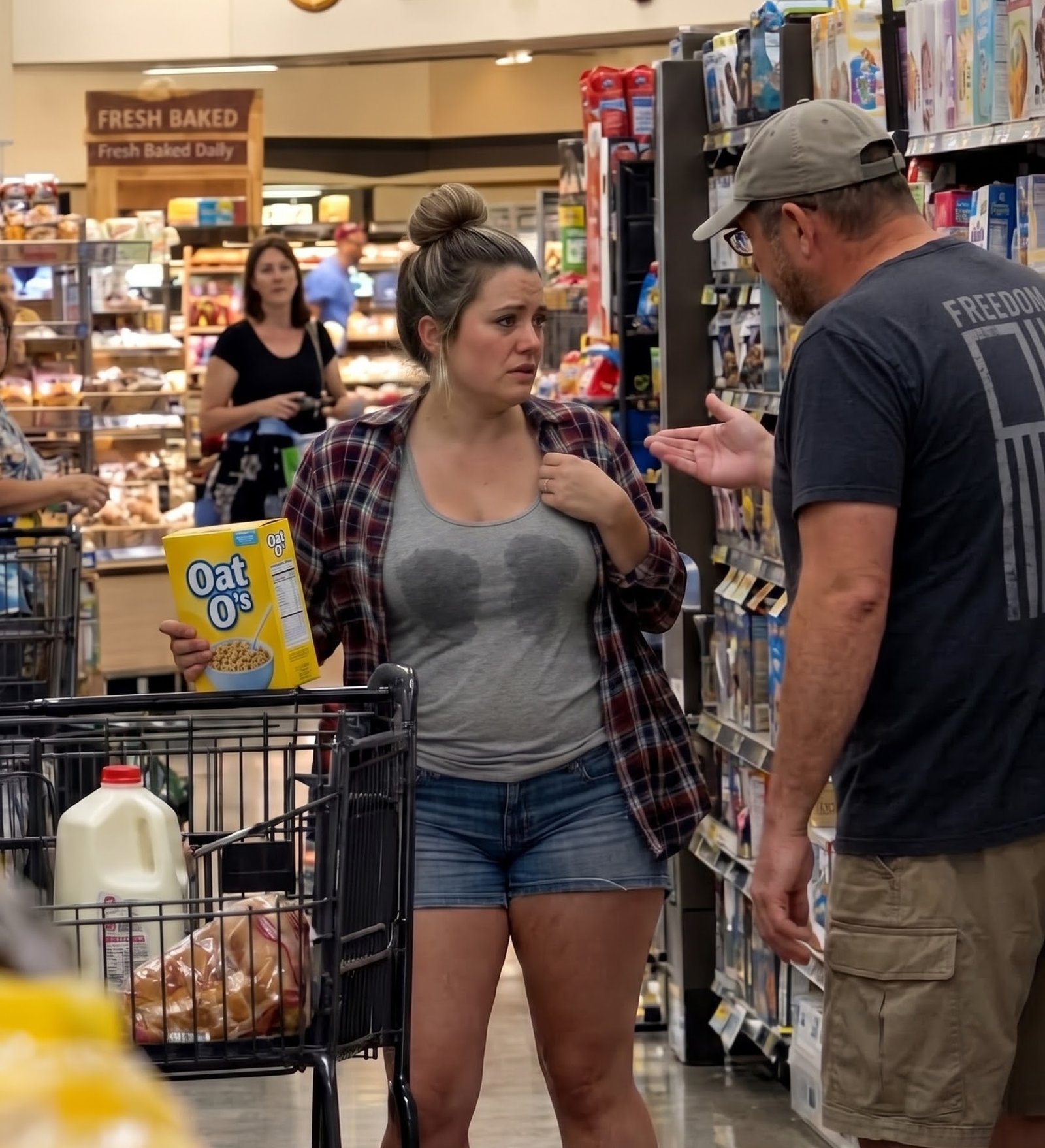
It was my first trip out of the house alone since my daughter was born. I thought the hardest part would be leaving her. Instead, a man I’d never met stood inches from my face and told me nobody wanted to see my body – and for a few awful seconds, I believed him.
Part One: “Cover Yourself”
My milk let down in the middle of the cereal aisle, and I never even felt it.
That’s the part I still can’t get over. Something that loud, that visible, that personal – and my body did it without asking me, without warning me, without so much as a tingle. One second I was a woman comparing the price of two cereal boxes. The next, I was a spectacle.
I was six weeks postpartum. It was the first time I’d left the house by myself since the day we carried Nora home from the hospital in a car seat that looked far too big for her.
When I left, my husband, Dan, was stretched out on the couch with our daughter asleep on his chest, one big hand spread across her back like he was holding a baby bird. He looked at me over the top of her tiny head.
“Take your time, Christy,” he said. “Seriously. Don’t rush back.”
I nodded like I believed that was something I was capable of.
Then I was out the door in under four minutes.
I’d dressed in denim shorts, a gray tank top, and an old flannel shirt I left hanging open. I’d showered. I’d pulled my hair up into something that almost resembled a ponytail. I had even – and I want this on the record – remembered deodorant.
At six weeks postpartum, that felt like accepting an award.
My best friend, Maria, was supposed to meet me at the store. She’d been trying to see me since Nora was born, and I’d canceled on her four separate times. Four. Always with some excuse that sounded reasonable at the time: Nora’s fussy. I didn’t sleep. Maybe next week. The truth was, I didn’t want anyone to see me the way I was.
Her first text arrived as I was pulling into the parking lot.
Stuck behind a truck.
Five minutes later: 5 minutes, I swear.
I smiled at my phone, slipped it into my pocket, and grabbed a cart.
I had bread and a gallon of milk in the basket when I stopped in the cereal aisle. I stood there holding two boxes, one in each hand, squinting at the tiny unit prices on the shelf tags. For reasons I cannot explain, my sleep-deprived brain had decided that saving thirty-seven cents was the single most important mission of my life.
That’s when he came down the aisle.
He looked to be in his sixties. Navy polo shirt tucked into khaki shorts. Gray stubble. White sneakers so clean they looked like they’d never touched the ground. He was pushing a cart with a few cans of soup rattling around in it.
He slowed when he saw me.
Then he stopped – much closer than anybody needed to stop.
“Oh, my God.”
I actually looked around. I thought he’d dropped something, or seen a spill, or maybe spotted a mouse. I even glanced at the floor.
Then he said, loudly enough to carry, “Cover yourself. Nobody needs to see that.”
Someone over by the bakery turned around.
“What?” I said.
He jabbed a finger toward my chest.
I looked down. I still didn’t understand. So – and I will cringe about this for the rest of my life – I grabbed both sides of my flannel and pulled them open, trying to see what he was pointing at.
And then I saw it.
Two wet circles soaked through the front of my gray tank top. Dark gray against light gray. Each one about the size of my palm, perfectly round, impossible to miss.
My milk had let down.
I’d been in that store for eleven minutes.
I stood there frozen, holding my own shirt open, staring down at my chest while a total stranger stood maybe eight inches from my face and watched me do it.
Heat flooded my cheeks so fast it made me dizzy.
And then, for a reason I will probably never understand, I apologized.
Part Two: Three Apologies in Six Seconds
“I’m sorry. I didn’t –”
He made a noise. A disgusted little sound in the back of his throat, the kind of noise you make when you find something rotten in the fridge.
“You people just do whatever you want now.”
“I’m sorry.”
“Walking around like that. In public.”
“I’m sorry.”
Three apologies. Maybe six seconds.
I hadn’t done a single thing to him. I hadn’t bumped his cart. I hadn’t blocked the aisle. I hadn’t spoken to him until he spoke to me. My body had done what bodies do when they’ve been feeding a newborn around the clock for six straight weeks.
And still, I apologized. Over and over, like the words were falling out of me on their own.
I pulled the flannel closed and held it tight with both fists, my shoulders curling forward the way they used to in middle school when I was trying to disappear. I could feel eyes on me. I could feel the whole store tilting in my direction. I remember thinking, very clearly, This is it. This is what I am now. A woman who can’t even go get groceries without making a mess of herself.
That’s when I saw Maria.
She had seen me first. That much was obvious from her face.
She had seen the man standing over me. She had seen me clutching my shirt closed with my chin tucked down. She had heard enough.
She didn’t say hello. She didn’t wave. She didn’t ask what was going on.
She walked straight up beside him – close enough that he had to turn his head to look at her – and she lifted her phone.
“Don’t move,” she said. “Either of you.”
The man frowned. “What are you doing?”
Maria took the picture.
Then she lowered her phone, checked the screen, and gave one small, satisfied nod.
“Good,” she said. “Now say the thing about her body again. I want the second one to have your mouth open.”
His whole face changed.
“What?”
“You heard me.”

Part Three: “Explain It”
“Delete that picture,” he snapped.
Maria let her phone drop casually to her side. “No.”
“I did not give you permission to photograph me.”
Maria glanced at me. Then back at him. Her voice was so calm it was almost pleasant.
“Did Christy give you permission to stand in her face and talk about her breasts?”
His mouth pinched tight. “I wasn’t talking about her breasts.”
Maria raised her eyebrows. “Wonderful. Then what were you talking about?”
He pointed at my shirt. “That.“
“And what is ‘that’?”
He looked around, and for the first time, I think he noticed we weren’t alone.
People were watching now. An older woman with silver hair and a basket of peaches had stopped near the endcap. A younger guy holding a shopping basket had pulled out one earbud. A woman with a toddler strapped into her cart had turned it sideways, blocking half the aisle, and was staring directly at us without even pretending otherwise.
The man lifted his chin. “She should cover herself.”
“Why?” Maria asked.
“Because this is a public place.”
“Yes. It’s a grocery store.”
“You know exactly what I mean.”
“No, I don’t,” Maria said. “Explain it.”
He looked at me again, and I felt myself shrink. I tugged the flannel even tighter, trying to hide the stains.
Maria noticed. Something flickered across her face – half a second of pure fury – and then it was gone, smoothed back into that terrifying calm. She turned back to him.
“She leaked breast milk through her shirt,” Maria said. “Her baby isn’t even here. So explain what she did wrong.”
His face went red.
“Women used to have some modesty.”
The mother with the toddler actually laughed. Out loud. One sharp burst of disbelief.
He heard it. His ears turned pink.
“So what should she have done?” Maria asked.
He didn’t answer.
“You walked up to her and told her to cover herself. What should she have done? Stopped her body from making milk? Told it to wait until she got home?”
“She should have noticed.”
“And done what, at this exact moment?”
“She should go to the bathroom.”
That’s when I finally lifted my head.
Because something strange was happening.
For that first horrible minute, I’d felt like every single person in that store was looking at me. At my shirt. At my body. At my failure.
Now they were looking at him.
And he knew it.
The confidence he’d walked in with was leaking out of him the way the milk had leaked out of me – quietly, visibly, with no way to stop it. His shoulders had stiffened. His eyes kept darting to the watching faces and away again.
Maria wasn’t yelling. Not once. Somehow that made it so much worse for him. There was nothing to push back against. No hysterics he could point to. Just a woman asking simple questions he couldn’t answer.
“So,” she said slowly, “you saw a woman whose shirt got wet because she’s feeding an infant. And your first instinct was to walk up, get in her face, and shame her.”
“I didn’t shame anybody.”
The older woman by the endcap spoke up.
“You absolutely did.”
She crossed her arms over her basket of peaches. “I heard you from two aisles over. Being loud and wrong.”
Part Four: “Manager!”
He looked around like he’d just realized the audience wasn’t on his side. Then his voice climbed.
“I want to speak to a manager.”
Maria smiled. “Oh, fantastic.”
“I mean it.”
“So do I.”
He craned his neck past us and bellowed down the aisle. “Manager!“
My stomach dropped. I leaned toward Maria and whispered, “Maria, please.”
She turned to me instantly. Not annoyed. Not impatient. Just present.
“Do you want me to stop?”
I didn’t know. Part of me wanted to crawl under the bottom shelf and live there with the discount oatmeal. Part of me wanted to run to the car and never come back to this store again.
The man was staring at me. “See?” he said. “Even she knows you’re causing a scene.”
And something inside me twisted.
He was trying to use me. My embarrassment. My shaking hands. He was trying to turn me into his witness against the one person who’d shown up for me.
“No,” I heard myself say. “I don’t.”
It came out quiet. But it came out.
Maria didn’t gloat. She didn’t smile. She just shifted half a step closer to me, so her shoulder was almost touching mine, and stayed there.
A few moments later, a man in a white button-down shirt came hurrying toward us. His name tag said PETER. He took in the scene – the crowd, the sideways cart, the older woman with her arms crossed, the red-faced man – and slowed down.
“What’s going on here?”
The man stepped forward like he’d been waiting his whole life for this. “Finally. These women are harassing me. She’s taking pictures of me without my permission.”
Peter looked at Maria.
Maria held up her phone slightly. “I took one picture. After he stood over my friend and yelled at her about her body.”
“I did not yell.”
“Yes, you did,” said the older woman.
The younger guy with the basket nodded. “He definitely did, man.”
Peter turned to the man. “Sir, what happened before the picture was taken?”
The man waved a hand in my direction, like I was a stain on the floor someone forgot to mop. “She was walking around like that.”
Peter glanced at my shirt.
I watched him understand. His eyebrows lifted, just barely, and then his whole expression went flat and cool.
“I simply told her,” the man continued, “that she should have some decency in public.”
“You told her nobody needed to see her,” the mother with the toddler corrected.
He spun on her. “Mind your own business.”
“Sir.” Peter’s voice sharpened. “You’re being rude.”
The aisle went quiet.

Part Five: Ronald
Peter stepped between us – careful, I noticed, to keep a respectful distance from me.
“What’s your name?”
The man hesitated. You could see him weighing whether to answer.
“Ronald.”
“Ronald,” Peter said evenly, “from what I’m hearing, you approached a customer who wasn’t bothering you, made comments about her body, and kept going after she was clearly uncomfortable.”
“I was trying to help.”
“By humiliating her?” Maria asked.
Ronald jabbed a finger toward me. “She’s the problem. Walking around like that.”
Peter didn’t even blink. “No. From what I’m hearing, you started this.”
Ronald’s mouth fell open. “You can’t be serious.”
“I am.”
Ronald let out a short, ugly laugh. “So this is acceptable now? This is what we’re doing?”
Peter looked at my shirt one more time, then back at him.
“A customer having breast milk leak through her clothing is not a violation of store policy.”
Somebody behind us snorted.
Ronald turned an even deeper shade of red.
“You’re welcome to finish your shopping,” Peter went on. “But you’re going to leave these customers alone. If you keep bothering them, I’ll ask you to leave the store.”
Ronald stared at him. “No apology?”
Peter looked honestly confused. “From whom?”
Ronald looked around.
At the older woman with her peaches. At the young guy with his earbud dangling. At the mother, whose toddler was now happily gnawing on a box of crackers. At Maria. At me.
Nobody said a word.
I think that was the moment it finally landed on him. Not one person in that aisle agreed with him. Not one. He’d walked in believing he was the voice of decency, and he was leaving as the only person who couldn’t see what everyone else could.
First his face flushed. Then his jaw locked. Then he dropped his eyes to his cart like he’d suddenly developed a deep fascination with canned soup.
Maria said nothing. Neither did I.
Ronald grabbed the handle of his cart and shoved off. As he rounded the end of the aisle, he muttered, “Unbelievable.”
The older woman called after him, sweet as pie. “Have a nice day, Ronald!”
A few people laughed.
I didn’t.
Because the second he disappeared around that corner, every ounce of strength drained out of my body at once. My knees went soft. My hands started to shake so hard I had to let go of the flannel.
Maria turned to me. “Hey.”
“I’m fine.”
She looked down at my hands. “No, you’re not.”
“I’m just embarrassed.”
“Christy.”
“I’m okay. Really.”
“You’re shaking.”
And that’s when I started to cry.
Part Six: “I’m Really Tired”
Not pretty crying, either. The kind that comes up from somewhere deep and doesn’t care where you are. Right there in the cereal aisle, next to the two boxes I never did decide between.
Maria pulled a napkin out of her purse and kept wiping my face, gently, like I was the baby.
“This is ridiculous,” I choked out.
“No, it isn’t.”
“Some old man yelled at me. People get yelled at every single day. It’s not a big deal.”
Maria leaned in close so only I could hear. “When’s the last time you slept more than a few hours in a row?”
I opened my mouth to answer. Then I closed it. I actually had to think about it.
“I don’t know.”
Her whole face softened.
“I’m tired,” I whispered.
“I know.”
My voice cracked right down the middle. “I’m really tired, Maria.”
It was the first time I’d said it out loud. To anyone. Even to myself.
I was exhausted in a way I didn’t have words for. I loved Nora more than I had ever loved anything in my life – more than I’d known it was possible to love something. But for six weeks, every hour of my existence had belonged to someone else.
Feeding. Pumping. Washing bottles. Changing diapers. Rocking. Bouncing. Shushing. Standing over the bassinet at three in the morning with my hand hovering over her chest to make sure it was still rising and falling. Googling terrifying things at two a.m. with the screen dimmed all the way down. Waking up even when Dan had her, because my body heard every sound she made – every squeak, every sigh – from two rooms away.
Maria took my hand. “Why didn’t you tell me?”
“I canceled on you four times.”
“That’s not an answer.”
I stared at the floor. “I didn’t want anyone thinking I couldn’t handle my own baby.”
“Christy. You’re not supposed to handle a baby alone.”
“I’m not alone. I have Dan, and he’s amazing.”
“I know he is.”
That made me cry harder. “He works all day, and then he comes home and takes her so I can rest, and I feel so guilty because he’s exhausted too. And when he tells me to go lie down, I just lie there. Listening for her. I can’t turn it off.”
Maria rubbed slow circles on my arm.
“I walked into this store today,” I said, “and I felt like I’d forgotten how to be a person.”
“You didn’t.”
“And then some stranger looked at me like I was disgusting.”
Maria’s jaw tightened. “He’s an idiot.”
I looked down at the two dark circles on my shirt. “I apologized to him. Three times.”
“He didn’t deserve a single one.”
“I didn’t even do anything wrong.”
“No,” Maria said. “You didn’t.”
She squeezed my hand hard, then let it go and stood up straight like a general about to issue orders.
“Okay. We’re getting out of here.”

Part Seven: Stolen for the Afternoon
She finished my shopping for me. Every item on my list, plus a bag of the expensive chocolate-covered almonds I always pretended I didn’t want.
I sat in the passenger seat of her car, zipped into her black hoodie, while she loaded my groceries into her trunk. The hoodie smelled like her laundry soap and faintly like vanilla, and for some reason, that almost made me cry all over again.
She slid into the driver’s seat and picked up her phone.
“We’re not going home yet.”
I frowned. “Why not?”
“First, I’m calling Dan.”
She dialed. He picked up almost immediately.
“Hi, Dan. It’s Maria.”
I could hear his voice through the speaker – instantly worried, the way new fathers are always one second away from worried.
“Christy’s okay,” Maria said. “She’s with me. Grocery store drama. She’ll explain later. But I’m stealing your wife for the afternoon.”
“Maria,” I hissed.
She held up one finger without looking at me.
“Yes, she’s fine. No, you don’t need to come. We’ll have her home by this evening.” She listened for a moment, then smiled. “Perfect. Keep the baby alive.”
She hung up.
I stared at her. “He said yes?”
“He said, and I quote, ‘Please don’t bring her back until she’s eaten something.‘”
That made me laugh. A small, surprised laugh, but a real one. The first one all day.
Maria drove me across town to a spa. Not some fancy resort with marble floors and cucumber water in crystal pitchers. Just a quiet little place tucked between a dry cleaner and a bakery, where she apparently knew one of the receptionists.
She bought me lunch first – a real lunch, sitting down, with a fork, where I ate an entire sandwich while it was still warm. Then she paid for a massage, a facial, and one of those ridiculous scalp treatments where someone spends twenty minutes massaging your head until you start wondering why you ever bothered washing your own hair.
For three hours, nobody needed anything from me.
Nobody cried. Nobody asked to be fed. Nobody touched me unless I said yes first.
Somewhere in the middle of the massage, I fell asleep. Deeply. When I woke up, I genuinely didn’t know where I was for about three seconds – just warm, heavy, and blank.
Then I realized how I felt.
Rested.
Actually, truly rested, for the first time in six weeks.
On the drive home, the sun was going gold over the rooftops. Maria kept her eyes on the road.
“I want to offer you something.”
“You’ve already done more than enough.”
She smiled. “I have some money I’ve been saving to spoil baby Nora.”
I turned toward her. “I told you to wait until she’s old enough to remember it.”
“She’s basically my niece. I’m going to spoil her whether she remembers it or not.” She tapped the steering wheel. “But I want to use the money for something else.”
“You always have wild ideas. What is it this time?”
“I want to pay for someone to come help you. A few hours a day.”
I sat straight up. “Maria. No. You can’t do that.”
“Yes, I can. That way I’m taking care of baby Nora and my best friend. Two for one.”
“I can’t let you do that.”
“Three or four hours. A few days a week. That’s all.”
“It’s too much.”
“For who?”
“For you.”
She glanced over at me at a red light. “Christy, I’ve known you since we were nineteen. You paid my rent for two months when I got laid off. You never let me pay it back.”
“That was different.”
“Why?”
I opened my mouth. Nothing came out. I had no answer, and we both knew it.
“Let me help you,” she said quietly. “For once, let somebody help you.”
I looked out the window at the houses sliding by. “What would I even do with the time?”
“Sleep. Get another massage. Anything you want.” When I laughed, she shook her head. “I’m serious. Sleep. Shower. Go for a walk. Sit in your car and stare at a wall. I don’t care what you do. Just do something that’s for you.”
The light turned green. She drove on.
A block later, she said, “You love your daughter. Nobody who knows you is confused about that.”
My throat tightened.
“Being tired doesn’t cancel out loving her.”
Part Eight: What My Body Is For
When we pulled into my driveway, Dan was already standing at the front window.
He opened the door before I’d made it halfway up the walk. Nora was curled against his chest, and she was awake. Her tiny face turned toward me the second I stepped inside, those dark, serious eyes finding mine, and everything inside me went soft.
“Hi,” Dan said.
“Hi.”
He looked me up and down, and a slow smile spread across his face. “You look different.”
Maria called from behind me, “She got moisturized.”
Dan laughed.
I reached for Nora. The moment she settled against me – warm and heavy and smelling like milk and sleep – I felt it happen again. That familiar tingling rush. Another letdown.
This time, I noticed.
I looked down at my shirt. Then over my shoulder at Maria.
And I laughed. A real, full, helpless laugh that shook my whole chest.
Dan looked back and forth between us, completely lost. “What’s funny?”
“I’ll explain later.”
Nora made a tiny sound and pressed her face into me, rooting, impatient, perfect.
Six weeks earlier, I’d believed being a good mother meant always being available. Always being grateful. Always coping. Never admitting that some days I felt like I was coming apart at the seams.
Standing in my doorway that evening, I was starting to understand that maybe being a good mother also meant knowing when I needed help. And letting myself take it.
Ronald had looked at my body and seen something shameful.
That morning, for a few terrible seconds in the cereal aisle, I had almost believed him.
By evening, I could look at the very same body and see something else entirely.
It was tired. It was leaking. It still ached in places nobody had ever warned me about.
But it had carried my daughter for nine months. It had brought her into the world. It was feeding her right now.
And it was mine.
Dan kissed my forehead. Maria squeezed my shoulder on her way out and mouthed, Call me tomorrow. This time, I knew I would.
Nora yawned against my chest.
For the first time since we brought her home, I didn’t feel like I had to prove I could do everything alone.
I had people. I had help.
And as of the following week, I also had a babysitter four afternoons a week, because Maria absolutely refused to take no for an answer.
I still think about that grocery store sometimes.
But I don’t think about Ronald’s face anymore. Not the disgust. Not the pointing finger. Not the way he said nobody needs to see that.
I think about the moment the whole aisle stopped looking at me.
And started looking at him.
I think about the way his confidence crumbled when he realized he was standing alone. The way he stared into his cart full of soup cans because he couldn’t bear to meet anyone’s eyes.
He walked into that aisle thinking I was the one who should be ashamed.
He walked out knowing it was him.
Disclaimer: This fictional story is for entertainment only. It does not represent any person or organization and does not encourage inappropriate behavior. Created with AI assistance.


