

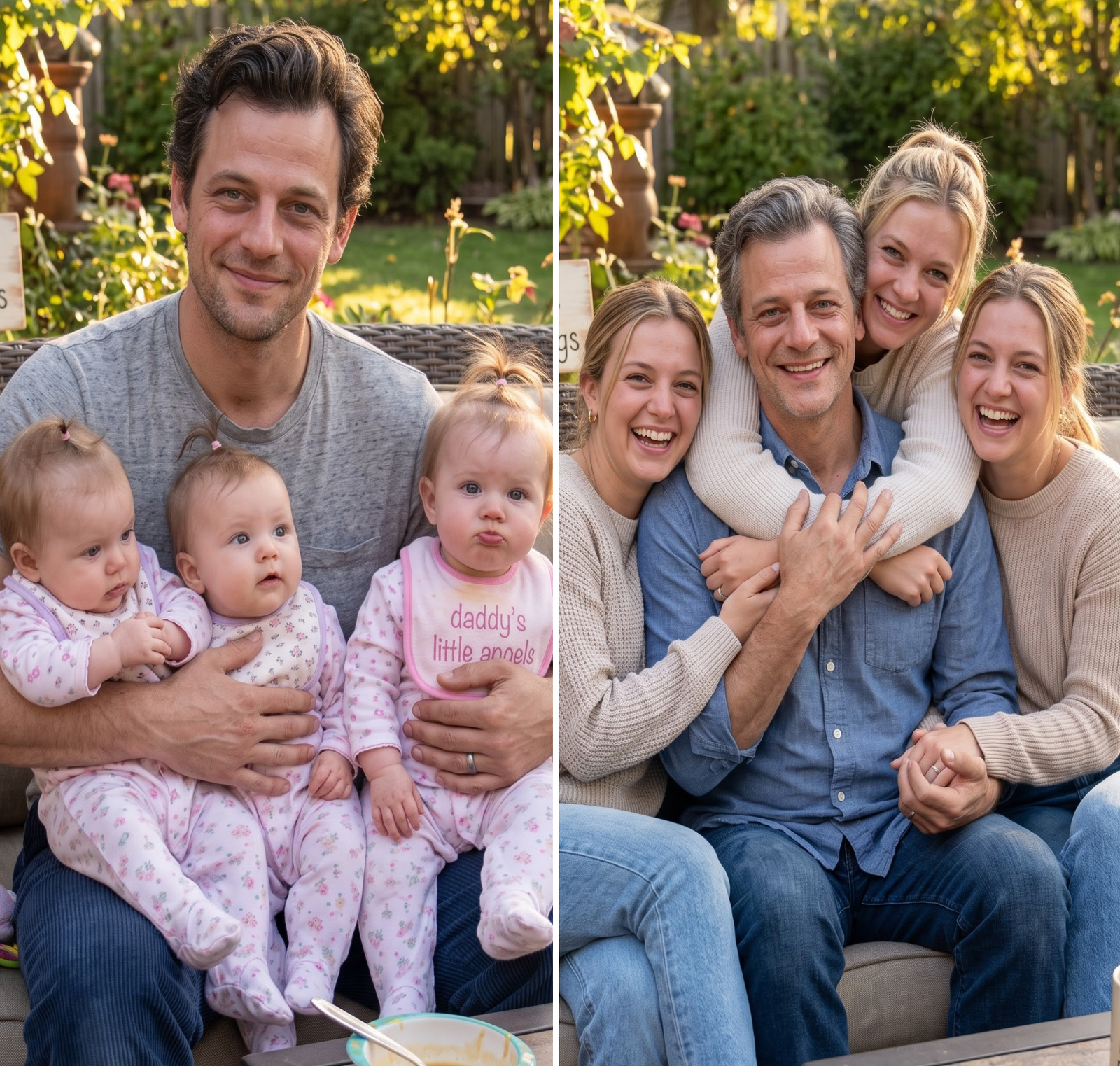
For twenty-one years, I believed the story was simple: my wife chose another man over our three baby girls, and she never looked back. Then a courier walked into our birthday party carrying three velvet boxes, and I learned she had been looking back the entire time. That turned out to be the hardest part of all.
You’ll Manage
Our daughters were eight days old when Vanessa left.
There was no fight. No suitcase dragged down the stairs in the middle of the night. No custody battle, no lawyer’s letter, no arrangement for weekend visits. Just a single sheet of paper pinned to the refrigerator under a souvenir magnet from a beach town we’d visited on our honeymoon.
Mark, I’m sorry. Daniel makes me feel alive. You’ll manage. You always do.
I read it standing in the kitchen with one baby on my shoulder and two more crying in the next room. I read it again at three in the morning, warming bottles in the dark. I must have read it a hundred times that first month, and every time, the same two words rose off the page and struck me across the face.
You’ll manage.
As if I were a man who could be trusted to carry anything. As if three newborns were a chore she was handing off before a trip.
Three cribs. Three car seats. Three fevers that always seemed to arrive on the same night.
But she was right about one thing. I managed.
The Father Who Learned Everything
I learned to braid hair before the sun came up – badly at first, then well enough that other mothers at the bus stop asked who did the girls’ French braids.
I sewed Halloween costumes that fell apart by the third house. I packed lunches that got better every year. I learned which daughter hated crusts, which one traded her apple for cookies, and which one secretly gave half her sandwich to a boy who never brought anything.
I sat through three parent-teacher conferences in a single evening, moving from classroom to classroom in the same tired tie. I showed up to every mother-daughter breakfast at their elementary school, the only man in a room full of mothers, because Emma, Sophie, and Claire refused to go without me.
“You’re our mom and our dad,” Claire told me once, when she was seven. “So you have to come to both.”
For twenty-one years, Vanessa never called.
Not on Christmas morning. Not on a single birthday. Not when Claire fell off the monkey bars at eleven and snapped her arm in two places. Not when Sophie won a full scholarship. Not when Emma walked across the stage as valedictorian and searched the crowd, just for a second, for a face she had never seen.
Nothing. Not a card. Not a word.
I stopped waiting for her somewhere around the girls’ third birthday. The anger I kept much longer. It turned out to be useful. Anger can get a man out of bed when love alone is too tired.
The Courier at the Gate
On our daughters’ twenty-first birthday, we threw a party in the backyard.
I’d strung fairy lights through the maple branches the night before. Forty friends and relatives filled the lawn with folding chairs and paper plates and laughter. There were three cakes on the picnic table, because the girls had declared at age eight that they would never share a birthday cake again, and none of them had ever reconsidered.
I was cutting Sophie’s lemon cake when a white courier van pulled up at the curb.
A young man climbed out carrying three identical boxes stacked in his arms. Dark blue velvet. Each one tied with a silver ribbon that caught the fairy lights.
“Delivery for Emma, Sophie, and Claire?”
The girls glanced at each other.
“That’s us,” Emma said.
He set the boxes on the table between the cakes and left. The party noise dipped, the way it does when something unexpected lands in the middle of a celebration.
On top of the stack sat a plain white envelope. Two words were written across it in slanted blue ink.
READ FIRST.
My body recognized the handwriting before my mind did. My chest went tight. My fingers went cold around the cake knife. It was the same hand that had written You’ll manage on a sheet of paper I had kept, God help me, in a kitchen drawer for twenty-one years.

For Their Father
Claire picked up the envelope.
“Dad?”
Sophie was already watching my face. She had always been the one who read me first.
“No,” she said quietly. “No, no, no.”
Emma looked from her sister to me. “Is this from her?”
I couldn’t make my voice work, so I just nodded.
Sophie pushed her box away so hard it nearly slid off the table.
“Throw them out. All of them. I don’t want anything she touched.”
But Claire had turned the envelope over, and she went very still.
“It’s not for us,” she said.
Beneath READ FIRST, in smaller letters, Vanessa had written: For their father.
I took the envelope into the kitchen and shut the door behind me. Through the window I could see my daughters standing by the picnic table, three silhouettes against the fairy lights, not one of them moving.
I expected an apology. Or a request to see the girls. Or some carefully worded excuse I could tear apart.
Instead, the first line read:
Mark, before you tell them I disappeared completely, count how many months I’ve been gone.
Weeks, Not Months
I sat down at the kitchen table and kept reading.
I have stage-four pancreatic cancer. My doctors believe I have weeks, not months. I know how that sounds. I am not asking you to feel sorry for me. I gave up any right to that a long time ago.
I read the sentence twice. I waited to feel something – triumph, grief, pity. What I felt was mostly exhaustion, as if someone had handed me one more heavy thing to carry after I’d finally set the last one down.
Then came the line that made the room go quiet.
The boxes are not gifts. They’re receipts.
Open yours first. There is a fourth box. Check the van.
I ran out the front door. The courier was still parked at the curb, filling out paperwork on a clipboard. When I asked, he frowned, then leaned across to the passenger seat.
A fourth velvet box sat there. Smaller than the others.
Inside was an old bank passbook, its corners soft with age. The account had been opened in 2005 – one month after Vanessa walked out of our lives.
Three names were written inside the cover.
Emma. Sophie. Claire.
Two Hundred and Fifty-Two
I turned the pages slowly.
Deposit. Deposit. Deposit.
Every month. Without a single gap. For twenty-one years.
Beneath the passbook lay a thick bundle of paper receipts bound with a rubber band gone brittle with time. Across the top, in that same slanted hand, Vanessa had written a number.
252.
Two hundred and fifty-two deposits. Two hundred and fifty-two months. One for every month she had been gone.
“How much?”
I hadn’t heard the kitchen door open. Emma stood there, her sisters crowded behind her.
I checked the balance on the final page. After twenty-one years of deposits and interest, the account held just over two hundred and eighty thousand dollars.
Sophie let out a short, bitter laugh.
“So that’s it.”
“What?”
“She wants us to know she paid.”
Emma’s jaw hardened. “She didn’t.”
I looked up at her.
“Not for us,” Emma said. “You did.”
What the Money Never Bought
She was right, and it landed in me like a stone dropped down a well.
I had never known that account existed. Not one dollar of it had ever touched our lives.
Vanessa’s money hadn’t bought a single diaper. It hadn’t covered the mortgage the year I worked nights at the warehouse and slept four hours between shifts. It hadn’t paid for braces or school uniforms or groceries in the lean months, or three prom dresses bought on the same credit card.
She had saved money for them.
She had not raised them with it.
Claire stared at the boxes on the table. “Why would she keep it all this time? Why not just send it?”
I went back to the letter. There was one final paragraph.
The girls may keep every dollar, whether they forgive me or not. But the boxes come with one condition. They must be opened together, with you in the room. Nothing inside will make sense alone.
“I don’t want anything from her,” Sophie said.
“You don’t have to take anything,” I told her.
Claire rested her hand on the lid of her box. “But I want to know.”
Emma looked at Sophie for a long moment. Then Sophie pulled out a chair and sat down, her arms folded tight across her chest.
“Fine. But all three. Together. Like she wants.” She said the last words like they tasted bad.

The Bank, the Number, and the Key
We carried the boxes into the kitchen, and the party went on without us in the yard.
Emma opened hers first. Inside, resting on white satin, was a single card. On it, Vanessa had written a date – the date of her first deposit, exactly one month after she left. On the back was the name and address of a bank downtown.
Sophie opened hers next, reluctantly, like she was lifting the lid on something that might bite.
It was packed with envelopes. Twenty-one of them, bundled with twine. One for every birthday, including this one. None had stamps. None had ever been mailed.
Tucked underneath was a small card printed with a safe-deposit box number.
Claire opened hers last.
Inside was a small brass key.
We laid the three things side by side on the kitchen table and stared at them.
A bank. A box number. A key.
Now her condition made sense. Alone, each gift was useless. Together, they opened a door.
The next morning, the four of us drove downtown.
The Letter That Wasn’t Mine
Inside the safe-deposit box was another envelope, this one addressed to the girls.
Claire unfolded it and read aloud, her voice careful.
“If you’ve made it this far, you know I saved money for you. Please do not confuse that with being your mother. Your father did that job. All of it.”
Sophie’s eyes flicked up to me. I kept my face still.
“I left because I was selfish. Daniel told me I deserved a life that wasn’t bottles and crying and bills. I wanted to believe him, so I did.”
Then Claire paused, and her voice changed.
“Six months after I left, I tried to come home.”
My heart stopped.
Emma turned to me. “Did she?”
“No,” I said. “Never. I’d have remembered.”
But Vanessa had written to me, the letter said, begging to come back. Two weeks later, a reply had arrived. She had kept it all these years. It was here, folded in the box.
I opened it with hands that didn’t feel like mine.
My name was typed at the bottom.
Vanessa – You made your choice. The girls don’t need you. They don’t even know you. Stay with Daniel and leave us alone. If you ever contact them again, I’ll make sure they know exactly what kind of woman their mother is. – Mark
Sophie stared at me. “Dad?”
“I never wrote that.” My voice came out rough. “I never saw her letter. I never wrote a word of this.”
Emma took the page from my hand. “Are you sure?”
I looked at my three daughters – the girls I had fed and bathed and sat up with through every nightmare.
“I spent twenty-one years hating your mother,” I said. “If I had done this, I would tell you. I wouldn’t hide behind it.”
Nine Years
There was another page in the box. On it, Vanessa explained that years later, in a drunken argument, Daniel had confessed. He had intercepted her letter and typed my reply himself.
For a moment, I felt the ground shift under my twenty-one years of anger. She had tried. Someone had stood between her and our door.
Then Claire read the next line, and whatever softness had begun to form in me went cold.
“I discovered the letter was fake nine years ago.”
Sophie stood up so fast her chair scraped the tile.
“Nine years?“
Claire’s hands were trembling, but she kept reading.
“By then you were twelve. I had already missed first words, first steps, first days of school, scraped knees, Christmas mornings, and twelve birthdays. I told myself coming back would only hurt you. That was partly true.”
Her voice broke.
“Mostly, I was a coward.”
Emma lowered her eyes.
There was one final sentence at the bottom of the page.
“By then, I wasn’t afraid your father would turn me away. I was afraid you would.”
For a long time, nobody said anything. The hum of the bank’s air vents filled the little room.
Then Sophie took the letter out of Claire’s hands and read it again herself.
“So she knew,” she said flatly. “Nine years ago, she found out Dad never told her to stay away.”
Claire nodded. “And she still didn’t come.”
Six Houses Away
One more page explained the rest. Daniel had forged my letter because he was afraid she’d go home – he needed her to believe there was nothing left to go home to. Less than two years later, she caught him with another woman and left him. The money in the account had never been his. Every deposit had come from her own paycheck.
But by the time she left Daniel, shame had done what his lie had started. It kept her away.
Back home that evening, Emma picked up the bundle of birthday letters.
“Can we read them?”
“They’re yours,” I said.
We sat on the living room floor like the girls used to when they were small, and they read them in order.
On their first birthday, Vanessa wrote about buying three cards and sitting in her car outside the post office, unable to go in.
On their fifth, she described seeing a set of triplets in a grocery store and crying in the parking lot for an hour afterward.
On their tenth, she wrote that she had found their school’s website and a photograph of Sophie holding a science fair trophy.
Sophie stopped reading. “She was watching us?”
Claire opened the twelfth.
“I finally learned the truth about the letter this year. I hired someone to find you. I know your address now. I know where you go to school. I know your father never remarried.”
Emma’s eyes filled. “So she could have come.”
“Yes,” Sophie said. There was no softness in it at all. “She could have come.”
The next line proved it.
“On your twelfth birthday, I drove to your street. I parked six houses away. I watched the three of you hanging balloons on the porch with your father. I sat there for forty minutes. Then I drove away.”
Claire pressed her hand over her mouth.
I remembered that birthday. I remembered the balloons – Emma insisted on purple, Sophie on green, Claire on silver. I remembered laughing on the porch steps, thinking my girls had everything they needed.
And six houses away, their mother had been sitting in a parked car, choosing to leave again.
That’s on Her
Emma was crying openly now. Claire’s shoulders shook.
Sophie didn’t cry.
She picked up the next letter and tore it cleanly in half.
“Sophie—”
“No.”
She tore it again.
“Daniel lied to her. Fine. That’s on him.” Another tear. “But after she found out? After she knew exactly where we were?”
She let the pieces fall onto the carpet.
“That’s on her.”
Nobody argued. There was nothing to argue with.
At the bottom of the bundle was one last card. Not a letter – just a phone number and a few lines.
I will be at St. Matthew’s Hospice until I am no longer able to receive visitors. You owe me nothing. If none of you come, I will understand.
Emma stared at the number like it might disappear.
Claire asked the question none of us wanted to face.
“Do we go?”
“No,” Sophie said instantly.
“I don’t know,” Emma whispered.
Claire turned to me. “Dad? What do you think?”
For twenty-one years, I had rehearsed what I would say if Vanessa ever came back. Speeches in the shower. Arguments in the car. Every one of them felt useless now.
“I think she doesn’t get to make this decision too,” I said.
They waited.
“She decided when to leave. She decided when not to come back. She decided when to send those boxes.” I looked at each of my daughters in turn. “This one belongs to you.”

The Woman in the Bed
Sophie didn’t go.
Emma and Claire did. I drove them.
I hadn’t planned on going inside. But in the hospice parking lot, Claire reached across the seat and took my hand the way she used to when she was little and scared of the dentist.
“Please, Dad.”
So I went in.
Vanessa was smaller than I remembered. That was the first thing that struck me. For two decades, she had taken up an enormous space inside my anger – a towering figure, a villain in every story I told myself at night. Now she was just a thin, gray woman propped against white pillows, her hands resting on the blanket like something set down and forgotten.
Her eyes found the girls first. She began to cry before anyone spoke.
“Emma?”
Emma nodded.
Vanessa’s gaze moved. “And Claire.”
Claire sat down in the chair beside the bed.
Vanessa looked toward the doorway. “Where’s Sophie?”
Emma’s face tightened. “She didn’t want to come.”
Vanessa closed her eyes. “Okay,” she whispered. “Okay.”
Then she saw me.
“Mark.”
I hadn’t heard her say my name in twenty-one years. It sounded like a word in a language I used to speak.
“Why now?” I asked.
She looked at the girls. “Because I’m dying.”
“That’s why you sent the boxes. It’s not why you waited nine years.”
She nodded slowly. “No.”
“Then why?”
Her answer was barely louder than the machines.
“Because every year I waited made the next one harder.”
“That’s it?” Emma said.
“No.” Vanessa met her eyes. “The uglier truth is that I wanted to come back while I could still imagine you wanting me. When I found out about the letter, you were twelve. You had a father. Friends. A home. A whole life I hadn’t earned a place in.”
“So you watched us instead,” Emma said.
“Yes.”
Claire’s voice was so soft I almost missed it. “Why didn’t you ever mail the birthday letters?”
“Because mailing them meant I’d have to accept whatever came back.”
That answer hurt more than any lie could have, because it was honest. She hadn’t stayed away to protect our daughters. She had stayed away because rejection frightened her more than her absence could ever hurt them.
Emma stood up. “I thought there would be a better reason.”
Vanessa’s lips trembled. “So did I.”
You Know Now. He Knew Then.
Claire asked about the money. “Why save all of it? Why not use it?”
Vanessa glanced at me, then back at the girls. “At first, it was guilt. Later, it was because I knew I had no right to show up someday and ask your father to carry the cost of my mistakes on top of everything else.”
“You could have helped him when he needed it,” Emma said.
“I know.”
“Dad worked nights for a year.”
“I know.”
“He sold his truck when Claire needed surgery.”
I turned to look at Emma. I had never told the girls why I sold that truck. I’d told them I just didn’t need it anymore. Somehow, they had worked it out on their own.
Vanessa’s face crumpled. “I know.”
Emma shook her head slowly.
“No. You know now. He knew then.”
That was the sentence that finally broke her. Vanessa covered her face with both hands and sobbed – deep, ragged sounds that filled the little room.
I felt no satisfaction watching it. But I didn’t rush to rescue her from it, either.
Some pain belongs to the person who caused it.
Claire stayed another twenty minutes. Emma lasted five.
As we turned to leave, Vanessa spoke one last time.
“Will you tell Sophie I’m sorry?”
Emma stopped at the door and looked back.
“No.”
Vanessa blinked.
“You can tell her yourself,” Emma said. “Write her a letter if you want. But I’m not carrying it for you.”
And in that moment, I saw something in my daughter that had nothing to do with me or with Vanessa. She wasn’t defending me. She wasn’t punishing her mother. She was simply setting down a weight that had never been hers to carry.
Vanessa nodded. “You’re right.”
We left.
Receipts and Photographs
Vanessa wrote Sophie one letter. Sophie read it. She never replied.
Claire went back twice more. Emma never returned, but she spoke to Vanessa once on the phone, for eleven minutes.
None of them ever called her Mom.
Vanessa died seventeen days after the boxes arrived.
The money was divided equally among the girls. There was no second condition, no final twist. Each daughter simply received her share.
Sophie used part of hers to pay off her student loans. Claire tucked most of hers into savings.
Emma did something I never expected.
She bought three picture frames. Into each one, she placed one of Vanessa’s earliest deposit receipts – yellowed, dated 2005 – beside a copy of our favorite photograph: the four of us on the porch steps, sunburned and laughing, the summer the girls turned ten.
She gave one frame to each sister.
Sophie stared at hers. “Why would I want this?”
Emma touched the glass over the receipt.
“Because this is what she gave us.”
Then she moved her finger to the photograph.
“And this is who raised us.”
Sophie looked at it for a long, long time. Then she took it home and set it on her bookshelf, where it still sits today.
Both Things Can Be True
On the first anniversary of Vanessa’s death, Claire came over for dinner and asked me, while we were washing dishes, whether I still hated her mother.
I thought about the note on the refrigerator. The forged letter. Two hundred and fifty-two deposits. Twenty-one birthday letters that never left her hands. A woman sitting in a parked car six houses from her own children, too afraid to walk up and knock.
“No,” I said.
And I meant it.
Hating Vanessa had been useful once. It got me through two a.m. feedings and overdue bills and school concerts with an empty seat beside me. It kept me standing when I had nothing else left.
But my girls were grown now. I didn’t need anger to raise them anymore.
Vanessa had been robbed of a second chance. And then she had thrown away another one herself.
Both things were true.
Daniel had deceived her. And she had abandoned our daughters.
She had saved money for them. And she had left me to spend twenty-one years doing the real work of loving them.
The velvet boxes didn’t erase any of it. They weren’t forgiveness. They weren’t secret proof that she had been a good mother all along.
In the end, Vanessa had been right about one thing. They were receipts – proof that a person can think about you every single day and still never show up.
My daughters didn’t need a bank balance to tell them who had raised them. They already knew.
For twenty-one years, I believed the worst thing Vanessa ever did was walk out our front door.
I was wrong.
The worst thing she did was let every year that followed become one more reason not to knock on it again.
Note: This story is a work of fiction inspired by real events. Names, characters, and details have been altered. Any resemblance is coincidental. The author and publisher disclaim accuracy, liability, and responsibility for interpretations or reliance. All images are for illustration purposes only.


