

Part 1: The Whisper Before the Bus
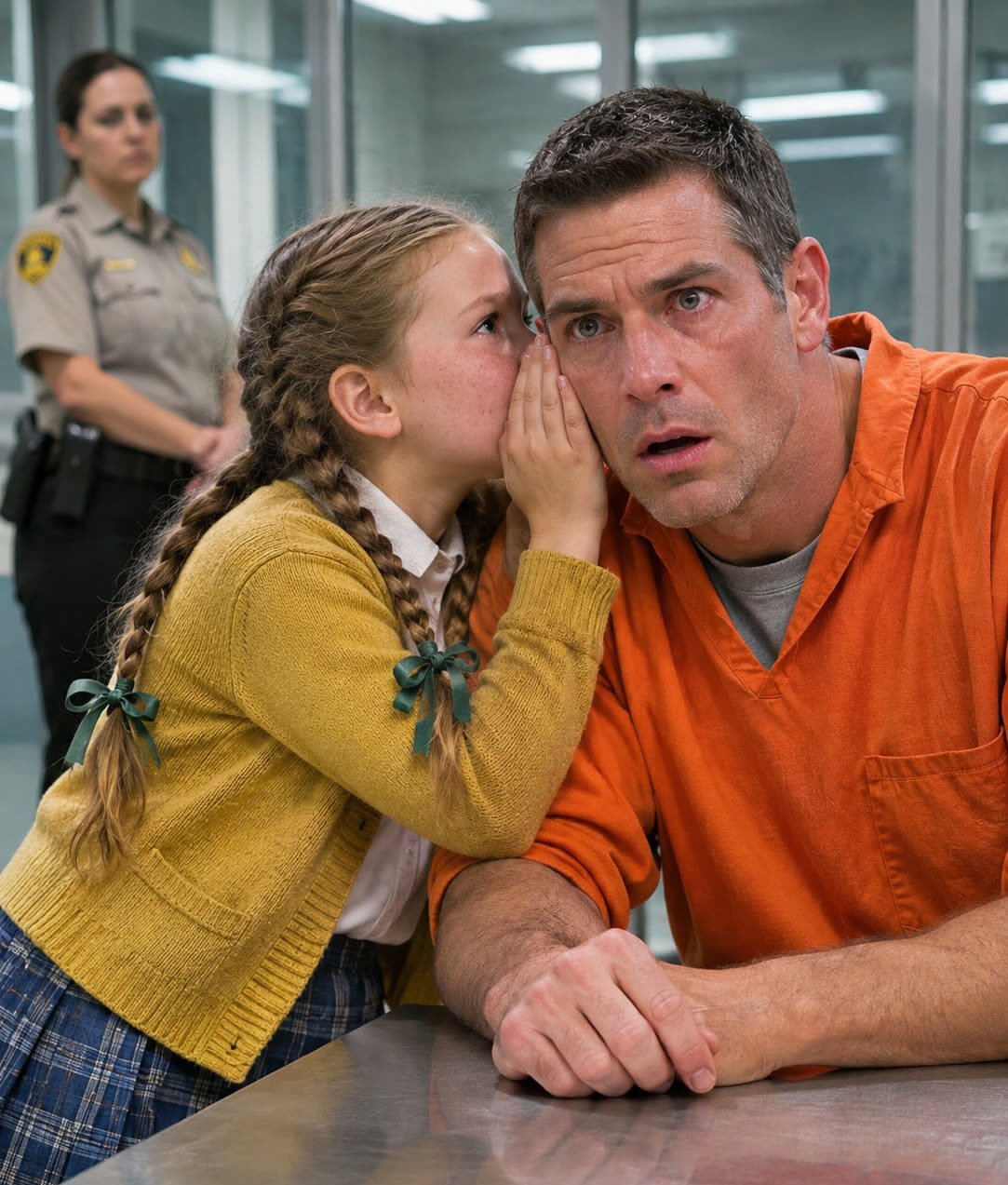
Six hours before a van was due to carry me four hundred miles north, my nine-year-old daughter pressed her lips against my ear and said the sentence I had stopped believing anyone would ever say. “Daddy, Mr. Pryce isn’t dead. I saw him on Uncle Curtis’s boat, and he told me to tell you to look in Grandpa’s compass box.” The chain on my cuffs scraped the steel table as my hand flew to my mouth. Behind Junie, Officer Okafor glanced up from her clipboard. I forced my face to go still, because for five years I had been the man who murdered his business partner, and that man was not allowed to look hopeful.
“Everything all right, Hartwell?” Okafor asked.
“Just a long hug,” I said. My voice sounded like it belonged to someone else.
Junie leaned back and looked at me with an unnerving steadiness. Her braids were tied with green ribbons, and her yellow cardigan was buttoned wrong, the way it always was when she dressed herself in a hurry. She was nine. She had been four the night my life ended.
That hug was supposed to be our last for a long while. At six o’clock that evening, a transport van would move me from the Muskegon Correctional Facility to a maximum-security prison in the Upper Peninsula, a full day’s drive from my daughter. Her aunt Dana had explained it in the car on the way here. Junie, I realized, had decided to say goodbye with a secret.
Five years earlier, in October, a fire destroyed Hartwell & Pryce Marine Supply, the shop I had built with Martin Pryce over twelve years. Firefighters found remains in the back office. They were identified as Martin by his wristwatch and by dental records from his dentist. The fire marshal ruled the blaze arson.
I had argued with Martin that afternoon, loudly, in front of two employees. I had found payments to a vendor I could not trace, and I told him I was calling an outside auditor on Monday. Hours later, my key card opened the back door at 11:12 p.m. I had left that card in my jacket, and I had left the jacket hanging in the office. At that hour, I was home with my sleeping daughter, and the only other adult who could have said so was my wife, Naomi, who had died of cancer two years earlier.
The jury deliberated for two days. The judge gave me thirty-two years for arson and second-degree murder. Martin’s widow, Colleen, sat in the second row and never looked away from me, and I never blamed her for it.
Junie went to live with Naomi’s sister, Dana, and Dana’s husband, Curtis Voss. Curtis had done the company’s outside accounting for years. He was the one who brought the boxes of paperwork to my lawyers, and the one who wept at my sentencing. I thanked him every month for taking my daughter in.
“Tell me exactly where you saw him,” I whispered to Junie. “Slowly. Don’t leave anything out.”
“Saturday. Uncle Curtis took me to Ludington. His boat is called Second Wind. He told me to stay in the cabin and color, but I had to go to the bathroom, and a man was sitting at the little table with a gray cap on. He has a beard now.”
“How did you know it was him?”
She held up her left hand and bent her little finger sideways. “His finger goes like this. And he whistled ‘Red River Valley.’ He used to whistle it at the shop when he counted the boxes.”
The air went out of my chest. Martin’s finger had been crushed in a winch six years before the fire, and I was the one who drove him to the emergency room. He whistled that song every day of the twelve years I knew him. A bearded stranger could not have copied both by accident.
“He gave me a butterscotch candy,” Junie went on. “Then Uncle Curtis came down the steps and said I must have been dreaming. But when Uncle Curtis went to the dock, Mr. Pryce knelt down and whispered. He said, ‘Tell your dad to look in Grandpa Hartwell’s compass box. Don’t tell Uncle Curtis.’ Then he looked really sad.”
My father’s brass compass lived in a cedar box he built himself, with a false bottom only three people knew about: my father, who had died eight years earlier, my mother, Ellen, and me. The fourth, I suddenly remembered, was Martin, who had once watched me open it at a barbecue and laughed that Dad had been a spy. The box had sat on a shelf in my mother’s garage in Norton Shores since the funeral.
I looked at Okafor. “I need Deputy Warden Haskins. Right now. Please.”
Haskins arrived ten minutes later, carrying the expression of a man whose day had already been scheduled to the minute. I told him everything while Junie sat beside me and kept hold of my sleeve. He listened without interrupting, then spoke kindly and firmly. “Caleb, a child spent a weekend on a boat. The transfer order came down from the state. I can’t hold a van on this.”
“Then send someone to my mother’s garage first,” I said. “Open the box. If it’s empty, I’ll climb into that van myself and never say another word.”
He studied me for a long moment. Five years without a single disciplinary report had earned me something. Finally he nodded and picked up the phone. “I’ll call your mother. And I’ll call Ms. Raman.”
Priya Raman, my appeals attorney, reached the visiting room before Ellen even answered. She dropped her briefcase on the table and slid a single sheet of paper in front of me. It was the transfer request, and a name sat in the box marked “Requesting Party.”
“Curtis Voss,” she said quietly. “Listed as the authorized family representative for Colleen Pryce. He filed it Monday morning.”
Junie had seen Martin on Saturday. Curtis had asked to send me away on Monday. Not once in five years had Curtis shown any interest in where I slept, and I wanted to know what had changed in forty hours.
Part 2: What the Box Kept
Ellen called back at ten past three. Haskins put her on speaker, and my mother’s voice filled the small office, thin and determined. “Caleb, I took it down. The bottom lifts. There’s an envelope inside.”
“Don’t touch it any more than you have to,” Priya said. “Put it back in the box and wait for a state police officer. Do not open anything else.”
“I opened the envelope, honey,” my mother said gently. “I’m seventy-one, not helpless. There’s a memory card, two bank statements, and a note.”
Priya closed her eyes briefly, the way lawyers do when procedure has already been broken. Then she asked my mother to read the note aloud.
“It’s Martin’s handwriting,” Ellen said. “‘Cal, if you ever read this, Curtis was right about one thing: nobody checks the books of the men they trust. Look at Lakeshore Marine Parts. I should have stopped it sooner. M.’ It’s dated October fifth.”
October fifth was nine days before the fire.
I leaned back in the chair. Lakeshore Marine Parts was the vendor I had challenged Martin about that Friday afternoon, the one I had never been able to trace. I told him I would call an outside auditor first thing Monday. I remembered his face going gray.
Now I understood what I had never allowed myself to see. I had mentioned the auditor to one person, in one conversation, and by midnight my shop had burned to the ground.
Detective Lena Ortiz of the Michigan State Police arrived forty minutes later. She collected the box and its contents from my mother and delivered them to a forensic accountant in Grand Rapids. By five o’clock, the accountant had given Ortiz a preliminary read of the memory card. It held spreadsheets showing payments to Lakeshore Marine Parts LLC totaling roughly one million four hundred thousand dollars over three years, all approved through the accounting login used by Curtis Voss.
“That alone doesn’t prove Martin is alive,” Ortiz told us in the visiting room. She had a calm, direct way of speaking that made it hard to argue with her. “But it gives two people a motive to burn that building that nobody considered during your trial.”
“Two people,” I repeated.
“Martin knew about the payments too,” she said. “His note says so himself.”
Priya filed an emergency motion that evening. She asked Judge Teresa Calloway to pause the transfer while the new evidence was reviewed, and she attached the note, the statements, and the accountant’s summary. At 5:40, Haskins came to my cell and told me the judge had signed a seventy-two-hour stay. He said it without looking at me, as though saying it aloud might break something.
I sat on my bunk, listening to the van pull away empty.
Ortiz interviewed Junie the next morning. A forensic interviewer, Ms. Bell, conducted it in a softly lit room while Ortiz watched from behind glass. Junie told the same story with the same details, down to the butterscotch candy and the song. When Ms. Bell asked if she was scared, Junie said she was only scared that no one would believe her.
Dana arrived to take her home afterward. She was Naomi’s younger sister, with the same dark eyes and the same habit of holding her elbows when she was anxious. I saw her through the glass as she bent to hug Junie, and I watched her face change as the school counselor explained what the interview had been about.
She asked to speak with me before leaving. Okafor allowed five minutes.
“Curtis told me he took her fishing,” Dana said, her voice tight. “That’s all. He said she’d had a lovely day.”
“Dana, I’m not accusing you of anything,” I said. “I’m asking you to watch her carefully. Don’t tell Curtis what she said until Detective Ortiz says it’s safe.”
“Five years,” she said. “Five years I’ve driven her here once a month, and now you want me to spy on my husband?”
“I want you to keep her safe. That’s all I’ve ever wanted.”
She looked at me for a long time. She did not agree, but she did not refuse either, and that was the first crack I saw in a family I had trusted completely.
Ortiz called the marina in Ludington that afternoon. The dockmaster confirmed that Second Wind, a thirty-eight-foot cruiser registered to Curtis Voss, had left its slip at dawn on Sunday. It had come back Monday evening. He remembered a bearded man in a gray cap who paid the slip fees in cash under the name “M. Dobbs.”
Then Ms. Bell shared one more thing from Junie’s interview, something Junie had not told me in the visiting room. After Curtis went up to the dock, Martin had knelt in front of her, eyes wet, and said two things. The first was about the compass box. The second was a name.
“He said he was sorry,” Ortiz read from her notes. “‘I’m so sorry about Raymond.’”
I stared at her. “I don’t know any Raymond.”
“Neither do I,” Ortiz said. She picked up her phone and began typing. “But someone does. Somebody wrote that name in a file five years ago, and I think it’s been sitting in the wrong drawer ever since.”
Part 3: The Missing Man Nobody Counted
Ortiz found the file in less than a day. She called me in person, which she had no obligation to do, and the first thing she said was, “Raymond Tolliver. Fifty-eight years old. Reported missing by the Harbor Light Shelter in Muskegon on October twenty-second.”
Eight days after the fire.
Raymond had spent most of his adult years working odd jobs on the docks and sleeping wherever he could. A shelter volunteer named Joyce Penhale had filed the report. She remembered that Raymond sometimes slept in an equipment shed behind Hartwell & Pryce, because Martin, in a gesture I had never known about, had let him. But Joyce had filed the report with a neighboring county. Nobody had ever linked it to the fire.
“Martin had height and build similar to Raymond’s,” Ortiz said. “The original medical examiner identified the remains using a wristwatch and dental records supplied by Martin’s own dentist. Nobody compared DNA, because nobody had any reason to doubt it.”
“Can you test it now?”
“The county medical examiner’s office kept a tissue sample, as they usually do. I’ve asked for an expedited comparison against Raymond’s sister.”
Marlene Tolliver lived in Saginaw. She drove to Muskegon the next morning and gave a cheek swab at the state police post. Ortiz told me later that Marlene had said only one thing: “I told them he wouldn’t just leave. They told me he was a grown man who could go where he pleased.”
Meanwhile, I faced a visitor I had been dreading for five years.
Colleen Pryce came to the facility on the second day of my stay. She wore a black wool coat and sat down opposite me with her hands folded in her lap. I had imagined this meeting a hundred times, and in none of those scenes had she looked so tired.
“You want me to believe my husband is alive,” she said. “I buried him. I paid for that headstone with money from an insurance policy I never wanted.”
“I’m not asking you to believe anything yet, Colleen. I’m asking you to wait for the DNA test.”
She was quiet for a while. Then she said something that surprised me. “Curtis pushed me to file the insurance claim within the week. He said it would be easier to handle things quickly. He offered to take care of everything.”
“Did that seem strange to you?”
“At the time it seemed kind.” She looked at her hands. “Every October fourteenth, my phone rings once from a blocked number. When I answer, nobody speaks. It’s happened four years in a row.”
She slid a folded sheet of paper across the table. It was a printout of her phone records with four dates circled in blue pen. Ortiz would later match two of those calls to cell towers near Ludington and Muskegon Lake.
“I never told anyone,” Colleen said. “I thought it was grief.”
I did not forgive her for how she had looked at me in that courtroom. But I understood her, and I thanked her. She nodded once and left without another word.
Ortiz did not stop at the records. With Colleen’s permission, she reached out to Dana.
Dana called her on Wednesday night, crying quietly. She had been watching Curtis for three days, and what she had noticed had frightened her more than anything Junie had said. He had begun taking short, whispered calls on the back deck. He had moved his laptop from the study to his car. When Dana asked about Lakeshore Marine Parts, he told her it was a legitimate vendor and that she shouldn’t listen to a convicted man.
She gave Ortiz written consent to search the home they shared. In the study closet, behind a stack of tax binders, investigators found invoices for Lakeshore with Curtis’s handwriting in the margins, a ledger of cash withdrawals, and a marina contract in the name “M. Dobbs.” The pen used to sign it was a brand Curtis kept in his desk.
Thursday morning, the lab called. The tissue sample recovered from the Hartwell & Pryce fire matched Marlene Tolliver’s DNA as a sibling. The remains buried in Colleen Pryce’s cemetery plot were those of Raymond Tolliver.
Martin Pryce had not died in that fire.
I sat on my bunk with the report in my hands, and I thought of a man who had slept in a shed behind my shop because nobody else would take him in. I thought of Marlene driving to Saginaw with her question unanswered for five years. I did not feel victorious. I felt as though I had been handed a debt I could never repay.
At 1:50 that afternoon, Priya called Okafor’s station, and Okafor brought the phone to me in the hallway. Priya spoke fast. “Caleb. Curtis picked Junie up from school at 1:40. He told the office there was a family emergency. Dana didn’t know. Her phone, Curtis’s phone, they’re both off.”
My knees nearly gave out.
“The boat,” Priya added. “The Ludington dockmaster says Second Wind left its slip twenty minutes ago.”
Part 4: What the Water Carried Back
There is nothing crueler than being locked in a building while the person you love most is somewhere beyond your reach. I could not drive, search, or call. All I could do was tell Priya and Ortiz everything I knew, and so I did.
I knew Second Wind. I had been on it twice. It was a thirty-eight-foot cruiser with a fuel range of roughly two hundred miles, and Curtis hated open water after dark. He had said so himself at a family barbecue, joking about how his wife teased him for it.
“He won’t cross the whole lake,” I told Ortiz. “Not in October, and not at night. He’ll hug the shoreline and stop at a harbor with fuel. Pentwater, maybe, or White Lake. He talked once about a storage unit in Pentwater.”
“Dana mentioned that,” Ortiz said. “We’re checking.”
I learned the rest later, in pieces, from Ortiz and from the statements Martin gave. It is the only way I know to tell it.
Curtis had taken Junie because he panicked. He had learned that the stay had been granted, that Dana was asking questions, and that his accounting logins were in the hands of a forensic accountant. He decided he and Martin would disappear together, and that a man traveling with a child would draw less suspicion. He told Junie they were going to see Mr. Pryce, and that if she told anyone, her daddy would never come home.
Martin, who had spent five years hiding in rented rooms and watching his own funeral photographs on a laptop, saw her face as she climbed aboard. He saw how tightly she held her braid. And something in him finally broke loose.
Second Wind reached Pentwater Harbor at 5:15 that evening. Curtis went ashore to find the fuel dock. While he was gone, Martin took Junie’s hand, walked her to the harbormaster’s office, and spoke quietly to the man behind the counter.
“My name is Martin Pryce,” he said. “I’m the man everyone thinks died in the Muskegon fire. This girl is Junie Hartwell. She is safe, and she is not hurt. Please call the state police and ask for Detective Ortiz.”
Then he sat on the bench by the door with Junie beside him, and he waited.
Ortiz reached the harbor thirty-five minutes later with two deputies. Curtis had returned from the fuel dock by then and noticed the empty boat. He tried to walk to the parking lot like a man out for a stroll, but an Oceana County deputy stopped him before he reached his car. He didn’t run or shout, and he asked, politely, for his lawyer.
At 7:40 that evening, Okafor opened my cell door and told me Detective Ortiz was on the phone. I held the receiver against my ear with both hands.
“She’s safe, Caleb,” Ortiz said. “She’s eating a grilled cheese sandwich at the harbormaster’s desk. She asked me if you’d been told yet.”
I slid down the wall and sat on the concrete floor and let myself cry for the first time in five years.
Martin Pryce was taken into custody that night. In his statement, he explained that he had been in debt from gambling losses, that Curtis had offered a way out, and that he had agreed to fake his death so the insurance payout would cover what he owed. He claimed he had never meant for Raymond to die. He said Raymond had told him earlier that evening he would sleep at the shelter, and that Martin had assumed the shed was empty when the fire was set.
He had not known Raymond was there until he read the news a week later. By then it was too late to take anything back, and cowardice had taken the place of conscience. He had called Colleen once a year because he could not stand the silence, and he had never been able to speak.
Curtis and Martin were charged with arson, murder, fraud, and filing false reports. Their cases would take months. Investigators opened a review into the original dental records and the handling of the missing person report. Several officials were questioned. Others, we learned, had simply never looked closely enough.
Priya filed a motion to vacate my conviction. The prosecutor’s office, to its credit, did not oppose it. At the hearing, Judge Calloway read a short statement about the fallibility of the system and the duty of those within it to correct their errors. Then she said, “Mr. Hartwell, you are free to go.”
It was five and a half weeks after Junie whispered in my ear.
Marlene Tolliver was waiting in the hallway outside the courtroom. I had asked Priya to arrange it. She was a small woman in a green coat, holding a photograph of her brother, grinning in front of a fishing boat.
“I’m sorry,” I said. “I didn’t know his name. I would have wanted to.”
“I’m not here to blame you,” she said. “I’m here because I want people to say his name out loud.”
“I will,” I promised. “Every time anyone asks me how I got free.”
Martin asked to see me before his plea hearing. Priya advised against it. I went anyway, with Ortiz in the room, and sat across a table from the man I had once trusted more than my own brother.
“I’m sorry,” Martin said, and his voice cracked on the second word.
“Say it to Raymond’s sister,” I told him. “Say it to Colleen. Say it to my daughter, someday, if she ever wants to hear it. I’m not the one you owe.”
He nodded and said nothing else, and I left.
Colleen Pryce did not forgive Martin. She did, in her own quiet way, speak to me one last time. She sent me a note thanking me for waiting for the evidence before asking her to doubt her grief. I kept it in my wallet, and I still do.
Dana lost her temporary guardianship but not her place in Junie’s life. She called every day for a month, then every other day, then wrote a long letter I read three times. She apologized for not asking questions sooner. I told her that what mattered now was what she did next, and I asked her to be at Junie’s tenth birthday.
The first night I spent in the little rented house in Norton Shores, across from my mother’s garage, I did not sleep. I stood outside Junie’s bedroom door for an hour, listening to her breathe. She had asked if she could keep the lamp on, and I had said she could keep it on for as long as she wanted.
We began seeing a family counselor, and Junie did most of the talking. She told us she had felt like a messenger carrying something too heavy for her. We told her she had done the right thing by speaking, and that she would never again have to carry something like that alone. I thought of how I had almost missed it. How easy it would have been to dismiss a child’s whisper as a dream.
On her tenth birthday, we put the cedar box on the kitchen table. My father’s brass compass sat inside, the needle steady.
“Does it still hold secrets?” Junie asked.
“No,” I said. “It just points north.”
She smiled and leaned against my shoulder. Then she cupped her hand around my ear, the way she had in that visiting room, and whispered, “I was scared no one would hear me.”
I turned and whispered back, as quietly as I could. “I’m listening, sweetheart. I’ll always be listening.”
Disclaimer: This story is a work of fiction inspired by real-life themes. Names, characters, places and events are fictionalized, and any resemblance to real persons is purely coincidental. It does not represent any person or organization and does not encourage inappropriate behavior. Images are for illustration purposes only.


