

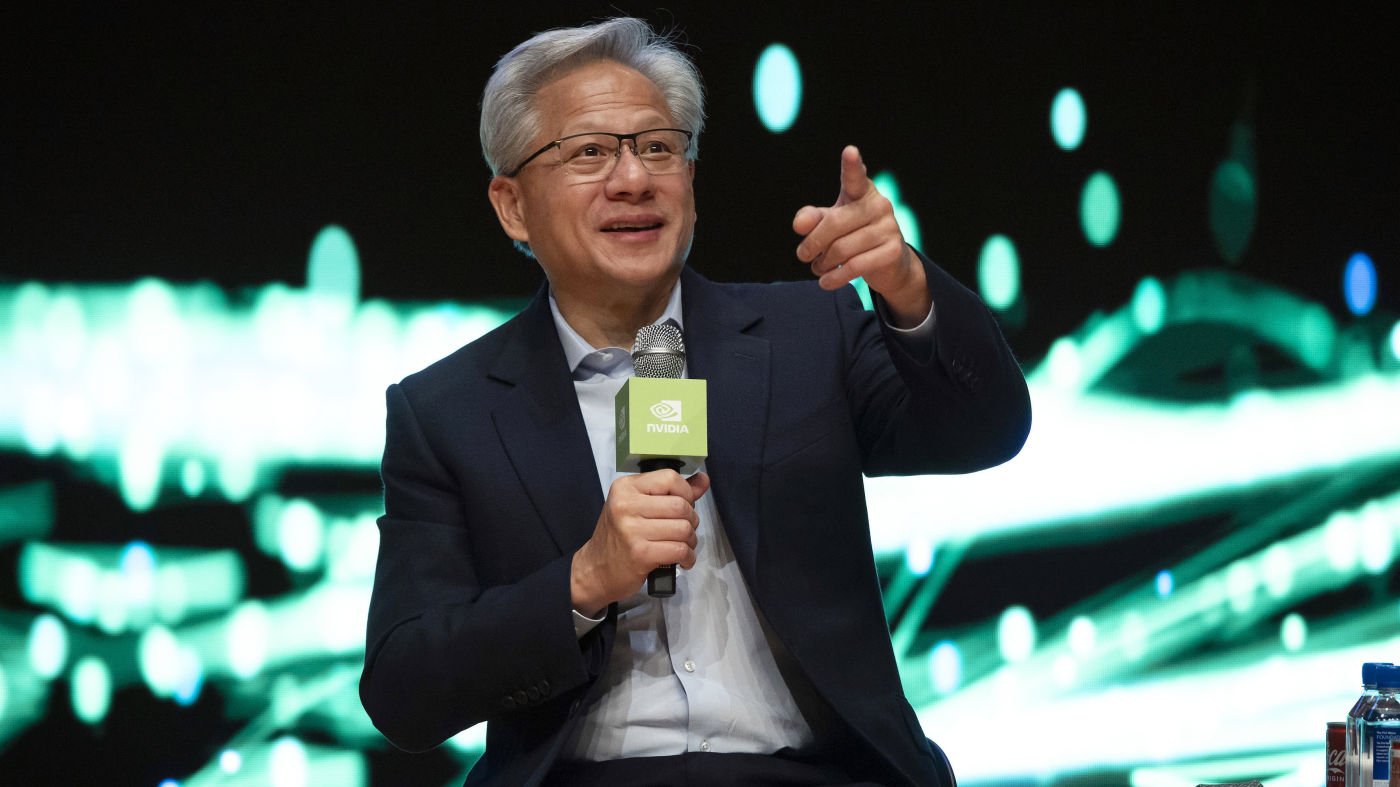
Nvidia boss Jensen Huang calls European companies will deploy artificial intelligence in all industrial sectors. During the Nvidia GTC conference Organized in Berlin, it defended a strategy based on industry, robotics and IT infrastructure, while presenting new equipment aimed at accelerating the construction of data centers. The goal is to make Europe a player in the AI economy and not just a market for American technologies.

“All companies will become AI companies”
For Jensen Huang, Europe has an important asset: its industrial know-how. The leader highlighted in particular the continent’s skills in machine design, mechatronics and precision systems. The automotive industry, robotics, pharmaceuticals and financial services are among the sectors expected to integrate more artificial intelligence.
“For Europe to benefit from AI and truly create an AI ecosystem and economy, all industries must adopt it”he said during the conference. I also believed that “All European companies will become AI companies”which he had already declared earlier this week.
The speech addresses in particular the so-called “physical” AI, which combines artificial intelligence models with machines capable of interacting with the real world. In this way, industrial robots, autonomous vehicles and automated systems could take advantage of AI to carry out complex tasks in specific environments. Nvidia seeks to position itself at the center of this evolution thanks to its processors, software and development platforms.
Lack of computing power, an obstacle for Europe
Behind this call to accelerate, a material problem remains: Europe lacks the computing capacity to train and operate AI models at scale. The continent only accounts for about 5% of global computing capacity dedicated to AI, compared to 75% for the United States. This dependency limits the possibilities of European companies and developers who want to design their own models.
To address this hurdle, Nvidia introduced the DSX Pod, a modular data center system that brings together the necessary servers, cabling, and equipment into a pre-assembled infrastructure. According to the company, this approach could reduce installation time from six months to about 14 days at a suitable site. The system is based on the Vera Rubin platform and should facilitate the deployment of new computing capabilities.
Nvidia increases industry partnerships in Europe
The American group also seeks to strengthen its presence in Europe by partnering with manufacturers and technology start-ups. Nvidia indicates that it has committed close to 10 billion dollars to the European ecosystem, between investments and partnerships. In Germany, it announced new investments in four startups: Agile Robots, specialized in industrial robotics, Avelios Medical, active in health technologies, Mirelo, which develops artificial intelligence tools for video, and Reflex Aerospace, specialized in satellites. In France, there is a partnership with Doctolib and Genenis AI.

Several large European groups are already developing projects with Nvidia. Mercedes-Benz is working on autonomous driving, Volkswagen is using its technologies in commercial vehicles, and Siemens is exploring applications of AI in medical equipment. These collaborations demonstrate Nvidia’s strategy: to extend the use of its technologies beyond data centers, to factories, vehicles and professional equipment.
Jensen Huang’s European offensive comes as investments in artificial intelligence raise more questions from investors. The cost of data centers, energy needs and the high valuations of some companies are fueling concerns about the long-term profitability of this industry. Nvidia therefore has a direct interest in convincing European companies to accelerate their projects: their adoption of AI can support the group’s demand for processors, infrastructure and software.
For Europe, the challenge is to transform its industrial skills into concrete AI development and production capabilities. Jensen Huang believes that the mainland has the necessary technical know-how. It remains to strengthen computer infrastructures and generalize uses in companies to convert this industrial advantage into economic weight in the sector.


