

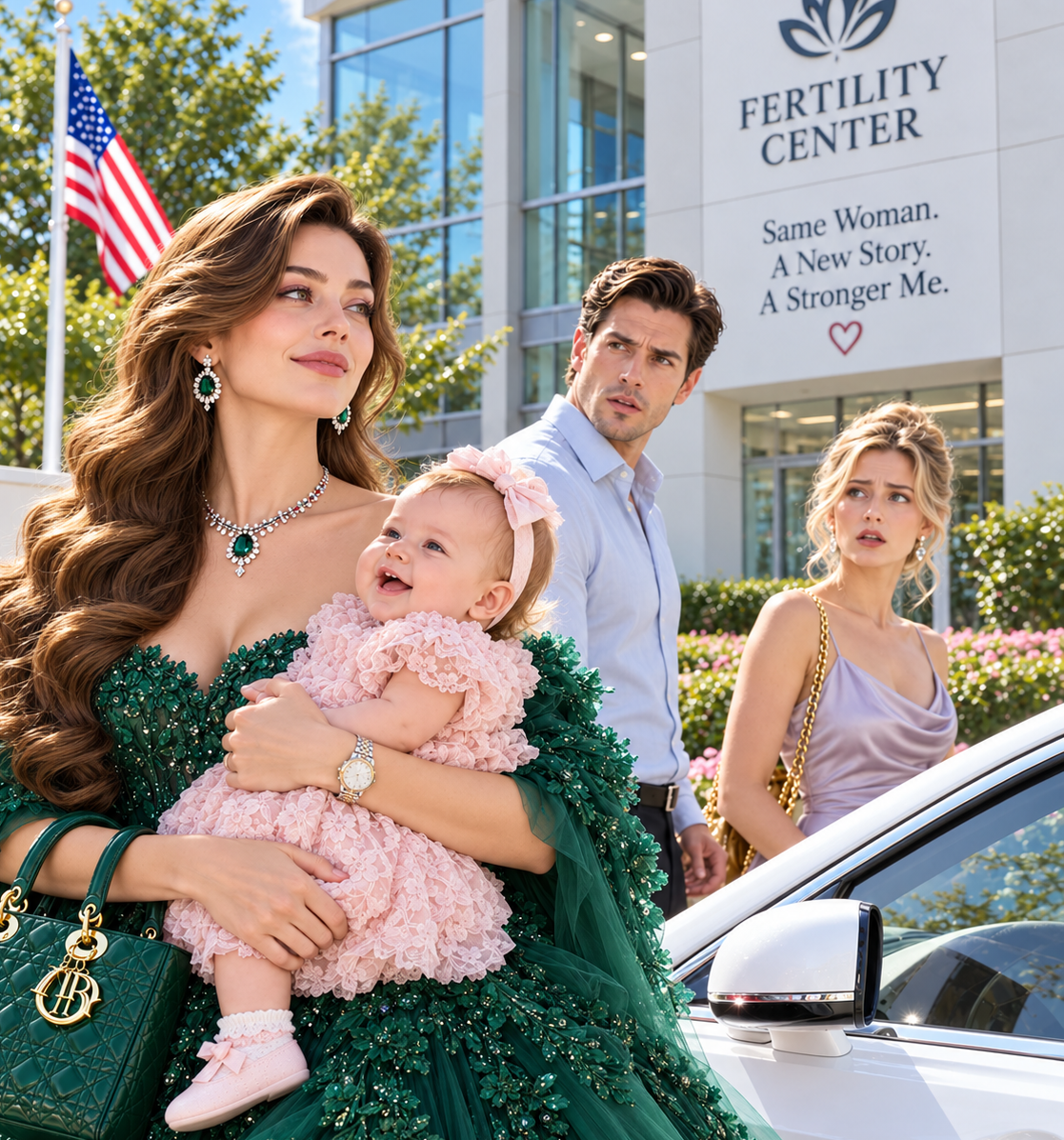
Part 1: The Parking Lot
At 4:40 on a Thursday afternoon in September, I was standing in the parking lot of Scioto Valley Fertility Center with a diaper bag on one shoulder and a framed photo under my arm. That’s when I heard my name.
“Natalie?”
I knew the voice before I turned around. I’d been married to it for nine years.
Derek was standing beside a silver Lexus SUV, holding the passenger door open for a woman with long auburn hair. I knew her too, though we’d never actually met. Kelsey Dunn. His high school girlfriend. She was the reason my side of the closet had been the only full side for the last thirteen months.
Then Derek saw the baby.
Hazel was asleep against my chest in a gray carrier. One small fist was tucked under her chin, and a pink knit hat covered most of her dark hair. She had Derek’s hair. I’d stopped pretending she didn’t somewhere around week three.
I watched his face change, one piece at a time.
First came the surprise. Then he looked at her size. Then I saw him doing the math, his eyes moving a little like he was reading lines off a page. He’d always done that, even when he was splitting a restaurant bill.
All the color left his face. I’d only seen that happen to him once before, when his father had a stroke at Thanksgiving.
He let go of the car door.
“Natalie,” he said quietly, as if somebody might overhear us in an empty parking lot. “Is she mine?”
Kelsey had one foot inside the car. She stopped and looked at him, then at me, then at Hazel.
I could have said no. It would have been the easiest word I’d said all year. I could have gotten into my Honda, buckled Hazel into her car seat, and driven home to Westerville, and he’d have spent the rest of his life wondering.
Part of me wanted to. I’m not proud of it, but it’s true.
The frame under my arm held a photo of Hazel at two weeks old, asleep in a laundry basket full of clean towels. On the back, in my handwriting, it said: For Dana and the team. Embryo #4 says thank you.
I was on my way to put it on the clinic’s baby wall. That’s where they hang pictures of all the children who began in their lab.
Derek knew about that wall. We’d walked past it on the way to fourteen appointments, and every time, he looked at the floor.
“Natalie,” he said again. “Please.”
Hazel stirred and made the little squeak she makes before she wakes up hungry.
I took a breath.
To explain what I said next, I have to go back thirteen months, to the last embryo, and to a piece of paper Derek signed without ever believing I’d use it.
Part 2: Embryo Number Four
Derek and I married when I was 28 and he was 30. We bought a three-bedroom ranch on Maple Glen Court in Westerville, Ohio, mostly because the backyard had an old oak tree I thought would be perfect for a tire swing.
I teach third grade at Hawthorne Elementary. Derek was a regional sales manager for an HVAC company, which meant he spent most weeks driving between Dayton and Zanesville, selling commercial furnaces to people who didn’t want to talk about furnaces.
We started trying for a baby a year after the wedding. We thought it would take a few months.
It took four years just to get a diagnosis, and the diagnosis was “unexplained infertility.” That’s what doctors call it when they can’t tell you why. Neither of us was technically the problem, so in a way we both were.
After that came three rounds of IVF. We spent $41,000. Some of it came from savings, some from a home equity line of credit, and $6,000 came from my mother, who said it was “an early baby shower gift” and wouldn’t hear any argument.
The third round gave us four embryos that were healthy enough to freeze. The nurses called them “good-quality blastocysts.” I called them by their numbers, because I couldn’t stand to call them anything else yet.
Number One didn’t implant.
Number Two did implant, and I lost that pregnancy at eight weeks, in a Kroger bathroom.
Number Three was transferred in July of last year. I stopped drinking coffee. I took my progesterone shots every night at 9 p.m. Derek did them for me at first, then only sometimes, then not at all.
Eleven days later, Dana called. She was our nurse, the one with the reading glasses on a beaded chain who always remembered I took my water without ice.
“I’m so sorry, Natalie. The beta is negative.”
Derek was standing in the kitchen when I hung up. He didn’t hug me. He leaned against the counter, rubbed his eyes, and said, “I can’t keep doing this.”
I thought he meant he couldn’t keep watching me get hurt.
Looking back, I think he meant something else entirely.
That left Number Four. One embryo, sitting in a tank of liquid nitrogen at minus 321 degrees in a building off Sawmill Road. The storage fee was $650 a year, and the bill came every August with a form inside asking us to make a “disposition decision.”
I kept that form on the refrigerator under a magnet shaped like a strawberry. Derek never touched it.
Over those years, I’d become the person who handled everything. I tracked the insurance appeals, booked the appointments, stayed on hold with the pharmacy, and set the shot reminders. I told myself it was love. I think it was really fear. If I held everything together tightly enough, nothing would fall apart.
I didn’t know yet that some things fall apart because you’re holding them so tightly.
Three weeks after that negative test, on a Sunday morning, I came back from the farmers market with a bag of peaches. Derek’s F-150 was backed up to the garage door, and the bed of the truck was full of his things.

Part 3: The Sunday He Left
He’d packed the way he did everything: quickly and badly. His golf clubs were lying on top of a laundry basket of dress shirts that weren’t folded. His Xbox was wedged between two lamps, and one of them was mine.
“Derek?”
He came out of the garage with a box of books and wouldn’t look at me.
“I was going to wait until you got back,” he said.
“You’re… what? What is this?”
He set the box down on the tailgate and finally looked at me. He looked tired, but under that he looked relieved, and that was the worst part. He looked like a man who’d been holding his breath for a long time and had just let it out.
“I’ve been talking to Kelsey,” he said.
I knew the name. Everyone in Derek’s family knew it. Kelsey Dunn had been his girlfriend from sophomore year through the first semester of college at Ohio State, when she left for California. His mother still called her “the one who got away,” usually after a glass of wine at Christmas.
She’d moved back to Columbus that spring after her divorce. They’d reconnected on Facebook. Then they had lunch. Then there were more lunches, and I’d believed every one of them was a client meeting in Marion.
“It’s not just some fling,” Derek said, as if that should make me feel better. “I’ve been living somebody else’s life, Nat. Clinics, shots, calendars. Every month we’re either hoping or grieving. I’m forty years old. I want to be happy before I’m too old to remember how.”
“And I don’t?”
He didn’t answer that. He picked up the box again.
I stood in the driveway holding my bag of peaches, which I’d paid $8 for at the stand by the library because they were the good Michigan ones. I remember thinking I should put them in the fridge before they bruised.
That’s what shock is really like. Nobody screams. You worry about the fruit.
“What about Number Four?” I asked.
He stopped with one hand on the tailgate.
“Nat.”
“There’s still one embryo. It’s still ours. What do you want me to do with it?”
He shut the tailgate harder than he needed to.
“I don’t care,” he said. “I’m done with that. Do whatever you want.”
He got into the truck and backed out of the driveway. He didn’t wave. Our neighbor, Mr. Okafor, was pretending to adjust his sprinkler and was quietly watching the whole thing.
I went inside, put the peaches in the refrigerator, and sat down on the kitchen floor with my back against the dishwasher. I stayed there until the light changed in the window.
At some point I looked up at the strawberry magnet and the storage form under it.
Do whatever you want.
I didn’t know then that I’d hold him to those exact words. I also didn’t know they’d end up on page eleven of a legal document with his initials beside them.
Part 4: Page Eleven
My lawyer was Ruth Abernathy. She was 64, wore cardigans with leather elbow patches, and kept a bowl of butterscotch candies on her desk that nobody ever took.
My mother found her through her church. Ruth charged $275 an hour, and she spent the first twenty minutes of our first meeting just listening.
When I got to the embryo, she put her pen down.
“Has he said what he wants done with it?”
“He said he doesn’t care. He said, ‘Do whatever you want.’”
“Did he put that in writing?”
I showed her the text he’d sent four days after he left. I had asked again, because I needed to be sure. His answer was:
Honestly take it. I’m not doing any of that anymore. I don’t want any part of it. Please stop asking.
Ruth read it twice. Then she looked at me over her glasses.
“Natalie, I’m going to ask you something, and you don’t have to answer today. Do you want to use that embryo?”
Nobody had asked me that before, not even me.
For four years, every decision had been something Derek and I decided together, or something I decided while he went along with it. I’d never let myself picture doing it alone. It felt selfish to imagine it, almost greedy.
“I don’t know,” I said.
“Then here’s what we’ll do,” Ruth said. “We’ll write the agreement so you can decide later. If he’s serious, he’ll sign it. If he isn’t, we’ll find out now instead of five years from now.”
She drafted a section on embryo disposition. It went on page eleven of our separation agreement as Section 14, and she wrote it in plain English. She told me courts don’t like surprises, and neither does she.
It said that the one remaining frozen embryo was awarded to me alone, to use, donate, or discard at my sole discretion. It said that if a child was born from it, Derek would have no parental rights and no parental obligations. He wouldn’t owe child support, and he wouldn’t have any claim to custody or visitation. It said he understood this fully and was signing voluntarily.
Ruth made both of us initial every page. On page eleven, she had Derek read Section 14 out loud in her conference room, with his lawyer sitting beside him.
I’ll never forget it. He read it the way you’d read the terms and conditions on a phone update. He was fast, a little bored, and already somewhere else.
When he finished, his lawyer leaned over and said quietly, “You understand that if she uses it, you won’t be her—”
“She’s not going to do it alone,” Derek said. He wasn’t being cruel. He sounded completely sure of it. “Natalie doesn’t do anything alone.”
Then he initialed it: D.L., in blue ink.
I think about that sentence a lot. Natalie doesn’t do anything alone.
He wasn’t wrong, or at least he hadn’t been wrong yet.
I drove home that night and took the storage form off the refrigerator. I sat at the kitchen table with a cup of decaf going cold beside me and read it until the words stopped looking like words.
Then I called the clinic and asked for Dana.
“I want to schedule a transfer,” I said. “Just me.”
There was a short pause on the line.
“Okay,” Dana said gently. “Are you sure?”
I wasn’t. But I’d been waiting nine years for someone else to be sure for me, and that hadn’t worked.
“I’m sure,” I said.
Part 5: Two Pink Lines and a Blocked Number
The transfer was on October 14th.
My mother drove me because the Valium they give you makes you loopy. She held my hand in the procedure room and cried before anything had happened. Dana pretended not to notice and handed her a tissue anyway.
Eleven days later, I took a drugstore test at 5:30 in the morning before school. I’d bought it for $11.49 at the Walgreens on State Street.
It had two pink lines. The second one was so faint I held it up under the bathroom light, then the kitchen light, then my phone’s flashlight, and then the light again, like it might change its mind.
The blood test came back positive that afternoon, and two days later the second one showed my numbers had doubled.
That night, I did something I’d been arguing with myself about since Ruth’s office.
I texted Derek.
The agreement said he had no rights and no responsibilities. But he was still a person, and this was still the embryo we’d made together on the worst and most hopeful days of our marriage. I didn’t owe him anything legally. I decided I owed him the truth anyway, because that was the kind of person I wanted to be, even if he hadn’t been that kind of person with me.
Derek, I wanted you to hear this from me. I used Number Four. I’m pregnant. Per our agreement, you don’t have any obligations, and I’m not asking for anything. I just didn’t want you to find out some other way. — N
The message stayed on “Delivered.” It never changed to “Read.”
I sent another one a week later, a shorter one. That one didn’t even say “Delivered.”
That’s when I understood he’d blocked my number.
On December 3rd, I tried one more time. I wrote him a letter by hand on a legal pad because my laptop felt too cold for it. I put in a copy of the 12-week ultrasound, the one where the baby looks like a lima bean with an opinion. I mailed it to the only address I had, which his sister had let slip at a Halloween party: 418 Linden Avenue, Bexley.
It was Kelsey’s house.
The letter never came back, and he never answered it.
So I stopped trying. I didn’t stop because I was angry. I stopped because I was worn out, and because Hazel had started kicking at 2 a.m. and I needed my energy for her.
She was born on July 2nd at 7:51 in the morning at Riverside Methodist. She weighed seven pounds, four ounces. My mother cut the cord, even though she said three times beforehand that she might faint.
I named her Hazel June. Hazel was my grandmother’s name. June was for the month I’d spent most afraid that something would go wrong.
I went back to work the second week of September. My mother watches Hazel three days a week, and a neighbor’s college-age daughter watches her the other two for $15 an hour. After the hospital bills, the transfer, the storage fees, and Ruth’s invoices, I had $3,218 in savings.
I’m telling you all this so you understand what was really at stake in that parking lot.
Ruth had warned me. “The agreement is strong,” she’d said, “but if he ever decides he wants to fight it, he can. He’ll probably lose, but it could cost you fifteen or twenty thousand dollars to make him lose.”
Twenty thousand dollars I didn’t have. Months of court dates. My daughter’s first year spent across a table from lawyers.
So when Derek stood there with his car door open and asked, “Is she mine?”, I knew that every way of answering would cost me something.
If I said no, I’d keep my peace, and I’d be lying to my daughter’s face before she could even understand me.
If I said yes, I’d be opening a door I’d spent thirteen months learning to keep closed.
Hazel opened her eyes. They were blue now and would probably turn brown later, like his.
“Biologically,” I said, “yes.”
Derek grabbed the roof of the car to steady himself.
Behind him, Kelsey said quietly, “Derek, you told me there was nothing left.”

Part 6: The Letter in Kelsey’s Drawer
For a second nobody moved. A woman pushing an empty stroller toward the clinic doors glanced at the three of us, decided this wasn’t her business, and kept walking.
“Nothing left?” I repeated.
Kelsey was still holding the top of the passenger door. Up close she looked older than in the photos I’d made myself stop scrolling through, and kinder. She had freckles across her nose and a worried line between her eyebrows that deepened as she spoke.
“He said you’d tried everything and none of it worked,” she said. “He said all of it was… finished.”
Derek turned toward her. “I thought she’d let it go. I thought she’d donate it or—Kels, I didn’t think she’d actually—”
“Why are you here?” I asked him.
I already knew. I could see the folder in Kelsey’s hand, the same blue Scioto Valley new-patient folder I’d carried for years. I just needed him to say it out loud.
He swallowed. “Consultation. Kelsey’s thirty-nine. We want—” He stopped.
The man who had told me in our driveway that he was done with clinics, shots, and calendars was standing outside the same clinic, holding the same folder, about to start all over again with somebody else.
I waited to feel triumphant. It didn’t come. I mostly felt tired.
“You never told me,” Derek said to me. His voice cracked. “You had my baby and you never even—”
“I texted you on October 25th,” I said. “And again on November 1st. You’d blocked me by then.”
He opened his mouth to argue, then closed it. He knew. He’d done it the night he moved into Kelsey’s house, because he couldn’t stand seeing my name on his screen. Later he told me it had felt like “a clean start.”
“And on December 3rd,” I said, “I mailed you a handwritten letter with the twelve-week ultrasound. Four-eighteen Linden Avenue.”
Derek frowned. “I never got any letter.”
Then he looked at Kelsey.
She’d gone very still. Her hand had slid off the car door, and she was holding her elbows as if she were cold, though it was 78 degrees out.
“Kels?”
She didn’t answer right away. When she did, she said it to the pavement.
“It’s in the drawer of my nightstand,” she said. “Under my passport.”
Derek stared at her as if she’d started speaking another language.
“I opened it,” she said. “I thought it was about the divorce, like more paperwork. And then I saw the picture, and I—” She pressed her lips together. “You’d just moved in. You’d just told me you finally felt like yourself again. I was so sure that if you saw that ultrasound, you’d go back to her. And I’d be alone again at thirty-nine, in a house I couldn’t afford, after everything with my ex.” She looked up at me, and her eyes were wet. “I told myself I’d give it to him after the holidays. Then it was February. Then it felt too late.”
“Nine months,” Derek said. “You had it for nine months.”
“Ten,” Kelsey whispered.
I won’t pretend I didn’t feel something hot and ugly rise in my chest. She had decided, from a nightstand drawer, what my daughter’s father was allowed to know.
But I also remembered sitting on my kitchen floor against the dishwasher. I knew what it was like to be terrified of being left. It doesn’t make you a villain. It can make you a coward, though, and so can a lot of other things.
“I’m sorry,” Kelsey said to me. Then, more firmly: “I’m sorry. That was wrong. I knew it was wrong the whole time.”
Derek let out a laugh that didn’t sound like a laugh. He turned back to me with his hands open, the way he used to when he wanted me to fix something.
“Okay. Okay. We can figure this out. I’ll talk to a lawyer, we can redo the agreement, I can—I want to be her dad, Nat. I want—”
“You read Section 14 out loud,” I said quietly. “In Ruth’s office. Your lawyer tried to explain it to you, and you said, ‘Natalie doesn’t do anything alone.’”
He stopped talking.
“I did it alone, Derek. Every shot. Every appointment. Eighteen hours of labor. Every two-a.m. feeding for eleven weeks.” I put my hand on Hazel’s back and felt her breathing. “I’m not punishing you. I’m telling you what happened. You don’t get to come back into the middle of it and rewrite the beginning.”
He looked at Hazel for a long moment. Then he asked the only question that mattered.
“What’s her name?”
I thought about not telling him.
“Hazel,” I said. “Hazel June.”
He closed his eyes.
Then I walked past both of them, through the clinic’s sliding doors, and hung my daughter’s picture on the wall he had never been able to look at.
When I came back out ten minutes later, the Lexus was gone. A piece of paper was tucked under my windshield wiper. It was a page torn from the back of a blue new-patient folder. It had a phone number written on it, then a line crossed out so hard the pen had torn through, and under that:
I’m not going to fight you. But I’m asking for one chance to earn something. Whatever you decide. — D
Part 7: What He Owed
I didn’t call for eleven days.
I talked to Ruth first. She ate two of her own butterscotch candies while I told her everything, which she’d never done before.
“Legally,” she said, “you owe him nothing. Section 14 holds. If he files anything, we fight it, and we’ll most likely win.”
“And if I don’t want to fight?”
“Then you set the terms. In writing. You decide what ‘a chance’ means, not him.”
So I wrote the terms myself, at the kitchen table under the strawberry magnet, while Hazel napped in her swing.
Derek could see Hazel twice a month, on Saturday mornings from 10 to 11:30, at Alum Creek Park or at my mother’s house, and always with me there. He couldn’t have overnights, and he couldn’t take her anywhere without me. He wouldn’t be called “Dad” unless and until I decided, and I’d decide based on what I saw, not on what he promised. He couldn’t bring lawyers into it, and he couldn’t use money to speed things up.
If he missed two visits without a real reason, the arrangement was over.
I emailed it to him. I didn’t text, because I didn’t want to know whether he’d unblocked me. He answered in four minutes.
Yes to all of it. Thank you. I’m sorry, Natalie. For all of it. Not just this.
Two days later, a padded envelope showed up in my mailbox. It had no return address, but I knew the handwriting on the label. It was the one I’d mailed to 418 Linden Avenue.
Inside was my original letter, creased in four places from ten months in a drawer, with the ultrasound still paper-clipped to the corner. There was also a folded note on lined paper:
Natalie,
This belongs to you, not me. I should have given it to him the day it came. I told Derek everything, including the parts that make me look worse. We’re going to counseling. I don’t know if we’ll stay together, and I’m learning that’s not something I get to control by hiding things.
She’s beautiful. I’m glad she has you.
— Kelsey
I read it twice and then put it in the drawer where I keep Hazel’s hospital bracelet. It didn’t fix anything, but it was honest, and after the last year, that meant something to me.
The first Saturday, Derek showed up at Alum Creek Park at 9:40, twenty minutes early. He sat on the bench by the duck pond and held Hazel so carefully, it was like she was made of thin glass. He didn’t talk much. When she grabbed his finger, he made a noise I’d never heard him make in nine years of marriage.
At 11:30 exactly, he handed her back to me.
“Same time in two weeks?” he asked.
“Same time,” I said.
He came the next time, and the time after that. Once he arrived during a thunderstorm, and he and my mother sat on her screened porch while Hazel slept, talking about the Buckeyes and the price of gutters. My mother had once told me she’d never forgive him. Later she admitted to me, a little grudgingly, “He’s very quiet with her. I’ll give him that.”
In November he asked if he could put money aside for her.
“I don’t want it,” I said. “I don’t want this to turn into a transaction.”
“It’s not for you,” he said. “It’s not even for me. Open whatever account you want. Put your name on it. I’ll never touch it. I just want to stop being a man who walks away from things.”
I thought about it for a week. Then I opened a 529 college savings plan in Hazel’s name, with me as the owner. On the first of every month, $200 lands in it, and he has never once mentioned it.
I didn’t forgive him all at once. Some days I didn’t forgive him at all. I’d watch him lift her out of the stroller and think about the peaches, the dishwasher, and the text I’d sent into nothing.
But forgiveness turned out to be less like a door and more like a dimmer switch. Every other Saturday, it went up a little.
Part 8: The Photo Wall
Hazel turned one on July 2nd.
We had a small party in my backyard under the oak tree. There was finally a tire swing hanging from it, a baby-sized bucket seat that Mr. Okafor from next door helped me hang with a rope he swore was “rated for a small car.” My mother made a lemon sheet cake. Dana from the clinic came with her beaded glasses chain and a stuffed giraffe, and she cried more than my mother did, which my mother took personally.
Derek arrived at 1:55 for a 2:00 party. He’d started joking that being early was the only promise he knew for sure he could keep.
He came alone.
He and Kelsey had separated in March. They did it calmly and without lawyers, after five months of counseling, and he told me about it standing on my driveway without asking me for anything. Kelsey had moved to Cincinnati for a new job. She sent Hazel a birthday card with a $25 bookstore gift card inside and a note: Read her the ones with the most animals.
I didn’t feel happy that they’d broken up, and I didn’t feel sad either. I felt like the part of my life where I compared myself to Kelsey Dunn was finally over.
Derek didn’t come into the house. He sat on the back steps with a paper plate of cake and watched Hazel smear frosting across her own forehead.
At one point she toddled across the grass on her new, unsteady legs. She wobbled past my mother, past Dana, and past the tire swing, and dropped into his lap. Then she grabbed his nose, the way she grabs everything she’s decided belongs to her.
“Ba,” she said. It’s the word she uses for balls, birds, bottles, and sometimes the dog next door.
Derek looked up at me. He didn’t look like he was asking permission. It was more like he wanted to be sure I’d seen it.
I had.
“We’re not there yet,” I said gently.
“I know,” he said. “I’m not in a hurry.”
That was the most grown-up thing I’d ever heard him say.
The following Thursday, I stopped by Scioto Valley on my way home from summer school to drop off a new picture. Hazel was one, wearing frosting like war paint.
The baby wall had grown since September. There were twins in matching Cleveland Browns onesies, a little boy in a firefighter costume, and a girl in a ballerina tutu with a cast on her arm.
My original photo was still there: Hazel at two weeks, asleep in the laundry basket.
I took it down and hung the new one in its place. Then I turned the old one over and read what I’d written on the back almost a year earlier.
For Dana and the team. Embryo #4 says thank you.
Under it, I added one more line in pen:
Her mother did it alone. She doesn’t have to anymore, but she knows she could.
I put the old photo in my bag to take home. It’s on my refrigerator now, under the strawberry magnet, where the storage form used to be.
Thirteen months earlier, I’d stood in that parking lot and believed the hardest question I’d ever be asked was whether Hazel was his.
It wasn’t, as it turned out.
The harder question was the one nobody asked me out loud. I had to ask it myself on the kitchen floor, in Ruth’s office, and in a parking lot with my daughter asleep against my chest: Am I enough on my own?
I am.
And because I finally believe that, I can leave the gate open on Saturday mornings without being afraid of who walks through it.
What would you have done in that parking lot: told him the truth, or protected your peace and said no?
Note: This story is a work of fiction inspired by real events. Names, characters, and details have been altered. Any resemblance is coincidental. The author and publisher disclaim accuracy, liability, and responsibility for interpretations or reliance. All images are for illustration purposes only.


