

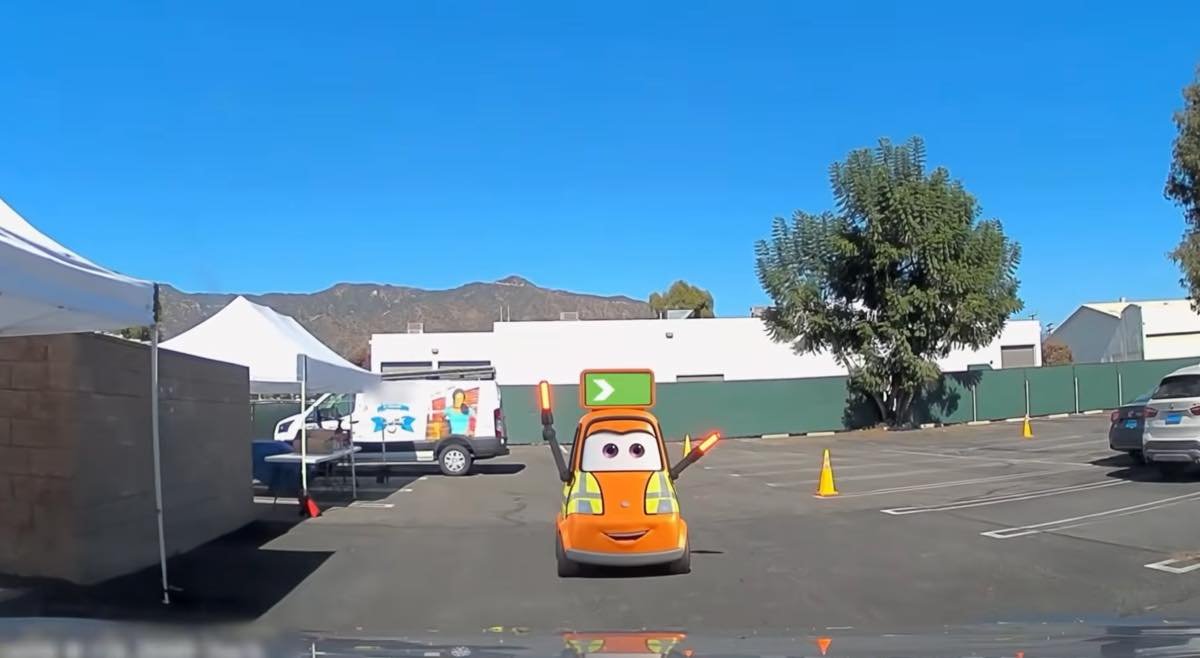
Disney presented two very specific robotic tests during its Accelerator Demo Day 2026 : machines capable of moving in changing parking spaces and arms in charge of manipulating 3D glasses between two sessions. These collaborations with FieldAI and Physical Intelligence remain experimental, but are already targeting real-world tasks in parks.

Robots outside, in the middle of the unexpected
FieldAI develops navigation intelligence for environments that cannot be fully mapped or repaired in advance. With Disney Experiences Technology and research from Walt Disney Imagineering, the company is exploring its use in parking operations.
The problem seems trivial, but it combines difficulties: car and pedestrian traffic, temporary obstacles, variable weather, partially hidden ground markings, and a configuration that changes throughout the day. A robot confined to a prerecorded trajectory would quickly be blocked. The demonstrator presented in Burbank intended, on the contrary, to show its adaptation to this type of dynamic terrain.

FieldAI develops artificial intelligence systems that allow robots, particularly those from Boston Dynamics, to navigate changing environments.
Disney is not announcing any commercial rollout, schedule or number of machines. The exact state is that of an examination carried out after four months of work on the Accelerator. FieldAI and Imagineering are also examining how this environmental awareness could later be used for robotic characters in parks, where public safety imposes much more severe limitations than a demonstration.

The 3D glasses test
The second collaboration refers to Physical Intelligence, a company specialized in learning models for multipurpose robots. Disney gave him a very specific task: grab, orient, and put away the 3D glasses in preparation for cleaning between shows.
This choice serves as a relevant test bed. Glasses arrive in disordered positions, may overlap, and must be handled without scratching or breaking. A traditional system would require a highly structured position and programming adapted to each orientation. A more general robot must recognize the situation, choose a support point, and correct its gesture when an object is not positioned as expected.
Disney presents the goal as helping employees with repetitive behind-the-scenes tasks, not completely replacing a team. The group did not provide success rates, performance, or data on human supervision. These figures will be essential to know if the experience goes beyond the demo stage and can operate during peak periods.
From the laboratory to attractions, the gap remains significant
The interest of Demo Day arises from the situation, but its limits are equally important. The robots showed specific scenarios; Disney does not say that they are already operating continuously in an open park. Collaborations explore uses and may still be stopped, modified or restricted to areas not accessible to the public.
Imagery has been working for a long time on mechanical characters capable of expressive movements. In particular, we present an Olaf robot destined for Disney parks. Testing with FieldAI and Physical Intelligence moves this research to another question: How can a machine perform a useful task when its environment never looks exactly like the training environment?
The same event showcased Haddy’s 3D printed set props, including a replica canoe for Jungle Cruise, as well as audio-visual production tools. In the case of robotics, however, Disney focuses on two easily quantifiable needs: moving without incident in a complex outdoor space and restoring order to a flow of physical objects. No price, product or opening to the public has been announced.


