

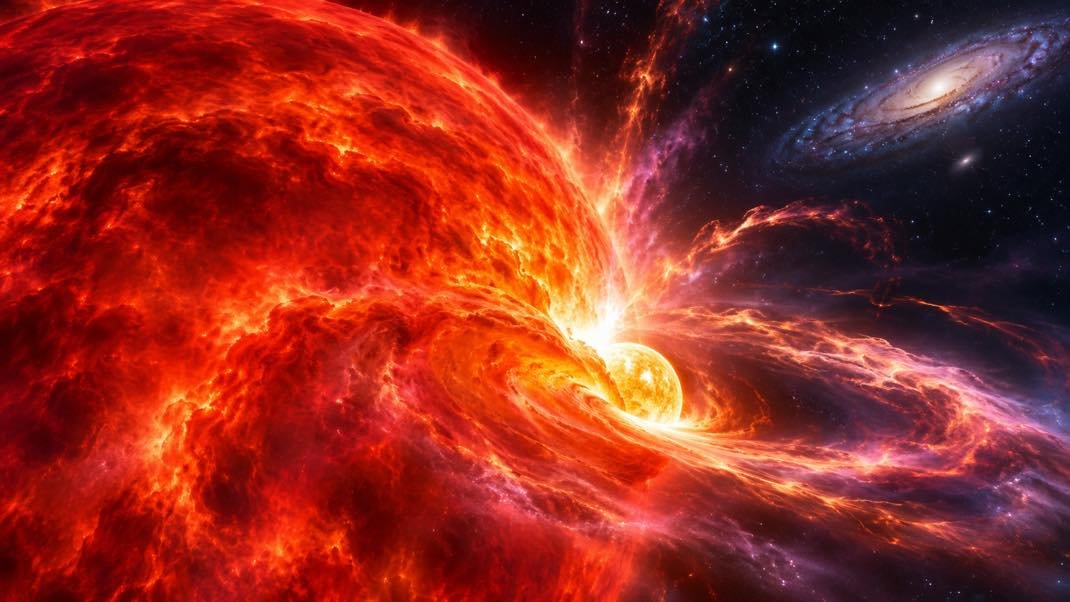
2.5 million light years from Earth, in the Andromeda galaxy, astronomers witnessed an exceptional cosmic phenomenon: a giant star engulfed its small companion before causing a tremendous explosion of light. Published in nature magazineThis observation offers a unique insight into the mechanisms that lead to the merger of two stars.
A star seven times more massive than the Sun
The main star, called Big Bao, belongs to the family of red giants, these aging stars whose outer layers are expanding considerably. Astronomers already knew of comparable systems, notably that of Betelgeuse and its companion star.

With a mass equivalent to seven suns, Big Bao gradually engulfed Small Bao, a star slightly less massive than our star. Prisoner of her partner’s gases, she began a fatal spiral, traveling less than ten orbits before reaching her heart.
“The excitement was real. We couldn’t believe our luck.” says Viraj Karambelkar, an astrophysicist at Columbia University and lead author of the study.
An explosion a million times brighter than the Sun
On October 17, 2025, the final collision triggered a luminous red nova, whose brightness briefly reached a million times that of the Sun. The event, identified as AT2025abao, also ejected about 10% of the giant’s gaseous envelope.
Thanks to observations from several ground-based facilities and the James Webb Space Telescope, researchers were able to reconstruct the different stages of this spectacular merger.
This discovery constitutes a major advance in understanding the evolution of binary star systems. Future observations from the Vera C. Rubin Telescope could now help identify more similar collisions, still largely unknown to astrophysicists.


