

Part 1: The Empty Chair
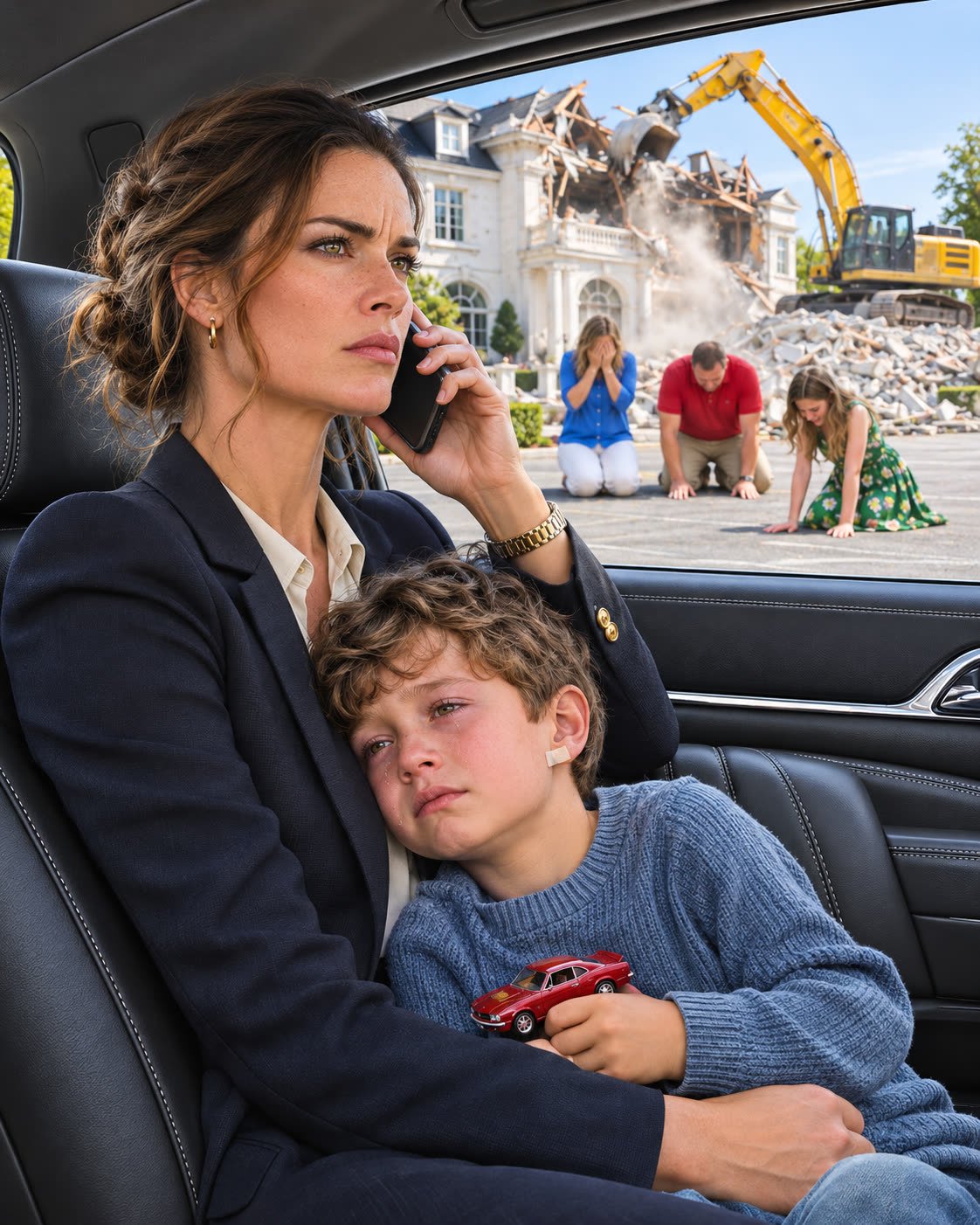
“Without my money, you’d be homeless,” my mother snapped as I lifted my crying son away from her dining table. Matthew’s fingers were pressed against his ear, and his little red car lay beside her plate.
Nobody stood up. My father adjusted his napkin, my sister pulled her own child closer, and the chair beside mine remained empty—the chair where my husband used to sit.
For one strange second, I waited for someone else to say what had happened was wrong. Then Matthew whispered, “Mommy, can we go?” and I stopped waiting.
Ten minutes earlier, he had been arranging paper napkins into a road beside his plate. His cousin Dylan reached across the table and took the car without asking.
“Please give it back,” Matthew said.
Dylan rolled it past the butter dish. At eight, he was nearly a head taller than my son, and he had learned that refusing something could hold an entire room’s attention.
“I’m still using it.”
“It’s mine.” Matthew reached for it.
My mother caught his wrist. When he tried to pull away, she struck the side of his head with her open hand; her ring caught the skin near his ear.
The sound stopped every conversation.
Then my sister Valerie said, “Matthew startled Dylan. You know how sensitive he is.”
I was already out of my chair.
“You hurt my child,” I said.
My mother released his wrist as though I had interrupted something perfectly ordinary. “Your son needs to learn some respect, Clara.”
Matthew stood so still that I could hear his breath catching. I crouched in front of him, moved his hand gently, and saw a small mark and a thin smear of blood.
“Look at me, sweetheart. We’re leaving.”
“I’m sorry,” he whispered.
“You have nothing to apologize for.”
The car was not valuable to anyone else. It was a palm-sized red coupe with doors that no longer opened properly, an identical replacement for the one Julian had bought Matthew shortly before he died.
Matthew had been two then. His memories of his father were fragments: a guitar, a scratchy cheek, pancakes shaped like animals that never looked like animals.
When the original car disappeared the previous winter, I spent four months finding the same model. Matthew held the replacement against his chest and said it helped him remember Daddy’s hands.
I picked it up from beside my mother’s plate.
“Don’t reward this behavior,” she said.
I put the car into Matthew’s pocket and lifted him. He was getting too big to carry comfortably, but his arms locked around my neck with a strength that made my knees feel unreliable.
My father finally spoke. “Let’s all calm down before this becomes something it isn’t.”
“It already is something.”
My mother followed me into the hall. “You’re not taking him to a hospital over a little correction.”
“You don’t get to decide whether he needs a doctor.”
That was when she made her remark about money.
For years, she had spoken as though the roof above my son’s head depended on her generosity. Sometimes the supposed generosity was a bag of groceries I had not requested; sometimes it was a birthday check she later mentioned in front of other people.
She knew I worked in technology. She knew I traveled occasionally and paid someone to watch Matthew when work ran late.
What she had never asked was what I actually did.
After Julian died, I founded Arcadia Systems, building on software work I had done for years. Four years later, the company’s latest financing valued it at approximately $7.2 billion.
My ownership stake made me a billionaire on paper. It did not mean billions sat in my checking account, but I had more than enough to give my child a safe home.
My relatives still pictured the rented townhouse where we had lived during the company’s first difficult year. They had never shown much interest in visiting us, and after we moved, I stopped extending invitations that became excuses to inspect my choices.
I had told myself that privacy protected something precious. If my family did not know about my money, whatever affection they gave Matthew would be real.
Standing in that hallway, I understood the flaw in my reasoning. I had been testing the sincerity of affection while failing to question whether the affection existed at all.
“We’ll discuss this when you can behave reasonably,” my mother said.
I opened the door.
“Clara.” Her voice sharpened. “Don’t make me regret everything I’ve done for you.”
I looked back once. “Tonight isn’t about you.”
Outside, I buckled Matthew into his car seat and checked that the bleeding had stopped. He held a clean tissue to his ear and watched my face with an attention no six-year-old should need.
At the first safe place to stop, I pulled into a pharmacy parking lot. I wanted to look at him without a rearview mirror between us.
“Was I bad?” he asked before I could speak.
I climbed into the back seat.
“No. Asking for your own toy back wasn’t bad.”
He studied the red car in his lap. “Maybe I should’ve just let him have it.”
“Nobody gets to hurt you because you say no.”
He rubbed one wheel with his thumb.
“Even Grandma?”
“Even Grandma.”
His face crumpled then, not with the startled crying from the dining room, but with something older and exhausted.
“She gets angry when you’re not there, too.”
I kept my hands still, although every part of me wanted to reach for my phone, turn the car around, and demand answers.
“You can tell me,” I said.
Matthew looked toward the dark window.
“But she said we could lose our house if I did.”
Part 2: What He Had Carried
I wanted to ask a hundred questions. Instead, I remembered the way Matthew watched my face and made myself breathe before I spoke.
“Our home is safe,” I told him. “You cannot make us lose it by telling the truth.”
“Grandma said you needed her.”
“Adults are responsible for adult problems. Taking care of us is my job, not yours.”
He turned the car over, studying its scratched underside.
“Sometimes she grabs my arms. Or pinches when nobody’s looking.”
I did not ask him to demonstrate. I did not ask whether he was sure.
“Thank you for telling me.”
There was a pause long enough for another car to enter the parking lot and leave again.
“And I didn’t break the blue bowl.”
I remembered the bowl immediately. Three months earlier, my mother had called while I was in a meeting, furious about a porcelain serving bowl she said Matthew had knocked from a cabinet.
He had denied it. She had insisted, and I had paid for the replacement because I wanted the argument to end.
I had called that keeping the peace.
“Tell me what you want me to know,” I said.
“Dylan hit it with his little baseball bat. Grandma saw.” His voice grew quieter. “She told me to say sorry, but I said I didn’t do it.”
My hands tightened against my knees.
“Then she put me in the laundry room and shut the door. The light was off.”
I remembered collecting him that afternoon. He had run to me before I reached the porch, and my mother had laughed about him being overtired.
I had accepted the explanation because accepting it allowed the world to remain familiar.
“I should have listened when you told me about the bowl,” I said. “I’m sorry I didn’t.”
He finally looked at me.
“You believe me now?”
“Yes.”
I did not promise that nothing frightening would ever happen again. I promised something I could control: he would not be alone with my mother, and I would listen when he told me something was wrong.
At the hospital, a nurse brought him a warm blanket while I explained the injury. Dr. Patel examined his ear, checked his balance and responses, and asked about headache, nausea, and changes in hearing.
The cut was small and did not need stitches. The examination did not suggest a serious head injury, but we received clear instructions about symptoms that would require urgent reassessment.
Then Dr. Patel asked how he had been hurt.
I answered without softening it.
“His grandmother struck him.”
Matthew’s fingers tightened around mine.
The doctor lowered herself onto a stool so she was not standing over him. She asked a few simple, open questions, then explained that a social worker would help us with the next steps.
When we spoke outside the room, she was direct.
“Given what you’ve described, we’re required to report concerns about possible child abuse. Someone will also need to speak with Matthew in an appropriate setting.”
“Please document everything,” I said.
A hospital social worker helped arrange the report and explained what might happen next. I stayed nearby while she spoke with Matthew, close enough that he knew where I was but not answering questions for him.
Later, an officer took my account of the dinner. I gave names, the address, and the words I remembered, resisting the urge to fill uncertainty with certainty.
I had spent my career making difficult information understandable. That night, it took all my concentration to say, “I saw my mother strike my son.”
Near midnight, Matthew leaned against me and asked whether Grandma would be angry.
“She might be,” I said. “But her feelings are not yours to manage.”
We reached home after one in the morning. Our house stood on twelve wooded acres, with a treehouse Julian would have loved and a security gate I had previously regarded as an inconvenience.
Matthew looked toward the upstairs windows.
“She can’t come in?”
“Not unless I allow it.”
“Don’t allow it.”
“I won’t.”
After he fell asleep, I sat outside his bedroom until my breathing stopped shaking. Then I called Daniel Mercer, Arcadia’s chief legal counsel.
“Is Matthew safe right now?” he asked as soon as I explained.
“He’s asleep. We’ve been to the hospital.”
“Good. I’ll connect you with a local attorney who handles protective orders and these investigations. Company counsel shouldn’t be your only advice on a family matter.”
That small distinction steadied me. I did not need someone promising to crush my relatives; I needed someone willing to do things correctly.
Then I asked him to review the family assistance arrangements his office had helped administer.
Years earlier, after my father’s investments went badly, I had established a privately funded assistance account through an entity that kept my identity confidential. My parents knew a benefactor was helping with specified housing expenses; my father had never questioned the story once the payments began.
The account covered a mortgage shortfall, property taxes, and approved medical bills. A separate educational grant paid Dylan’s private-school tuition.
I had not diverted company money. Every dollar came from my personal funds.
“I want no new commitments,” I said. “And I want existing voluntary support ended wherever the agreements allow.”
“Some payments require notice. Tuition already committed for this school year will need to be honored.”
“Then honor it. No shortcuts.”
When I finally checked my phone the next morning, there were forty-seven missed calls.
I scrolled past accusations, demands, and instructions to apologize.
Not one message asked whether Matthew was all right.
Part 3: The Price of Silence
By Monday afternoon, my mother had settled on the word misunderstanding.
She used it in three voicemails and a message instructing me to tell the police that Matthew had moved unexpectedly. Valerie said I was allowing grief to distort my judgment.
I saved everything and sent it to my attorney.
Then I canceled meetings, informed Matthew’s school that certain relatives were no longer authorized for pickup, and gave the office copies of the relevant contact restrictions as they became available.
The school counselor did not ask why I had failed to notice sooner. She asked what would help Matthew feel safe that morning.
I nearly cried at the usefulness of that question.
Two days after the dinner, my father called from outside our gate. He had asked my assistant where he could deliver Matthew’s overnight bag, and I had authorized a drop-off at the gatehouse, not a visit.
“Whose house is this?” he asked.
“Mine.”
He gave a short, uncertain laugh. “Clara, I’m standing in front of it.”
“I know. I can see the gate camera.”
Through the security feed, I watched him look past the ironwork toward the drive.
“Let me in.”
“Leave the bag with security.”
His confusion turned to irritation. “Your mother made one mistake. You don’t get to shut us out because you’ve found somebody rich enough to put you up.”
I stood at my kitchen counter with Matthew’s breakfast bowl still beside the sink.
“There is no somebody, Dad. I own this house.”
He said nothing.
“And Matthew has described other incidents. You watched what happened on Sunday and kept eating.”
“I was trying not to make it worse.”
That sentence had been the wallpaper of my childhood.
“Worse for whom?” I asked.
He shifted the overnight bag from one hand to the other. “After everything we’ve done for you, I thought you’d at least hear us out.”
“Who do you think has been covering the gap in your mortgage payments?”
His face changed.
I explained the assistance account, the property taxes, the medical invoices. I gave him enough information to understand, not enough to turn the gate into a financial negotiation.
“That was you?”
“Yes.”
“Why wouldn’t you tell us?”
“At first, because you needed help and would have refused it from me. Later, because I wanted to see whether we could have a relationship that wasn’t about money.”
He looked down at the bag.
“Your mother won’t believe this.”
“She doesn’t have to believe it today. The administrator will send proper notice of the changes.”
“You’re taking our house?”
“No. I don’t own your house. You’ll have time to make a budget, refinance if appropriate, or decide what you can afford. I’m ending voluntary payments, not seizing property.”
For the first time, he asked about Matthew.
But he asked whether Matthew had really said those things to the hospital staff.
I ended the call.
Three days later, Valerie arrived at Arcadia’s headquarters. Reception contacted my office before admitting her, and I agreed to one short meeting with security nearby.
She entered the conference room carrying the expression she used when a restaurant had made a mistake.
Then she saw my name on the room reservation screen and the employees waiting for my next meeting.
“You work here?”
“I founded the company.”
She looked through the glass wall toward my office.
“Arcadia Systems?”
I nodded.
Her gaze returned to me slowly. I used my married surname professionally, and my family had never followed business coverage, but there had been no secret identity for them to uncover—only a question none of them had bothered asking.
“You’re the CEO?”
“Yes.”
She sat without being invited.
I explained the valuation because she asked. Then I explained that company valuation and personal cash were different things.
“But you’re a billionaire.”
“On paper, yes.”
For several seconds, she stared at my ordinary watch.
“You let us think you were struggling.”
“You decided that. I told you I was working, that we were fine, and that I didn’t need money.”
She opened her mouth, then closed it.
I placed copies of the assistance summaries in front of her. She reached Dylan’s educational grant and stopped.
“You paid for his school?”
“For three years. This year’s existing commitment will be completed. It won’t be renewed.”
“You can’t punish Dylan for this.”
“He will finish the school year. You have time to make other arrangements, and he has access to a public school. But I am not obligated to keep financing a family that tells my son being hurt is his fault.”
Valerie pushed the papers away.
“Mom lost her temper. Matthew can be stubborn.”
“He was six, asking for his toy.”
“I know, but—”
“Did you know about the laundry room?”
Her eyes moved toward the door.
I did not speak.
“I wasn’t there for that part,” she finally said.
Something in me went cold.
“What part were you there for?”
She rubbed her thumb along the edge of her purse.
“Dylan told me about the bowl. Mom said she’d handled it, and I thought bringing it up would just make everything worse.”
I thought of the check I had written, the apology Matthew had been pressured to give, the way he had fallen asleep in the car afterward.
“You knew he hadn’t broken it.”
Valerie’s voice dropped. “Clara, please don’t put that in writing.”

Part 4: The Record That Remained
I did not promise Valerie secrecy.
“You need to tell the investigator what you know,” I said.
She stood abruptly. “You’re really going to choose this over your family?”
“Matthew is my family.”
“So is Dylan.”
“Then teach him that telling the truth won’t cost him your love.”
After she left, I wrote down the conversation while it was fresh and sent the account to my attorney. I knew it was my recollection, not a recording, and labeled it that way.
The investigation moved more slowly than anger wanted. There were interviews to arrange, records to obtain, and questions I could not answer on Matthew’s behalf.
My attorney helped me seek temporary protection under local law. The court issued an order limiting contact while the allegations were investigated, and we followed the process for service and a subsequent hearing.
I did not post about it online. I did not call journalists or use Arcadia’s communications staff to threaten anyone.
The people who needed evidence received evidence.
My parents had security cameras covering their entry hall and the doorway between the kitchen and dining room. Because those recordings were routinely overwritten, investigators sought prompt preservation.
My father, who jointly controlled the system, agreed to provide the available footage.
It did not contain every incident Matthew had described. It did show Sunday’s confrontation clearly enough to contradict my mother’s claim that she had merely stopped him from falling.
Another recent recording showed her pulling him hard by the arm toward the hall while he tried to move away.
The blue bowl incident was outside the retained footage. That part depended on accounts from the people involved, including what my father eventually admitted.
At first, he described my mother as strict. Later, after being asked specific questions, he acknowledged seeing rough handling on other occasions and hearing her threaten Matthew about telling me.
He had known more than I had wanted to believe.
That discovery hurt differently from my mother’s behavior. I had spent a lifetime mistaking his quietness for kindness.
At home, Matthew began seeing a pediatric trauma therapist. She explained that recovery would not follow a neat schedule and that my job was to provide predictable safety, not to make him talk whenever I felt frightened.
Some nights, he slept through until morning. Other nights, he checked the front-door lock twice before bed.
I checked it with him without turning the ritual into a lesson.
One afternoon, he dropped a glass in the kitchen. It broke near his feet, and he flattened himself against a cabinet.
“Stay still so I can clear the pieces,” I said.
“I didn’t mean to.”
“I know.”
“Are you mad?”
I set down the broom and looked at him.
“I’m concerned about your bare feet. The glass is replaceable.”
He watched me clean the floor, then fetched the dustpan without being asked. Later, he returned to the kitchen simply to lean against me.
That small return meant more than any reassuring sentence I could have practiced.
Meanwhile, the assistance administrator sent formal notices. My parents had ninety days before the specified housing support ended; already approved medical obligations were handled according to the existing terms.
There was no dramatic seizure, no moving truck arriving overnight. My parents had retirement income and equity, but keeping their current lifestyle would require decisions they had avoided while someone else paid the shortfall.
Valerie received the tuition notice early enough to plan for the following school year.
My mother called from an unfamiliar number after the notices arrived.
“You’re destroying this family.”
I stood beside the window, watching Matthew and his sitter inspect a crooked birdhouse they had built.
“The investigation concerns your behavior,” I said. “The financial notices concern my decisions about my money.”
“You always were vindictive.”
I remembered being nine and spilling grape juice on Valerie’s birthday dress. My mother had gripped my shoulder and told me that crying did not erase consequences.
For years, that memory had seemed too small to mention. Now I recognized the familiar arrangement: someone with power deciding that fear was an acceptable teaching method.
“You told me once that actions have consequences,” I said.
“Don’t you dare compare—”
“Then stop asking Matthew to carry yours.”
I ended the call and blocked the number.
Several months after Sunday dinner, the criminal case reached a plea agreement. My mother accepted responsibility for a charge arising from the incident, with a suspended sentence, supervised probation, required treatment, and court-ordered restrictions on contact with Matthew.
My attorney reviewed the terms with me before the hearing. Nothing required me to arrange visits, and any future change would have to comply with the court’s conditions.
I submitted a victim-impact statement describing what Matthew had asked in the pharmacy parking lot.
I did not mention my net worth.
At the courthouse, my mother looked smaller than she had at her dining table, but not transformed. When our eyes met, she glanced away.
An apology never came.
In the corridor afterward, my father approached only as far as my attorney permitted.
“What am I supposed to do now?” he asked.
For once, I did not solve the problem for him.
“Tell the truth when it costs you something.”
That evening, Matthew asked whether the judge had decided Grandma could come back.
“No,” I said. “You’re staying safe here.”
He nodded, then disappeared upstairs.
A few minutes later, he returned carrying a drawing folded so carefully that I knew he had been waiting for the right moment to show me.
Part 5: Beyond the Safe Line
There were three people beneath a yellow sun: Matthew, me, and Julian holding a guitar. Across the page stood his grandparents, Valerie, and Dylan.
Between the groups, Matthew had drawn a thick black line.
“My therapist said I could show you if I wanted,” he said.
I sat beside him on the floor.
“Would you like to tell me about it?”
He pointed to Julian first. “I know Daddy doesn’t live in our house anymore. That’s the remembering part.”
“I like the remembering part.”
Then he touched the black line.
“That’s the safe line.”
I waited.
“People can’t just cross because they want to.”
“That’s right.”
He looked up at me. “Not even if they’re sad?”
“We can care that someone is sad and still keep a boundary.”
Matthew considered this, then slid the drawing toward me.
“Can it go on the fridge?”
I put it there with the strongest magnet we owned.
In the weeks that followed, the line stopped appearing in every conversation. There were school projects, missing socks, disagreements about bedtime, and a treehouse window that stuck whenever it rained.
Ordinary problems began returning to their proper size.
Matthew still had difficult moments. Once, a teacher’s sudden clap to quiet the classroom made him cry, and the school counselor called so we could coordinate support.
Another time, he asked whether telling a small lie about brushing his teeth meant I would stop believing him about Grandma.
“No,” I said. “Those are different things, and you never have to be perfect to deserve safety.”
His therapist helped me understand that trust grew through repeated experiences, not one powerful conversation. So I kept doing the unremarkable work of showing up.
I moved an overseas trip rather than miss his school conference. I also went back to work when he was secure with the people caring for him, because I did not want him believing he was too fragile for an ordinary afternoon.
Arcadia continued to grow. Months after the case, I attended a technology conference following our acquisition of a European artificial-intelligence company.
During an interview, a journalist asked what had helped me keep perspective while building the business.
“My son,” I said. “He has a very efficient way of reminding me that a lost tooth is more important than a product launch.”
The profile attracted attention beyond the business press. Relatives who had barely acknowledged my work began sending congratulations and suggesting dinners.
I answered genuine kindness where I found it. I did not reopen relationships merely because someone had discovered my balance sheet.
Valerie enrolled Dylan in public school for the next academic year. She complained through relatives that I had taken opportunities away from him.
I declined to argue through intermediaries.
Dylan was a child who needed guidance, not an enemy I needed to defeat. But understanding that did not make continued access to Matthew safe.
My parents remained in their home while they reorganized their finances. Their sacrifices were real but ordinary: less travel, deferred renovations, difficult conversations with an accountant.
They were not homeless.
Neither were we.
Six months after the dinner, a handwritten letter arrived from my father. My attorney checked that receiving it did not conflict with any court terms before I read it privately.
He wrote that he had confused avoiding conflict with being a good husband. He admitted hearing my mother frighten Matthew and choosing to pretend that I would intervene if anything serious were happening.
One sentence made me set the letter down.
I made your absence into my excuse, when it should have been my reason to protect him.
He did not ask for money. He did not request a visit or suggest that Matthew owed him forgiveness.
I kept the letter in a drawer.
I did not answer.
Acknowledgment mattered. It did not erase the need for time, sustained change, or my son’s freedom from pressure.
On Matthew’s seventh birthday, we went to the Pacific coast. He chose the beach instead of a large party, though he negotiated firmly for cupcakes with two friends the following weekend.
We built a garage in the sand for the red car. He reinforced its walls with flat stones and explained that the entrance needed to face away from the water.
“Good engineering,” I said.
“Obviously.”
Julian used to say that exact word whenever he fixed something with tape, and I laughed before I could stop myself.
Matthew grinned. “Daddy said that, didn’t he?”
“Whenever he wanted me to think he knew what he was doing.”
We talked about Julian’s terrible jokes, his guitar, and pancakes that looked more like spilled batter than dinosaurs.
As the light softened, Matthew asked whether I thought Daddy could still see us.
“I don’t know, sweetheart. But I know how much he loved you.”
He turned the red car in his hands.
“I think love doesn’t just disappear.”
“I think you’re right.”
For a while, we listened to the water.
Then he asked whether Grandma would ever come to his birthday again.
I did not answer more quickly than the question deserved.
“Only if it could happen safely and in a way the court allows. And you don’t have to make any decisions about that today.”
“Even when I’m eight?”
“Even then.”
His shoulders loosened. He began smoothing the sand beside the garage, then stopped.
“You’re not mad I told the doctor about the laundry room?”
I moved closer.
“No. I’m glad you told someone who could help.”
“Because everything changed after.”
“The people who hurt you are responsible for that change. Telling the truth didn’t break our family.”
He leaned against me until the next wave reached the edge of our shoes.
Then, with the abrupt change of subject only a child can manage, he asked, “Are we actually billionaire rich?”
I laughed. “Technically, yes. A lot of that is the value of my shares in the company, not money sitting in a giant room.”
He looked deeply disappointed by the absence of a giant money room.
“Then why did I have to save my allowance for three months for my LEGO set?”
“Because learning to choose and save matters, even when we have enough.”
He considered that explanation with visible suspicion.
“Can I still have birthday money?”
“Absolutely.”
“Okay. That’s fair.”
When it was time to leave, a wave slid into his little garage and softened one wall. Matthew watched it collapse, rescued the red car, and brushed wet sand from its wheels.
“We can build another one next time,” he said.
He did not look frightened by what had fallen apart.
At the path, he slipped his hand into mine and asked whether we could make pancakes on Sunday.
“The terrible dinosaur kind?”
“Obviously.”
I squeezed his hand, and we started toward home—a place where the next thing he had to tell me could be anything at all.
Can a family truly heal without first making room for the truth and the boundaries that protect its children?
Disclaimer: This story is a work of fiction inspired by real-life themes. Names, characters, places and events are fictionalized, and any resemblance to real persons is purely coincidental. It does not represent any person or organization and does not encourage inappropriate behavior. Images are for illustration purposes only.


