Réécris le contenu suivant en français naturel, fluide et professionnel, adapté à un site d’actualités technologiques et de cybersécurité.
RÈGLES STRICTES :
1. LANGUE
– Le contenu final doit être entièrement en français.
– Utilise un français naturel, moderne et professionnel.
– Ne laisse pas de phrases ou paragraphes en anglais, sauf les noms propres, marques, produits, technologies, citations ou termes qui doivent rester dans leur forme originale.
– N’utilise pas de traduction littérale maladroite.
2. EXACTITUDE
– Conserve toutes les informations et affirmations factuelles du contenu original.
– N’invente aucune information.
– N’ajoute aucune spéculation, opinion, statistique, citation ou détail absent de la source.
– Conserve correctement les noms, entreprises, produits, technologies, dates, chiffres et termes techniques.
– Ne change jamais le sens d’une information.
3. HTML — TRÈS IMPORTANT
– Conserve TOUS les balises HTML existantes.
– Ne supprime, n’ajoute, ne renomme et ne réorganise aucune balise HTML.
– Conserve exactement les attributs href, src, alt, title, class, id et tous les autres attributs HTML.
– Conserve exactement les URL, liens, images et éléments intégrés.
– Ne transforme pas le HTML en Markdown ou en texte brut.
4. QUALITÉ RÉDACTIONNELLE
– Réécris réellement le contenu avec une nouvelle formulation et une structure de phrases naturelle.
– Améliore la grammaire, la fluidité, la clarté et la lisibilité.
– Adopte le style d’un journaliste professionnel spécialisé dans la technologie et la cybersécurité.
– Utilise des transitions naturelles.
– Évite les répétitions, le remplissage et les formulations artificielles.
– N’utilise pas de langage sensationnaliste ou clickbait.
5. STRUCTURE
– Conserve la structure générale de l’article.
– Conserve les paragraphes, titres, listes, liens et éléments HTML dans leur emplacement d’origine.
– Conserve approximativement le même niveau de détail et la même longueur.
– Ne raccourcis pas l’article de manière importante sans raison.
6. SORTIE
– Retourne UNIQUEMENT le contenu réécrit en français.
– N’ajoute aucune explication, note, commentaire ou introduction en dehors de l’article.
CONTENU ORIGINAL :
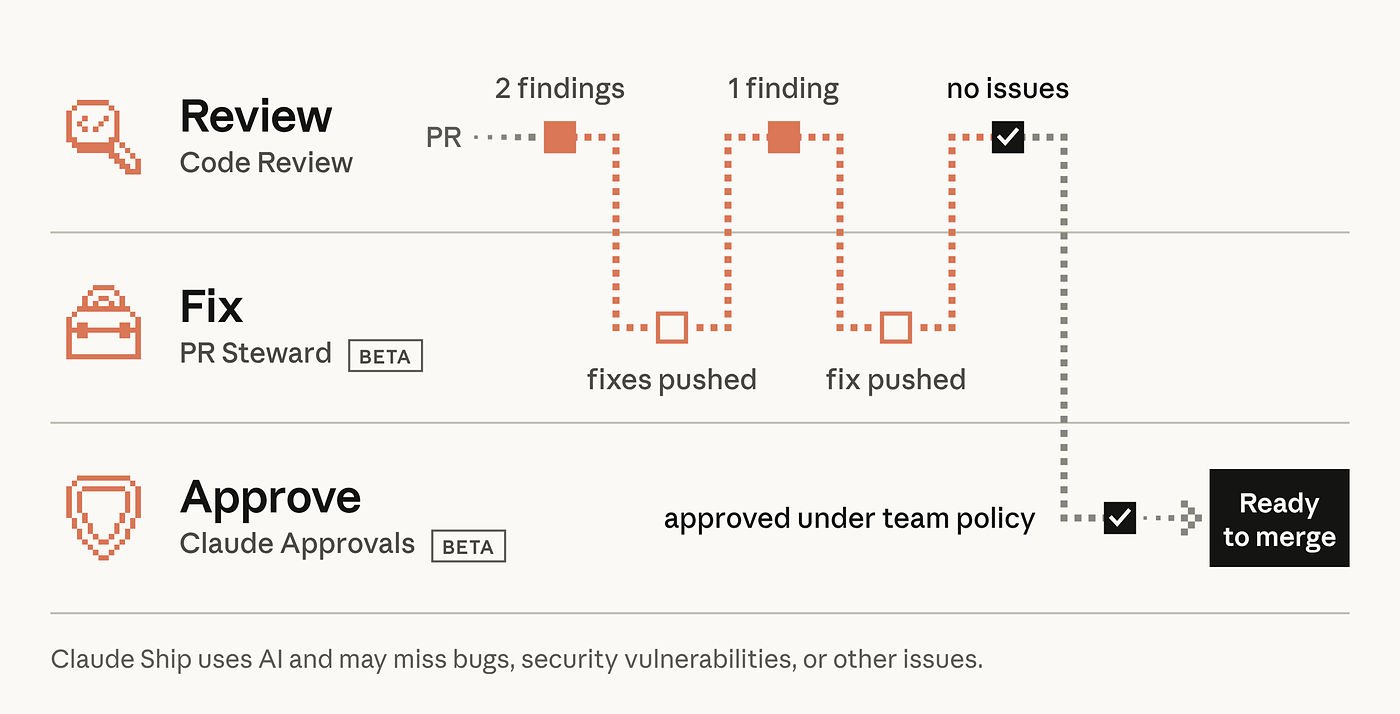
Anthropic wants to automate a new stage of software development with claude ship. This set of AI agents can now review code changes, fix detected issues, and even approve certain merge requests without human intervention, as long as the rules defined by the team allow it.

Claude Ship is aimed at developers and teams who already use artificial intelligence to write code. Anthropic seeks to accelerate everything that happens after this step, particularly pull requests (PRs), requests that allow changes to be reviewed and integrated into a project hosted on GitHub. Committing them can take time when multiple developers have to review changes, report bugs, and wait for fixes to be made. Claude Ship intends to take charge of a large part of these exchanges.
Three AI agents to review, fix and approve code
Claude Ship is based on three complementary components, two of which are still in beta. The first, Code Review, was already available before this announcement. You analyze the changes in light of the rest of the project, examine potential problems from multiple angles, and verify your own conclusions before publishing your comments in the pull request. Three levels of depth are offered: Fast, Standard and Deep.
The PR person then steps in to address the reported issues. You can fix failed automated tests, resolve conflicts between multiple edits, or respond to reviewer comments. After each intervention, the AI agent explains the changes made and indicates how to undo them. Developers can also give you instructions directly in the conversation associated with the pull request or ask you to stop your work. However, you are not allowed to approve or merge changes yourself.
Introducing Claude Ship (beta): Claude can review your pull requests, work on fixes, and approve those allowed by your team’s policy.
The goal is to help you ship code as fast as you can write it. pic.twitter.com/b9OBAhEBmr
—Claude Devs (@ClaudeDevs) November 23, 2026
It is the third component, Claude Approvals, who proposes the most important change. Teams can define their own rules in a file directly embedded in the GitHub repository. The agent can then automatically approve changes considered routine, while more sensitive changes may still require approval from a developer. The rules may take into account, in particular, the results of the code review and other criteria defined in natural language.
Claude Ship is limited to GitHub repositories
Developers can use the /ship command directly from Claude Code. This pushes your changes to GitHub, opens a pull request, and triggers the review and fix process. Companies can also automatically enable all three components in the repositories of their choice with levels of control tailored to their needs. Anthropic also recommends starting with an observation mode in which Claude Approvals evaluates modifications without actually approving them while taking time to verify the reliability of the established rules.
Available for Claude Team and Enterprise subscriptions, Claude Ship only works with repositories hosted on GitHub. Usage is billed based on the number of tokens consumed, the size of the pull requests, and the depth of the scans. Administrators can set spending limits to prevent overconsumption. Anthropic also specifies that AI can miss errors or security vulnerabilities: teams are therefore still responsible for defining changes that require human validation.