

Part 1: The Price of Perfect
The first person who taught my daughter to worry about her face was someone who claimed to love her more than anything. I discovered that on an ordinary Tuesday, with a hairbrush in my hand and Junie sitting cross-legged in front of me.
“Mommy, do you think Grandma wishes I had a different face?”
The brush stopped halfway through her hair. Until that moment, our biggest disagreement had been whether she could wear two enormous bows to school instead of one.
“Why would you think that, sweetheart?”
Junie touched the pale patch covering much of her left cheek. “She said people might stare at me in her wedding pictures.”
I set the brush down before my grip could tighten around it. “Tell me exactly what she said.”
“That everybody should look their very best. And maybe we could do something about my cloud.” She glanced at me through the mirror. “Do clouds look bad in pictures?”
I turned her gently toward me. “No. And neither do you.”
She nodded, but it was the polite little nod she gave when an adult explained something she wasn’t sure she believed. That frightened me more than the question.
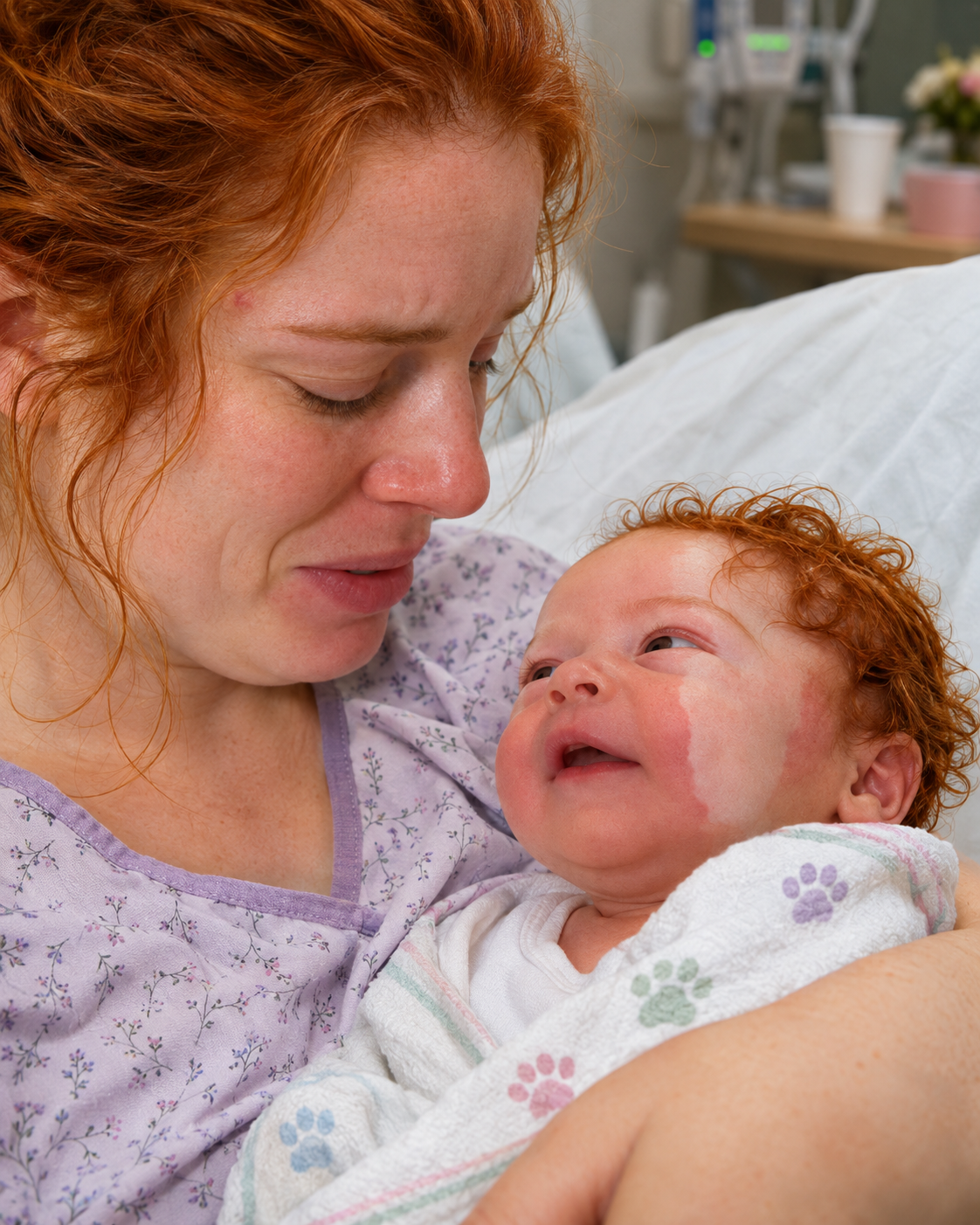
Junie had been born with an area of skin on her cheek that lacked the pigment of the surrounding skin. Her doctors had examined it, explained what to watch for during ordinary checkups, and assured us that the mark itself was harmless and needed no treatment.
Daniel and I had spent those first newborn days worrying about feeding, sleep, and whether every small sound meant we should call the pediatrician. Her cheek had never made our list of things to fix.
When she was four, she found a cloud in a picture book shaped roughly like her birthmark. She held the page beside her face and announced, “See, Mommy? My little cloud!”
The name stayed. Sometimes she drew herself with a cloud on her cheek and sometimes she forgot it entirely, because there were frogs to inspect, friends to make, and swimming lessons to argue she was ready to take without us watching.
My mother-in-law never seemed able to forget it.
When Junie was two, Patricia suggested another specialist, though we hadn’t asked for one. When she was four, a birthday package included a little makeup kit and a remark about having options when she wanted to look like everyone else.
Daniel returned the kit. He told his mother that presents were not an excuse to criticize our daughter.
Patricia cried afterward and said he had misunderstood her. She was concerned, she explained; children could be cruel.
I had believed, for too long, that concern and cruelty would be easy to tell apart.
That Tuesday evening, after Junie went to bed, I repeated her question to Daniel. He stood at the kitchen counter without moving, the unopened dishwasher beside him.
“I’ll talk to her,” he said.
“We’ve talked before.”
He looked at me then. “I know. This time she needs to understand there will be consequences.”
Patricia was getting married in six weeks. She was sixty-two, and Daniel’s father had died almost twelve years earlier; when she met Robert, we had genuinely hoped she was beginning a happier chapter.
Robert owned a commercial plumbing company and listened more than he talked. He remembered that Junie liked drawing animals and once spent an entire dinner helping her decide whether a dragon would need a veterinarian or a firefighter.
Patricia’s wedding plans were less relaxed. There would be nearly two hundred guests at a hotel two hours from our home, a string quartet, an elaborate dinner, and photographs she referred to as an investment.
Junie had been asked to be a flower girl. Every evening, she practiced walking down our hallway with a basket of fabric petals borrowed from a craft box.
“Am I supposed to smile the whole time?” she asked Daniel.
“Only if you feel like smiling.”
She practiced an enormous grin anyway.
Two days after our conversation at the kitchen counter, Patricia invited me to lunch. Daniel had already told her to stop discussing Junie’s appearance, so I assumed this was her attempt to settle things.
Instead, before our food arrived, she pushed an envelope across the table.
Inside was a check made out to me for $20,000.
“What is this?” I asked.
“Enough for a consultation and whatever a good specialist recommends. I found a cosmetic dermatologist who sees children.”
For a moment, I honestly thought I had misunderstood. “For Junie?”
“Obviously, Claire. If we start now, perhaps there’s something they can do before the wedding.”
“A doctor has already told us she doesn’t need treatment.”
“I’m not talking about need.” Patricia lowered her voice as a server passed. “I’m offering you an opportunity. Those photographs will be in our family for generations.”
I slid the envelope back without folding it. “So will Junie.”
Patricia’s lips tightened. “You don’t have to make everything sound ugly.”
“You offered me money to change my child’s face for your wedding pictures.”
“I never said she was ugly.”
“You don’t have to use that word for a seven-year-old to hear it.”
She glanced toward the other tables, more troubled by the possibility of being overheard than by what she had said. “I thought you would appreciate that I’m willing to pay.”
I stood, placed enough cash beside my water glass to cover what I had ordered, and left before the food came.
* * *
That evening, Daniel called his mother with me beside him. He did not raise his voice, which somehow made his anger clearer.
“Junie’s birthmark is not up for discussion.”
Patricia began explaining the specialist. He stopped her.
“No appointments. No treatments. No makeup to hide it. No comments to her about looking different. If those conditions are a problem, we won’t attend.”
There was a long silence before she said, “You would punish me on my wedding day?”
“We would protect our daughter on any day.”
She called me the next morning. Her apology began with not meaning to upset anyone and ended with wanting Junie to look her best.
“She already does,” I said.
This time, Patricia finally said she understood.
Daniel and I considered withdrawing anyway. But Junie had made a paper calendar and was crossing off the days, and we wanted our decision to protect her rather than simply take away something she loved.
We explained that being a flower girl was her choice, not an obligation. She asked whether she would still get to scatter petals, then returned to practicing.
For six weeks, Patricia kept her promise. She sent dress choices, checked shoe sizes, and bought Junie a bracelet with a little silver flower.
When we confirmed the wedding-morning arrangements, I put our boundary in writing: simple hair, no facial makeup, and a call if Junie wanted either parent. Patricia replied that everything was understood.
By the Friday we drove to the hotel, I had begun to believe her. Looking back, that was the last comfortable moment before I learned how carefully she had separated keeping her word from appearing to keep it.
Part 2: The Walk We Practiced
That Friday evening, Junie laid her shoes beside the hotel bed and asked whether flower girls were allowed to wave. Daniel told her there probably wasn’t a licensing board that could stop her.
She laughed so hard she had to start brushing her teeth again.
At breakfast the next morning, she barely touched her toast. Two other flower girls, sisters a little older than her, were getting ready in Patricia’s suite, and she wanted to know whether they liked drawing.
At 8 a.m., Patricia called to say the hairdresser was ready.
I repeated the arrangement before handing Daniel the phone. “Hair only. And she can call us whenever she wants.”
“Claire, we’ve discussed this,” Patricia said. “Please let today be pleasant.”
Daniel took Junie upstairs. He stayed while she joined the other girls at a table with coloring pages, gave the bridal assistant both our numbers, and reminded Patricia that we were only a few floors away.
When he came back, he said Junie had already begun explaining how to draw a turtle.
I let myself breathe.
The morning filled with ordinary wedding tasks. Daniel helped Robert’s brother carry place cards downstairs, while I steamed a crease from my dress and answered a call from my sister.
At 10:30 a.m., the bridal assistant confirmed that the girls had eaten, finished their hair, and were staying with the wedding party until the procession. I asked whether Junie was happy.
“They’re comparing their baskets,” she said. “Yours has very strong opinions about equal petal distribution.”
That sounded so completely like my daughter that I laughed.
We were seated near the front shortly before noon. I kept turning toward the doors, waiting for that big practiced smile.
The first flower girl appeared, dropping petals with solemn concentration. Her sister followed.
Then Junie stepped into the aisle.
For a second, I couldn’t understand what was wrong. Her basket was upright, her dress was the one we had chosen, and the silver bracelet rested against her wrist.
Then she turned her face.
A thick layer of makeup covered her left cheek. It was darker than the surrounding skin, and her hair had been drawn across that side in a style she hadn’t wanted when we practiced at home.
But it was her expression that made me grip the edge of my chair. Junie, who waved at delivery drivers and introduced herself to dogs, was looking at the floor.
“What did Mom do?” Daniel whispered.
Junie reached our row. I leaned toward the aisle, ready to stand if she stopped or reached for me.
She looked up just long enough to find my face.
I gave her the small smile I used when she searched for me from the pool. I wanted her to know I was there, not that she had done anything wrong.
Her fingers loosened slightly around the basket. Then she moved on.
The ceremony continued around us. Patricia walked toward Robert, guests stood, and the quartet softened as the officiant began speaking.
I heard almost none of it. I watched my daughter sit beside the other girls and carefully keep her hands away from her cheek.
Daniel’s hand stayed over mine. Neither of us mistook silence for acceptance; we were waiting for the first moment we could reach Junie without turning her into the center of two hundred people’s attention.
When the ceremony ended, a coordinator began directing the wedding party toward the garden doors. Daniel and I reached Junie before she joined the line.
“Mommy.” She said it like she had been holding the word in her mouth for hours.
I knelt. “Would you like to come somewhere quiet with us?”
She nodded immediately.
We found an empty sitting room off the lobby. Daniel closed the door, then sat beside her instead of standing over her.
“You haven’t done anything wrong,” he said before either of us asked a question.
Junie looked at me. “Are you mad about my face?”
“Not at you, sweetheart. Never at you.”
Her chin trembled. “Grandma said you might be.”
I took a breath slowly enough that she could see me do it. “Tell us what happened.”
She explained that the older flower girls had received a little lip gloss. Junie had wanted some too.
“Then Grandma said mine needed extra help. The lady put stuff on my cheek, and Grandma kept saying she could still see it.”
Daniel’s jaw tightened, but his voice stayed gentle. “Did you tell them you wanted to stop?”
“I asked if I could be done. Grandma said the lady was fixing it.”
I moved closer. “What did the makeup lady say?”
“She asked if you knew. Grandma said you said yes.” Junie rubbed her bracelet between two fingers. “Then Grandma said not to tell you before the wedding because you’d get upset and ruin everything.”
There it was: not a misunderstanding, not a spontaneous dab of powder. Patricia had known exactly whose permission she didn’t have.
“You can always tell us something an adult asks you to hide,” Daniel said. “Even if it’s Grandma. Especially if it makes you feel bad.”
“Even on a wedding day?”
“On every day,” I said.
Junie touched the edge of the makeup. “It feels sticky.”
“Would you like us to take it off?”
“Can we?”
The relief in that question nearly undid me.
* * *
Ten minutes later, in our hotel bathroom, I softened a clean washcloth with warm water while Daniel found the gentle cleanser we had packed. I removed the makeup slowly, checking that nothing stung.
He took the pins from her hair one at a time, asking before he moved each section. Small choices mattered now: the bow on top or at the back, the ribbon tied again or left alone.
As the pale shape emerged on her cheek, Junie leaned toward the mirror.
“There’s my little cloud.”
I smiled, though my throat hurt. “There it is.”
She examined herself from one side, then the other. “I look like me again.”
Daniel crouched beside her. “Would you rather go home, or would you like to stay for the party? Either answer is okay.”
She thought seriously. “Will the other girls still want me at their table?”
“I think they were interested in you, not your makeup,” I said.
“And there’s strawberry cake.”
“There is,” Daniel said.
“Then I want to stay. But I don’t want to get ready with Grandma anymore.”
“You won’t,” I promised.
Before we went downstairs, I called Hannah, Daniel’s cousin. She had babysat Junie for years, and Junie adored her.
I told her only what she needed to know: Junie had had an upsetting morning, we needed a private conversation with Patricia, and no one was to take her anywhere without us.
“I’ll be by the children’s table,” Hannah said. “She can help me investigate the cake situation.”
Junie took my hand as we left the room. Her grip was warm and ordinary, and I held on to that while we rode down.
Patricia saw us near the reception entrance. Her gaze went straight to Junie’s uncovered cheek.
“What happened to her makeup?” she asked.
Junie moved half a step behind me.
“We washed it off,” I said.
Patricia looked toward the waiting photographer. “But we haven’t done the family portraits.”
Daniel stepped forward. “Mom, we need to talk.”
“Not now.”
“Yes. Now.”
Robert approached, his smile fading as he took in our faces. “What’s happened?”
Patricia lifted a hand as if she could smooth the whole conversation away. “A completely unnecessary disagreement over a little makeup.”
Then she looked past me at Junie and said, “Well, at least the photographer can still fix it.”
Part 3: What the Camera Kept
For one second, nobody spoke. Then Daniel turned to Hannah, who had just reached us, and asked her to take Junie to the children’s table.
I bent close to my daughter. “You don’t need fixing. We’re going to make that very clear.”
“Can I have cake while you do?” she asked quietly.
“Ask Hannah when they’re serving it,” I said, and kissed her forehead.
I watched them walk away together before following Daniel, Patricia, and Robert into the small meeting room the coordinator offered us.
Patricia remained standing beside the door. “I have guests waiting.”
“And we have a daughter who thinks you’re disappointed in her face,” Daniel said.
“That is a terrible thing to accuse me of.”
“She asked Claire whether you wished she had a different one.”
Patricia looked at me as if I had supplied Junie with the question. I let the silence remain until she looked away.
Robert pulled out a chair but didn’t sit. “Start at the beginning.”
I told him about the comments, the check, and the condition under which we had agreed to attend. Daniel showed him the message confirming no facial makeup.
Patricia folded her arms. “Cosmetic treatment is one thing. Wedding makeup is another.”
“You knew exactly what we meant,” I said. “That’s why you told the artist we had agreed.”
“I’m her grandmother.”
“You are not her parent,” Daniel said. “And Junie asking to be finished should have been enough for anyone.”
Patricia’s face changed at that, but only briefly. “Children complain about sitting still.”
“Then you stop,” I said. “You don’t tell them their face needs more work.”
Robert finally spoke. “Did you say that to her?”
“Not in the way they’re making it sound.”
“Did you ask her to keep it secret?”
Patricia looked toward the door. “I wanted one peaceful morning.”
I had arrived in that room furious. Hearing that answer made my anger quieter and much more certain.
“You made a child responsible for protecting you from the consequences of your own decision,” I said. “She spent the morning worried that telling her mother would ruin your wedding.”
“I never meant to hurt her.”
“But you did,” Daniel said.
Robert set his chair back under the table. “There’s something else we need to discuss.”
Patricia turned sharply toward him.
“Yesterday, the photographer asked me to confirm a special editing instruction,” he said. “I told him I hadn’t requested anything and that we would clear it up before portraits.”
Daniel glanced at me. “What instruction?”
Robert hesitated, plainly uncomfortable. “To remove Junie’s birthmark from every official photograph. And to photograph her mostly from the other side.”
I could hear the muted reception music through the wall. Somewhere outside that room, people were laughing over drinks while I tried to absorb that Patricia had arranged to erase part of my daughter twice.
“You asked for that before today?” I said.
“Photographs are edited all the time.”
“A wrinkle in a tablecloth isn’t my child’s face.”
Robert was watching Patricia now. “You also told him the request came from me.”
She reached for his hand. He did not pull away, but he did not let the gesture end the conversation.
“I thought you would want everything to look polished,” she said.
“You told him I was concerned because my business associates would see the pictures.”
“Robert, please.”
“I asked for Junie to be included because she’s family. I never asked anyone to change her.”
For the first time since we entered the room, Patricia sat down.
Daniel rested his hands on the back of a chair. “You used his name with the photographer and ours with the makeup artist. You knew people would question this unless you made it sound like somebody else had approved.”
“I was thinking about what people might say.”
“About a seven-year-old?” Robert asked.
“People can be cruel.”
I looked at her. “Today, the person who made her ashamed was you.”
Her eyes filled. I didn’t enjoy seeing that, but I no longer felt compelled to rescue her from it.
“I love that little girl.”
“Then she needs to be able to trust you,” Daniel said. “For now, there won’t be any visits alone with you. No outings, no sleepovers, no getting ready behind a closed door.”
Patricia stared at him. “You’re keeping my granddaughter from me.”
“We’re keeping her with people who respect the boundaries we set.”
Robert nodded. “That’s reasonable.”
She looked between them as though the room had rearranged itself without asking her.
After a while, she said, “My mother used to tell me that if I looked perfect, people would leave me alone.”
No one interrupted.
“They teased me about everything when I was young. I thought if Junie didn’t give them something to notice…” She pressed a tissue beneath her eyes. “I thought I could spare her that.”
I believed that she remembered being hurt. I could even believe she had built a whole set of rules around never feeling that helpless again.
But sympathy for the child she had been could not come before protecting the child waiting outside.
“You taught her the same thing your mother taught you,” I said. “That being accepted is her responsibility, and changing herself is the price.”
Patricia stared at the tissue in her hands.
“You can understand why you did something and still take responsibility for it,” I said.
“I’m sorry,” she whispered.
“Junie deserves to hear that when she’s ready,” Daniel said. “Without excuses. Not while she’s trying to enjoy the reception.”
* * *
A few minutes later, Robert brought the photographer to us while Patricia remained in the meeting room. Daniel and I made our instructions clear: Junie’s birthmark was not to be concealed, recolored, or removed.
The photographer looked genuinely troubled. He explained that Patricia had described it as a request from both families, then showed us the note so there could be no misunderstanding about what was being canceled.
He deleted it in front of us and added that any questions about photographs of Junie would come directly to us.
We also spoke to Elise, the makeup artist, who was packing her kit upstairs. She did not deny what had happened.
“I asked about parental permission,” she said. “Patricia told me she had spoken to you that morning.”
“You should have checked with us,” Daniel said.
“Yes,” Elise said. “I should have. And when Junie asked to be finished, I should have stopped instead of accepting her grandmother’s answer.”
It was the first apology that afternoon that didn’t require us to untangle an excuse. I thanked her for acknowledging it, without telling her it was all right.
By the time we returned to the reception, Junie was showing the other girls how to fold their napkins into uneven fans. Hannah caught my eye and nodded.
“Mommy, they haven’t cut the cake yet,” Junie reported. “We didn’t miss it.”
“Good,” I said. “I was worried about that.”
She studied my face. “Are we in trouble?”
I pulled out the chair beside her. “No. Grandma made a choice she wasn’t allowed to make. The grown-ups are taking care of it.”
“Do I have to talk to her?”
“Not today unless you want to.”
Her shoulders settled, and she returned to the napkin.
When the coordinator called for family photographs, I asked Junie whether she wanted to join us. She looked toward the garden, where Patricia was standing beside Robert.
“Will you be next to me?”
“The whole time.”
She took Daniel’s hand with one hand and mine with the other.
The photographer arranged us without fuss. Junie stood in front of Daniel, her bow slightly crooked and her cloud uncovered.
“Everybody ready?” he asked.
Junie looked back at us, then faced the camera and gave the enormous grin she had practiced in our hallway.
Afterward, Robert crouched a comfortable distance away. “Thank you for being part of our wedding.”
“Did you see me walk?”
“Every step.”
He offered her a small flower that had fallen from an arrangement. She accepted it, then ran back to Hannah when the cake cart appeared.
Patricia watched her go. For once, she did not ask Junie to pose again.
We left after cake and two dances, when Junie said she was tired. She fell asleep in the car with her basket against her knees.
I thought the hardest conversation was behind us. Then, a week later, Patricia called Daniel and asked if we would let her speak to Junie—and I realized the next decision belonged partly to our daughter.
Part 4: A Place for Clouds
A week after the wedding, Daniel took his mother’s call in the kitchen while Junie and I were planting bean seeds in paper cups. He listened for several minutes before saying we would discuss it and call back.
He didn’t promise a visit simply because Patricia had finally asked the right question.
That evening, we sat with Junie at the kitchen table. I explained that Grandma wanted to apologize for the makeup and the things she had said.
Junie pushed a stray bit of soil across a paper towel. “Will she be sad if I don’t want to?”
“Maybe,” Daniel said. “But her feelings are not a job you have to do.”
“Do I have to say it’s okay?”
“No,” I said. “You can listen and still be upset. You can also decide you aren’t ready.”
She thought about that for a long time. Then she asked whether the visit could happen at our house, with both of us in the room.
“That’s exactly how it would happen,” Daniel said.
“And no makeup bags.”
“No makeup bags,” I agreed.
* * *
That Saturday, Patricia arrived empty-handed. I was grateful she had listened when Daniel told her not to bring presents; Junie did not need an apology tangled around a toy she wanted.
Patricia sat on the couch, leaving space between herself and Junie. Daniel took the armchair, and I stayed at the other end of the couch.
“I’m sorry I covered your cloud,” Patricia said. Her voice shook, but she kept going. “You asked to be finished, and I didn’t listen. I also told you to keep a secret from Mommy and Daddy, and that was wrong.”
Junie looked at the little silver bracelet she had chosen to wear that morning. “Why didn’t you like it?”
Patricia swallowed. For a moment, I wondered whether she would start explaining her childhood.
Instead, she said, “I was wrong to think it needed hiding.”
“Mommy says everybody looks different.”
“Your mommy’s right.”
Junie looked up. “You said people might stare.”
“I did. And I made you worry about something you weren’t worried about before. I’m sorry.”
That answer mattered more to me than tears would have.
Junie considered it. “If somebody asks about my cloud, I can tell them. Or I can say I don’t want to talk about it.”
“Yes,” Daniel said.
Patricia nodded. “Yes, you can.”
“And I don’t want the sticky stuff again.”
“You won’t have to wear it,” Patricia said.
Junie glanced at me, making sure we had heard. Then she picked up her drawing pad.
“I’m making a rabbit house,” she said.
It wasn’t forgiveness announced for everyone’s comfort. It was a child deciding she had finished a difficult conversation.
We let her finish it.
Patricia stayed for another twenty minutes while Junie drew, then said goodbye without asking for a hug. Junie waved from the table.
At the door, Patricia looked at me. “I know this doesn’t make it disappear.”
“No,” I said. “But it’s a beginning.”
She nodded and left.
When I returned to the kitchen, Junie was adding a swimming pool to the rabbit house. She asked whether rabbits would need tiny life jackets.
I sat beside her and said we should probably draw some.
* * *
Over the next several weeks, we kept the boundaries Daniel had set. Visits happened with one of us present, and we ended conversations when Patricia slipped into commenting on what Junie should wear or how she ought to arrange her hair.
Not every mistake was another betrayal. Sometimes it was an old habit, and Patricia caught herself before we said anything.
Once, she began, “You’d look so much better with—” and stopped.
Junie looked up from her puzzle.
Patricia tried again. “Would you like your hair tied back while you work?”
“No, thanks.”
“All right.”
It was a small exchange. I noticed it anyway.
Daniel did not mistake improvement for restored trust. When Patricia asked about taking Junie shopping alone, he told her we were not ready, and she did not argue.
Robert visited with her twice. He brought a book about unusual animals and accepted Junie’s corrections about the difference between a tortoise and a turtle with admirable seriousness.
Nobody asked Junie to praise Grandma for doing better. Nobody told her the family would be happier if she forgot what happened.
Still, there were moments when the morning at the hotel returned.
One night, while brushing her teeth, Junie asked whether school picture photographers fixed children’s faces too.
I turned off the tap so I could answer without rushing.
“A photographer should listen to the family about things like that. We can make sure yours knows not to change your cloud.”
She watched our reflections in the mirror. “What if I want lip gloss someday?”
“Then we can talk about lip gloss. Enjoying makeup and feeling like you have to hide are different things.”
“Like costumes?”
“A little. You can put on something fun without believing the person underneath is wrong.”
She nodded, apparently satisfied, and went back to brushing.
I stayed beside her until she finished. I was learning that protecting her confidence wasn’t one grand speech; it was answering the next question honestly, even when I wished she had never needed to ask it.
* * *
Several weeks after the wedding, the photographs arrived. Robert mailed us a print of the family portrait with a short message thanking Junie again for helping make the day special.
Daniel opened the envelope at the kitchen counter. I looked over his shoulder and felt my chest loosen.
There she was: our daughter in the front row, her bow crooked, her smile enormous, the pale shape on her cheek clear and unchanged.
Patricia stood at the other end of the group. Robert had one hand at her back, and Daniel’s hand rested lightly on Junie’s shoulder.
It wasn’t a photograph of a perfect day. I knew exactly what had happened outside its frame.
But it was an honest photograph of our family, and Junie had not been asked to disappear inside it.
She came running when Daniel called her.
“Let me see.”
He lowered the print to her height. She studied it carefully, tracing the edge of the paper rather than touching the picture.
“My flower stayed in the basket,” she said first.
“It did,” Daniel said.
Then she leaned closer. “They left my cloud.”
I had not realized I was still waiting for that sentence until she said it.
“Of course,” I said. “We made sure.”
She looked at the picture for another moment, then smiled. “Can it go in my room?”
“Where would you like it?”
“Next to my cloud drawing.”
Daniel found a frame that afternoon. Junie supervised the hanging from the hallway, correcting him twice before deciding the photograph was straight.
That evening, I found her standing beneath it in her pajamas.
“I look happy,” she said.
“You were happy when we took that.”
She turned toward me. “Even after Grandma made me sad.”
I knelt beside her. “Someone making you feel bad doesn’t mean there’s anything wrong with you.”
She thought about that, her eyes returning to the photograph.
“Good,” she said. “Because I like my face.”
I pulled her close, and she let me hold her for a moment before wriggling free to straighten a pencil on her desk.
Patricia had offered $20,000 for the possibility of changing something that had never troubled my daughter until an adult taught her it should. The photograph Junie chose for her own wall showed how much we would have lost by accepting.
Her grandmother’s approval was not fully repaired, and I could not promise that nobody would ever say another careless thing. But Junie knew we would listen, and she was beginning to trust her own answer again.
The next morning, she carried a blank sheet of paper to the breakfast table. She drew a girl with a white cloud on her cheek, then reached for another color.
“I’m making this for Grandma,” she told me.
“Would you like help writing something?”
Junie shook her head and bent over the page with the determined expression I knew so well.
“No,” she said. “This time, I know exactly what I want her to see.”
When someone calls hurtful behavior concern, what boundary would you set to help a child feel safe and accepted?
Disclaimer: This story is a work of fiction inspired by real-life themes. Names, characters, places and events are fictionalized, and any resemblance to real persons is purely coincidental. It does not represent any person or organization and does not encourage inappropriate behavior. Images are for illustration purposes only.


