

Part 1: The Child at the Door
For nine years, I welcomed people into a store where most emergencies involved a missing wallet or a spilled carton of milk. Then a little girl grabbed my vest, and a stranger demanded that I let him leave. By the next morning, I had lost my job. Weeks later, he wanted my savings, my house, and a quarter of a million dollars I had never possessed.
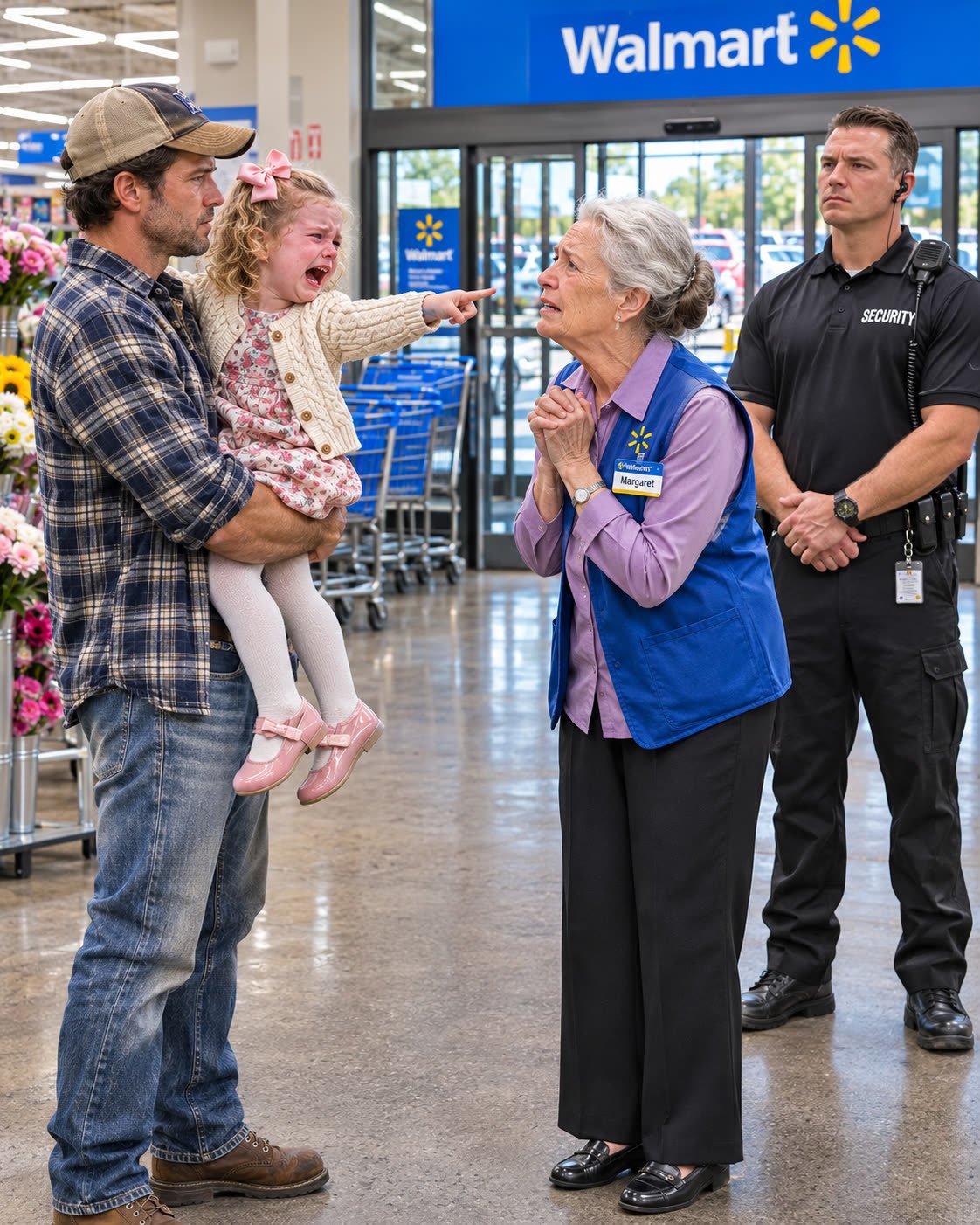
The first thing I noticed was her hand. Not the crying, which carried above the checkout scanners, but the way her little fingers opened toward me as though she had already decided I was the person who ought to help.
The man carrying her was moving quickly toward the automatic doors. Her yellow rain boots knocked against his knees, and a teal jumper had twisted sideways over her striped leggings.
I stepped out from beside the shopping carts with a star sticker balanced on my thumb.
“Hello, sweetheart. Would a star help?”
She lunged so suddenly that I caught the edge of a cart to steady myself. Both her hands closed around my blue vest.
“I want Mommy. You’re not my daddy!”
The man’s smile appeared a second too late.
“We’re having a difficult afternoon. Come on, Lucy.”
He knew her name. I noticed that. I also noticed how she tucked her face toward my shoulder when he tried to loosen her fingers.
My name is Evelyn Brooks. I was sixty-nine that March, with thirty-one years at the post office behind me and nine more greeting customers at RiverMart in Ashford, Illinois. My husband, Paul, had died shortly before I retired at sixty. After six months of eating lunch in a silent kitchen, I had applied for a job that required me to say hello.
I liked the work. I knew which customers needed a cart with a smooth wheel and which children preferred two small stars to one large one.
But nothing in nine years had prepared me for a child holding on as if my vest were a handle over deep water.
“Sir, could we pause a moment?” I asked.
“She needs a nap.”
He shifted toward the opening doors. I moved alongside him, not touching him, leaving the other exit clear.
“Lucy, do you know this gentleman?”
Her answer came in broken pieces.
“He came to Miss June’s. I said Mommy comes.”
The man’s jaw tightened.
“I’m her father. Would you like to see identification, or is this just how you treat people?”
I pressed the button on my radio.
“Denise, could you come to the front doors, please? I need assistance with a distressed child.”
Denise Ward, our security officer, was near the service desk. She started toward us, one hand already at her own radio.
The man pulled a wallet from his jacket and held out his license.
“Grant Mercer. That’s my daughter. Look.”
On his phone was a photograph of him holding a baby wrapped in a hospital blanket. Beside him stood a young woman whose face was partly cut off.
A photograph could tell me he had held a baby. It could not tell me why the child in front of me was pleading to stay.
“I’m not saying you aren’t related,” I told him. “I’m saying she’s frightened.”
Our manager arrived before Denise reached us.
Adam Keene was thirty-eight and careful about every number that appeared on his weekly report. Customer complaints troubled him more than broken equipment because complaints traveled upward.
“What’s happening?” he asked.
Grant answered immediately.
“Your employee is stopping me from taking my daughter home. I’ve shown her my license. I’ve shown her a picture. Now she’s called security.”
“She said he took her from Miss June’s,” I said. “I think we should call the police and let them check.”
Adam glanced at the phone, then the license.
“Evelyn, step back.”
Denise stopped beside him.
“We can ask dispatch for guidance,” she said.
“There’s no need to escalate a family tantrum.”
Lucy was still holding my vest. I looked down at her knuckles, pale around the fabric.
“Adam, please listen to what she’s saying.”
His voice dropped.
“You are not authorized to detain customers. Let go of this situation, or clock out.”
I wasn’t holding Grant. I wasn’t holding Lucy. But arguing about the distinction was wasting the seconds in which someone might still help.
I loosened the fabric beneath her fingers so it would not pull against her hands.
“I hear you, sweetheart,” I told her.
Grant turned before I could say anything more. Lucy reached backward over his shoulder.
Denise spoke into her radio, requesting the entrance footage be preserved. Adam told her to remain inside while he handled the complaint.
I followed Grant only as far as the public sidewalk. From there, I photographed his face, the child through the rear passenger window, and the license plate of a dark pickup. He saw my phone and pointed at me.
“You’ll regret this.”
Then he climbed in and drove away.
My fingers slipped twice before I reached the emergency number. I gave the dispatcher facts: what Lucy had said, what the man had shown us, which direction he had driven. When asked whether I knew a crime had occurred, I answered honestly.
“No. That’s why I’m calling.”
I sent the photographs using the link the dispatcher provided and stayed on the sidewalk until my shaking eased.
The next morning, Adam called me into his office.
Grant had complained through the customer hotline. According to Adam, I had pursued a customer after being told to disengage and had created a confrontation outside the store.
“Was the little girl all right?” I asked.
“That is not the subject of this meeting.”
He slid a termination form across the desk.
I asked whether he had watched the entrance recording. He said the decision had been reviewed with district personnel. When I asked again, he looked at the form.
I signed only the line acknowledging receipt. Then I emptied my locker into a grocery bag: lunch container, cardigan, spare glasses, two rolls of stars.
At home, I put the stickers beside the telephone. I called the police nonemergency line, gave my incident number, and asked whether there was anything more they needed.
An officer confirmed that my information had been passed to investigators. He could not discuss a child’s circumstances with me.
For three weeks, that was all I knew.
Then a process server knocked on my door and handed me a complaint bearing Grant Mercer’s name.
He was suing me for $250,000—and the first page said I had grabbed him.
Part 2: The Price of Being Believed
I read the accusation standing in my hallway with my coat still on.
According to the complaint, I had seized Grant’s arm, blocked every exit, and shouted that he was a kidnapper in front of a crowd. He claimed damage to his reputation and severe emotional distress.
None of that had happened.
There were other words I understood less well: compensatory damages, punitive damages, prayer for relief. The final phrase offended me most. I had been praying for a child. He was asking a court for everything I owned.
My house was small and nearly paid off. My postal pension covered necessities, and the store wages had paid for repairs, dental bills, and the occasional train trip to see my sister. I was not destitute. I was also nowhere near capable of financing a prolonged lawsuit.
For two nights, I slept with the complaint on the kitchen table, as though leaving it within sight might stop it from growing worse.
On the third morning, my sister Ruth called.
“Have you answered it?”
“I wrote down what really happened.”
“That isn’t what I asked.”
Ruth had been a school secretary long enough to recognize paperwork capable of hurting people. She found the county bar association’s referral number and stayed on the telephone while I called.
The first lawyer quoted a retainer that made my mouth go dry. The second had a conflict. The third offered a consultation through a volunteer civil-defense program.
That was how I met Noah Ellis.
He had black curls, square glasses, and a document bag with one handle repaired in a different shade of leather. I was ashamed of the relief I felt when he told me he had been practicing for seven years.
“You were hoping I’d be older,” he said.
“Considerably.”
He smiled, then turned the complaint toward himself.
“I can’t promise this will be quick. I can promise we won’t miss deadlines.”
He asked me to tell the story without interruption. Afterward, he went through it again, separating what I had seen from what I had assumed.
“Did you touch him?”
“No.”
“Did you call him a kidnapper?”
“No.”
“Did you tell anyone you knew he had committed a crime?”
“I told the dispatcher I didn’t know.”
He underlined something.
“Good. Don’t improve that answer because you think it sounds weak. Accuracy is our strength.”
Noah agreed to represent me without charging attorney fees through the volunteer program. He explained possible expenses, obtained assistance for the initial filing costs, and sent preservation requests immediately.
I worried that we were already too late for the store recording.
“Someone may have kept it,” he said. “We ask before we assume.”
Denise had kept it.
Following the entrance incident, she had opened a security report and marked the relevant footage for retention. She had also recorded my request for police assistance and Adam’s instruction not to escalate.
When Noah told me, I sat down so abruptly that my chair scraped the wall.
“Will she get in trouble?”
“She followed the reporting procedure. And she’s agreed to speak with me.”
For the first time since the process server arrived, I could draw a full breath.
Breathing did not make the next months easy.
Grant’s lawyer requested documents and written answers. Noah objected where appropriate and helped me respond where required. I learned that being innocent did not exempt a person from calendars, copier bills, or questions designed to make a simple memory sound unreliable.
At my deposition, Grant’s attorney asked whether I had ever mistaken one customer for another.
“Of course.”
“Then your judgment is not infallible.”
“No one’s is.”
“Yet you decided this man was abducting a child.”
Noah objected to the characterization. I waited, as he had taught me.
“I decided a frightened child needed someone to check,” I answered.
Grant sat across the conference table, turning a pen between his fingers. He did not look at me when the attorney played the security recording.
There I was beside the cart bay. There was Lucy reaching. There was the space between Grant’s arm and my hands.
Afterward, in the elevator, I began to cry from the effort of not crying upstairs.
Noah handed me a folded tissue.
“The recording matters,” he said. “So does the emergency call.”
By summer, he had also obtained records that explained why another prosecutor’s office had requested my photographs. He told me there was a related criminal case and that Grant had been released under conditions while it proceeded.
I gripped the edge of Noah’s desk.
“The child?”
“She was located that afternoon. She’s with her mother.”
He let me sit with that before saying anything else.
I asked whether I could contact them.
“Not without an invitation. They have an advocate, and they’re managing a great deal.”
I understood. Still, that night I moved the stars from beside the telephone into my handbag. I could not have explained why.
In September, Noah filed a motion asking the court to enter judgment in my favor without a trial. He said the record no longer supported the central allegations. Grant’s lawyer opposed it.
The court scheduled an October hearing to address the motion and related evidentiary issues. It was not the grand courtroom reckoning I had imagined during sleepless nights. It was another date, another preparation meeting, another clean blouse laid over a chair.
Before we went in, Noah told me the child’s mother would attend and might testify on a limited issue if the judge permitted it. Her statement and the relevant records had already been disclosed to the other side.
“You don’t have to speak to her unless you both want to,” he added.
Inside, Grant wore a dark suit. His lawyer arranged papers into straight piles.
I concentrated on placing my handbag beneath my chair without spilling its contents.
Then a young woman entered with an advocate and a little girl in yellow boots.
Lucy stopped beside the back row. Her eyes moved over the room, found me, and widened.
“Mommy,” she whispered loudly enough for both tables to hear. “That’s the star lady.”
Part 3: What the Photograph Could Not Prove
For months, I had remembered Lucy reaching backward over Grant’s shoulder. Now she lifted her hand in a small wave.
I lifted mine.
Her mother bent to hear something she said, then looked toward me. She pressed her lips together and nodded once.
Before the hearing began, the advocate took Lucy to a waiting area outside the courtroom. I was grateful. Whatever the adults needed to say, she did not need to sit beneath it.
Judge Elena Soto reviewed the matters before her without speeches or visible impatience. She confirmed which exhibits had been submitted, heard the lawyers’ positions, and allowed limited testimony concerning the circumstances behind my emergency call.
When the young woman took the witness stand, she placed both hands flat on her lap.
“Please state your name,” Noah said.
“Claire Bennett.”
She was twenty-nine, a nursing assistant at a residential care center, and Lucy’s mother. She spoke quietly but did not need to be asked to speak up.
“Is Mr. Mercer Lucy’s biological father?”
“Yes.”
The answer landed with a strange weight. Grant had told one important truth at the doors. It had been enough to make Adam stop asking questions.
Noah handed Claire a copy of a court order.
She identified it as the order granting her sole custody and restricting Grant’s contact. A separate protective order prohibited him from approaching her and Lucy except as specifically authorized by the court. At the time he took Lucy, no visit had been authorized.
The orders had followed an assault against Claire when Lucy was a baby. She did not describe the injuries. She explained the hospital visit, the police report, and the months required to arrange a safer life.
Grant stared at the table.
“What happened on the afternoon in question?” Noah asked.
Claire had been at work when Grant appeared at Little Acorn Home Daycare. He claimed Claire had been taken to a hospital and had sent him for Lucy.
June, the provider whose name Lucy had cried out, was away at a medical appointment. A substitute recognized Grant from an old enrollment photograph but failed to check the current authorized-pickup list and the restriction notice in Lucy’s file.
“June called me when she returned,” Claire said. “She asked which hospital I was in.”
Claire stopped. Her fingers pressed together.
“I was taking someone’s blood pressure.”
The room stayed quiet while she gathered herself.
The daycare reported the unauthorized pickup, and Claire called police. Investigators matched her report with my emergency call. My photographs supplied a current vehicle, a clear plate, and a confirmed direction of travel.
Officers located the pickup on a highway south of town a little over an hour after it left RiverMart.
“Lucy was taken to the hospital for evaluation,” Claire said.
Noah did not ask her to interpret medical findings. Those records belonged to the criminal investigation and had limits on how they could be used here.
He asked only whether Lucy had been returned to her care.
“That evening.”
I lowered my head. I had spent that evening sitting beside a telephone, wondering whether I had made a terrible mistake.
Claire had spent it waiting to find out whether her daughter would come home.
Grant’s attorney questioned her about the old family photograph and whether Lucy had known her father previously. Claire answered yes to both.
“Children sometimes resist leaving a store, don’t they?”
“Yes.”
“And they sometimes say things that aren’t literally accurate?”
Claire looked toward him.
“That is why I’m glad someone called people who could check.”

After her testimony, Denise identified the security recording and her contemporaneous incident report. She confirmed that I had requested help, had not grabbed Grant, and had not announced that he was a kidnapper.
Grant’s lawyer challenged the camera angle. Noah played the second view.
There was no dramatic gasp. Only the soft click of a keyboard as the clerk marked another exhibit.
I found that more reassuring than any speech could have been.
Judge Soto did not rule from the bench. She requested short supplemental filings on the remaining legal issues and took the motion under advisement.
Outside the courtroom, Grant left with his attorney. No deputies seized him. No one could erase the months already spent or decide a separate criminal case in the corridor.
Claire approached me beside a drinking fountain.
“I wanted to call you,” she said. “The advocate asked me to wait until the lawyers had arranged things.”
“You didn’t owe me a call.”
She shook her head.
“You lost your job.”
“You got your little girl home.”
We stood there, each unable to make the other sentence smaller.
Then Lucy came around the corner holding her advocate’s hand. She stopped a few steps away, studying me with the serious concentration children give an important decision.
“Do you still have stars?”
I opened my handbag.
The first sticker bent when I peeled it. I almost apologized, but Lucy held out her palm as though I had produced exactly what she wanted.
She pressed the star onto her jumper.
“This one stays with me.”
Claire turned away for a moment. I pretended to search for the backing paper.
The judge’s written decision arrived twelve days later.
Noah called before emailing it. The court had entered judgment in my favor on all claims. The recording contradicted the alleged grabbing and obstruction; the evidence did not support the claimed false public accusation. My good-faith report of a suspected emergency was addressed under the applicable protections.
The order was careful, specific, and nothing like the thunderous vindication I had rehearsed in my kitchen.
I read every page anyway.
“Can he file the same case again?” I asked.
“Not simply start it over. He has appeal rights, and there are deadlines. I’ll explain those too.”
We discussed costs and a separate request concerning litigation conduct. Noah also sent the prosecutor a copy of correspondence in which Grant had offered to drop his demand if I corrected my police statement to say I had misunderstood.
“Is that another crime?” I asked.
“That’s for investigators and prosecutors to assess. We give them the evidence. We don’t decide the charge.”
I put the judgment beside Paul’s photograph, then made myself a proper lunch for the first time in days.
That afternoon, a victim-witness coordinator called.
The civil case was over. Grant’s criminal trial was approaching, and the prosecution needed me to tell the story again—with him sitting close enough to hear every word.
Part 4: The Question Asked Again
I thought winning the civil case would make me brave.
Instead, when the trial subpoena arrived, I dropped a spoon into the sink and could not remember what I had been preparing.
Noah reminded me that fear and truth were unrelated.
“You don’t need to feel confident to give an accurate answer.”
He was not the prosecutor and could not tell me how the criminal case would unfold. He could sit with me while I reviewed my own statements, explain the courtroom process, and remind me not to guess.
A prosecutor met with me separately. She asked what I remembered independently and what I knew only from later conversations.
That distinction mattered. I had witnessed an encounter at a store. I had not witnessed the daycare pickup, the highway stop, or what happened inside Grant’s truck.
By December, I had practiced saying, “I don’t know,” without treating it as an apology.
Claire and I had met twice by then, once at a park and once at a quiet café where Lucy spent most of the visit arranging sugar packets by color.
We did not discuss testimony. We talked about Claire’s work schedule, my sister’s opinion of frozen pie crust, and Lucy’s determination to wear rain boots regardless of the forecast.
Once, Claire told me the daycare’s licensing review had resulted in corrective requirements. She had moved Lucy to another provider with a pickup password and a system that required staff to check current authorizations every time.
June had apologized in person and in writing.
“I can understand how the mistake happened,” Claire said. “That doesn’t mean I can take Lucy back there.”
I thought of Adam’s office and understood exactly.
On the morning I testified, Grant looked smaller than he had at the doors. Not weaker or less responsible—simply a man seated at a table, without a frightened child in his arms.
The prosecutor asked me to describe the first thing that drew my attention.
“Her hand,” I said.
I described Lucy reaching, the words I heard, the old photograph, and my request for help. The emergency call was played for the jury.
My recorded voice sounded steadier than I remembered feeling.
“I don’t know if a crime has happened. The little girl says she wants her mother. Please have someone check.”
During cross-examination, Grant’s lawyer asked whether I had training in family law.
“No.”
“Child psychology?”
“No.”
“Then you were not qualified to determine custody.”
“That’s correct.”
He paused, perhaps expecting resistance.
“I called people who could find out,” I added.
When my testimony ended, my knees trembled on the two steps down from the witness stand. I kept one hand on the railing and walked slowly.
Afterward, I followed the trial through the coordinator’s updates and attended only when permitted. The jury heard evidence I had not been present to see.
The responding officer described locating the truck and finding Lucy unusually drowsy. A pediatric clinician explained that tests detected a sedating over-the-counter medicine and that the hospital had monitored her until she was safely alert.
The clinician did not claim a laboratory result could prove who had administered it or why. Other evidence addressed that: medicine recovered from the vehicle, Grant’s own recorded statements, and messages about keeping Lucy asleep during a long drive.
Hearing this was harder than hearing my own testimony challenged.
That evening, I called Claire and almost asked how she could bear it.
Instead, I asked whether she wanted company.
“Not tonight,” she said. “But thank you for asking instead of coming anyway.”
It was a lesson I needed. Caring did not give me permission to decide what someone else required.
The jury returned guilty verdicts on the charged child-abduction and protective-order offenses. Sentencing took place later, after the court received the required reports and heard statements.
Grant received a substantial prison sentence. The protective orders remained in place, and Claire worked with her attorney and advocate on longer-term safety planning.
When she called me afterward, she did not say everything was over.
“We have room to breathe now,” she said.
I sat at my kitchen table and let that be enough.
A local reporter contacted me after the verdict. I declined at first. The idea of strangers discussing Lucy made my skin prickle.
Claire had the same concern, but she wanted people to understand that a photograph and a shared surname were not substitutes for checking a frightened child’s safety.
With her consent, I agreed to a short interview that omitted identifying details about Lucy’s routine and location. She and her advocate reviewed what information they were comfortable making public.
The reporter asked whether I considered myself a hero.
“No.”
“Then why risk your job?”
I looked at the stars beside my cup.
“I didn’t know I was risking it. I knew she was asking for help. Calling someone to check seemed more important than pretending I hadn’t heard.”
The interview aired on a Thursday.
By Saturday, there were letters in my mailbox from teachers, cashiers, parents, and people who remembered occasions when someone had taken their fear seriously.
One woman wrote only three sentences. As a child, she had asked an adult for help and been told not to make trouble. She thanked me for letting a little girl make trouble.
I kept that letter.
RiverMart contacted Noah the following week.
Their review had included the preserved footage, Denise’s report, the termination decision, and my written appeal, which had sat unresolved for months.
A regional operations director named Marissa Cole asked to meet with us.
She began without explaining how difficult the situation had been for the company.
“You requested appropriate help,” she said. “Our response failed you, and it failed the child.”
They offered reinstatement, compensation for lost wages under a written agreement, restoration of seniority, and a revised safety procedure for the district. Noah would review the terms before I signed anything.
Then Marissa asked whether I would return to the entrance.
For nine years, that doorway had been the place where I felt useful.
Now I had to decide whether usefulness was enough reason to trust it again.
Part 5: A Star of Her Own
I did not answer Marissa in the meeting.
That surprised her, though she tried not to show it. Perhaps she had imagined an apology would open the same door that a termination had closed.
“I appreciate the offer,” I said. “I need to know what would happen if it happened again.”
She set down her pen.
“Tell me what you need clarified.”
I wanted the emergency-reporting policy in writing. I wanted employees told they could contact emergency services when they reasonably believed someone might be in danger, without waiting for a manager’s permission. I wanted staff trained not to make custody decisions from a photograph or attempt a dangerous confrontation themselves.
Most of all, I wanted the procedure to continue working after everyone forgot my name.
Noah asked about implementation, training records, and how reports would be reviewed. Marissa agreed to provide details rather than assurances.
The money mattered too. I was tired of pretending that being grateful for Lucy’s safety made the loss of my wages inconsequential.
For months, I had postponed replacing a leaking water heater and stretched an old pair of glasses past usefulness. Noah checked the wage calculations, benefits, and tax treatment with me. The final agreement gave me time to review it and did not require me to describe the termination as a misunderstanding.
It had not been a misunderstanding. People had made choices.
Adam was no longer managing the Ashford store. Marissa would not discuss private personnel details, and I did not ask her to. Denise later told me he had been reassigned while the company addressed the failures found in its review.
A week before I returned, a letter arrived from him.
It was longer than six words and less polished than the messages he used to post in the break room.
He wrote that Grant’s confidence had seemed more credible to him than Lucy’s distress. He had mistaken ending the complaint for solving the problem.
He also admitted that my request for help had given him enough information to choose differently.
There was no request that I reassure him.
I appreciated that.
After two days, I wrote back.
“Thank you for taking responsibility. I hope the next employee who raises a concern does not have to argue to be heard.”
I did not add that everything was forgiven. I was not ready, and he had not asked me to pretend.
Claire understood my hesitation about returning.
“You don’t owe that store a happy ending,” she said.
We were sitting at my kitchen table while Lucy and Ruth built a crooked tower from wooden blocks in the next room. Ruth had come for the weekend and was losing, very convincingly, to a three-year-old architect.
“I know,” I said. “But I liked my work before they made me feel foolish for doing it carefully.”
Claire turned her mug in both hands.
“Then go back for that. Not for them.”
It was the clearest advice anyone had given me.
I signed the agreement after Noah completed his review. I chose three shifts a week instead of four, leaving one weekday free for the library’s reading program.
For the first time since Paul died, I was not filling every empty hour simply because I feared an empty room.
Claire was making changes of her own. She moved to a work schedule with fewer last-minute shifts and continued meeting with her advocate. Lucy had support from a child therapist experienced in helping young children after frightening events.
Some days were ordinary. Some were not.
A truck idling outside once made Lucy refuse to cross a parking lot. On another afternoon, she spent an hour laughing at a dog trying to carry a branch through a gate.
Claire stopped measuring progress by whether difficult moments disappeared.
“Yesterday she told her new teacher she didn’t want a hug,” she said once, smiling. “The teacher said okay. Lucy came home very pleased with herself.”
That seemed worth celebrating.
The store asked whether I would lend my name to the new procedure. I declined.
“Put the instructions on the page,” I told Marissa. “People don’t need to remember Evelyn Brooks. They need to remember what to do.”
The final training emphasized listening, promptly seeking appropriate help, preserving useful information, and avoiding assumptions about family relationships. It did not tell employees that every upset child meant a crime. It told them that uncertainty was a reason to ask for assistance, not an excuse to ignore a credible concern.
Denise helped teach the first sessions.
On my first Saturday back in January, she met me at the staff entrance with a fresh vest folded over her arm.
“Same pockets,” she said. “I checked.”
I laughed harder than the joke deserved.
The entrance looked almost unchanged: stacked carts, a stubborn floor mat, the same customer who always asked which coffee was on sale before remembering to say good morning.
But the duty manager came over before the doors opened.
“If you need support, call. We’ll come.”
It was a small sentence. After what had happened, I knew its value would lie in whether people kept it.
At ten fifteen, Claire and Lucy arrived.
Lucy walked rather than ran. Near the carts, she looked up at her mother.
“Can I go to Miss Evie?”
Claire nodded.
She crossed the few feet between us and held out her hand.
“A star for my pocket, please.”
I peeled one from the roll. Then I offered a second.
“Would you like another?”
She considered this carefully.
“That one is yours.”
I bent so she could reach my vest. She pressed the sticker above my name badge and smoothed each point with one small finger.
There were customers moving around us, carts rattling, someone asking where to find batteries. No applause. No cameras. Just a mother watching her daughter decide where a star belonged.
Claire touched my arm.
“We’re doing better,” she said.
I believed her—not because everything difficult had ended, but because I had seen the work behind those words.
Lucy tucked her own star into the pocket of her coat. Then she took her mother’s hand and headed toward the produce aisle.
At the corner, she turned back.
“Miss Evie? If I lose it, can I ask for another?”
“You can always ask.”
She nodded, satisfied, and disappeared beside the apples.
I looked down at the slightly crooked star over my name. Once, she had held that vest because she was afraid to let go. This morning, she had let go because she knew she could come back.
Disclaimer: This story is a work of fiction inspired by real-life themes. Names, characters, places and events are fictionalized, and any resemblance to real persons is purely coincidental. Images are for illustration purposes only.


