

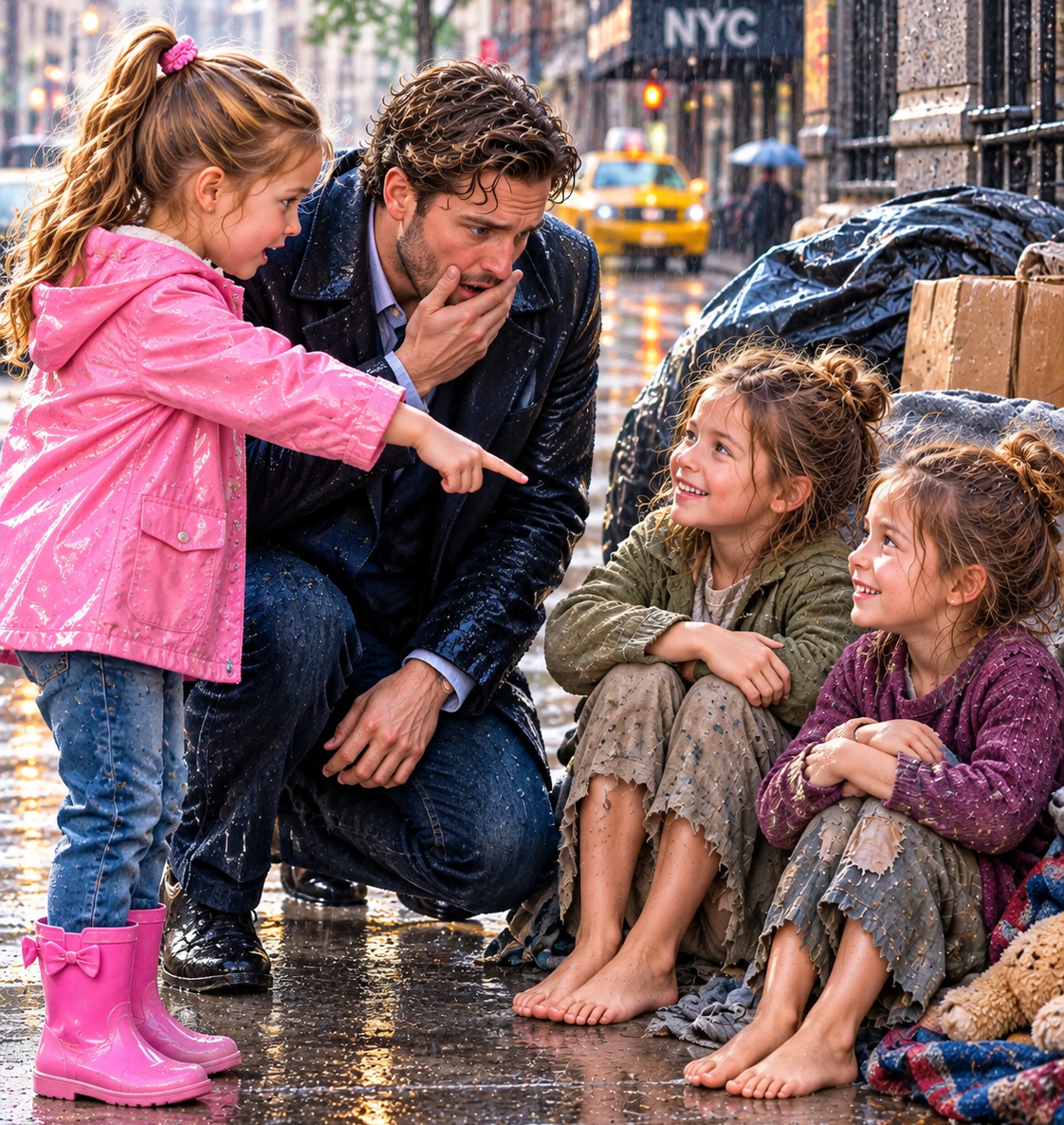
It was almost 9 p.m. on a rainy Thursday on the Lower East Side when my five-year-old screamed from the back seat: “Daddy, stop! Those girls have my face!” Two barefoot sisters were huddled on wet cardboard half a block from my hotel. One of them wore a locket I bought my wife the year before she died.
Part 1: The Girls Under the Awning
“Daddy, stop! Stop the car! There are two girls with my face sitting by the trash!”
Valerie shouted it so loudly that my foot hit the brake before my brain caught up.
It was a few minutes before nine on a Thursday night, and a cold, steady rain was coming down over Manhattan’s Lower East Side. We were heading home from a walk-through at one of my company’s hotel renovations. I’d spent the drive arguing with a contractor on speakerphone. My daughter had spent it looking out the window.
I followed her finger. Under the awning of a printing shop with its metal gate pulled down, two little girls sat pressed together on a flattened cardboard box. Their feet were bare. The older one had taken off her sweater and wrapped it around the younger one, and she was shivering so hard she could barely keep it in place.
“They look like me,” Valerie said, her nose against the glass.
I got out without an umbrella.
I’m Brett Calder, thirty-nine, founder of a hotel and property company. For most of my life, I believed money could at least keep the people I loved safe.
That night was the beginning of learning how wrong I’d been.
The older girl lifted her head as I came close. She had Valerie’s dark curls. Valerie’s pointed little chin. And, just in front of her left ear, a tiny brown birthmark in exactly the spot where my daughter has one.
Then the younger girl looked up, and I forgot how to breathe.
Green eyes, flecked with gold.
I had only ever seen eyes like that on one person. My wife, Lena.
Lena, who I had buried—or believed I had—five years earlier.
The curly-haired girl scrambled to her feet and stepped in front of her sister.
“We didn’t take anything, mister. We’re going.”
I didn’t know it yet, but those were the first words of the truth my family had spent five years hiding from me.
Part 2: Three Names
“Nobody thinks you took anything,” I said, crouching down so I wasn’t towering over her. “Are you out here by yourselves?”
Before she could answer, I heard the car door. Valerie had climbed out in her pink raincoat, dragging her kindergarten backpack. She unzipped the front pocket and pulled out a little bag of cheddar crackers.
“Here,” she said, holding it out. “I was saving some for tomorrow, but you can have them.”
The younger girl took exactly one cracker. She broke it in half, looked at both pieces, and handed the bigger one to her sister.
It would be weeks before I understood why such a small thing hit me so hard.
“What are your names?” I asked.
“I’m Vera,” the older one said. “That’s Violet.”
Everything inside me went quiet.
Six years earlier, at a diner on Second Avenue, Lena had found out we were having triplets. That same night, she grabbed a paper napkin and a pen from the waitress and started writing names. Three survived the cross-outs.
Valerie. Vera. Violet.
That day started with an emergency and ended with me alone in a waiting room. Hours later, my mother-in-law, Eunice, came through the double doors with her face wet. Lena hadn’t made it, she told me. Of our three daughters, only one had survived. Dr. Tillman, the obstetrician, used words like “irreversible” and “nothing more we could do.”
I never got to see the other two babies. I never got to see Lena again, either. Eunice took care of everything—the cremation, the paperwork, the funeral home—while I sat in a nursery chair learning how to warm bottles for Valerie. A few weeks later, she handed me an urn.
“Where’s your mom?” I asked Vera now.
She pressed her lips together.
“We don’t have a mom. Aunt Marnie takes care of us.”
Marnie. Lena’s little sister. She vanished right after the memorial. Eunice told me grief had broken her, and that she didn’t want to hear from any of us.
“Where’s your aunt tonight?”
“She said to wait here, by the big hotel,” Vera said. “She was going to talk to a man. She didn’t come back. That was two nights ago.”
“The print shop lady gave us water,” Violet added, very softly. “But today she didn’t open.”
I looked down the block. The hotel half a block away was mine. Marnie would have known that Thursday nights were when I checked on the renovation.
That wasn’t a coincidence. Somebody had been trying to reach me.
Part 3: The Locket
I called 911 and told the dispatcher I’d found two young children who appeared to be alone. Then I had Dez, my hotel’s security manager, bring blankets and keep the corner clear.
While we waited, Valerie knelt down on the wet cardboard next to the sisters.
“I have a little spot too,” she said, pushing her curls back to show them.
Three girls. Three nearly identical birthmarks, all in the same place. I suddenly remembered Lena lying on the couch with her hand on her belly, laughing that our daughters would have their own secret constellation.
“Daddy,” Valerie whispered, “why do they have my face?”
I didn’t have an answer that wouldn’t scare her.
Violet tugged at the collar of her T-shirt and pulled out a small gold locket on a dark cord.
“Aunt Marnie said this was our mom’s,” she said. “We’re never supposed to lose it.”
I knew it before she finished the sentence. I’d bought that locket for Lena on our first anniversary. On a trip to Vermont the next fall, she’d dropped it on the stone steps of a bed-and-breakfast, and it had a small dent in one corner ever since.
The dent was there.
“Can I see it?” I asked.
Violet didn’t take it off. She just opened it carefully with her thumbnail.
Inside was a photo of Lena, smiling, with one hand resting on her pregnant stomach. Folded behind the photo was a tiny slip of paper in her slanted handwriting. I had never seen it before.
If we’re ever separated, make sure all three of them know they were wanted.
Under it was a date. Valerie’s birthday.
All three.
This wasn’t a resemblance. It wasn’t a grieving husband seeing his wife’s face in strangers.
The police arrived with a caseworker from the Administration for Children’s Services. They were kind but clear: the girls would go somewhere safe tonight, and ACS would assess everything before I could take them anywhere.
I understood. It didn’t make it easier when Vera looked up at me and asked, “Are they going to split us up again?”
Again.
“I’m not going to disappear,” I told her. “Tomorrow, you’ll know exactly where to find me.”
Valerie cried the whole way home. I told her that sometimes being family means letting the people whose job is protecting children do that job.
I was saying it to myself as much as to her.
And somewhere in the back of my mind was the question I couldn’t put down: if two of my daughters had been alive all this time, what else had Eunice told me that wasn’t true?
Part 4: The Signature That Wasn’t Mine
At seven the next morning, I was in the office of Jenna Ross, an attorney my company uses for family matters. I’d brought photos of all three girls and a manila envelope I hadn’t opened in years: every piece of paper from the day Lena delivered.
Near the bottom was a cremation authorization form with my signature on it.
It looked like my signature. Almost. But I’ve signed my name the same way since high school, with a long loop on the final r in Calder. This one ended in a flat, short tail.
I had never signed that form.
“That could be a forgery,” Jenna said, studying it. “But suspicion won’t get us anywhere. We need the originals and a handwriting expert.”
Then she asked for the death certificates for the two babies who’d supposedly died.
I went through the envelope twice. I had Valerie’s tiny inked footprints. I had her hospital bracelet. For her sisters, I had a single unnumbered hospital statement and a funeral home invoice billed to Eunice.
No birth records. No death certificates. Nothing official at all.
Jenna sat back in her chair.
“Someone decided what you were allowed to know,” she said quietly. “And they counted on you being too grief-stricken to ask.”
That day, we sent preservation requests to the hospital, reported possible falsified records to the District Attorney’s office, and started the process for court-approved DNA testing. Whatever the truth was, I wanted it found in a way that protected the girls.
Then I dug through my old email. I’d been on medication that first week just to sleep, and Eunice had offered to “handle the hospital” for me.
One email stopped me cold. It was from the head nurse, a woman named Sylvia Rhodes. The subject line read: Pending: record sheet for three births.
I had never replied. Eunice had.
Mr. Calder does not wish to receive any further information. All communication must go through me.
That afternoon, the director of the private hospital where Valerie was born met me with a polished smile that made my neck prickle.
“Those are very old files, Mr. Calder. We’d have to review our procedures.”
“While you’re reviewing,” I said, handing him the printed email, “review why my mother-in-law was speaking for me.”
He read it and didn’t say a word.
I was almost to the parking garage when a gray-haired woman in a tan raincoat stepped into my path.
“Mr. Calder? I’m Sylvia Rhodes. I retired last year. A friend at the front desk told me you’d been asking questions.”
She swallowed.
“I tried to come talk to you that night. Dr. Tillman told me if I went into that waiting room, I’d lose my job.”

Part 5: What the Nurse Saw
At a coffee shop two blocks away, Sylvia showed me a photo of her own handwritten shift notes—kept after she raised concerns that night and was quietly moved to another floor.
Under Lena’s name, in blue ink:
Multiple birth. Three girls, all with vital signs. Neonatal transfer authorized by Tillman.
“Transferred where?” I asked.
“Only Valerie went to the NICU you visited,” Sylvia said. “The other two were taken out through the vendor entrance. When I asked, I was told they’d died. But Mr. Calder, I saw them breathing. Both of them.”
I set my coffee down because my hand wasn’t steady.
“There’s something else,” she said. “Your wife had a serious complication during surgery. Her oxygen dropped. But she was alive when Dr. Tillman had her moved out of the hospital. She was still on breathing support.”
“The paperwork says she died that afternoon.”
“I know what the paperwork says.”
For five years, an urn had sat on a shelf in my study. I no longer knew whose ashes were in it.
That evening, ACS approved a supervised visit. Vera and Violet had been placed together at an emergency foster home in Queens. Vera met me at the table in the visiting room with a drawing she’d made: three girls holding hands in front of a yellow house.
“Aunt Marnie says we’re three sisters,” she whispered. “But she says we can’t ever tell Grandma Eunice where we live.”
My heart started pounding.
“You know Grandma Eunice?”
Vera nodded.
“One time she came to our apartment with a man in a white coat. Aunt Marnie locked the door and made us hide under the bed.”
The caseworker gently ended the visit. In the hallway, my phone buzzed. Unknown number.
“Brett,” a thin, slow voice said. “Don’t let Eunice near the girls. Not Valerie either. Please listen to me.”
I put a hand on the wall.
“Who is this?”
“It’s Lena.”
For five years, I had prayed to hear her voice one more time. I never imagined the first thing she’d say would be a warning.
“My mother knows I’m alive, Brett. And she just found out you found our daughters.”
Then the line went dead.
Part 6: Oakridge
I called back nine times. Straight to voicemail. Finally Jenna took the phone out of my hand.
“If Lena is alive,” she said, “the worst thing we could do is tip off the person who’s been hiding her.”
She was right. We reported the call to investigators and asked for extra protections for all three girls.
The next morning, a text came from yet another number.
Oakridge Care Center, outside Poughkeepsie. Ask for Laurie Mason. I’m Ada, a nurse there. Don’t come alone.
I forwarded it to the DA’s office. For the first time, I had an address for my wife that wasn’t a funeral home.
That same afternoon, Eunice walked into my office without an appointment. She was in a camel coat and pearls, wearing the same calm, composed expression she’d worn the week Lena “died.”
“I hear you picked up two little girls off the street,” she said. “You need to think about Valerie.”
“Their names are Vera and Violet,” I said. “You already knew that.”
“Lena picked those names out. Anyone in the family could have told them.”
“Could anyone in the family have given them her locket? And why are there no death certificates, Eunice?”
“Don’t reopen wounds that have healed.”
“They never healed. You just covered them up.”
I asked her straight out if Lena was alive. She shook her head. But when I said the word Oakridge, she stood up so fast her chair tipped over backward.
“You have no idea what you’re doing,” she said.
“Then explain it to me.”
She didn’t. She said she’d keep “those strangers” away from Valerie if it was the last thing she did. Jenna, sitting in the corner, wrote it down word for word.
Ten minutes later, I removed Eunice from Valerie’s school pickup list.
Two days after that, I drove to Oakridge with two investigators and a court order. The records showed that a woman registered as Laurie Mason had been admitted five years earlier with neurological complications from childbirth. Eunice had paid for everything. Eunice had controlled every visitor.
Lena was sitting by a window when I walked in.
Her hair was short now. There was a small scar at her temple, and her right hand rested stiffly on the arm of her wheelchair. She was thinner and older, but when she saw me, she pressed her lips together and lifted her chin—the exact face she always made when she was trying not to cry.
“Brett,” she said, slowly.
“I thought you were dead.”
“And I thought you’d left me.”
I started toward her, and she held up her good hand.
“Wait.”
I stopped. A moment later, she reached out and took my hand and held on hard.
Later, in the hallway, Ada explained. The oxygen loss had caused a brain injury. For years Lena could barely move or speak, and only in recent months had she been able to communicate clearly.
And the whole time, Eunice had been visiting and telling her that I’d remarried and moved on. That none of the babies had lived.
“It was Ada who showed me a photo of you with Valerie,” Lena said when I came back in. Her words were slow but clear. “My baby was alive. And I knew everything else had been a lie.”
“What about Marnie?”
“She came three weeks ago. She brought pictures of Vera and Violet. She said she was going to find you.” Lena’s eyes filled. “Then she stopped answering her phone.”
She looked straight at me, exhausted.
“Mother knew I was getting better. She told me if I ever tried to leave, I’d lose my children all over again.”
Ada had kept copies of Lena’s written pleas for help. Jenna had them preserved and requested an independent evaluation so Lena could choose her own care.
Everything in me wanted to wheel her out to the car that afternoon. Before I could say it, she spoke first.
“Nobody makes decisions for me ever again, Brett. Not even you.”
“I won’t,” I said.
I meant it. But we still didn’t know where Marnie was—or who had taken her.
Part 7: Marnie’s Side
Investigators pulled footage from the security cameras outside my hotel. On the night the girls were left waiting, it showed Marnie walking toward my front entrance. Two men intercepted her. They steered her, against her will, toward a gray SUV. In the last frame before the door closed, she was looking back over her shoulder toward the printing shop.
Dez, my security manager, recognized the SUV. It belonged to a private security firm Eunice had used for years.
For two nights, the girls believed their aunt had abandoned them. She’d been trying to reach me.
Four days later, police found Marnie in a house linked to one of the security employees, where she said she’d been held. She had been twenty-two when the triplets were born. That night, she overheard Dr. Tillman arranging for two newborn girls to be taken to a private home, where people were waiting who’d pay to adopt without paperwork. Later, investigators would find the payments in the books of Eunice’s charitable foundation, listed as “incubator donations.” In the weeks before the birth, Lena had spotted suspicious transactions in that same foundation and told her mother she planned to report them.
“I thought Mom had listened to her,” Marnie said. “I never imagined she was part of it.”
Sylvia had quietly told Marnie that all three babies were alive. Marnie followed the transport van, and with help from a caregiver at the house, she took the two babies and ran. Afterward, Eunice showed her a document with my “signature” on it and told her that I’d agreed to the whole arrangement—and that if Marnie went to anyone, she’d be charged with kidnapping.
“I should have come looking for you,” Marnie told me, staring at her hands. “But I had two newborns with no birth certificates, and my mother kept telling me you’d sold them. So I hid. And the longer I hid, the more scared I got that telling the truth would mean losing them.”
For five years, she cleaned houses for cash and kept moving. The girls never had a regular doctor or went to preschool. A few months ago, Sylvia found her and told her Lena was alive.
After seeing her sister, Marnie decided to come to me through the hotel. She didn’t know Eunice had been watching her.
She’d left me two messages at the front desk. One was misfiled. The other went straight to Eunice, who had once sweetly asked my staff to tell her if her “troubled younger daughter” ever showed up. It had never occurred to me to draw a line.
“I’m not asking you to forgive me,” Marnie said. “I just need you to know I didn’t keep them for money.”
I couldn’t forgive her on Vera and Violet’s behalf. That wasn’t mine to give.
But I also knew that without Marnie, my daughters might have been raised by strangers who’d paid for them, and never known each other at all.
“What I need from you now,” I told her, “is the whole truth. All of it. No more protecting anyone.”
She nodded. And she gave it.
Over the next weeks, investigators recovered the original delivery records and the foundation’s books. A $50,000 “donation” dated the day of the birth was traced to the middleman Marnie had named. A forensic handwriting examiner confirmed the signature on the cremation form wasn’t mine. Oakridge confirmed that Lena had been admitted alive on the same day her death was recorded.
That false death certificate had ended every question about Lena’s care—and about the two babies with no records.
Then the DNA results came back.
Valerie, Vera, and Violet were all our biological daughters.
Part 8: The Yellow House
Correcting the records took months. Lena’s death certificate had to be reversed, and Vera and Violet needed birth certificates for the first time in their lives.
One morning, the hospital called about personal items that had sat in storage under Lena’s name for five years. Among them was her old leather purse.
Inside, folded into a small square, was the diner napkin.
There was a faded coffee ring on one corner. Two dozen crossed-out names. And three that weren’t crossed out, in Lena’s slanted handwriting.
I keep it in my desk drawer now. Not as evidence. As proof of the family we’d planned before anyone else got to decide for us.
Before a court hearing, Eunice asked to speak with Lena privately. Lena agreed, as long as her attorney and I stayed in the room.
“It all got out of control,” Eunice said. “Dr. Tillman swore to me you wouldn’t survive. By the time you started responding, it was too late to tell the truth.”
Lena took a long breath before answering.
“It was too late for you. For me, there was still a whole life left. You took five years of my children from me.”
“I paid for your care.”
“With money from the foundation you used to hide me.”
Eunice started crying. Lena didn’t comfort her.
Months later, prosecutors filed charges against Eunice and Dr. Tillman, including falsifying records and unlawful confinement. A judge issued a protective order keeping Eunice away from Lena and the girls. Nothing has been decided at trial yet, and the case will go through the courts like any other.
After medical checkups, counseling, and our parentage being legally established, I was granted temporary custody of Vera and Violet.
For the first few weeks, Vera slept with a packed backpack next to her bed, in case she had to leave in the middle of the night. Violet hid pieces of bread under her pillow. I learned quickly that no amount of money in my bank account could undo five years of not knowing where the next meal was coming from.
One night, Vera asked if she was allowed to close her bedroom door.
“You can close it,” I told her. “Or you can leave it open a little. Either one is okay.”
She thought about it for a long time. Then she asked if she could keep the hall light on.
I didn’t hug her until she came to me first. I’ve learned that being safe and feeling safe don’t happen at the same speed.
Lena chose a rehab center twenty minutes from our house, and the girls began visiting her, a little longer each time. On one of them, Violet opened the locket and asked if she’d thought about them during all those years apart.
“Every single day,” Lena said. “Even when I couldn’t say your names.”
Marnie is still part of our lives. She gives the girls space when they need it. She loved them fiercely, and some of her choices also cost them things they’ll never get back. Both are true. Whatever comes next between them will have to be built slowly, and honestly.
Last Sunday afternoon, the three sisters were coloring together at the dining room table. Out of nowhere, Valerie asked if Grandma Eunice had ever really loved us.
I looked over at Lena, standing in the doorway with her cane.
“Maybe she did, in her own way,” I said. “But loving someone doesn’t give you the right to lock them away. Or to decide which of your children they get to know.”
Valerie nodded and went back to her drawing.
It was the same picture Vera had made in that visiting room: three little girls holding hands in front of a yellow house.
Only this time, there was a woman smiling in the doorway. And next to her, a man holding an umbrella.
I don’t know if I’ll ever forgive Eunice.
But I know this: I will never again confuse being able to provide for the people I love with actually listening to them.
And I’ll never again drive past something my daughter is trying to show me.
If your child begged you to stop the car on a rainy night, would you have pulled over?
Note: This story is a work of fiction inspired by real events. Names, characters, and details have been altered. Any resemblance is coincidental. The author and publisher disclaim accuracy, liability, and responsibility for interpretations or reliance. All images are for illustration purposes only.


