

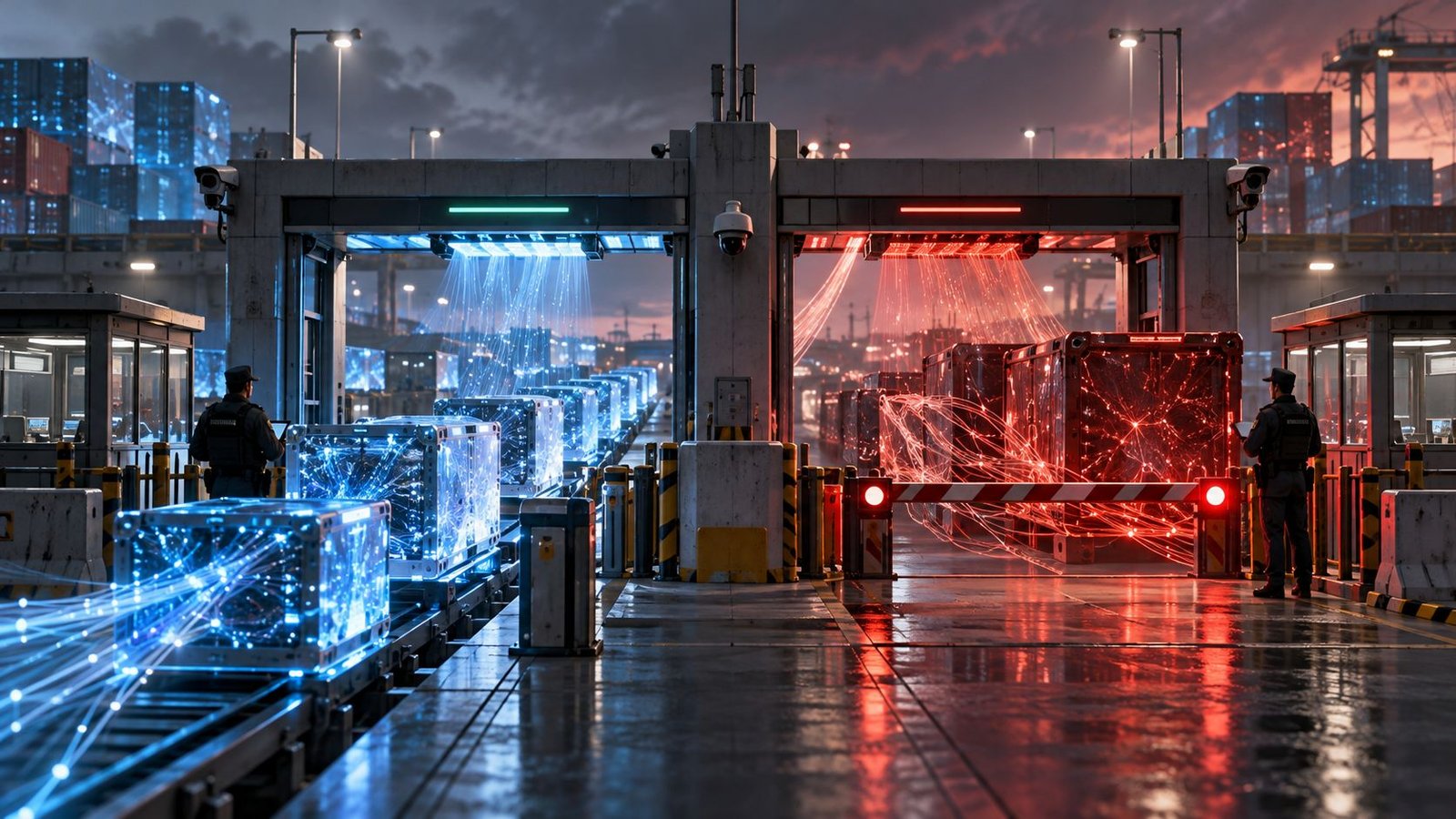
China wants to put 23 artificial intelligence technologies under export control, from large models and agents to computing groups and certain chip design processes. The project does not block access to Chinese remote services, but now subjects the knowledge transfers in question to a registration obligation.

Twenty-three AI technologies in a broader catalog
The Ministry of Commerce and the Ministry of Science and Technology of China published on October 16 a draft revision of the national catalog of technologies prohibited or restricted for export. In total, forty elements are addressed: 23 in artificial intelligence, five in biotechnologies and twelve in photovoltaic energy. The advertisement cites large models, agents, computing clusters and information processing without presenting these families as a uniform block.
The legal distinction is essential. The text does not mean that all Chinese models will be banned abroad. Certain technologies would be prohibited, others would be accessible under license, with conditions still subject to consultation. Content that has already entered the public domain through an open source publication or scientific article is explicitly excluded from the system. Beijing also says the measure does not target any particular country, region or company.
Control primarily refers to technology transfer: transfer of intellectual property, license granted to a foreign actor, or change of control to the benefit of an entity outside China. In other words, selling access to a model through an API, site, application, or cloud service does not necessarily equate to transferring the technology that allows it to be trained or operated independently.
This nuance would allow groups like Alibaba or DeepSeek to continue offering their models outside China, while giving authorities the right to review more structuring agreements. The debate comes as technological sovereignty has become a shared concern far beyond Beijing and Washington.
An immediate check-in before the final rules
The project is still open to comments, but a transitional measure is already coming into force. Any company planning to export one of the listed technologies must register the operation on the ministry’s platform. This also applies to transactions started but not completed. The form requests the identity of the exporter and recipient, the country or region, the technology, its intended use, and the estimated value of the operation.
This mechanism offers Beijing immediate mapping of flows prior to adoption of the revised catalogue. It is not yet an automatic ban, but it makes visible contracts that could previously be concluded with less central control. Joint venture projects, model licensing or the transfer of training tools are therefore more directly affected than the normal use of a chatbot hosted in China.
China presents the text as a periodic modernization of its trade policy, begun since 2001. However, the strategic context is impossible to ignore. The United States has restricted the delivery of semiconductors and advanced equipment to China for several years. Beijing is now reversing the logic by treating certain AI insights as assets whose output must be controlled. We have already discussed alternative solutions related to AI servers, but the current proposal affects the technology itself and not just the hardware.
Online services remain accessible
The exemption granted to APIs and online software avoids, for the moment, a brutal decoupling. A foreign company could continue to call a Chinese model remotely, while the local installation of certain technical bricks or the recovery of its intellectual property would require a procedure. This choice protects the international revenues of Chinese suppliers while preserving the territory’s most sensitive capabilities.
The ministry also justifies its initiative by preventing autonomously generated or modified malicious software from attacking critical infrastructure. This is a national security argument formulated in a commercial text, which leaves an important margin of interpretation when it comes to future licenses.
The public consultation will remain open until November 15, 2026. Individuals and organizations can send their comments by email, fax or postal mail to the Ministry of Commerce of China; Pre-registration of specific exports applies from publication on October 16 and will remain mandatory until the final catalog comes into force.


